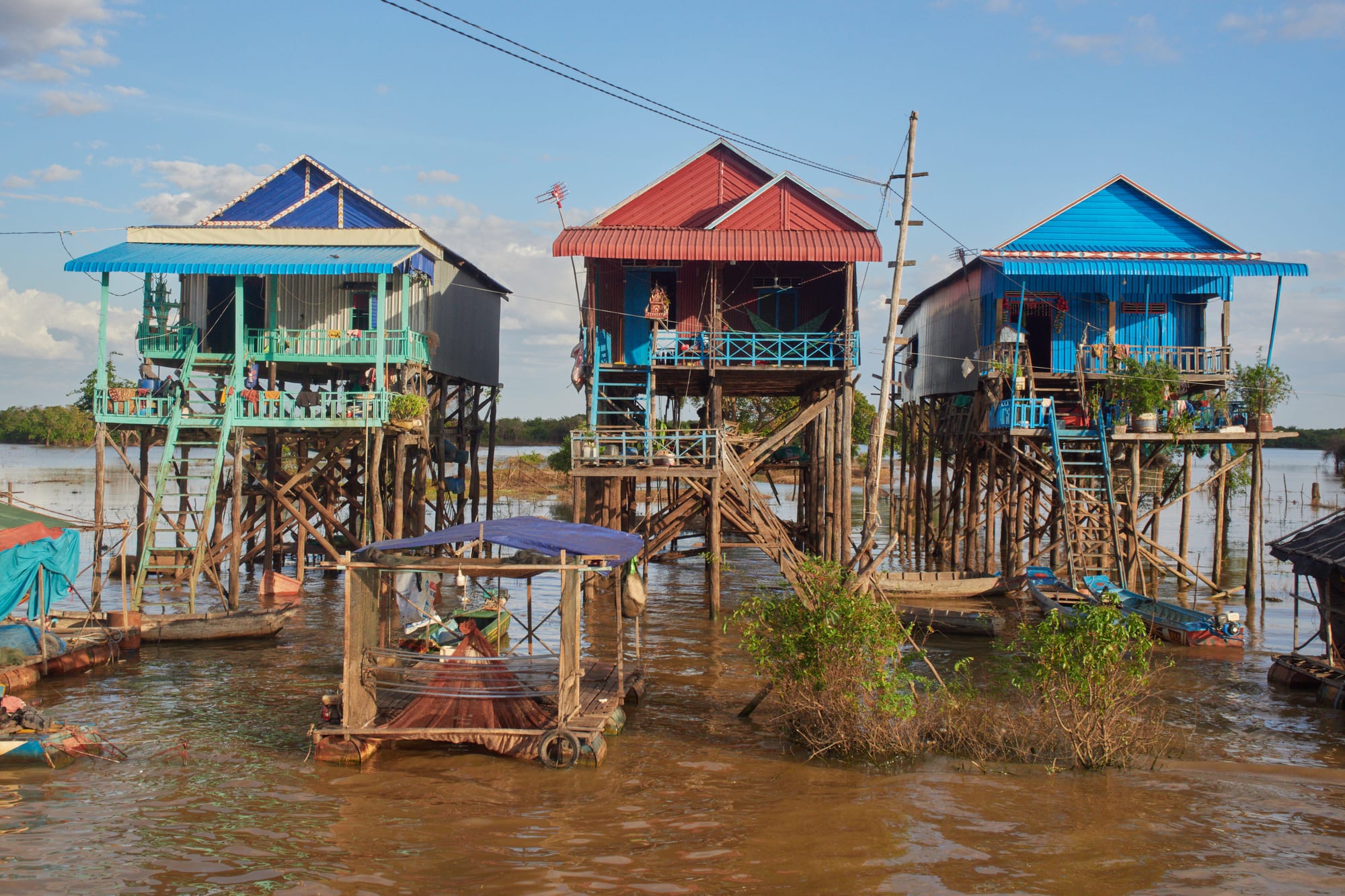
Brightly painted wooden stilt houses standing in brown floodwater, with small boats moored beneath under a blue sky

Cambodia

Siem Reap, Angkor & the Northwest

Stilt houses in the flood season at Kampong Phluk, a fishing village on the Tonlé Sap near Siem Reap. (lumoplank / Wikimedia Commons · CC0)

North-western Cambodia, from the temples of Angkor and the town of Siem Reap around the northern and western shores of the Tonlé Sap to Battambang, Pursat and the Thai border — the old imperial heartland, the country's rice bowl and the last stronghold of the Khmer Rouge.

Explore Siem Reap, Angkor & the Northwest

History

The north-west was the core of the Khmer Empire. Jayavarman II proclaimed himself universal monarch on Phnom Kulen around 802, and his successors built their capitals on the plain between the hills and the Tonlé Sap, fed by vast reservoirs called baray. Suryavarman II raised Angkor Wat in the first half of the 12th century, and Jayavarman VII, after driving out the Cham invaders of 1177, built Angkor Thom, the Bayon, Ta Prohm and far-flung temples such as Banteay Chhmar. After Ayutthaya's attacks in the 15th century the court moved south, and the temples, except Angkor Wat, were largely left to the forest.

From 1795 Battambang and Siem Reap were ruled by Siam, and it took a French treaty in 1907 to return them to Cambodia. The French made Battambang a prosperous rice town and Siem Reap the base for restoring Angkor, which drew visitors from the 1920s. Siam, as Thailand, briefly retook the provinces from 1941 to 1946.

The Khmer Rouge years were especially brutal here, and the movement held out longest in the north-west. After 1979 its forces retreated to the Thai border, running Pailin as a base funded by gems and timber and making Anlong Veng in Oddar Meanchey their final headquarters. Pailin's commanders defected in 1996, and Pol Pot died in Anlong Veng in 1998. Angkor became a UNESCO World Heritage Site in 1992, and Siem Reap grew into a tourist city.

Culture & Customs

The north-west regards itself as the guardian of Khmer heritage. Siem Reap's schools and troupes keep apsara dance, shadow puppetry and pinpeat music alive, often for visitors, while Battambang is known as a home of Cambodian art and music: the Phare Ponleu Selpak arts school, whose circus also performs in Siem Reap, was founded by Cambodians who had learned art in the refugee camps, and many well-known singers were born or based in the city.

Monks and pagodas play a large part in village life, and Angkor Wat itself is still an active place of worship, with monks, shrines and offerings among the galleries. At Khmer New Year in April, Angkor hosts games and gatherings, and Pchum Ben brings families to pagodas across the region. Near the border, many people speak some Thai and trade daily with Thailand.

The floating villages of the Tonlé Sap include Khmer, Cham and ethnic Vietnamese fishing communities, each with their own pagodas, mosques or churches afloat. Crafts include stone carving and silk, revived by workshops in Siem Reap.

Daily Life

Siem Reap and Battambang are the main towns. Siem Reap lives almost entirely from tourism, with hotels, restaurants and tuk-tuks spread along the Siem Reap river, and was hit hard when visitor numbers collapsed during the pandemic. Battambang is a trading and agricultural town of French shophouses. Sisophon in Banteay Meanchey, Pursat, Samraong in Oddar Meanchey and the small town of Pailin are the other provincial centres, and Poipet is a busy, sprawling border town of casinos and markets.

Farming is the base of the economy: Battambang is one of the country's main rice provinces, and the region grows cassava, maize and fruit, much of it sold to Thailand. Fishing on the Tonlé Sap supports hundreds of thousands of people, though catches have fallen with dams upstream, overfishing and drought. Migration to Thailand for work is common.

The day starts before dawn with markets and temple visits, lunch is followed by a rest in the heat, and evenings in Siem Reap centre on the night markets and Pub Street.

Food

The Tonlé Sap feeds the region. Freshwater fish is grilled, dried, smoked and fermented into prahok, and the fish amok served in Siem Reap's restaurants comes steamed in banana leaf with kroeung, the lemongrass and galangal paste at the base of Khmer cooking. Nom banh chok, rice noodles with a green fish gravy of lemongrass and turmeric, is eaten for breakfast, and samlor korko, the thick mixed soup of fish and vegetables, is a village staple.

Battambang is known for its jasmine rice and its fruit, and it has Cambodia's only winery. Phnom Kulen's name means "mountain of the lychees".

Sugar palms, a national symbol of Cambodia, dot the rice fields, and their sap becomes palm sugar and palm juice. Grilled fish, beef lok lak and Khmer curries fill the restaurants of Siem Reap, which also has a lively cooking-school scene.

Attractions & Natural Wonders

The Angkor Archaeological Park, north of Siem Reap, holds Angkor Wat, the walled city of Angkor Thom with the Bayon's carved faces and the Terrace of the Elephants, the tree-bound temple of Ta Prohm, Preah Khan, the pink-sandstone carvings of Banteay Srei further north, and the sacred hill of Phnom Kulen with its riverbed carvings and waterfall. Beng Mealea, a collapsed jungle temple, lies to the east.

On the Tonlé Sap, the floating and stilt villages of Chong Khneas, Kampong Phluk and Kampong Khleang are reached by boat from Siem Reap, and the Prek Toal bird sanctuary on the lake's north-west shore shelters storks, pelicans and other waterbirds.

Battambang has its colonial riverside centre, the hill temple of Phnom Banan, the bat caves and Khmer Rouge killing caves of Phnom Sampeau, and the bamboo train, a norry platform on rail wheels that once ran on the main line and now runs as a short tourist ride. Pursat gives access to the northern Cardamom Mountains.

Near the Thai border, Banteay Chhmar in Banteay Meanchey is a vast Jayavarman VII temple with long bas-reliefs, visited through a community-based tourism scheme. The Pailin hills, once a gem-mining and Khmer Rouge area, have the hilltop pagoda of Phnom Yat, while Anlong Veng in Oddar Meanchey holds Pol Pot's grave.

Cities in Siem Reap, Angkor & the Northwest

Planning basics

Budget

Siem Reap has the full range, from cheap hostels on Pub Street's fringes to luxury resorts, and the Angkor pass and a daily tuk-tuk or driver are the main fixed costs. Battambang is cheaper and quieter, and Pursat, Banteay Meanchey, Oddar Meanchey and Pailin see few visitors and have only basic hotels at low prices.

Daily Budget Midrange
USD 70–150 (boutique hotel, restaurants, private tuk-tuk or car and a temple guide)
Daily Budget Shoestring
USD 25–40 (guesthouse, street food, shared tuk-tuk, plus the Angkor pass)

Buy the Angkor pass only at the official ticket centre, and agree tuk-tuk day rates for the small or grand temple circuit in advance.

Safety

Siem Reap is safe, with petty theft, bag snatching and scams around nightlife and the temples the main concerns. The Thai border areas of Banteay Meanchey, Oddar Meanchey, Battambang and Pailin still hold landmines and unexploded ordnance off the roads, and the Poipet crossing has touts and gambling-related crime. Border tensions with Thailand have at times closed crossings.

Stay on marked paths in rural areas and at remote temples, use only official border posts, and watch belongings at sunrise crowds. Check current official travel advice before travelling.

Climate

Tropical monsoon, like the rest of the country, but the Tonlé Sap shapes everything: in the wet season the lake swells several times over and floods the forests and fields around it, and by the end of the dry season it shrinks back and some floating villages become hard to reach by boat. The hills around Pailin and Phnom Kulen are a little cooler.

Summer
very hot in March to May, 35–40°C at Angkor; humid with afternoon storms from May to October
Winter
dry and warm, 22–32°C, with cool early mornings from December to January

Transportation

The Siem Reap–Angkor International Airport, opened in 2023, lies well east of the town. Buses and minivans link Siem Reap with Phnom Penh in about six hours, Battambang in about three and the Thai border at Poipet in about three. Boats cross the Tonlé Sap to Battambang in the high-water season, and Angkor's temples are toured by tuk-tuk, car, bicycle or electric scooter.

Allow extra time for the transfer from the new airport, and start temple days early to beat the heat and crowds.

Best Time to Visit

November to February is the best time for Angkor, dry and relatively cool, though it is also the busiest. The lake villages are best reached from about August to December, when the water is high. April is extremely hot, but Khmer New Year is celebrated at Angkor with games and gatherings.