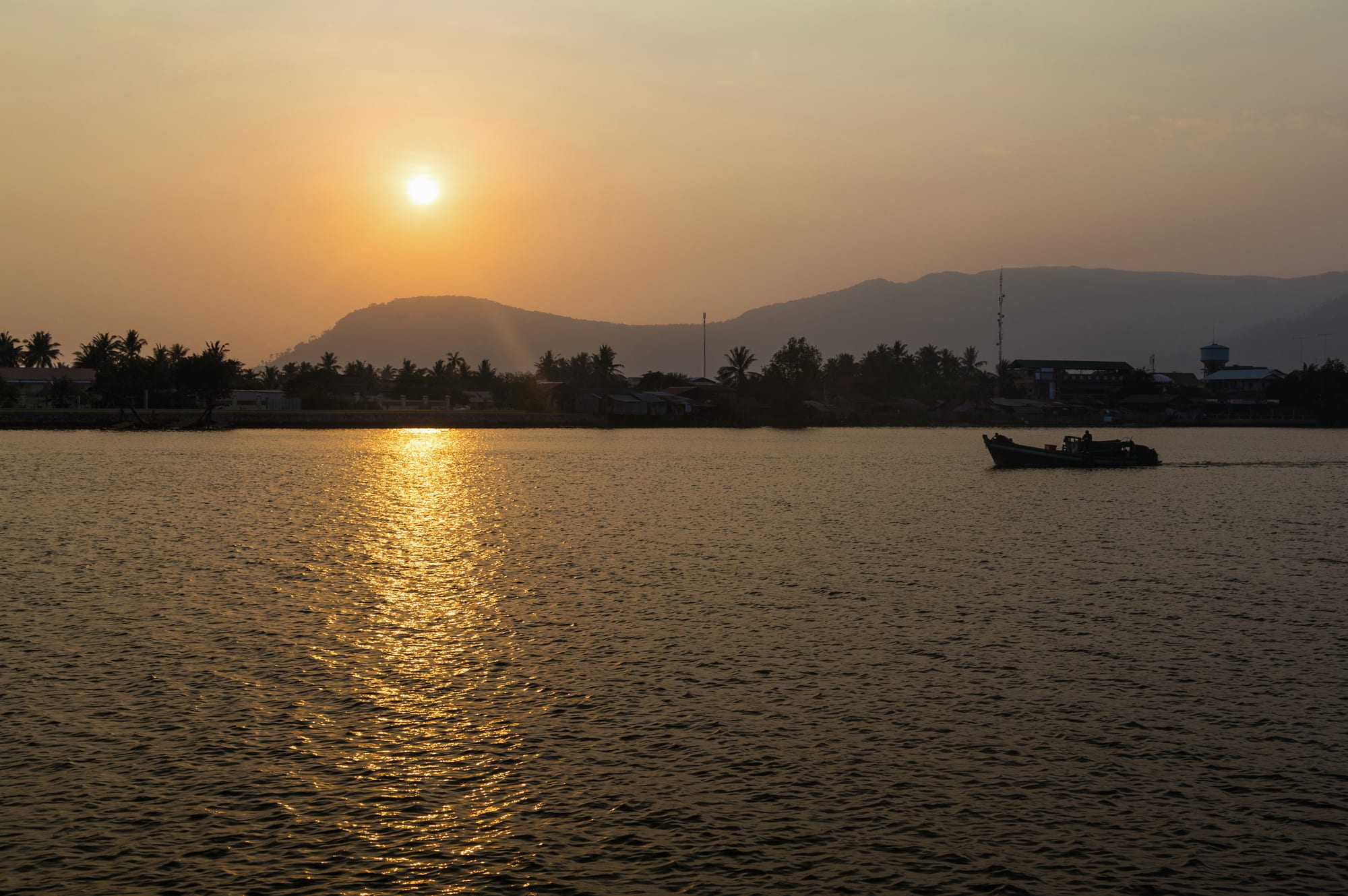
Sunset over a wide calm river with a small boat, palm-lined bank and hazy mountains behind

Cambodia

Kampot, Kep & the South Coast

Sunset over the Praek Tuek Chhu river at Kampot, with the Bokor hills beyond. (Marcin Konsek / Wikimedia Commons · CC BY-SA 4.0)

Cambodia's short coastline on the Gulf of Thailand, from the pepper country of Kampot and the old French seaside resort of Kep to the port of Sihanoukville, the islands of Koh Rong and the mangroves and rainforest of Koh Kong below the Cardamom Mountains.

Explore Kampot, Kep & the South Coast

History

The coast was a trading shore for centuries, but it rose to national importance when the Mekong's mouth passed under Vietnamese control. In the mid-19th century, under King Ang Duong, Kampot became Cambodia's main seaport, trading with Singapore, and Chinese merchants settled there. Pepper had been grown in the area since at least the 13th century; the French began intensive production in the 1870s.

The French also turned the coast into a playground. Kep-sur-Mer was laid out as a seaside resort for colonial officials in the early 20th century, and in the 1920s they cut a road to the plateau of Bokor and built a hill station there with a hotel and church. After independence the Cambodian government built a deep-water port at Kampong Som, later named Sihanoukville, from the mid-1950s, and in the 1960s Kep became the favourite resort of the Phnom Penh elite, with modernist villas along the shore.

The Khmer Rouge emptied the coast after 1975, and in May 1975 American forces fought them on Koh Tang after the seizure of the cargo ship Mayaguez. Kep's villas were stripped for materials and left to ruin, and Khmer Rouge guerrillas remained in the hills around Kampot and Kep into the 1990s. Since then, pepper farming has been revived, and Sihanoukville was transformed by Chinese casino investment in the late 2010s until the government banned online gambling in 2019.

Culture & Customs

The coast is a mix of peoples. Chinese-Khmer families have long run Kampot's trade and pepper farms, Cham Muslims form a significant part of Kampot's population, and Koh Kong, close to the Thai border, has many Thai speakers and a strong Thai influence in its markets and cooking. Sihanoukville has a large Chinese presence since the casino boom.

Kampot has also become a small cultural centre, with a community of artists, writers and foreign residents, riverside cafés and a well-kept stock of colonial architecture.

Religion follows the national pattern, with pagodas in every town and mosques in the Cham villages. The annual Khmer holidays, especially Khmer New Year and Pchum Ben, fill the beaches at Kep and Sihanoukville with families from Phnom Penh, and a day at the coast with seafood and a hammock is a Cambodian ritual.

Daily Life

Sihanoukville is the coast's largest city, Cambodia's main deep-water port and a special economic zone for factories, with unfinished high-rises left from the casino boom still marking its skyline. Kampot is a quiet provincial town, Kep a small resort of scattered villas, and Koh Kong a border town on the Kah Bpow river estuary.

The economy combines fishing, salt production on the flats around Kampot, pepper farming, durian and fruit orchards, tourism and port work. Large development projects, including the Dara Sakor resort zone in Koh Kong and the Ream naval base, expanded by Chinese state-owned firms and reopened in 2025, have brought Chinese investment and international scrutiny, and some parts of Sihanoukville have been linked to online-scam compounds.

In Kampot and Kep, days start with the fish landings and markets, slow down in the heat and end with families eating seafood along the waterfront.

Food

The south coast has Cambodia's best seafood and its most famous spice. Kampot pepper, grown on small farms in the hills between Kampot and Kep, has a protected geographical indication and is sold green, black, red and white. Green pepper is used fresh on the stem in stir-fries, most famously in kdam chaa mrech Kampot, crab fried with fresh Kampot green pepper, the dish of Kep's crab market.

Grilled squid, prawns and fish are sold on skewers along the beaches, and fish from the gulf is dried, salted and turned into fish sauce. Kampot is also known for its durian and fish sauce, and for sea salt harvested from the flats outside town.

Sihanoukville's restaurants serve seafood alongside Chinese cooking, and in Koh Kong Thai-style curries and salads are common. Freshly cut coconuts and sugar-cane juice are the drinks of the beach.

Attractions & Natural Wonders

Kampot's attractions are its riverfront, old market and shophouses, boat trips on the Praek Tuek Chhu at sunset, the pepper farms in the surrounding hills, and the cave temple of Phnom Chhnork, with a pre-Angkorian brick shrine inside. Above the town, Bokor, in the Preah Monivong Bokor National Park, has the old French hotel and church, the Popokvil waterfall and views to the sea.

Kep has its crab market, a short beach, ruined 1960s villas, a national park of forest trails above the town and boat trips to Koh Tonsay, Rabbit Island, for simple bungalows and a quiet beach.

Sihanoukville has beaches such as Otres and Ochheuteal and nearby Ream National Park, with mangroves and beaches. Ferries run to Koh Rong, with its long beaches and the busy village of Koh Touch, and to quieter Koh Rong Sanloem, known for Saracen Bay and Lazy Beach.

Koh Kong province holds the Cardamom coast: the Tatai river, the Peam Krasop mangroves, the island of Koh Kong Krao, and community-run ecotourism at Chi Phat, gateway to treks and cycling in the Southern Cardamom forests.

Cities in Kampot, Kep & the South Coast

Planning basics

Budget

Kampot and Kep are good value, with riverside guesthouses and inexpensive seafood. The islands cost more because food and fuel are shipped in, and beach resorts on Koh Rong and Koh Rong Sanloem range from simple bungalows to upmarket villas. Sihanoukville's prices have been pushed up and down by the casino boom, and Koh Kong's eco-lodges and guided treks are the main extra costs there.

Daily Budget Midrange
USD 60–140 (boutique hotel or island resort, restaurant meals, boat trips and guided tours)
Daily Budget Shoestring
USD 20–35 (guesthouse or bungalow, local seafood, buses and shared ferries)

Take enough cash to the islands, where cash machines are few or absent, and check ferry return times before booking accommodation.

Safety

Kampot and Kep are calm. Sihanoukville has had problems with crime and scams linked to its casino and online-scam compounds, and road accidents are frequent on the coastal highway. Other risks are strong currents in the monsoon, rough ferry crossings, sandflies and drug offences on the islands, and dengue in the wet season.

Avoid swimming in rough seas, use reputable ferries, and be wary of job offers or invitations in Sihanoukville's casino areas. Check current official travel advice before travelling.

Climate

Tropical, but the coast gets more rain than the interior: the south-west monsoon from May to October hits the Cardamom Mountains and Koh Kong with some of the heaviest rainfall in Cambodia, and seas are rough. The dry season brings calm, clear water. Bokor's plateau, at about 1,000 metres, is several degrees cooler than the coast and often in cloud.

Summer
hot and humid, 28–34°C; very wet from May to October, with rough seas and heavy storms
Winter
dry and pleasant, 24–32°C, with calm seas; cool and misty on Bokor

Transportation

The Phnom Penh–Sihanoukville expressway has cut the trip from the capital to around three hours, and Sihanoukville has an airport with domestic and regional flights. A slow train runs from Phnom Penh through Takeo and Kampot to Sihanoukville. Buses and minivans link Kampot, Kep and Koh Kong, and fast ferries run from Sihanoukville to Koh Rong and Koh Rong Sanloem in under an hour.

Rent a scooter or tuk-tuk for the day around Kampot and Kep, and book ferries directly from reputable operators.

Best Time to Visit

November to April, when the sea is calm, ferries run reliably and beaches are at their best. The rainy season brings green hills, full waterfalls in Koh Kong and fewer visitors, but boat trips can be cancelled in bad weather.