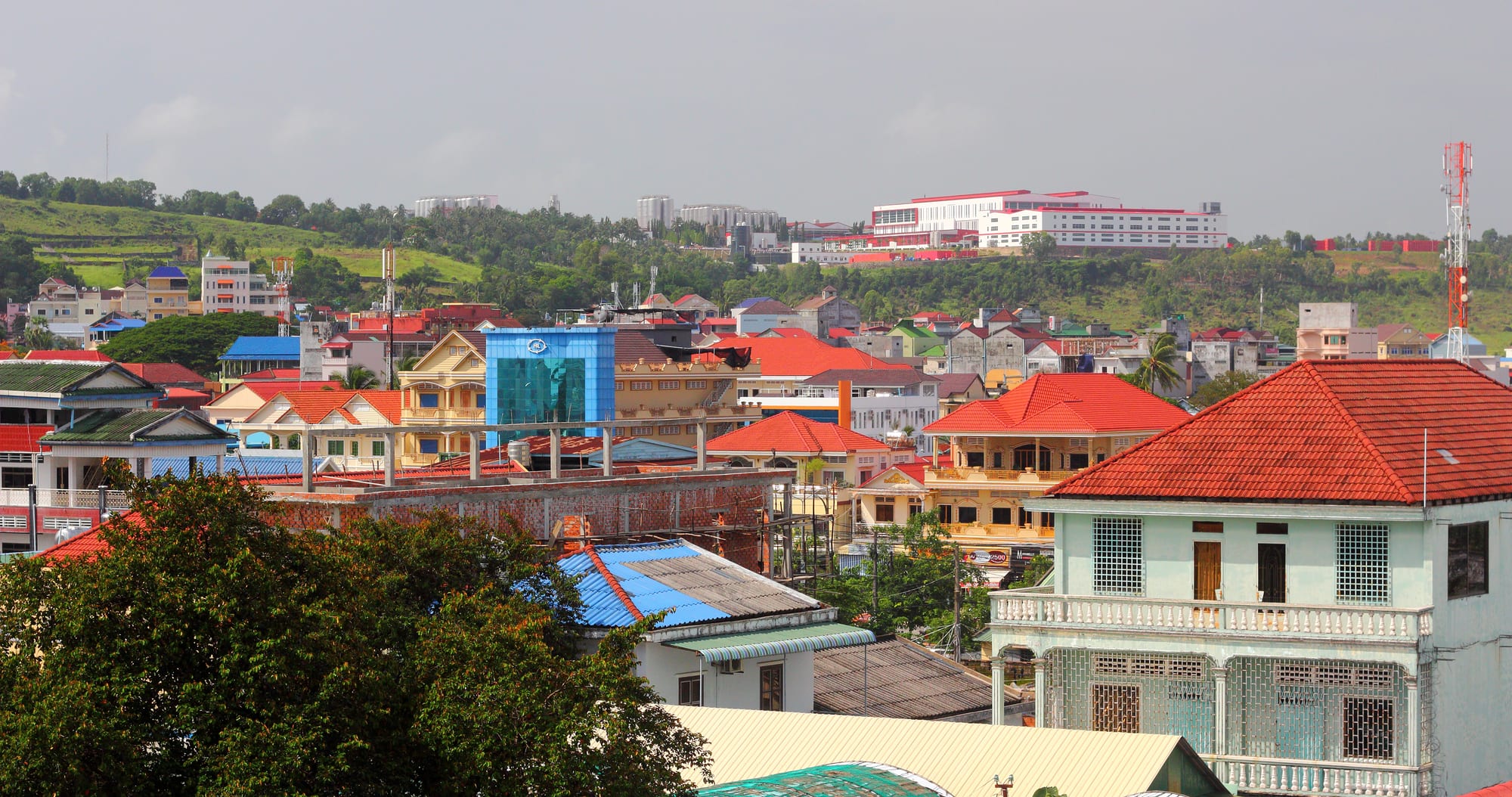
Rooftops of red, blue and green tin and tile across Sihanoukville, rising to larger white buildings on a green hill behind

Kampot, Kep & the South Coast, Cambodia

Sihanoukville

A view across the rooftops of Sihanoukville towards the hills behind the city. (Dmitry Makeev / Wikimedia Commons · CC BY-SA 4.0)

Cambodia's only deep-water port and its main coastal city, built from the mid-1950s on a headland between beaches on the Gulf of Thailand. A backpacker beach town for two decades, it was transformed by casino and property investment in the late 2010s, and it remains the gateway to the offshore islands and the site of the coast's airport.

Neighbourhoods

  • Downtown and Ekareach Street
    • Local life
    • Markets
    • Close to transport

    The commercial spine of the city runs inland from the port along Ekareach Street, past banks, markets, phone shops and Khmer restaurants. It is where residents shop and where bus and minivan offices cluster, well away from the beach strips.

    Open in Maps
  • Serendipity and Ochheuteal
    • Beaches
    • First-time visitors
    • Nightlife

    The main visitor area on the city's south-east shore, where the ferry pier for the islands sits at the top of a long sandy beach. Hotels, bars, tour agents and seafood restaurants line the streets behind it, in a district heavily rebuilt during the construction boom.

    Open in Maps
  • Otres
    • Beaches
    • Quiet and residential
    • Sunsets

    A longer, flatter beach a few kilometres south-east of the centre, historically the low-key alternative to the main strip, with bungalows, beach bars and a stretch of mangrove and river behind. Development has reached it in places, but it stays calmer.

    Open in Maps
  • Independence Beach and Sokha
    • Beaches
    • Hotels
    • Quiet and residential

    The western beaches below the headland, named after the modernist Independence Hotel above it, with resort grounds, quieter sand and views to the islands. Most of the seafront here is taken up by large hotels rather than by small guesthouses.

    Open in Maps
  • Victory Hill and Victory Beach
    • Beaches
    • Budget stays

    The area on the north-west side near the port, once the city's first backpacker quarter, with a short beach, small hotels and bars on the slope above it. Much of it emptied and changed hands during the boom and bust of recent years.

    Open in Maps
  • The port and the economic zone
    • Working city
    • Close to transport

    Cambodia's deep-water port and the special economic zone beside it dominate the northern edge of the city — container cranes, warehouses and factories, with the long-distance bus and freight traffic that goes with them.

    Open in Maps

Things to do

Beaches

  • Ochheuteal Beachbeach

    The city's main beach, a long stretch of pale sand on the south-east shore backed by restaurants and hotels, busy with Cambodian and foreign visitors.

    Open in Maps
  • Otres Beachbeach

    A quieter, wider beach a few kilometres south of the centre, with a slow strip of bungalows and bars and a river mouth and mangroves at its far end.

    Open in Maps
  • Independence Beachbeach

    A western beach below the headland, named after the modernist Independence Hotel that stands above it, with calm water and sunset views.

    Open in Maps
  • Victory Beachbeach

    A short beach on the north-west side near the port, the first part of the city developed for visitors and still the closest sand to the ferry and bus routes.

    Open in Maps
  • Sokha Beachbeach

    A curved bay between the headlands on the western side, largely occupied by a large resort, with fine sand and sheltered water.

    Open in Maps

Temples and landmarks

  • Wat Leulandmark

    A hillside pagoda in the forest above the city, reached by a winding road, with a view over the port, the beaches and the islands.

    Open in Maps
  • Wat Kromlandmark

    The lower pagoda, in the town below the hill, associated with Yeay Mao, a southern Cambodian ancestral spirit whose shrine draws fishing families before voyages.

    Open in Maps
  • Sihanoukville Autonomous Porttransit hub

    Cambodia's only deep-water container port, opened in the 1960s, with the special economic zone beside it and cruise and ferry berths nearby.

    Open in Maps
  • Serendipity Piertransit hub

    The jetty at the top of the main beach where fast ferries leave for Koh Rong and Koh Rong Sanloem.

    Open in Maps

Parks and waterfalls

  • Ream National Parkpark

    A protected area of mangrove, forest, beaches and estuary about 18 km east of the city, with boat trips up the Prek Teuk Sap river and walking trails.

    Open in Maps
  • Kbal Chhay Waterfallattraction

    A set of falls and pools in forest north-east of the city, a popular weekend picnic spot for Cambodian families.

    Open in Maps

Islands and boat trips

  • Koh Rongattraction

    A large island of forest and long white beaches, with a busy village at its main pier and quiet bays elsewhere.

    Open in Maps
  • Koh Rong Sanloemattraction

    The quieter of the two main islands, known for Saracen Bay, a lighthouse headland and small bungalow beaches.

    Open in Maps
  • Koh Ta Kievattraction

    A small, thinly developed island with rough beaches, simple camps and clear water, closer to the mainland than the Koh Rong pair.

    Open in Maps

Short trips from the city

  • Kampotattraction

    A provincial town of colonial shophouses on a river below the Bokor plateau, surrounded by pepper farms and salt flats.

    Open in Maps
  • Bokor Hill Stationlandmark

    The remains of a colonial hill station on a high plateau, with an abandoned hotel, a church and views over the coast.

    Open in Maps

Seasonal events

  • Khmer New Yearmid-April

    The city's beaches fill with families from Phnom Penh for the biggest holiday of the year, with music, food stalls and water-throwing.

  • Pchum BenSeptember or October

    Fifteen days of offerings to ancestors at the pagodas, ending in a public holiday when workers return to their home provinces.

  • Water FestivalNovember

    The national river and moon festival, marked with boat racing, fireworks and crowded waterfronts around the country.

Eat and drink

Long-standing places and food districts in Sihanoukville. Hours, ratings and directions come from your maps app, always current.

Sihanoukville classics

  • Grilled seafood on the beachrestaurant

    Squid, prawns, crab and whole fish grilled over charcoal at tables set on the sand, served with lime, salt and black pepper dipping sauce.

    Open in Maps
  • Crab with Kampot pepperrestaurant

    Crab stir-fried with fresh green peppercorns from the farms along the coast at Kampot and Kep, the signature dish of this coastline.

    Open in Maps

Markets and food streets

  • Psar Leu marketmarket

    The city's main produce market, inland from the beaches, piled with fish, vegetables, fruit and dry goods, with noodle and rice stalls around its edges.

    Open in Maps
  • Ekareach Streetneighborhood

    The main road through the centre, lined with Khmer rice and noodle restaurants, bakeries and coffee shops used by residents rather than visitors.

    Open in Maps
  • Chinese restaurants around the centreneighborhood

    Hotpot, dumpling and regional Chinese kitchens opened during the investment boom, now a fixed part of the city's eating.

    Open in Maps

Experience Sihanoukville

History

Sihanoukville is younger than almost any other city in Cambodia. When the Mekong delta passed out of Cambodian hands, the country's trade depended on Vietnamese and Thai ports or on the shallow river harbour at Kampot. After independence in 1953, the government chose a fishing settlement at Kampong Som, on a headland between deep bays, for a new deep-water port, and construction began in 1955 with French assistance; the port opened at the end of the decade and the growing town took the name of King Norodom Sihanouk. A highway was cut through to Phnom Penh and an oil refinery and rail line followed.

The 1960s brought modernist hotels on the beaches and a brief run as a seaside resort, cut short by war. The port was a strategic prize in the conflicts of the early 1970s; in May 1975 the seizure of the American cargo ship Mayaguez in nearby waters led to fighting on Koh Tang island offshore. The Khmer Rouge years emptied the town, and it recovered slowly through the 1980s and 1990s as the port reopened and fishing resumed.

From the late 1990s the beaches drew backpackers, and a low-rise town of guesthouses, bars and bungalows grew behind them. That ended abruptly in the late 2010s, when large-scale Chinese investment in casinos, hotels and apartment towers remade the city at speed; the government banned online gambling in 2019 and much of the construction stopped, leaving unfinished towers across the skyline. The expressway from Phnom Penh, the expanded airport and the port's growth have continued since, and parts of the city have been linked to online-scam compounds.

Culture & Customs

The city's culture is that of a port and a boom town rather than an old Khmer settlement. Its population came from elsewhere — fishing families, dock and factory workers, traders, hotel staff from the provinces — and it has never had the settled village rhythm of Kampot or Kep. Pagodas on the hills above the beaches, Wat Leu and Wat Krom among them, anchor Buddhist life, and the shrine to Yeay Mao, a southern Cambodian ancestral spirit, is visited by fishers and drivers before journeys.

Since the late 2010s a large Chinese-speaking community has become part of the city, with restaurants, shops, signage and schools of its own, and the relationship between that community and long-established Khmer residents is one of the city's live subjects. Cambodian weekenders from Phnom Penh form another population, arriving for seafood and a swim, and a smaller foreign resident community remains from the backpacker years.

Customs are Cambodian and largely conservative away from the beaches: modest dress in town, palms-together greetings, shoes off indoors, quiet voices and respect for monks and elders. Visitors are expected to keep swimwear to the sand, to ask before photographing people, and to be discreet around casinos and construction sites. Locals speak frankly about what the boom brought and took away, and the subject is best approached by listening rather than judging.

Daily Life

The city had roughly 90,000 residents at the last published census, with a much larger floating population of workers and visitors that has risen and fallen sharply in recent years. It is a working city: the deep-water port handles most of Cambodia's container trade, and the special economic zone beside it holds garment and light-manufacturing factories that employ thousands, many of them women from rural provinces.

Fishing remains important, with boats landing squid, crab and fish for the markets and for the islands' restaurants, and tourism supports hotels, bars, ferries, tour operators and drivers. Casino and property investment reshaped the labour market and the skyline in the late 2010s, and unfinished towers, half-built roads and abandoned sites are still visible parts of the landscape, alongside new hotels and completed developments.

Daily life is divided by geography. The centre and the markets around Ekareach Street work Khmer hours — early mornings, a slow midday, busy evenings — while the beach strips run on a visitor timetable and the port and factories on shifts. Traffic, dust, flooding in heavy rain, waste management and the cost of housing are the recurring local complaints, and the city's reputation, damaged by the scam-compound reporting of recent years, is a matter of open debate among residents who depend on tourism.

Food

Seafood is the city's obvious strength. Squid, prawns, blue crab, snapper and mackerel come in on local boats and are grilled over charcoal on the beaches or cooked to order at restaurants near the market. Crab stir-fried with fresh green Kampot pepper, the dish of the coast to the east, is on most menus here, and grilled fish is eaten with tuk meric, a dipping sauce of lime, salt and crushed black pepper.

The Khmer standards are all present: amok trey, fish steamed with coconut milk, lemongrass and kroeung spice paste in banana leaf; beef lok lak in a peppery sauce; sour soups with tamarind; samlor korko, the thick mixed-vegetable soup with prahok; and num banh chok, rice noodles under a fish gravy, sold from baskets in the morning. Breakfast is kuy teav noodle soup or bai sach chrouk, grilled pork over rice with pickled vegetables, and baguettes remain a French inheritance in the bakeries.

What makes the city's food distinctive now is how much of it is Chinese. Hotpot restaurants, northern dumpling houses, Sichuan kitchens and barbecue places opened in numbers during the investment boom and have stayed, giving a Cambodian port city one of the widest ranges of regional Chinese cooking in the country. Thai and Vietnamese dishes appear as well, a reflection of the coastal trade. Iced coffee with condensed milk, fresh coconuts, sugar-cane juice and Cambodian beer are the everyday drinks.

Planning tools

Budget

Prices here swing more than elsewhere on the coast: hotel rooms built for a boom can be cheap outside holidays and expensive during them, while seafood, ferries to the islands and taxis are steady costs. Simple Khmer meals inland from the beaches cost a fraction of beachfront dinners.

Daily Budget Midrange
USD 60–140 (boutique hotel or island resort, restaurant meals, boat trips and guided tours)
Daily Budget Shoestring
USD 20–40 (guesthouse room, market and street food, shared transport and local buses)

Draw cash in the city before taking a ferry, as cash machines on the islands are scarce, and keep small dollar notes for taxis and boats.

Best Time to Visit

November to April is dry and calm, with reliable ferries, clear water and the busiest Cambodian holidays. May to October brings the south-west monsoon, with heavy rain, rough seas, cancelled crossings and low prices. The city is at its most crowded at Khmer New Year and Chinese New Year.

Suggested Number of Days

Most visitors treat the city as a base for a night or two before or after the islands. Four to six days suits anyone combining the beaches, the islands and the coast east of here. Rough weather at sea is the usual reason to allow more.

First Visit
1–2 days
With Surroundings
4–6 days

Transportation

The city is spread out and hilly, and tuk-tuks, motorbike taxis and ride-hailing apps do most of the moving between the port, the centre and the beaches. Scooters can be hired, though traffic is heavy and lorries use the main roads. Buses and minivans run to Phnom Penh, Kampot and Koh Kong, and fast ferries leave from the pier at the main beach.

Agree fares before setting off or use a ride-hailing app, and allow extra time for port and construction traffic on the main roads.

Airport & Station Connections

Sihanouk International Airport, about 18 kilometres east of the centre, has domestic and regional flights. The expressway has cut the drive from Phnom Penh to around three hours by bus or car, and a slow train runs from the capital through Takeo and Kampot to the city. Ferries connect the pier with Koh Rong and Koh Rong Sanloem.

Walkability

Walking works within a beach strip but not between them: the centre, the port and the beaches are several kilometres apart, over hills and along busy roads with incomplete pavements. Heavy vehicles, construction sites and poor lighting make night walking uncomfortable, and most people ride even short distances.

Safety

Sihanoukville has had problems with crime and scams linked to its casino and online-scam compounds, and road accidents are frequent on the coastal highway. Snatch theft from motorbikes, drink-spiking and disputes around gambling venues have been reported, and unfinished buildings and open construction sites are hazards in themselves. Strong currents in the monsoon, rough ferry crossings and dengue in the wet season are the other risks.

Be wary of job offers, casual invitations or work arrangements in the casino areas, keep bags away from the roadside, avoid walking alone late at night, and use reputable ferry operators. Check current official travel advice before travelling.

Climate

Tropical and monsoonal. The dry season from November to April is warm, breezy and settled; the south-west monsoon from May to October brings some of the heaviest rainfall in Cambodia, with storms and rough seas.

Summer
hot and humid, about 27–33°C, with heavy rain and big swells from May to October
Winter
warm and dry, about 25–32°C, with calm water and the clearest skies of the year

Local Customs

Khmer manners hold away from the beach: greetings with palms together, shoes off in homes and pagodas, shoulders and knees covered at temples, and swimwear kept to the sand. The city has a large Chinese-speaking population alongside Khmer residents, and signs and menus often appear in both languages. Photographing casino premises, security staff or construction sites is unwise.

Tipping is not expected but is welcomed by drivers and boat crews; gambling is legal only in licensed venues and closed to Cambodian nationals, and drug offences carry severe penalties.

Common Payment Methods

The US dollar is used for most prices, with Cambodian riel as change. Cards work in hotels and larger restaurants, but markets, tuk-tuks, boats and beach stalls want cash, and banks and cash machines are easy to find in the centre and thin on the islands.