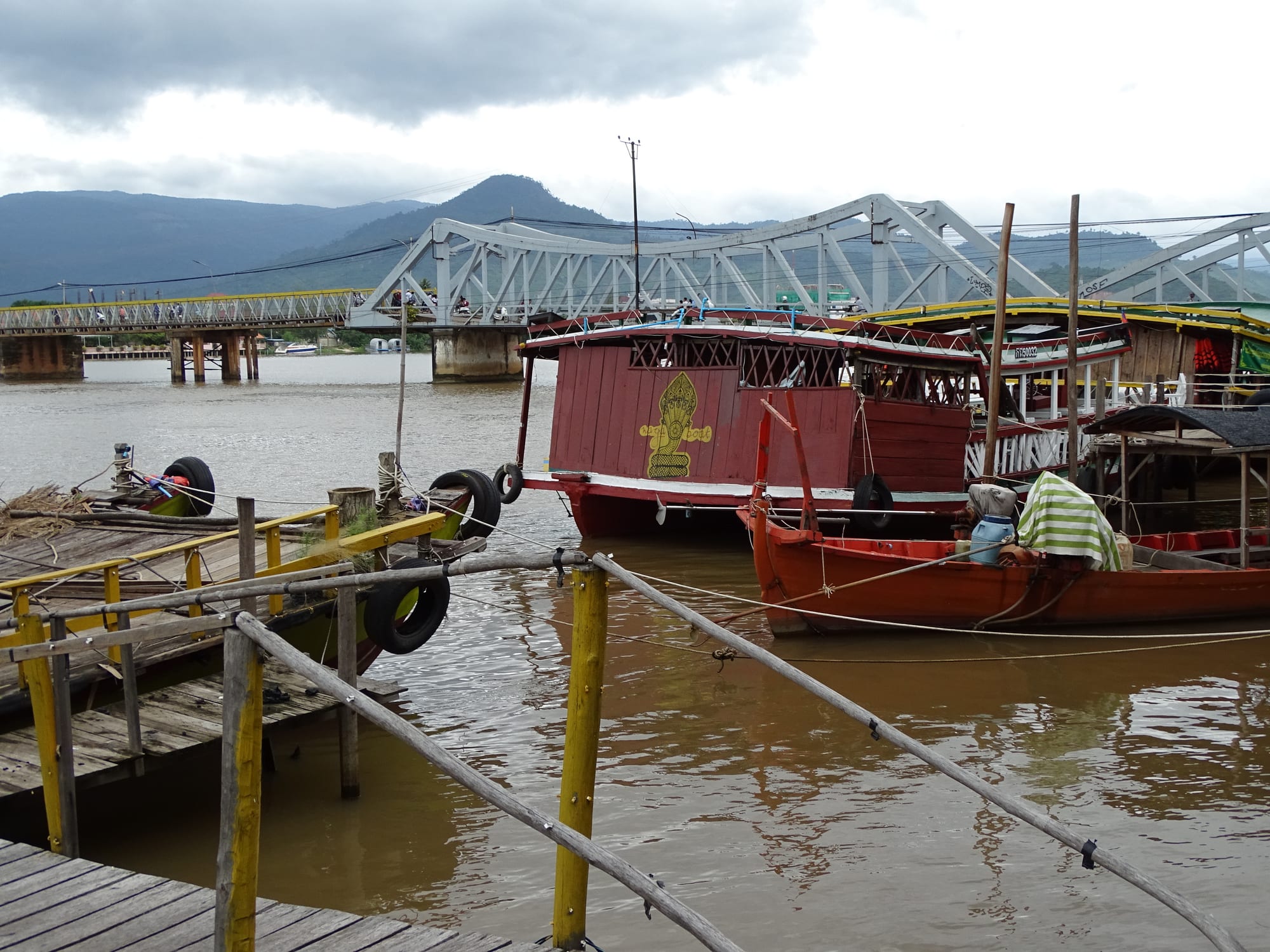
Wooden tour boats moored at a jetty on the brown river at Kampot, with the steel truss of the old bridge and hills behind

Kampot, Kep & the South Coast, Cambodia

Kampot

Boats on the Praek Tuek Chhu at Kampot, with the old bridge and the Bokor hills behind. (Adam Jones / Wikimedia Commons · CC BY-SA 2.0)

A provincial town on the Praek Tuek Chhu river a few kilometres inland from the Gulf of Thailand, backed by the Bokor plateau. Cambodia's main seaport in the 19th century and a French colonial administrative centre afterwards, it kept its grid of shuttered shophouses and is now known for pepper farms, salt flats, river trips and a slow riverside pace.

Neighbourhoods

  • The old town and the riverfront
    • First-time visitors
    • Architecture
    • Best for food

    The grid of two-storey shophouses between the old market building and the river, much of it French-era and Chinese-merchant work with shuttered upper floors and arcaded ground floors. Cafés, guesthouses and restaurants have taken over many of them, and the riverside promenade is where the town gathers at sunset.

    Open in Maps
  • Kampong Bay and the new market
    • Local life
    • Markets
    • Close to transport

    The busier Khmer side of the centre north of the old quarter, around the main market, the bus and minivan offices and the banks. Fewer visitors stay here, and the food stalls, hardware shops and motorbike repairers make it the town's working heart.

    Open in Maps
  • The west bank of the river
    • Quiet and residential
    • Views

    Across the bridges, a strip of riverside guesthouses, bungalows and bars faces the town and the Bokor escarpment. It is quieter, greener and a short ride from the centre, and most river and kayak trips start from this side.

    Open in Maps
  • The road to Kep and the pepper country
    • Day trips
    • Countryside

    East of town the land flattens into salt pans and rice fields before rising towards limestone outcrops and the pepper farms of the Kep road. Farm stays and small resorts are scattered along the way towards Kep.

    Open in Maps

Things to do

In the town

  • Kampot Provincial Museummuseum

    A small provincial museum in one of the town's old colonial buildings, covering Kampot's history, its port trade and its pepper.

    Open in Maps
  • The old market and the shophouse quarterneighborhood

    The covered market hall and the streets of shuttered shophouses around it; unlike most Cambodian provincial capitals, Kampot's centre is largely 19th-century French colonial architecture.

    Open in Maps
  • The riverside promenadeattraction

    A walk along the Praek Tuek Chhu past moored boats and food carts, with the Bokor escarpment filling the view upstream.

    Open in Maps

Rivers, salt and pepper

  • The Praek Tuek Chhu riverattraction

    The river the town sits on, used for sunset boat trips, kayaking and swimming, and lined with mangrove and stilt houses downstream.

    Open in Maps
  • The salt flatsattraction

    Shallow evaporation pans east of town where sea water is worked into salt in the dry season; sea salt is one of the products the town is known for.

    Open in Maps
  • The pepper farmsattraction

    Smallholdings on the slopes between Kampot and Kep growing Kampot pepper on poles under thatch, several of them open to visitors.

    Open in Maps

Caves and hills

  • Phnom Chhnorklandmark

    A limestone hill about 8 km north-east of Kampot whose cave holds a 7th-century Funan brick temple dedicated to Shiva, reached by stone steps.

    Open in Maps
  • Bokor Hill Stationlandmark

    The French hill station built on the Bokor plateau in the 1920s, with the shell of the old Bokor Palace hotel, a church and views down to the sea.

    Open in Maps
  • Preah Monivong Bokor National Parkpark

    The forested plateau above the town, reached by a winding road, with cool misty weather, the Popokvil waterfall and wide coastal views.

    Open in Maps

Short trips from the town

  • Kepattraction

    A small coastal town of ruined modernist villas, a hillside national park and a shoreline crab market.

    Open in Maps
  • Koh Tonsaybeach

    Rabbit Island, a small island off Kep with a shallow beach, simple bungalows and fishing boats.

    Open in Maps

Seasonal events

  • Khmer New Yearmid-April

    Three days of pagoda visits, games and water-throwing, when families from Phnom Penh fill the riverfront and the coast.

  • Pchum BenSeptember or October

    The fifteen days of offerings to ancestors at the pagodas, ending in a national holiday that empties the town's workplaces.

  • Water Festivallate October or November

    The national river festival, marked with boat racing and evening crowds on waterfronts around the country.

Eat and drink

Long-standing places and food districts in Kampot. Hours, ratings and directions come from your maps app, always current.

Kampot classics

  • Kampot pepper crabrestaurant

    Crab stir-fried with whole stems of fresh green Kampot pepper, the dish of this coast, served at seafood places in town and along the road to Kep.

    Open in Maps
  • Fish amok and river fishrestaurant

    Steamed curried fish in banana leaf and grilled freshwater fish from the Praek Tuek Chhu appear on almost every Khmer menu in the town.

    Open in Maps

Markets and food streets

  • Kampot's main marketmarket

    The town's produce market, piled with pepper, salt, durian, fish and vegetables, with noodle and rice stalls at its edges in the morning.

    Open in Maps
  • The riverfront and old town streetsneighborhood

    Khmer restaurants, bakeries, bars and cafés fill the shophouses between the old market and the river, many run by long-settled foreign residents.

    Open in Maps
  • Night food stalls by the rivermarket

    Carts and folding tables set up near the waterfront after dark for grilled meat, noodles, fried snacks and shakes.

    Open in Maps

Experience Kampot

History

Kampot's importance came from geography. When the Mekong delta passed out of Cambodian control in the 18th and 19th centuries, the country lost its access to the sea, and the small port on the Praek Tuek Chhu became its main outlet. Under King Ang Duong in the mid-19th century it handled trade with Singapore and the Gulf ports, and Chinese and Vietnamese merchants settled along the river, shipping out pepper, salt, timber and fish.

Under the French protectorate from the 1860s, Kampot became a provincial capital and was rebuilt with a grid of shophouses, a governor's residence, a bank and administrative buildings, many of which survive. Pepper had been grown in the hills for centuries, and the French developed it into an export crop. In the 1920s a road was cut up to the Bokor plateau and a hill station built there for colonial officials.

The town's fortunes fell when the deep-water port at Sihanoukville opened from the mid-1950s and took the sea trade. The Khmer Rouge years emptied Kampot, the pepper farms were abandoned and their vines destroyed, and fighting continued in the hills near the town into the 1990s. Recovery was slow. Pepper planting resumed, and Kampot pepper won geographical indication status in Cambodia in 2010 and protection in the European Union in 2016; the shophouses were restored one by one as guesthouses and cafés, and the town became a place people stop for several days rather than pass through. A modern resort has since been built on the plateau above, and salt production continues on the flats outside.

Culture & Customs

Kampot is a trading town, and its population shows it: Khmer families alongside long-settled Chinese-Khmer merchant households, a significant Cham Muslim community with its own mosques and fishing boats, and Vietnamese-Cambodian families along the river. Buddhist practice sets the calendar, with pagodas around the town, monks collecting alms at dawn and the national festivals observed in full, but the mix of communities is unusually visible for a place this size.

Since the 2000s the town has attracted artists, writers, musicians and retirees from abroad, drawn by the cheap shophouses and the river. The result is a small cultural scene out of proportion to the population — live music in riverside bars, galleries, a bookshop or two, film nights and small festivals — running alongside, rather than instead of, ordinary provincial life. Weekend visitors from Phnom Penh add a third layer, filling the waterfront restaurants on Saturday nights.

Local identity rests on pepper and salt. Farming families in the hills speak of the crop with the pride of a wine region, and the salt workers' season, ending when the rains come, is a fixture of the year. Manners are Cambodian and unhurried: voices stay low, disagreements are not aired in public, hats and shoes come off in pagodas, and elders are greeted first. Visitors who ask before photographing and who dress modestly away from the riverside are treated warmly.

Daily Life

The municipality has close to 50,000 people and the province around 630,000, and Kampot works at a pace that surprises anyone arriving from Phnom Penh. The morning belongs to the market and the river: fish landed, salt and pepper traded, students on bicycles, coffee drunk on plastic stools. The middle of the day is hot and quiet, and life returns to the riverside promenade in the late afternoon, when families, joggers and food carts take over the embankment.

The economy rests on farming and fishing more than tourism. Rice, durian, fruit and above all pepper come from the surrounding communes; the salt fields employ many people seasonally; and boats work the estuary and the gulf. Government offices, schools and the hospital are significant employers, and tourism supports guesthouses, cafés, boat operators and drivers. Remittances from relatives working in Phnom Penh, Thailand and South Korea matter to many households.

Development has begun to change the town. Land prices along the river have risen, new hotels and roads have been built, and improved highways have brought Phnom Penh within a few hours. Flooding in the wet season, water supply and the pressure of construction on the old shophouse quarter are recurring local concerns, as is the future of the salt flats, which are worth more as building land than as salt.

Food

Pepper is the first thing to eat here, and the best way is kdam chaa mrech Kampot — crab stir-fried with whole stems of fresh green peppercorns, pulled from the vine days earlier and still soft enough to chew. The crabs mostly come from Kep along the coast, but the pepper is local, graded green, black, red and white, and sold in the market by the handful. Black pepper goes into beef lok lak, the diced steak with a pepper-and-lime dipping sauce that appears on every menu in town.

The rest is Cambodian coastal cooking. Amok trey, fish steamed with coconut, lemongrass and kroeung spice paste in banana leaf, is the standard; sour soups with tamarind, samlor korko with mixed vegetables and prahok, grilled squid and prawns, and freshwater fish from the Praek Tuek Chhu all follow. Breakfast is kuy teav, rice-noodle soup with pork, or bai sach chrouk, grilled pork over rice with pickles, eaten before the heat. Num banh chok, rice noodles under a fish gravy, is sold from baskets in the morning.

Kampot is also durian country — the fruit is one of the things the town is known for — and the orchards inland supply mangosteen, rambutan and jackfruit. Salt from the flats seasons everything and makes the fish sauce and prahok of the region. In the old town, bakeries, cafés roasting Cambodian coffee and riverside bars serve the visitor trade, and iced coffee with condensed milk is the drink of the afternoon everywhere else.

Planning tools

Budget

Kampot is one of the cheaper places on the Cambodian coast, with riverside guesthouses, inexpensive Khmer food and short, low-cost boat trips. Costs rise with a boutique hotel, a hired car up Bokor or a private tour of the pepper farms and caves, and seafood is dearer than rice-plate meals.

Daily Budget Midrange
USD 60–140 (boutique hotel or island resort, restaurant meals, boat trips and guided tours)
Daily Budget Shoestring
USD 20–35 (guesthouse room, market and street food, a rented scooter or tuk-tuk shares)

Cash machines are easy to find here, unlike the islands, so draw money before heading out to the coast or to Koh Tonsay.

Best Time to Visit

November to April is the dry season, with calm weather, clear views from Bokor and the salt pans in production. March and April are hot. The rains from May to October are heavy on this coast, turning the plateau to cloud and the rivers brown, but bringing green countryside, full waterfalls and fewer visitors.

Suggested Number of Days

Two or three days suits the town and the countryside immediately around it. Four or five allows the coast and the islands nearby at a slower pace. Wet weather and long, winding roads are the usual reasons to add a day.

First Visit
2–3 days
With Surroundings
4–5 days

Transportation

The centre is small enough to walk, and tuk-tuks and motorbike taxis cover everything else cheaply. Many visitors rent a scooter or a bicycle for the pepper farms, salt flats and caves; a car with a driver or an organised tour is the usual way up Bokor, on a steep mountain road. Minivans and buses run along the coast to Kep and Sihanoukville.

Ride slowly on the Bokor road and on the narrow country lanes, and agree tuk-tuk fares before setting off.

Airport & Station Connections

Kampot is about three to four hours from Phnom Penh by bus or minivan, and roughly two from Sihanoukville, whose airport is the nearest with regular flights. A limited passenger service on the Phnom Penh–Sihanoukville railway, reopened to travellers in 2016, calls at the town's station. Most visitors arrive by road, and shared taxis and private cars are easy to arrange.

Walkability

The old town is flat, compact and pleasant on foot, and the riverside promenade makes the natural walking route; crossing the centre takes fifteen or twenty minutes. Pavements are uneven and often occupied by parked motorbikes, and traffic is light but pays little attention to lanes. Anything beyond the bridges is better reached on two wheels.

Safety

Kampot is a calm town with little violent crime, and its risks are practical ones: scooter accidents on rough roads, strong currents and submerged debris in the river, and theft from unlocked rooms or unattended bags. The Bokor road is steep and slippery in rain, and the wet season brings dengue-carrying mosquitoes.

Wear a helmet, avoid swimming in the river after heavy rain or at night, and use mosquito repellent at dusk. Check current official travel advice before travelling.

Climate

Tropical and monsoonal, with a dry season from November to April and heavy rain from May to October. The coast here is wetter than inland Cambodia, and the Bokor plateau above the town is several degrees cooler and often inside cloud.

Summer
hot and humid, about 28–34°C, with heavy afternoon and evening rain from May to October
Winter
dry and warm, about 24–32°C, with the clearest skies and calmest seas of the year

Local Customs

Kampot keeps small-town manners: greetings with palms together, modest dress away from the river, shoes removed in homes and pagodas, and shoulders and knees covered at temples. Photographing people, especially salt workers and monks, is worth asking about first. The town has a large foreign resident community, but Khmer courtesy still sets the tone.

Tipping is not expected though small amounts are welcomed; drinking is normal in the riverside bars but public drunkenness is frowned on, and drug offences are treated severely.

Common Payment Methods

Prices are quoted in US dollars and Cambodian riel, with riel used for change and small purchases. Cash is standard; banks and cash machines are easy to find in the centre, and cards are accepted by hotels and larger restaurants but not by markets, tuk-tuks or farms.