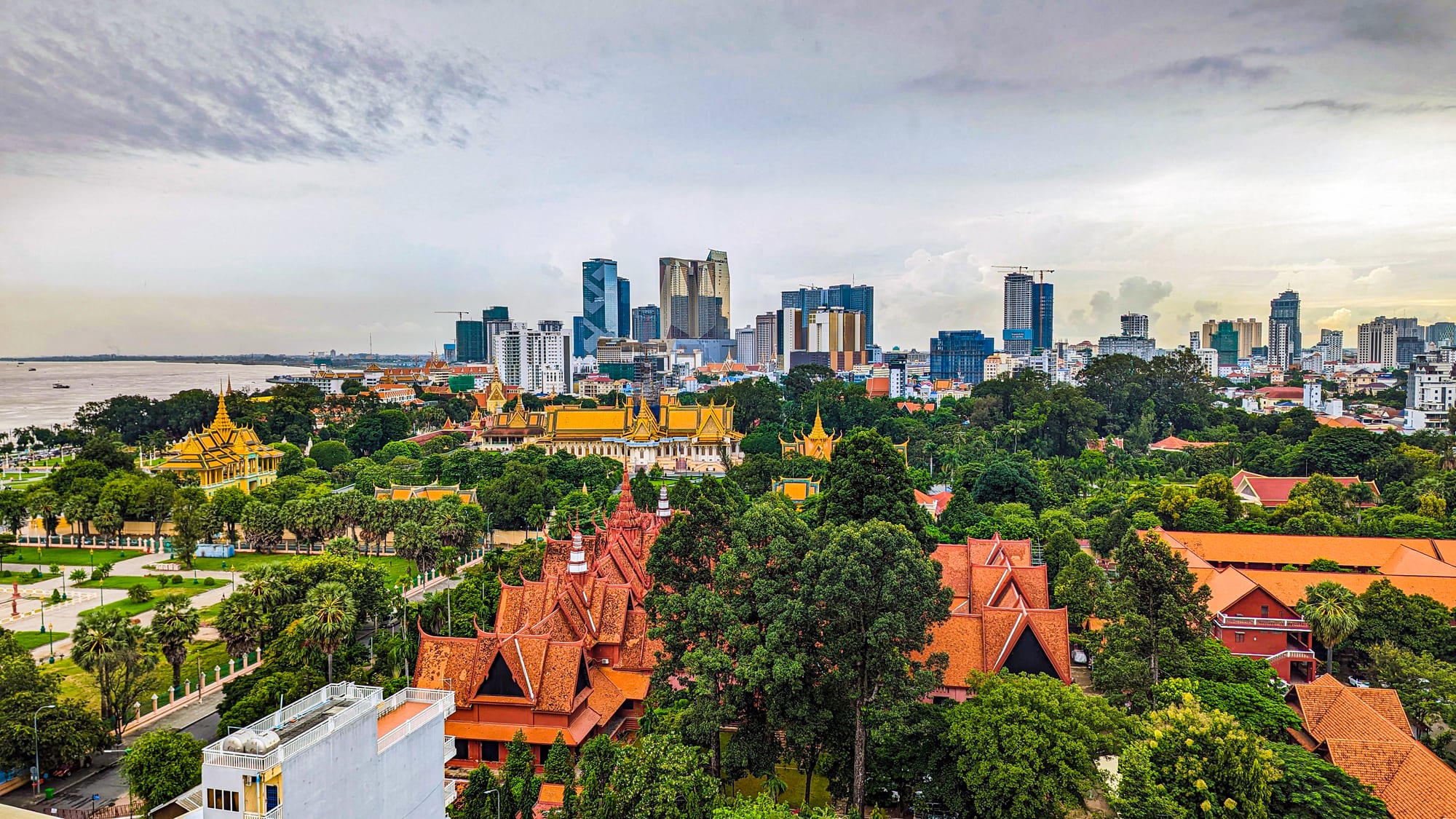
Gold-roofed pavilions of the Royal Palace and red-roofed museum among trees, with Phnom Penh's towers and the river behind

Cambodia

Phnom Penh, Kampong Cham & the Mekong

The Royal Palace and National Museum in front of Phnom Penh's modern skyline beside the river. (Mao Piseth / Wikimedia Commons · CC BY-SA 4.0)

The Cambodian heartland of rice plains, rivers and old royal capitals around Phnom Penh, where the Mekong, the Tonlé Sap and the Bassac meet — stretching from Kampong Thom and Kampong Chhnang to the Vietnamese border, and holding the pre-Angkorian cities, the post-Angkor capitals and the memorials of the Khmer Rouge years.

Explore Phnom Penh, Kampong Cham & the Mekong

History

The lower Mekong was the cradle of Khmer civilisation. Angkor Borei in Takeo is thought to have been a major centre of Funan, the trading state of the early centuries AD, and the hill of Phnom Da nearby has sanctuaries associated with the 6th and 7th centuries. In Kampong Thom, the brick temples of Sambor Prei Kuk mark Ishanapura, a capital of the Chenla kingdom in the 7th century. Angkor itself lay to the north-west, but its kings left temples here too, among them Phnom Chisor and Tonle Bati in Takeo and Wat Nokor in Kampong Cham.

After Angkor was abandoned in the 15th century, the royal court moved south to the meeting of the rivers. Phnom Penh, named after the hill of Wat Phnom and the legendary Lady Penh, served as a capital for a time, followed by Longvek in Kampong Chhnang and then Oudong, capital from the early 17th century until King Norodom moved to Phnom Penh in 1866. Under the French protectorate, Phnom Penh was rebuilt with boulevards, villas and the Central Market.

The Vietnam War reached the region first along the Vietnamese border, where Svay Rieng's "Parrot's Beak" was invaded in 1970. The Khmer Rouge took Phnom Penh on 17 April 1975 and emptied it within days. Tuol Sleng school became the S-21 prison, and prisoners were killed at Choeung Ek. After 1979 the city slowly refilled, and since the 2000s it has grown into a high-rise capital.

Culture & Customs

This is the most Khmer part of Cambodia in speech and custom, and Phnom Penh sets the national standard: the Royal Ballet, the court music of the pinpeat orchestra, the royal ceremonies of the ploughing festival in May and the Water Festival, when hundreds of long boats race on the Tonlé Sap. At Pchum Ben, families visit pagodas across the region with rice for the spirits of the dead.

The region also holds Cambodia's largest Cham Muslim communities, in fishing and trading villages along the Mekong in Kampong Cham, Tboung Khmum and around Phnom Penh, where mosques stand beside pagodas and many women wear headscarves. Vietnamese and Chinese-Cambodian families are prominent in the capital's trade.

Crafts are regional specialities. Koh Dach and villages in Takeo weave silk, including the patterned hol cloth; Kampong Chhnang, whose name means "port of pottery", makes clay pots. Manners follow the national pattern, with the sampeah greeting and modest dress at pagodas and the palace.

Daily Life

Phnom Penh, with around two million people, dominates the region. Its economy runs on government, garment factories on the city's edges, construction, banking and services, and it has expanded onto the river island of Koh Pich and across the rivers. Kampong Cham, Kampong Thom, Takeo, Prey Veng and Svay Rieng are much smaller provincial towns.

Outside the city, life follows the rice seasons and the floods. Kandal's riverbanks grow fruit and vegetables for the capital, Kampong Speu supplies palm sugar, Tboung Khmum and Kampong Cham grow rubber, and Svay Rieng's Bavet has garment factories and casinos by the Vietnamese border. Many young people leave the villages for factory work in Phnom Penh or jobs in Thailand. Rapid growth has brought traffic, land disputes and debt from microloans.

Mornings start before six with markets and noodle stalls, lunch is followed by a rest in the heat, and in the evening Phnom Penh's riverfront fills with families and exercise groups.

Food

Phnom Penh gives its name to kuy teav Phnom Penh, a pork-broth rice-noodle soup with minced pork, offal, prawns and herbs that is the capital's breakfast. Bai sach chrouk, grilled marinated pork with broken rice and pickles, and nom banh chok are sold from pavement stalls in the morning. Beef lok lak and fish amok fill the restaurant menus, and the markets sell num pang baguettes.

The rivers supply the protein. Fish from the Tonlé Sap and Mekong is grilled, dried, salted or made into prahok in the dry season, and fried spiders from Skuon in Kampong Cham province are a famous roadside snack. The Cham villages make beef dishes and halal curries, and Kampong Speu's palm sugar sweetens desserts such as num ansom, sticky rice cakes often filled with banana.

Drinks include sugar-palm juice, iced coffee with condensed milk and sugar-cane juice, while Phnom Penh has the country's craft-beer bars and cocktail bars along the riverfront.

Attractions & Natural Wonders

In Phnom Penh, the Royal Palace and Silver Pagoda, the National Museum's Angkorian sculpture, Wat Phnom and the art deco Central Market lie close to the riverfront. The Tuol Sleng Genocide Museum and, 17 kilometres south of the centre, the Killing Fields at Choeung Ek, with its memorial stupa, explain the Khmer Rouge years. Koh Dach, a Mekong island north of the city, has silk-weaving villages and river beaches.

North of the capital, Oudong's ridge holds the stupas of former kings and other shrines, with views across the plains. Kampong Chhnang's pottery villages lie beyond, and in Kampong Thom the forest temples of Sambor Prei Kuk stand in a UNESCO World Heritage Site.

Upriver, Kampong Cham has the Angkorian temple of Wat Nokor, the hills of Phnom Pros and Phnom Srei, and the island of Koh Paen, reached by boat in the wet season and by a long bamboo bridge in the dry season. Across the Mekong in Tboung Khmum, riverside Khmer and Cham villages of stilt houses, rubber estates and fishing boats line the banks.

South of Phnom Penh, Takeo has the pre-Angkorian sites of Angkor Borei, with its museum, and the hill sanctuaries of Phnom Da, reached by boat in the flood season, as well as the Angkorian temples of Phnom Chisor and Tonle Bati.

Cities in Phnom Penh, Kampong Cham & the Mekong

Planning basics

Budget

Phnom Penh is Cambodia's most expensive city for hotels, restaurants and bars, though guesthouses and street food remain cheap. Outside the capital prices fall sharply: Kampong Cham, Kampong Thom and Takeo have simple, inexpensive hotels and markets, and day trips to Oudong, Koh Dach and the Takeo sites are cheap by tuk-tuk, car or boat.

Daily Budget Midrange
USD 60–130 (boutique hotel in Phnom Penh, restaurants, a car and driver for day trips)
Daily Budget Shoestring
USD 20–35 (guesthouse, street food and markets, buses and shared tuk-tuks)

Carry small dollar notes and riel for tuk-tuks and markets, and use ride-hailing apps in Phnom Penh to avoid haggling.

Safety

The main risks are in Phnom Penh: bag and phone snatching from passing motorbikes, especially at night and around the riverfront, road accidents, and scams in nightlife areas. The countryside is calm, though roads are dangerous after dark, and the border casino towns such as Bavet in Svay Rieng have links to organised crime.

Keep phones and bags away from the street side, travel by tuk-tuk or app car at night, and avoid driving rural roads after dark. Check current official travel advice before travelling.

Climate

Hot and low-lying. The central plains are among the hottest parts of Cambodia before the rains, and the flood season from about August to October swells the Mekong and the Tonlé Sap, turns fields around Prey Veng and Kandal into sheets of water and makes some roads difficult. Phnom Penh's streets flood briefly after heavy downpours.

Summer
very hot in March and April, 35–38°C; then humid with daily storms from May to October
Winter
dry and warm, 24–32°C, with the most comfortable days from December to January

Transportation

Phnom Penh's international airport and bus stations connect the whole country, and an expressway now runs to the coast. Buses and minivans reach Kampong Cham in about three hours and Kampong Thom in about three, while Takeo, Oudong and Kampong Chhnang are easy day trips. Boats cross to Koh Dach and on to Mekong villages, and a slow railway runs south towards Takeo and the coast.

Leave Phnom Penh early in the morning to avoid heavy traffic, and hire a car with driver for Takeo's scattered sites.

Best Time to Visit

November to February for dry, less humid weather. The Water Festival brings boat races to Phnom Penh's riverfront in October or November, and the Pchum Ben festival fills pagodas across the region in September or October. Late in the wet season the rivers are at their fullest and the countryside at its greenest.