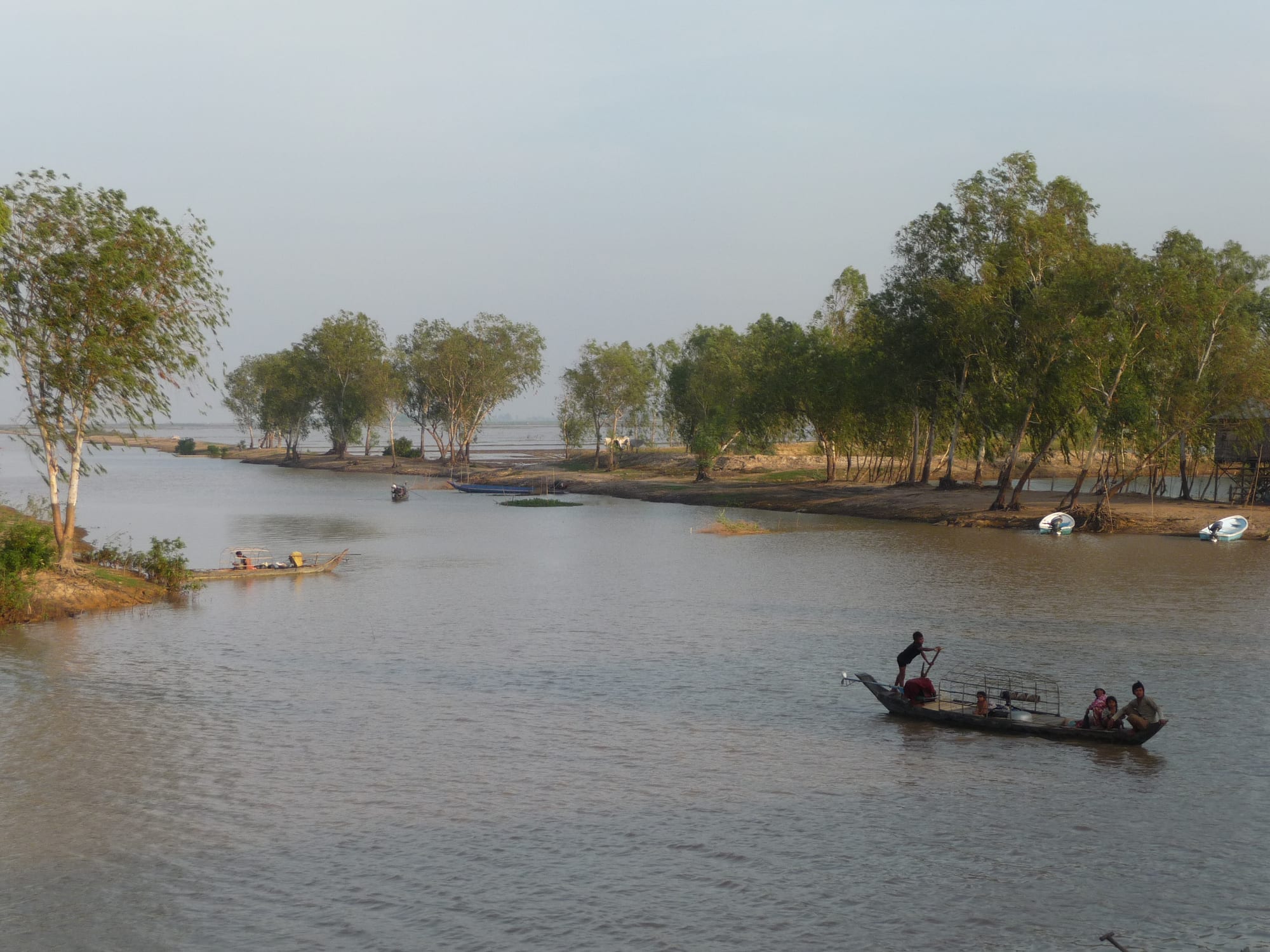
A narrow wooden boat carrying passengers on a broad brown waterway, with flooded fields and lines of trees on low banks

Phnom Penh, Kampong Cham & the Mekong, Cambodia

Takeo

A boat on the canal that links Takeo town with Angkor Borei across the floodplain. (Martpan / Wikimedia Commons · CC BY-SA 3.0)

A quiet provincial town south of Phnom Penh, officially called Doun Kaev, set on a canal at the edge of a wide seasonal floodplain. Its province is sometimes called the cradle of Khmer civilisation: boats run from the town across the flooded fields to Angkor Borei, thought to have been a centre of the ancient state of Funan, and to the hill sanctuaries of Phnom Da.

Neighbourhoods

  • The town centre and the market
    • First-time visitors
    • Markets
    • Best for food

    A small grid of streets around the concrete market hall, with the province's offices, a few hotels and guesthouses, noodle shops and phone and clothing stalls. Everything in town is within ten minutes' walk of here.

    Open in Maps
  • The canal and boat landing
    • Boat trips
    • Waterside walks

    The waterfront on the edge of town where boats leave for Angkor Borei across the floodplain. Fishing craft, stilt houses and vegetable gardens line the bank, and the water level changes dramatically between the seasons.

    Open in Maps
  • The lake and the island
    • Quiet walks
    • Waterside

    The stretch of water north of the centre, with a small island in it and a bank that fills with families at the end of the day. Quiet, open and a reminder of how much of the province is water for half the year.

    Open in Maps
  • The National Road 2 strip
    • Transport
    • Convenience

    The highway to Phnom Penh, lined with workshops, petrol stations, restaurants for passing traffic and the stops where minivans and buses set down.

    Open in Maps

Things to do

Ancient sites

  • Angkor Boreilandmark

    A walled ancient town about 20 kilometres north-east of Takeo, thought to have been an early capital of Funan, with brick foundations, ponds and old canals inside its walls, and a museum of finds in the modern village.

    Open in Maps
  • Phnom Dalandmark

    A granite outcrop about three kilometres south-east of Angkor Borei, crowned by an ancient sanctuary; the statues found here, among them the Vishnu triad now in the National Museum, belong to what may be the earliest tradition of Khmer sculpture.

    Open in Maps
  • Phnom Chisorlandmark

    A hilltop temple built by Suryavarman I in the 11th century, about 27 kilometres north of the town, reached by a long stairway of hundreds of steps, with carved sandstone lintels and views over the rice plain.

    Open in Maps
  • Tonle Batilandmark

    A small lake about 40 kilometres north of the town on the road to Phnom Penh, with Ta Prohm of Bati, a temple built in the reign of Jayavarman VII, and picnic platforms over the water.

    Open in Maps

The town and the water

  • Boat trip to Angkor Boreiattraction

    The journey by motorboat along the canal and across flooded fields, the usual way to reach the ancient town and the fastest in the wet season.

    Open in Maps
  • Takeo marketmarket

    The town's concrete market hall, selling fish from the floodplain, rice, palm sugar, fruit and cloth, with a cooked-food section busiest early in the day.

    Open in Maps

Short trips from the town

  • Silk-weaving villagesattraction

    Households in villages along the highway near the town work looms under their stilt houses, weaving the patterned hol cloth for which Takeo is known; the province holds most of Cambodia's silk weavers.

    Open in Maps

Seasonal events

  • Khmer New Yearmid-April

    Three days of pagoda offerings, games and water throwing, when the hill temples in the province fill with families on holiday.

  • Pchum BenSeptember or October

    The fortnight of offerings for ancestors, when families take rice to the pagodas before dawn.

  • Water FestivalOctober or November, at the full moon

    Bon Om Touk, marked with boat races and gatherings in the towns along the rivers and canals as the flood turns.

Eat and drink

Long-standing places and food districts in Takeo. Hours, ratings and directions come from your maps app, always current.

Market and canal-side food

  • Takeo market food stallsmarket

    Cooked-food aisles serving kuy teav noodle soup, bai sach chrouk, curries and palm-sugar sweets from early morning.

    Open in Maps
  • Restaurants by the canalneighborhood

    Simple open-fronted places near the water cooking freshwater fish, samlor soups, beef lok lak and fried rice.

    Open in Maps
  • Roadside kitchens on National Road 2neighborhood

    Places aimed at drivers and bus passengers, with grilled meats, noodle soups, iced coffee and fruit stalls alongside.

    Open in Maps

Experience Takeo

History

The province claims some of the oldest history in Cambodia. Angkor Borei, on the floodplain north-east of the present town, is believed to have been a major settlement of Funan, the trading state that flourished in the lower Mekong delta in the first centuries AD and traded as far as India and China. Canals linked it to the sea and to other settlements, brick foundations and water tanks survive within its old walls, and the sculptures found at nearby Phnom Da are among the earliest masterpieces of Khmer art, giving their name to a distinct style.

Khmer power later moved north, but the area remained settled and important enough for Angkorian kings to build here: the temple on Phnom Chisor was built by Suryavarman I in the 11th century and Ta Prohm of Bati under Jayavarman VII at the end of the 12th. The modern town of Doun Kaev grew as a market and canal port on the edge of the floodplain and became the provincial seat under the French, who cut and improved the waterways that still carry boats to Angkor Borei.

The 20th century was hard. The province lay close to the Vietnamese border during the war years, and under the Khmer Rouge it was part of the movement's south-western zone, whose commander, Ta Mok, was born in the province and built his power there. After 1979 the province returned to rice farming and weaving, and it has remained one of the poorer and least visited parts of the country, its ancient sites better known to archaeologists than to travellers.

Culture & Customs

Takeo is a strongly rural province, and its culture is that of the rice village: the pagoda as the centre of community life, monks on alms rounds at dawn, and festivals that gather families from the fields. Khmer New Year in April and Pchum Ben in the autumn are the great occasions, and the hill temples at Phnom Chisor and Tonle Bati fill with picnickers on holidays.

The province is known across Cambodia for silk, and holds roughly two-thirds of the country's weavers. Households weave beneath their stilt houses on wooden looms, producing the patterned hol cloth made by tying and dyeing the threads before weaving, along with plain silk and cotton kramas, the checked scarves worn for every purpose. Weaving has been revived since the 1990s with help from craft organisations and is an important source of income for women in the villages.

Memory of the Khmer Rouge years is close to the surface here, and is spoken of carefully and rarely with strangers. Manners follow the national pattern and are formal in a village way: the sampeah greeting, respect for age, modest dress, shoes off at the door, and food and drink pressed on guests. Visitors who are patient and unhurried are treated with warmth.

Daily Life

Doun Kaev is a town of about 43,000 people at the 2019 census, serving a large farming province. The day starts before six at the market and the pagodas, business slows through the heat of the afternoon, and the canal bank and the food stalls fill at dusk. Traffic is light except on the highway, and much of the town is still single-storey wooden and concrete houses with gardens.

Rice dominates the economy, grown on the floodplain and in the fields around the hills, with fish from the seasonal waters, palm sugar tapped from the sugar palms that stand in the paddies, cattle and vegetables. Silk weaving brings in money in the villages, and the town provides the province's administration, hospital, schools and market. Its closeness to Phnom Penh means many families have relatives working there, and garment factories in the province employ others.

The pressures are familiar across rural Cambodia: irregular rainfall and flooding, falling fish catches, debt from microloans, and young people leaving for factory work in the capital or jobs in Thailand. Tourism is small — a few guesthouses, boatmen who take visitors across to Angkor Borei, and a museum that sees a handful of people a day — but the province's archaeology keeps researchers coming back.

Food

The floodplain provides. Freshwater fish is grilled over charcoal, fried, dried in the sun or fermented into prahok in the dry season, and eaten with rice at nearly every meal. Samlor korko, the thick mixed soup of fish and vegetables, is the everyday village dish, while fish amok, steamed in banana leaf with coconut and the lemongrass paste called kroeung, is what restaurants cook for guests. Small fish, snails and river prawns appear at the market in season.

Breakfast is kuy teav, the pork-broth rice-noodle soup, or bai sach chrouk, grilled marinated pork over broken rice with pickled cucumber. Nom banh chok, cold rice noodles with a green fish gravy and a heap of raw vegetables, is sold from baskets in the morning and is at its best in the countryside. Beef lok lak with a lime and black-pepper dip and coconut-thickened Khmer curries fill out restaurant menus.

Sugar palms are everywhere in the province, and their sap is boiled down into palm sugar sold in discs and jars at the market, sweetening desserts such as num ansom, sticky rice cakes wrapped in banana leaf, and num chak kachan, layered steamed cakes. Palm juice, sugar-cane juice and iced coffee with condensed milk are drunk through the day, with Cambodian lager in the evening.

Planning tools

Budget

Takeo is among the cheapest places to stay in the country, with simple hotels and guesthouses in the centre and very inexpensive market food. The main costs are hiring a boat to Angkor Borei, which is usually priced for the whole boat rather than per person, and a tuk-tuk or car for the hill temples.

Daily Budget Midrange
USD 45–90 (the best hotel in town, restaurant meals, a boat hire and a car with driver)
Daily Budget Shoestring
USD 15–30 (guesthouse, market food, shared transport)

Share a boat with other travellers if possible, and carry cash in small dollar notes and riel, as the villages and the sites have no machines.

Best Time to Visit

November to February is dry, warm and the most comfortable season for the hill temples. From about August to November the floodplain is full and the boat trip to Angkor Borei is at its most striking, with fields under water on both sides. March and April are very hot, and in the late dry season the canal can be low.

Suggested Number of Days

One night is the usual stay, long enough for the town and the boat trip across the floodplain. Longer suits anyone who also wants the hill temples and the weaving villages, and the province is close enough to the capital to be seen on a long day trip instead.

First Visit
1 day
With Surroundings
2 days

Transportation

The town is small and flat, and walking covers the centre. Tuk-tuks and motorbike taxis wait near the market for trips to the hill temples and the boat landing, and guesthouses arrange cars with drivers. Boats to Angkor Borei are hired at the canal. Minivans and buses to Phnom Penh run through the day along National Road 2.

Agree the boat price and the return time before leaving the landing, and fix a tuk-tuk fare in advance for the hill temples.

Airport & Station Connections

Takeo lies about 75 kilometres south of Phnom Penh on National Road 2, roughly two hours by minivan or bus, and the same road continues to the Vietnamese border. There is no airport, and the railway between Phnom Penh and Sihanoukville, which carries a limited passenger service, runs through the province.

Walkability

The centre is compact and quiet, and the market, hotels, restaurants and the canal are all within a short walk. Pavements are uneven and there is little shade, and the sites that bring visitors here are all outside town, so walking is for the centre only.

Safety

The town is calm and crime against visitors is rare, mostly opportunist theft. Traffic on National Road 2 is the main daily danger, and boats on the floodplain are small, low in the water and rarely carry life jackets. Paths up the temple hills are steep and slippery after rain.

Choose a boat that is not overloaded and avoid crossings in storms, take care on the temple stairways, and keep to cleared paths in rural areas. Check current official travel advice before travelling.

Climate

Tropical and hot all year, with a dry season from November to April and a monsoon from May to October. The province is low-lying, and from about August the floodplain around Angkor Borei fills, turning fields into sheets of water that drain again through the dry season.

Summer
very hot in March and April, around 35–38°C, then humid with afternoon storms from May to October
Winter
dry and warm, generally 24–32°C, with cool early mornings in December and January

Local Customs

A rural, Buddhist province where visitors are still unusual enough to be greeted with curiosity. The sampeah, palms together at the chest, is the normal greeting, and elders and monks are greeted first.

Shoulders and knees should be covered at pagodas and ancient sites, shoes removed before entering a hall or a home, and permission asked before photographing people or monks. Tipping is not obligatory but is welcomed by boatmen, drivers and guides.

Common Payment Methods

US dollars and Cambodian riel are used side by side, with riel for small amounts and market purchases. Cash is needed for almost everything, including boats and site entry; cards are accepted in very few places. There are cash machines in the town centre but none at the sites or in the villages.