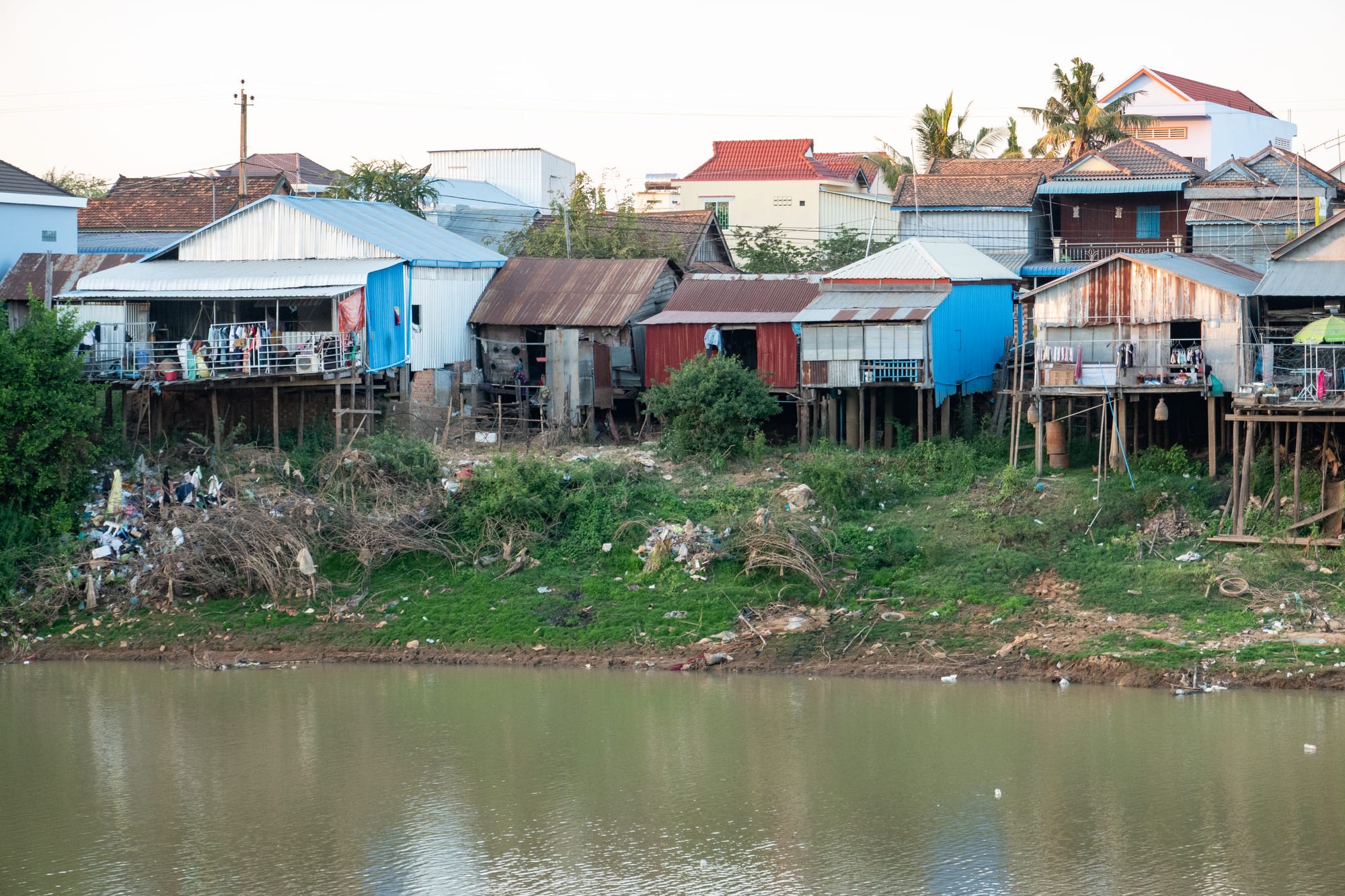
Wooden and tin stilt houses crowded along a green riverbank above brown water, with tiled roofs and palms behind

Phnom Penh, Kampong Cham & the Mekong, Cambodia

Kampong Thom

Stilt houses on the north bank of the Stung Sen river at Kampong Thom. (PsamatheM / Wikimedia Commons · CC BY-SA 4.0)

A market town on the Stung Sen river in central Cambodia, halfway along the main road between Phnom Penh and Siem Reap. It is the capital of a large farming province that reaches to the Tonlé Sap, and the usual base for Sambor Prei Kuk, the brick temples of a 7th-century Chenla capital that stand in forest a short drive north-east.

Neighbourhoods

  • The riverside centre
    • First-time visitors
    • Best for food
    • Close to transport

    The few blocks either side of the bridge over the Stung Sen, holding the market, the main hotels and guesthouses, government offices and the noodle shops. Everything a visitor needs is within a short walk, and the river bank is the pleasant part of town at dusk.

    Open in Maps
  • The National Road 6 strip
    • Transport
    • Convenience

    The highway through town, lined with petrol stations, tyre shops, bus stops, restaurants aimed at passing traffic and a string of hotels. Functional and noisy, but it is where most buses between Phnom Penh and Siem Reap set people down.

    Open in Maps
  • The north bank and the stilt-house lanes
    • Local life
    • Quiet and residential

    Rows of wooden and tin stilt houses along the river, with gardens, fish traps and boats below. A working residential quarter rather than a sight, and a good half-hour walk from the bridge.

    Open in Maps
  • The Santuk road and the rice country
    • Short trips
    • Temples

    The road running south-east towards Phnom Santuk, quickly leaving town for paddy fields, sugar palms and pagoda compounds, with a silk farm and the sacred hill at the end of it.

    Open in Maps

Things to do

Temples and ancient sites

  • Sambor Prei Kuklandmark

    The brick temple groups of Ishanapura, capital of the Chenla kingdom in the 7th century, standing in forest about 30 kilometres north-east and inscribed as a UNESCO World Heritage Site in 2017.

    Open in Maps
  • Phnom Santuklandmark

    A hill about 13 kilometres south-east of town, the most sacred in the province, with a white-walled temple at the top reached by a stone stairway lined with statues, and reclining Buddhas more than ten metres long carved into the rock below.

    Open in Maps
  • Prasat Kuha Nokorlandmark

    A small, well-preserved sandstone and laterite temple of the Angkorian period, standing inside a modern pagoda compound south-west of the town.

    Open in Maps

The town and the river

  • Stung Sen riverattraction

    The river that runs through the middle of town on its way to the Tonlé Sap, lined with stilt houses, fishing boats and gardens planted on the banks as the water falls.

    Open in Maps
  • Kampong Thom marketmarket

    The covered provincial market beside the main road, selling fish from the lake and the river, rice, palm sugar, fruit, cloth and household goods, with cooked-food aisles from dawn.

    Open in Maps
  • The old French-era buildingslandmark

    A handful of colonial-period offices and shophouses near the bridge, the remains of the town's beginnings as a French administrative post.

    Open in Maps

Short trips from the town

  • Tonlé Sapattraction

    The great lake whose flooded forests and fishing villages lie west of the province, swelling several times over in the wet season and shrinking back in the dry.

    Open in Maps

Seasonal events

  • Khmer New Yearmid-April

    Three days of temple offerings, games and water throwing, when families gather at the pagodas and at Phnom Santuk.

  • Pchum BenSeptember or October

    The fortnight of offerings to ancestors, when pagodas across the province fill before dawn with families bringing rice.

  • Water FestivalOctober or November, at the full moon

    Bon Om Touk, which marks the turn of the Tonlé Sap's flow and is celebrated with boat races, food and gatherings in river towns.

Eat and drink

Long-standing places and food districts in Kampong Thom. Hours, ratings and directions come from your maps app, always current.

Market and roadside food

  • Kampong Thom market food stallsmarket

    The cooked-food aisles of the provincial market, where kuy teav noodle soup, bai sach chrouk, curries and palm-sugar cakes are sold from early morning.

    Open in Maps
  • Roadside restaurants on National Road 6neighborhood

    Large open-fronted places serving beef lok lak, grilled fish, fried rice and soups to bus passengers and drivers crossing between the capital and Siem Reap.

    Open in Maps
  • Riverside kitchens near the bridgeneighborhood

    Small family places looking onto the Stung Sen, cooking freshwater fish, samlor soups and rice dishes, with iced coffee served through the day.

    Open in Maps

Experience Kampong Thom

History

The province was the heartland of Chenla, the Khmer state that preceded Angkor. At Sambor Prei Kuk, north-east of the present town, King Isanavarman I built the capital of Ishanapura in the early 7th century, a city of brick sanctuaries with carved lintels and octagonal towers set among trees, some of them still standing and some swallowed by roots. It is among the oldest substantial temple groups in Cambodia and was inscribed as a UNESCO World Heritage Site in 2017.

When power moved north-west to Angkor, this stretch of the plain remained on the road between the capitals and the great lake, and Angkorian kings left smaller works here, among them the temple of Prasat Kuha Nokor and the shrines on Phnom Santuk. The town itself is much younger: it grew as a market and river crossing on the Stung Sen and became a French administrative seat, with a handful of colonial offices near the bridge and a road that later became National Road 6.

The 1970s were harsh across the province, which saw heavy bombing, early Khmer Rouge control and the forced labour of the years that followed; Saloth Sar, who took the name Pol Pot, was born in a village in the province in the 1920s. Rebuilding was slow, and the province stayed poor and agricultural. The paving of the main road in the 2000s brought steady traffic between the capital and Siem Reap, and the recognition of Sambor Prei Kuk has since drawn a modest but growing number of visitors.

Culture & Customs

Life in the province is organised around the pagoda and the rice year. Monks collect alms at dawn, temple committees run the festivals, and the main gatherings are Khmer New Year in April, when Phnom Santuk and the town's pagodas fill with families, and Pchum Ben in the autumn, when rice is offered for the dead before first light. Weddings and ordinations are large, loud village affairs with amplified music that carries for kilometres.

Craft work supplements farming across the province. The traditional Khmer crafts — textiles, mat weaving, silverwork, stone carving, lacquer and ceramics — are practised in the villages, and silk is raised and woven in Santuk district, south-east of the town, where the sacred hill of Phnom Santuk stands. Basketry and palm-sugar making are village trades elsewhere in the province.

The province is also known for the shadow of its history — Sambor Prei Kuk's antiquity, and a Khmer Rouge past that is discussed carefully and rarely with strangers. Manners follow the national pattern: the sampeah greeting with palms together, respect for age and for monks, modest dress at pagodas, shoes removed at the door, and hospitality offered quickly to visitors who arrive in a village.

Daily Life

Kampong Thom is a small provincial capital of a few tens of thousands of people, strung between the river and the highway. The day begins before six at the market and the pagodas, business is done in the morning, the afternoon is quiet under the heat, and the evening belongs to the riverside and the food stalls. Traffic through town is constant, as buses and lorries between Phnom Penh and Siem Reap pass on the main road.

The province lives from rice, above all, with cassava, maize, sugar palms, fishing on the Stung Sen and the Tonlé Sap, and cattle in the drier districts. The town supplies the administration, the hospital, the schools and the market that the surrounding districts depend on, and a small tourist trade serves people visiting the temples. Handicrafts and silk raising add income in the villages to the south.

Poverty is higher here than in the cities, and many young people leave for work in Phnom Penh's garment factories, on construction sites or across the border in Thailand, sending money home. Irregular rainfall, flooding along the Stung Sen and debt from microloans are common worries, and improvements to roads, electricity and water supply have arrived unevenly across the districts.

Food

Freshwater fish is the base of the cooking, from the Stung Sen and from the Tonlé Sap to the west: grilled over charcoal, fried with garlic, dried, or fermented into prahok in the dry season, when the paste that flavours half the country's dishes is made in bulk. Samlor korko, the thick soup of fish and whatever vegetables are in season, is the village dish, and fish amok, steamed with coconut and the lemongrass paste called kroeung, appears in restaurants.

Breakfast is kuy teav, the pork-broth rice-noodle soup with herbs and lime, or bai sach chrouk, grilled marinated pork over broken rice with pickles. Nom banh chok, cold rice noodles under a green fish gravy with raw vegetables, is sold in the mornings from baskets. Beef lok lak with a lime and black-pepper dip and Khmer curries thickened with coconut fill the roadside restaurants that feed passing buses.

The province is sugar-palm country, and the tall palms standing in the rice fields are tapped for sap that is boiled into palm sugar, sold in cakes and jars at the market and used in desserts such as num ansom, sticky rice cakes wrapped in banana leaf. Palm juice, sugar-cane juice and strong iced coffee with condensed milk are the everyday drinks, alongside Cambodian lager in the evening.

Planning tools

Budget

Kampong Thom is cheap, with simple hotels along the highway and near the river, market meals at low prices and short tuk-tuk journeys. The main cost is transport to the temples: a tuk-tuk or car and driver for Sambor Prei Kuk and Phnom Santuk, plus the Sambor Prei Kuk entrance fee.

Daily Budget Midrange
USD 45–90 (comfortable hotel, restaurant meals, a car and driver for the temples)
Daily Budget Shoestring
USD 15–30 (guesthouse, market food, shared transport)

Bring cash in small dollar notes and riel; there are machines in town but none at the temple sites.

Best Time to Visit

November to February is dry, warm and the easiest time for the forest tracks at Sambor Prei Kuk. March and April are very hot. From May to October afternoon storms make the unpaved approaches muddy, though the countryside and the flooded forests around the Tonlé Sap are at their fullest late in the season.

Suggested Number of Days

Most visitors stay one night, using the town as a base for the pre-Angkorian sites nearby before continuing along the main road. Longer stays suit anyone who wants a slower look at the province, its pagodas and the country towards the lake.

First Visit
1 day
With Surroundings
2 days

Transportation

The centre is small enough to walk, and tuk-tuks and motorbike taxis wait near the market and the bus stops for trips to the temples. Guesthouses arrange cars with drivers, and motorbikes can be rented. Buses and minivans running between Phnom Penh and Siem Reap stop on the highway through town several times an hour during the day.

Agree a return fare and waiting time with a tuk-tuk driver before setting out for Sambor Prei Kuk, as there is no transport back from the site.

Airport & Station Connections

The town sits on National Road 6 about halfway between Phnom Penh and Siem Reap, roughly three hours by bus or minivan from either. There is no airport; travellers arrive by road, and long-distance buses set down on the highway in the centre of town rather than at a station.

Walkability

The riverside centre is flat and compact, and the market, hotels and restaurants are within ten minutes of each other. The highway is loud and fast-moving, with little shelter from the sun, and the outer parts of town spread along dusty roads, so most people walk only in the centre and take a tuk-tuk for anything else.

Safety

The town is quiet and crime against visitors is rare, mostly opportunist theft. The real risks are traffic on National Road 6, which carries heavy lorries and buses at speed through the town, and rural land off the paths at remote temple sites, where unexploded ordnance has been found in parts of the Cambodian countryside.

Cross the highway with great care, keep to cleared paths and tracks at forest temples, avoid rural roads after dark, and watch bags in market crowds. Check current official travel advice before travelling.

Climate

Tropical and hot all year, with a dry season from November to April and a monsoon from May to October. The Stung Sen rises through the wet months on its way to the Tonlé Sap, and the surrounding rice country turns from dust to flooded green and back again.

Summer
very hot in March and April, around 35–38°C, then humid with afternoon storms from May to October
Winter
dry and warm, generally 24–32°C, with cool early mornings in December and January

Local Customs

This is a rural, conservative province where Buddhist practice is part of daily life. Greetings are made with the sampeah, palms together at the chest, elders and monks are greeted first, and quiet politeness counts for a great deal.

Shoulders and knees should be covered at pagodas and at the temple sites, shoes removed before entering a hall or a home, and permission asked before photographing people or monks. Climbing on ancient brick towers is discouraged, and tipping is not obligatory though it is welcomed by drivers and guides.

Common Payment Methods

US dollars and Cambodian riel circulate together, with riel used for small change and market purchases. Cash is needed almost everywhere; cards work only in a few hotels. Cash machines in the centre dispense dollars and riel, and there are none at the temples or in the villages.