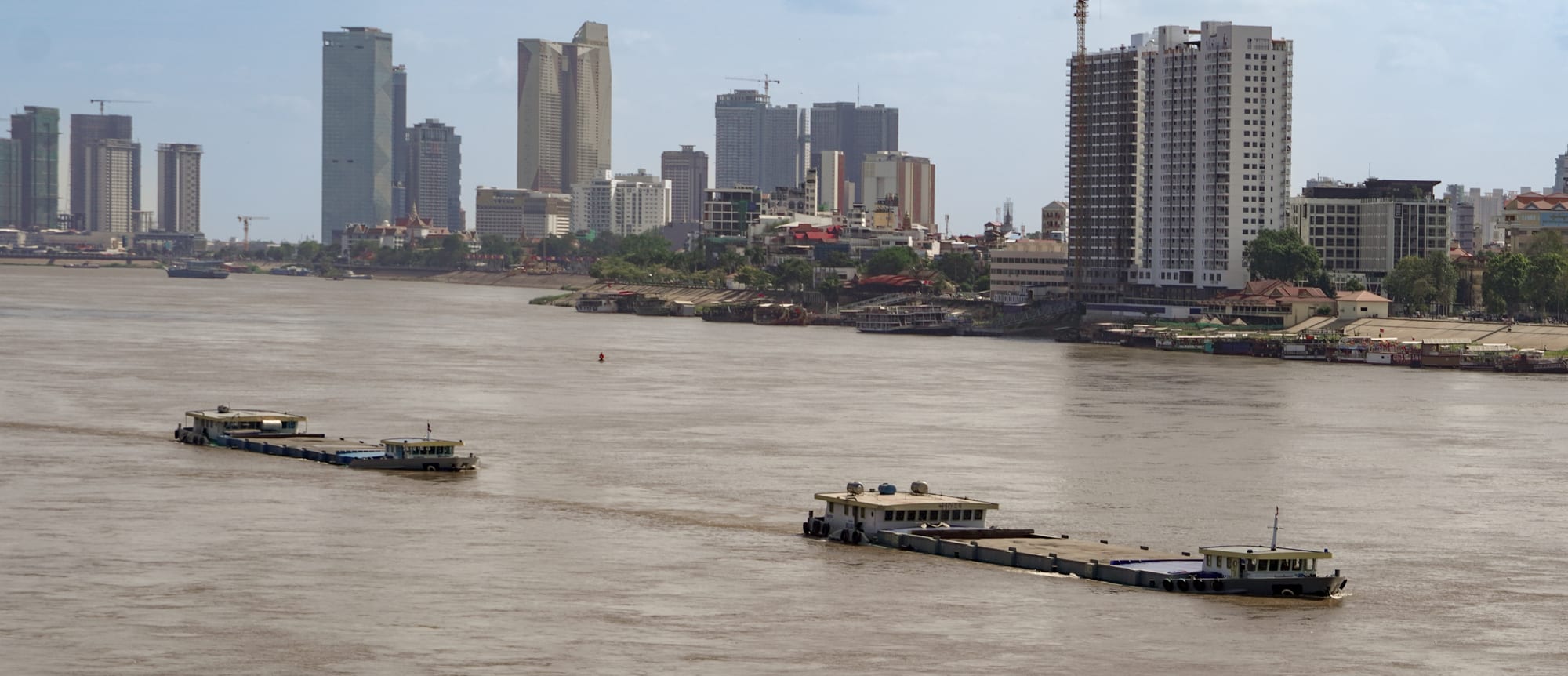
Two long barges on a wide brown river with a skyline of towers and cranes rising behind the far bank

Phnom Penh, Kampong Cham & the Mekong, Cambodia

Phnom Penh

Barges on the Tonlé Sap river below the growing skyline of Phnom Penh. (Josh Greiveldinger / Wikimedia Commons · CC BY-SA 4.0)

Cambodia's capital, built where the Mekong, the Tonlé Sap and the Bassac meet. A royal city from the 15th century and again from 1866, rebuilt by the French with boulevards and markets, emptied by the Khmer Rouge in 1975 and refilled after 1979, it is now a fast-growing city of towers, pagodas, markets and memorials along the river.

Neighbourhoods

  • Daun Penh and the riverfront
    • First-time visitors
    • Historic district
    • Riverside walks

    The old colonial and royal quarter along Sisowath Quay, holding the Royal Palace, the National Museum, Wat Phnom and the Central Market. Hotels, bars and travel agencies line the river, and the promenade fills with families and exercise groups in the evening.

    Open in Maps
  • Boeung Keng Kang
    • Best for food
    • Nightlife
    • Cafés

    The district south of Independence Monument known as BKK, with embassies, serviced flats, coffee shops, bars and many of the city's international restaurants along Streets 278 and 308. Quieter by day than the riverfront, busier after dark.

    Open in Maps
  • Tuol Tom Poung
    • Markets
    • Shopping
    • Local life

    The area around the Russian Market, a dense covered bazaar of clothing, silverware, spare parts and food stalls. The surrounding blocks have become one of the city's café and small-restaurant quarters while staying largely residential.

    Open in Maps
  • Chamkarmon
    • Residential
    • Restaurants

    The wider southern district that takes in BKK and Tuol Tom Poung, with tree-lined streets of villas, schools, offices and new apartment blocks — where much of the city's expatriate and middle-class life is based.

    Open in Maps
  • Toul Kork
    • Quiet and residential
    • Parks

    A planned district north-west of the centre, laid out with wide streets and gardens, now full of universities, large houses, clinics and shopping malls. There is little for visitors to see, but it shows how the modern city lives.

    Open in Maps
  • Chroy Changvar
    • Views
    • New developments

    The peninsula across the Tonlé Sap where the rivers meet, reached by bridge, with riverside restaurants, new estates and the best long views back to the palace and the quay.

    Open in Maps
  • Koh Pich
    • Modern architecture
    • Families

    Diamond Island, a flat island in the Bassac developed since the 2000s with convention halls, apartment towers and imitation European streets — a favourite for evening strolls and weddings.

    Open in Maps

Things to do

Palaces, temples and monuments

  • Royal Palacelandmark

    The walled royal compound built from the 1860s and still the king's official residence, where visitors may walk the central compound with its Throne Hall and the Chanchhaya Pavilion above the quay.

    Open in Maps
  • Silver Pagodalandmark

    The royal temple inside the palace grounds, its floor laid with silver tiles and its treasures including a Buddha of gold and another of emerald-coloured crystal.

    Open in Maps
  • Wat Phnomlandmark

    The hilltop pagoda at the north end of the old quarter, founded according to legend in the 14th century by Lady Penh, who gave the city its name.

    Open in Maps
  • Wat Ounalomlandmark

    The seat of Cambodian Buddhism beside the riverfront, headquarters of the country's monastic hierarchy, rebuilt after the Khmer Rouge years.

    Open in Maps
  • Independence Monumentlandmark

    A lotus-shaped tower of dark red stone raised in 1958 to mark independence from France, standing at a busy junction of boulevards.

    Open in Maps

Museums and memorials

  • National Museum of Cambodiamuseum

    The red pavilion beside the palace holding the country's greatest collection of Khmer sculpture, from pre-Angkorian statues to bronzes and Angkorian stonework.

    Open in Maps
  • Tuol Sleng Genocide Museummuseum

    The former school used by the Khmer Rouge as the S-21 prison, kept as it was found, with photographs of prisoners and the records the regime left behind.

    Open in Maps
  • Choeung Ekattraction

    The killing fields about 17 kilometres south of the centre, where prisoners from S-21 were executed, now a memorial with a stupa of skulls and an audio tour.

    Open in Maps

Markets and shopping

  • Central Marketmarket

    Phsar Thmei, the 1937 art deco market under a huge yellow dome with four arched wings, selling jewellery, watches, cloth, flowers and food.

    Open in Maps
  • Russian Marketmarket

    Phsar Toul Tom Poung, a hot, crowded covered market known for silk, silverware, curios and a food section of noodle and dessert stalls.

    Open in Maps
  • Phsar Kandal and the old quarter streetsmarket

    A working neighbourhood market a block from the river, with fish, fruit, herbs and prepared food spilling into the surrounding lanes.

    Open in Maps

Parks, the river and architecture

  • Sisowath Quayattraction

    The riverside boulevard and promenade facing the Tonlé Sap, lined with restaurants and bars and busiest at dusk when families and exercise classes take over the walkway.

    Open in Maps
  • Chaktomuk Conference Halllandmark

    A fan-shaped hall of 1961 on the riverfront by Vann Molyvann, one of the best-known works of the New Khmer Architecture movement in the city.

    Open in Maps
  • National Olympic Stadiumattraction

    Another Vann Molyvann design, opened in the 1960s, where crowds come at dusk to jog, play football and join aerobics classes on the terraces.

    Open in Maps
  • Wat Botum Parkpark

    A green square between the palace and Independence Monument, with memorials, shade trees and the stupas of the pagoda that gives it its name.

    Open in Maps

Short trips from the city

  • Koh Dachattraction

    The silk island in the Mekong upstream of the city, reached by ferry, with weaving households, sandy river beaches and quiet lanes.

    Open in Maps
  • Oudonglandmark

    The royal capital from 1618 until 1866, about 35 kilometres north-west, a ridge topped with the stupas of former kings and wide views over the plain.

    Open in Maps
  • Tonle Batilandmark

    A lakeside picnic spot south of the city with the Angkorian temple of Ta Prohm of Bati, one of the shelters built in the reign of Jayavarman VII, in laterite and sandstone.

    Open in Maps
  • Phnom Chisorlandmark

    An 11th-century temple on a hill south of the capital, reached by a long stairway, with views across the rice plains to the Vietnamese border country.

    Open in Maps

Seasonal events

  • Water FestivalOctober or November, at the full moon

    Bon Om Touk, which marks the reversal of the Tonlé Sap's flow, when hundreds of long boats race on the river and enormous crowds gather on the quay.

  • Khmer New Yearmid-April

    Three days of temple offerings, games and water and powder throwing, when much of the city empties to family villages in the provinces.

  • Pchum BenSeptember or October

    The fortnight of offerings to ancestors, when families bring rice and food to pagodas across the city before dawn.

  • Royal Ploughing CeremonyMay

    A royal rite opening the planting season, in which sacred oxen are offered dishes whose choice is read as a forecast for the harvest.

Eat and drink

Long-standing places and food districts in Phnom Penh. Hours, ratings and directions come from your maps app, always current.

Phnom Penh classics

  • Kuy teav stalls in the old quarterneighborhood

    Morning pavement kitchens serving kuy teav Phnom Penh, the pork-broth rice-noodle soup with minced pork, offal, prawns and a plate of herbs that is the city's breakfast.

    Open in Maps
  • Bai sach chrouk cartsneighborhood

    Grilled marinated pork served over broken rice with pickles and a bowl of broth, sold from charcoal grills on street corners from first light.

    Open in Maps

Markets and food streets

  • Central Market food hallsmarket

    The wings of the art deco market where stalls sell noodle soups, grilled skewers, fruit shakes and desserts alongside the jewellery and cloth traders.

    Open in Maps
  • Russian Market food sectionmarket

    A tight grid of stalls at the heart of the market cooking rice dishes, curries, noodles and iced coffee for shoppers and traders.

    Open in Maps
  • Street 278 and the BKK streetsneighborhood

    The main concentration of cafés, bars and restaurants in Boeung Keng Kang, mixing Khmer kitchens with Vietnamese, Japanese, Indian and French cooking.

    Open in Maps
  • Sisowath Quay restaurantsneighborhood

    The riverside strip of terraces facing the Tonlé Sap, from Khmer grills to long-standing French and Italian places popular in the evening.

    Open in Maps

Experience Phnom Penh

History

The city's founding story belongs to Lady Penh, a wealthy widow who is said to have found sacred images in a tree floating on the river in the 14th century and raised a hill, phnom, to house them — the origin of Wat Phnom and of the name Phnom Penh. After the Khmer court abandoned Angkor in the 15th century it moved south to this meeting of waters, and the settlement served as a royal capital for a period before the court shifted to Longvek and then to Oudong.

For three centuries Phnom Penh was a trading town of Khmer, Chinese, Cham, Malay and Portuguese merchants at the junction of the rivers. King Norodom returned the capital here in 1866, under a French protectorate declared three years earlier, and the French laid out boulevards, quays, villas, a Central Market and the grid of numbered streets that still orders the city. By the 1960s, independent Cambodia's capital was known for the modernist buildings of Vann Molyvann and a confident national culture.

War ended that. American bombing of the countryside and the civil war swelled the city with refugees, and on 17 April 1975 the Khmer Rouge took Phnom Penh and emptied it within days, driving its people into the countryside. A school in the south of the city became the S-21 prison, and its prisoners were killed at Choeung Ek. Vietnamese forces entered in January 1979 and people walked back to a looted, half-ruined city. Recovery was slow through the 1980s and 1990s; since the 2000s the capital has grown fast, with towers, satellite developments and a population several times what it was on its return.

Culture & Customs

Phnom Penh sets the national standard in language, dress and ceremony. The royal court survives in the palace on the quay, with ceremonies such as the Royal Ploughing Ceremony in May, and the classical arts — the Royal Ballet's apsara dance, the pinpeat orchestra, shadow puppetry — are taught and performed here, having been rebuilt almost from nothing after the 1970s, when most of their masters died.

Buddhism orders the year. Monks collect alms at dawn, pagodas fill for Pchum Ben in September or October as families bring rice for the dead, and the Water Festival in the autumn draws enormous crowds to the riverfront for boat races that mark the reversal of the Tonlé Sap's flow. The city also has old Cham Muslim, Chinese and Vietnamese communities, with mosques, temples and associations of their own, and a small Catholic congregation.

A young, connected population has built a contemporary culture alongside the traditional one: galleries and independent cinema, hip hop and rock bands that sample the pre-war pop of Sinn Sisamouth and Ros Serey Sothea, cafés and skate parks. Manners remain formal: the sampeah greeting with palms together, respect for age and monks, modest dress at pagodas and the palace, and a strong dislike of raised voices.

Daily Life

About 2.1 million people lived in the capital at the 2019 census, and the number rises every year with arrivals from the provinces. The day starts before six with markets, noodle stalls and exercise groups on the riverfront, slows through the heat of the early afternoon, and picks up again at dusk, when the quay, Koh Pich and the Olympic Stadium terraces fill with families, joggers and aerobics classes.

The economy runs on government, banking, construction, tourism and the garment factories on the city's edges, which employ hundreds of thousands of workers, mostly women, many of them living in rented rooms and sending money home. Property development has reshaped whole districts, filling lakes and building satellite towns on former wetland, and Chinese investment has been a large part of it. Motorbikes and tuk-tuks carry most of the traffic, and new flyovers and ring roads have not kept up with it.

The city's pressures are those of rapid growth: congestion, flooding after heavy rain where drainage has been built over, air pollution, evictions and land disputes, and a wide gap between the new towers and the crowded neighbourhoods behind them. Alongside this, public services, schools and universities have expanded, and a generation born long after the Khmer Rouge years now makes up most of the population.

Food

Phnom Penh has given its name to kuy teav Phnom Penh, the pork-broth rice-noodle soup with minced pork, offal, prawns, fried garlic and a plate of herbs that is the standard breakfast, eaten at pavement tables from before dawn. Its rival is bai sach chrouk, thin slices of marinated pork grilled over charcoal and served on broken rice with pickled cucumber and a bowl of clear broth. Nom banh chok, cold rice noodles under a green fish gravy of lemongrass and turmeric with raw vegetables, is carried through the streets in baskets.

The city's restaurant dishes are the country's best known: fish amok, steamed in banana leaf with coconut and kroeung, the lemongrass and galangal paste at the base of Khmer cooking; beef lok lak, seared cubes of beef with a lime and pepper dip using Kampot pepper; samlor korko, the thick vegetable and fish soup; and prahok, fermented fish paste, in dips and marinades. Num pang, the baguette filled with pâté, pork and pickles, is a French inheritance.

Markets are where most of this is eaten. The art deco Central Market and the Russian Market both have food sections, and streets of stalls sell grilled skewers, fried noodles, sugar-palm cakes and fruit. Drinks run to iced coffee with condensed milk, sugar-cane and palm juice, and Cambodian lager, while Boeung Keng Kang and the riverfront hold the craft-beer and cocktail bars.

Planning tools

Budget

Phnom Penh is Cambodia's most expensive city for hotels, restaurants and bars, but street food, markets and tuk-tuks remain cheap, so daily costs depend almost entirely on where a visitor sleeps and eats. Museum and memorial tickets are modest, and a car with driver for the sites outside the city is the main extra.

Daily Budget Midrange
USD 60–130 (boutique hotel, restaurant meals, museum entries, a car and driver for day trips)
Daily Budget Shoestring
USD 20–35 (guesthouse or hostel, street food and markets, shared tuk-tuks and buses)

Carry small US dollar notes and riel for tuk-tuks and markets, and use a ride-hailing app to avoid haggling over fares.

Best Time to Visit

November to February is the driest and least humid stretch, and also when the Water Festival brings boat races to the riverfront. March and April are very hot. The rains from May to October fall mostly in heavy afternoon storms that flood some streets briefly, and the rivers are at their fullest late in the season.

Suggested Number of Days

Two or three days cover the central sights and the memorials at a reasonable pace. Four or five allow for the river islands and the older royal and temple sites in the surrounding provinces, and heavy traffic means crossing the city takes longer than the map suggests.

First Visit
2–3 days
With Surroundings
4–5 days

Transportation

Tuk-tuks are the standard way to get about, both the traditional trailer kind and the small three-wheelers summoned through ride-hailing apps, which also offer cars and motorbike taxis at fixed prices. There is a limited city bus network, and boats cross to Chroy Changvar and the Mekong islands. Traffic is dense and slow at peak hours, and driving yourself is not recommended.

Use an app for fares and routes, keep bags on the inside of a tuk-tuk away from passing motorbikes, and allow extra time in the late afternoon.

Airport & Station Connections

Techo International Airport, which opened south of the city in September 2025 and replaced the old Phnom Penh International Airport as the capital's hub, handles flights from Bangkok, Singapore, Ho Chi Minh City, Kuala Lumpur, Seoul and other Asian hubs. Buses and minivans run to Siem Reap in about six hours, to Kampong Cham in about three and to Sihanoukville along the expressway, and international coaches and river boats connect with Vietnam. Thailand closed its crossings with Cambodia during the 2025 crisis and reopening has been tied to conditions set in the talks, so do not count on entering or leaving by land there.

Walkability

The old quarter between the river, the palace and the Central Market is walkable, and the riverfront promenade is pleasant in the early morning and evening. Elsewhere the heat, broken pavements used for parking and cooking, and fast motorbike traffic make walking hard work; most people take a tuk-tuk for anything beyond a few blocks. Crossing roads is done slowly and steadily rather than by waiting for a gap.

Safety

The main risks are bag and phone snatching by thieves on passing motorbikes, especially at night and around the riverfront, road accidents, and scams in nightlife areas. Violent crime against visitors is uncommon. Traffic is the most serious everyday danger, and pavements offer little protection. Cambodia has become a base for large-scale online scam compounds; UN and Amnesty International reporting links them to trafficking and forced labour, often through job offers that bring people into the country.

Keep phones and bags away from the street side and out of sight in tuk-tuks, travel by app car or tuk-tuk at night rather than walking unlit streets, and be wary of strangers offering card games, gem deals or work. Check current official travel advice before travelling.

Climate

Tropical, hot all year, with a dry season from November to April and a monsoon from May to October. The hottest weeks come in March and April before the rains break; storms then arrive most afternoons and can flood low streets within minutes.

Summer
very hot in March and April, around 35–38°C, then humid with daily storms from May to October
Winter
dry and warm, generally 24–32°C, with the most comfortable days in December and January

Local Customs

Cambodia is Theravada Buddhist and manners are formal in small ways. Greetings are made with the sampeah, palms together at the chest, and elders and monks are greeted first. Calm voices and a smile settle most situations; public anger causes loss of face on both sides.

Shoulders and knees must be covered at the Royal Palace and at pagodas, and shoes come off before entering a temple hall or a home. Tuol Sleng and Choeung Ek are places of mourning, so quiet dress and behaviour and no posed photographs are expected. Tipping is not obligatory but is appreciated in restaurants and by drivers and guides.

Common Payment Methods

US dollars circulate alongside the Cambodian riel, and prices are often quoted in dollars, with riel given as change for amounts under a dollar. Cards are accepted in hotels, malls and larger restaurants; markets, tuk-tuks and street food need cash. Cash machines dispense dollars and riel and usually charge a fee, and QR-code payment apps are now common.