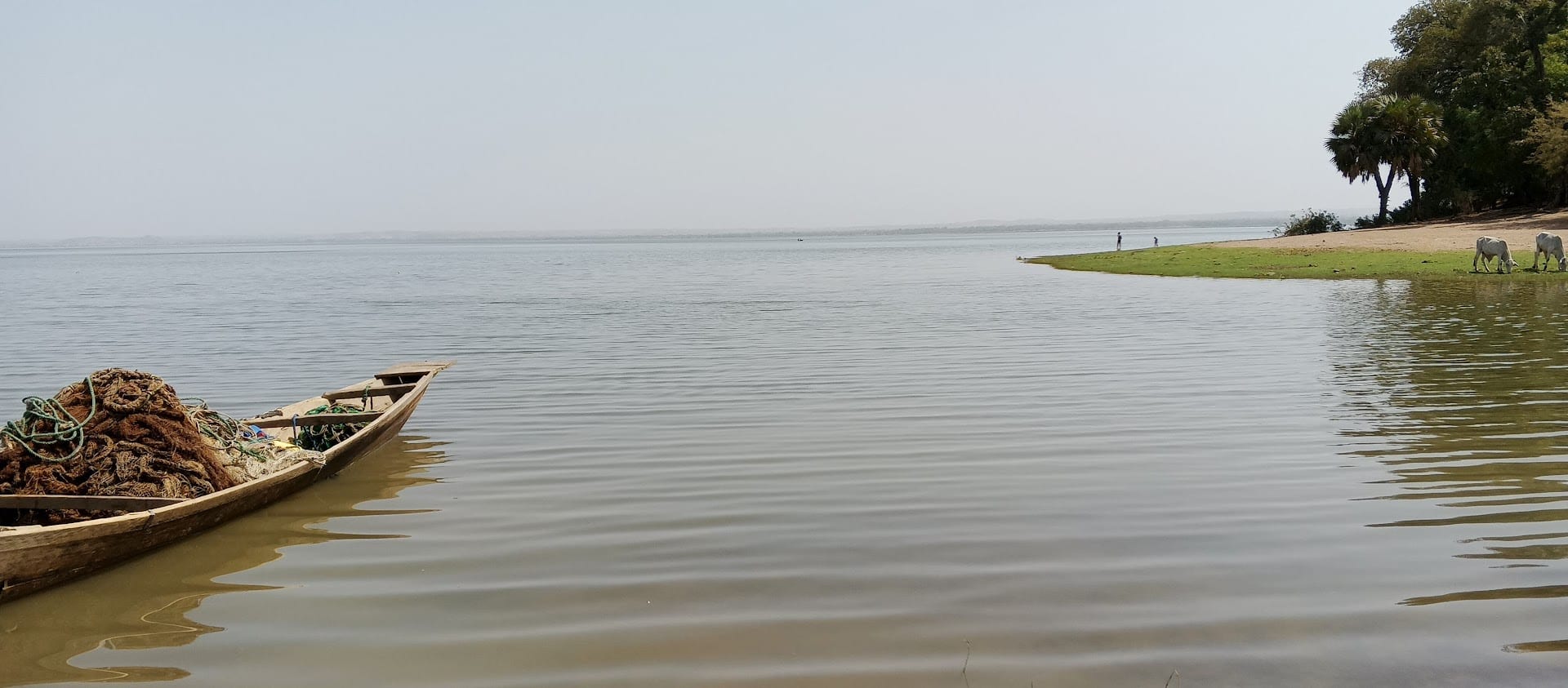
A wooden fishing canoe loaded with nets on the calm brown water of a wide lake, with a grassy shore and cattle on the right

N'Djamena & the West, Chad

Léré

A fishing canoe on Lake Léré in south-western Chad, with cattle grazing on the shore. (Pabouni Blaise / Wikimedia Commons · CC BY-SA 4.0)

A town in south-western Chad, close to the Cameroon border, set between two lakes on the Mayo Kébbi river in the green cotton country of Mayo-Kebbi Ouest. It is the seat of a Moundang traditional ruler, a farming and fishing centre, and the base for the lakes and the Gauthiot Falls nearby. This page is written to explain the town, not to encourage travel.

Neighbourhoods

  • The town centre and market
    • First-time visitors
    • Markets
    • Local life

    The few administrative buildings, shops, mosque and churches stand around the market and the main road through town. Market days bring in farmers and traders from the surrounding villages and from across the Cameroon border.

    Open in Maps
  • The lakeshore
    • Quiet and residential
    • Fishing life
    • Views

    Compounds, gardens and landing places spread towards the water east of the town, where canoes are drawn up and nets dried. Cattle are watered along the same shore, and the light on the lake is best in the early morning.

    Open in Maps
  • The chieftaincy quarter
    • Historic district
    • Local customs

    The area around the residence of the Moundang traditional ruler, whose court keeps ceremonial customs alive. It is a residential quarter of walled compounds rather than a sight, and permission is expected before taking photographs.

    Open in Maps

Things to do

The lakes and the river

  • Léré Lakeattraction

    The lake beside the town, about 14 kilometres long, fed by the Mayo Kébbi, fished from dugout canoes and home to West African manatees, which survive here in good numbers.

    Open in Maps
  • Lake Trénéattraction

    A smaller lake of about six kilometres by two on the same river system, just upstream of Lake Léré.

    Open in Maps

In the town

  • Léré marketmarket

    The town's market, where millet, sorghum, groundnuts, dried fish and cloth are traded, busiest on market days.

    Open in Maps

Short trips from the town

  • Gauthiot Fallsattraction

    A series of cascades on the Mayo Kébbi dropping some 17 metres in all, noted for their position between the Mayo Kébbi and Logone drainage systems, water on one side reaching Lake Chad and on the other the Bénoué and the Niger.

    Open in Maps
  • Binder-Léré Faunal Reservepark

    A reserve of about 1,350 square kilometres established in 1974 around the lakes and the river, a Ramsar wetland site since 2005.

    Open in Maps
  • Palaattraction

    The capital of Mayo-Kebbi Ouest, a market and administrative town on the road towards Bongor and the Logone.

    Open in Maps

Seasonal events

  • Dry-season festivals and wrestlingdry season, roughly December to April

    Harvest celebrations, dances and wrestling matches are held across Mayo-Kebbi once the fields are cleared and travel is easy.

  • Christmas and EasterDecember and spring

    Major occasions in a largely Christian and traditional-religion area, marked by long church services, choirs and family meals.

Eat and drink

Long-standing places and food districts in Léré. Hours, ratings and directions come from your maps app, always current.

Léré classics

  • Lake fishrestaurant

    Fish from Lake Léré and the Mayo Kébbi, grilled fresh or sold smoked and dried, is the local speciality and the town's main trade in food.

    Open in Maps
  • Boule and saucerestaurant

    Stiff millet, sorghum or cassava porridge eaten by hand with okra, groundnut or fish sauce is the everyday meal in the town's few eating places.

    Open in Maps

The market

  • Léré marketmarket

    Grain, groundnuts, sesame, shea butter, dried fish, fruit and cooked snacks are sold from stalls and mats, with bili-bili millet beer brewed and sold nearby.

    Open in Maps

Experience Léré

History

Léré sits in Moundang country, on the plain between Lake Tréné and Lake Léré where the Mayo Kébbi runs west towards the Bénoué. Long before colonial rule the Moundang here were organised under a ruler, and Léré was his seat — a chieftaincy strong enough to be recorded by the first Europeans to reach the area, with its own court, drums and ceremonies. The peoples of these lakes and floodplains lived beyond the Muslim sultanates of the north, whose slave raids reached this far and left a long distrust of them.

French forces reached the Mayo Kébbi at the beginning of the twentieth century and attached the area to Chad within French Equatorial Africa, keeping the traditional ruler in place under colonial supervision, as they did elsewhere in the south. Catholic and Protestant missions arrived with schools and clinics, and Christianity spread widely alongside older practices. From the 1920s the administration pushed cotton growing on southern farmers, and Mayo-Kebbi became part of the cotton belt that paid for the colony.

After independence in 1960 the region supplied a disproportionate share of Chad's educated officials, and Mayo-Kebbi developed its own tradition of opposition politics. The town has remained small, its economy tied to farming, fishing and trade with Cameroon a few kilometres away, and its ruler still recognised. The lakes and the river drew scientific attention in the twentieth century, both for the manatees that survive in them and for the Gauthiot Falls downstream, which mark the boundary between two of Africa's great drainage systems.

Culture & Customs

This is Moundang country, and Léré is its centre. The traditional ruler, whose office the Moundang have kept through colonial rule and independence, still holds a court with its own titles, regalia and ceremonies, and his presence makes the town a place of ritual importance out of proportion to its size. Neighbouring peoples — Massa, Toupouri, Moussey and others — share the wider region, and their languages are heard in the market alongside French.

Most people are Christian, Catholic and Protestant both, or follow traditional religions, often at the same time; a Muslim minority lives mainly in the trading quarters. Churches are full on Sunday and choirs are a serious matter. Funerals, weddings and harvests are marked with drums, dance and, in the villages, masked or costumed performance that outsiders are not always invited to see.

Manners are those of the wider south: long greetings that ask after family and fields, the right hand for eating and giving, and hospitality offered even by households with very little. Calabashes of bili-bili, the home-brewed millet beer, are passed round as a normal gesture of welcome. Wrestling and dance competitions fill the dry season, and cattle remain a measure of wealth for the herding families who move through the area.

Daily Life

Léré recorded 89,237 residents at the 2009 census, most of them living from the land rather than in anything resembling an urban economy. Millet, sorghum, groundnuts, sesame and cassava are grown for the household, cotton for cash, and cattle, goats and sheep are kept by most families. Fishing on the two lakes and the Mayo Kébbi supplies fresh fish to the town and smoked and dried fish to markets further away.

The town has a market, schools, a hospital and administrative offices, and the border with Cameroon a short distance west shapes daily trade: fuel, goods and livestock move both ways, formally and informally. Salaried work is scarce, so young people leave for Pala, Moundou or N'Djamena, and money sent back matters to many households.

Life follows the seasons. The rains from May bring planting and then months when tracks are bad and villages are isolated; the dry season brings harvest, ceremonies, weddings and easier travel. Electricity and piped water are limited, and cooking is on wood or charcoal. Pressure on grazing and on water, competition between farmers and herders, and the state of the roads are the practical concerns people raise most often.

Food

Everyday food here is boule, a stiff porridge of millet, sorghum or cassava, eaten by hand with a sauce. The sauces use what grows locally: okra, known as gombo, sorrel and other leaves, groundnut paste, sesame, and fresh or dried fish. Shea butter, pressed from the nuts of wild trees, is a common cooking fat, and dried fish from the lakes seasons much of what is cooked.

Fish is what the area is known for. Perch and catfish from Lake Léré and the Mayo Kébbi are grilled fresh over charcoal or smoked for storage and sale, and both appear in the market beside grain, groundnuts and sesame. Meat is mostly goat or chicken and mostly for occasions, although roadside grills sell brochettes in the evening.

Mangoes, guavas and citrus grow around the town and are sold in season, and roasted groundnuts and sesame bars are the usual snacks. To drink, there is bili-bili, the cloudy home-brewed millet beer sold from compounds and drunk from calabashes, bottled Gala lager brewed in Chad, sweet tea, and karkanji, the chilled hibiscus juice drunk across Chad.

Planning tools

Budget

Léré has only simple lodgings and mission guesthouses, and food in the market or from a local kitchen costs very little. The real expense of going there is transport: a hired vehicle and driver from N'Djamena or Pala, and fuel, since there is no useful public transport for visitors and roads to the lakes are tracks.

Daily Budget Midrange
USD 150–350 (the best available room, meals, and a hired car with driver from N'Djamena)
Daily Budget Shoestring
USD 40–70 (basic room or mission guesthouse, market food, bush taxis between towns)

Bring all the cash needed from N'Djamena or Pala in CFA francs; there is no reliable way to draw money locally.

Best Time to Visit

November to February, when the rains are over, the lakes are still full and the tracks have dried out. March to May is very hot, and from June to September rain makes the roads around the lakes and the falls difficult, although the countryside is at its greenest and the falls at their strongest.

Suggested Number of Days

A day is enough for the town itself. Two or three allow time for the lakes, the reserve and the falls at an unhurried pace, and for the long drive in and out, which is what really sets the length of a visit.

First Visit
1 day
With Surroundings
2–3 days

Transportation

Bush taxis and pick-up trucks link Léré with Pala and on towards Bongor, running when full rather than to a timetable, and motorbikes are the usual way to cover short distances. Anything off the main road, including the lakeshore and the falls, needs a 4x4 or a motorbike and a local guide. Léré has a small airport, but no scheduled flights of use to visitors.

Arrange a vehicle and driver in advance, travel by day, and allow for checkpoints and for tracks that stay soft well after rain.

Airport & Station Connections

Most visitors come by road from N'Djamena, a long day's drive south-west through Bongor and Pala, or from Pala itself in a few hours. The Cameroon border lies only a few kilometres west, and there is local traffic across it, but crossings require the right visas and papers. There is no passenger rail anywhere in Chad.

Walkability

The town is small and flat, and walking between the market, the mosque, the churches and the edge of the lake is straightforward, best done early or late because of the heat. Streets are sand and dust, unlit after dark, and the reserve, the falls and the far shore of the lake are all well beyond walking distance.

Safety

Mayo-Kebbi is calmer than the Lake Chad shore and the eastern borders, but banditry and kidnapping for ransom occur near the Cameroon border, and clashes between farmers and herders happen in the wider south. Most governments advise against all or all-but-essential travel to the country. Wildlife is a practical risk too: large animals live in the lake and the river, and boats are best left to local boatmen.

Globeway covers Chad so it can be understood. Travel only by day with a local driver, keep away from the border area, and do not photograph officials or security posts. Check current official travel advice before travelling.

Climate

Wetter and greener than the Sahel to the north, with a long rainy season from about May to October and a dry season when the Harmattan brings dust and the grass burns off. It is hot all year, with the peak heat in March and April.

Summer
rainy season May to October, humid at 25–33°C, with heavy storms and flooded tracks
Winter
dry and hazy, 30–35°C by day and around 15–20°C at night from December to February

Local Customs

The Moundang are the main people of the area, and the town is the seat of a traditional ruler whose position is still respected; visitors are expected to pay their respects before spending time in the chieftaincy quarter. Most residents are Christian or follow traditional religions, with a Muslim minority. Greetings are long, the right hand is used for eating and giving, and sharing millet beer is a normal courtesy.

Ask before photographing people, compounds or ceremonies, dress modestly, and take a local guide when visiting the lakes and villages.

Common Payment Methods

The currency is the Central African CFA franc, pegged to the euro. Léré is a cash economy: cards are not accepted, cash machines cannot be relied on, and small notes are needed for the market, transport and any guide or boatman.