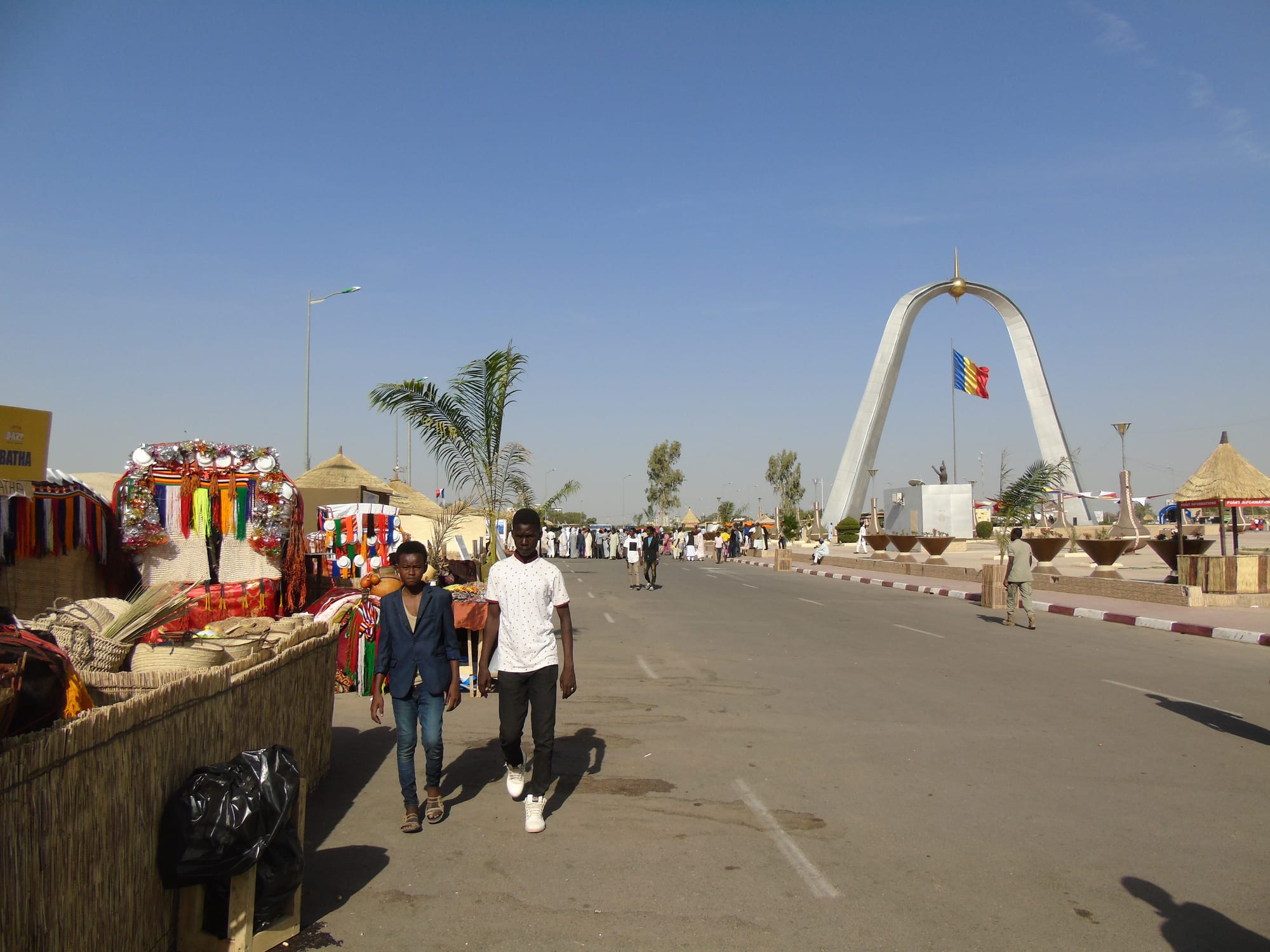
A tall white arch with a gold sphere and the Chadian flag beside a wide empty avenue, with craft stalls and thatched shelters along the left side

N'Djamena & the West, Chad

N'Djamena

The monument on the Place de la Nation in central N'Djamena, with craft stalls set up along the avenue during a festival. (YACOUB DOUNGOUS / Wikimedia Commons · CC BY-SA 4.0)

Chad's capital and only large city, on the east bank of the Chari river opposite Cameroon, founded by the French as Fort-Lamy in 1901 and renamed in 1973. It is a low, spread-out city of sandy avenues, mosques and churches, markets and government compounds, wrecked by fighting in 1979 and 1980 and rebuilt since. This page is written to explain the city, not to encourage travel.

Neighbourhoods

  • Centre-ville
    • First-time visitors
    • Landmarks
    • Government quarter

    The colonial-era core near the river, laid out with wide avenues around the Place de la Nation. Ministries, embassies, banks, the cathedral and most of the city's larger hotels stand within a few blocks, and the Grand Mosque and the central market are at its eastern edge.

    Open in Maps
  • Moursal
    • Local life
    • Restaurants

    A busy residential district east of the centre, with schools, small shops and a mix of households from across the country. Its streets have grills and eating places that fill after dark.

    Open in Maps
  • Chagoua
    • Markets
    • Local life
    • Transport links

    A southern district on the way towards the Chari and the bridge to Cameroon, known for its market and its bus and shared-taxi traffic. It is crowded, commercial and low-rise, and floods in parts during heavy rains.

    Open in Maps
  • Farcha
    • Riverside
    • Industry and trade

    The north-western quarter beside the Chari, mixing warehouses, a livestock trade and ordinary housing. The riverbank here is used by fishermen and brickmakers, and the water is visible from the road in places.

    Open in Maps
  • Walia
    • Quiet and residential
    • Close to the river crossing

    South of the centre across the Chari channel, a fast-growing area of compounds and small businesses near the road to the Nguéli bridge. It is one of the parts of the city worst affected when the rivers rise.

    Open in Maps

Things to do

Landmarks

  • Grand Mosque of N'Djamenalandmark

    The city's principal mosque near the central market, the focus of Friday prayers and of the two Eid festivals.

    Open in Maps
  • Cathedral of Our Lady of Peacelandmark

    The Roman Catholic cathedral in the centre, inaugurated in 1965, destroyed in the fighting of 1980 and rebuilt between 1983 and 1986.

    Open in Maps
  • Place de la Nationlandmark

    The ceremonial square in the centre, with a monument at its heart, used for national occasions and for festivals that fill the avenue with stalls.

    Open in Maps

Museums

  • Chad National Museummuseum

    The country's national collection, covering the Sao culture of the river plains, Saharan rock art and the skull of Toumaï, held in Chad to be the earliest human ancestor.

    Open in Maps

Markets and the riverside

  • Grand Marchémarket

    The central market, the commercial heart of the city, selling food, cloth, plastic goods and imports brought across the border from Cameroon and Nigeria.

    Open in Maps
  • The Chari waterfrontattraction

    The riverbank on the city's western side, where fishing canoes work the channel and the Cameroonian bank is visible across the water.

    Open in Maps
  • N'Djamena International Airporttransit hub

    Chad's only international airport, also called Hassan Djamous International Airport, a few kilometres from the centre, with civilian and military installations on opposite sides of its single runway.

    Open in Maps

Short trips from the city

  • Gaouiattraction

    A village about ten kilometres north-east of the city, said to have been a capital of the Sao civilisation and known for its traditional architecture and pottery, with a museum.

    Open in Maps
  • Koussériattraction

    The Cameroonian town on the far bank, which the two rivers separate from the capital, linked to it by the bridge at Nguéli and long tied to it by daily trade.

    Open in Maps

Seasonal events

  • Eid al-Fitr and Eid al-Adhadates move through the year with the Islamic calendar

    The two largest days of the Muslim year, marked by mass prayers, new clothes, visiting and shared meals across most of the city.

  • Independence DayAugust

    Chad's national day, marked in the capital with official ceremonies and parades.

  • Christmas and EasterDecember and spring

    Public occasions in the districts where southern Chadian families live, with long church services and choirs.

Eat and drink

Long-standing places and food districts in N'Djamena. Hours, ratings and directions come from your maps app, always current.

N'Djamena classics

  • Grilled capitainerestaurant

    Nile perch from the Chari, grilled or fried whole and served with rice, chips or boule, is the dish most associated with the city's riverside eating places.

    Open in Maps
  • Evening meat grillsrestaurant

    Mutton and goat cooked over charcoal at roadside stands, eaten with bread, raw onion and chilli once the heat of the day breaks.

    Open in Maps

Markets and food districts

  • Grand Marchémarket

    The central market, where dried and smoked fish, millet and sorghum, dates, spices and vegetables are sold in bulk.

    Open in Maps
  • Moursal eating streetsneighborhood

    A residential district east of the centre whose small restaurants and grills serve rice dishes, groundnut stews and brochettes to a local crowd.

    Open in Maps
  • Avenue Charles de Gaulleneighborhood

    The main central avenue, lined with shops, bakeries and cafés serving coffee, sweet tea and French-style bread.

    Open in Maps

Experience N'Djamena

History

The city began with a battle. In April 1900 French forces defeated the Sudanese warlord Rabih az-Zubayr at Kousséri, just across the water, in a fight that also killed the French commander Amédée-François Lamy. The military post on the east bank of the Chari, founded by Émile Gentil in 1901, was named Fort-Lamy after him. It grew as the administrative centre of the French territory of Chad, a garrison and river port of sandy avenues, barracks and trading houses, with African quarters spreading east and south of the European town.

Fort-Lamy became the capital at independence in 1960, and in 1973 President François Tombalbaye renamed it N'Djamena, after a village nearby, as part of his campaign of cultural authenticity. Its position — far from the north and the east, within sight of Cameroon — made it the prize in every one of Chad's power struggles. Factional fighting in 1979 and 1980 wrecked large parts of the city and drove most of its residents across the river or into the countryside, and rebel columns reached the streets again in 2006 and 2008.

Reconstruction and oil revenue from 2003 changed the centre, adding ministries, monuments, wide new roads and a handful of large hotels, while the outskirts filled with people arriving from the countryside and from areas emptied by conflict. The city has also absorbed floods, most severely when the Chari and Logone burst their banks in 2022, and remains the place where the country's politics is decided.

Culture & Customs

N'Djamena is the one place where all of Chad meets. Arab, Kanembu, Hadjarai, Ouaddaïan and Zaghawa quarters sit beside neighbourhoods of southerners, and Chadian Arabic is the language of the street and the market while French dominates offices, schools and paperwork. The Muslim calendar sets much of the city's rhythm, with Friday prayers and the two Eids the largest days of the year, but Christmas and Easter are public occasions in the southern districts, and the cathedral and the Grand Mosque are both landmarks of the centre.

Manners are formal and unhurried. Greetings run through several questions about family and health before business begins; the right hand is used for eating and for handing anything over; tea is poured in rounds for guests and refusing the first glass is awkward. Dress is modest, and older men often wear a long robe with an embroidered cap.

The city carries the country's cultural life as well, such as it is: a national museum, a few cultural centres, wrestling and football followed closely, and music that runs from Chadian Arabic song and the one-stringed kinde and balafon of the south to Congolese and Nigerian pop played in bars and taxis. Photography is a sensitive matter in a capital used to soldiers and checkpoints, and cameras are best kept away from anything official.

Daily Life

N'Djamena passed a million inhabitants in the early 2010s, several times the size of any other Chadian town, and the city grows steadily as families arrive from the countryside and from insecure regions. Government, the army, embassies and aid agencies employ a small salaried class; almost everyone else works in trade, transport, construction or small workshops. An enormous informal economy moves goods over the bridge from Cameroon and on from Nigeria, and the Grand Marché is its centre.

Neighbourhoods run from the old administrative centre near the river out through Moursal, Chagoua, Farcha, Diguel and Walia to newer districts on the sandy edges, where plots are cheap and services thin. Piped water, electricity and paved streets are patchy, and power cuts are a regular part of the day. Housing is single-storey, built around courtyards behind mud-brick or concrete walls.

The day starts early, before the heat, and stops in the worst of the afternoon; the evening, when the temperature drops, is when markets, grills and riverbanks fill. The city's pressing problems are the cost of food, unreliable water and power, the flooding of low-lying districts in the rainy season, and the strain of a population that keeps growing faster than the services beneath it.

Food

Everyday food in N'Djamena is boule, a stiff porridge of millet or sorghum eaten by hand with a sauce — okra, known here as gombo, dried or fresh fish, meat, or daraba, a mix of vegetables thickened with groundnut. Kissar, a thin fermented sorghum pancake, is eaten with stews in Arab households, and rice dishes and groundnut stews are common in the middle of the day.

The rivers give the capital its best-known dish. Capitaine, the Nile perch, is grilled or fried whole and eaten with rice or chips, and smaller fish dried in the sun are sold in heaps in the market for sauces. In the evening, charcoal grills along the streets sell mutton and goat with bread, raw onion and chilli, and breakfast is often fried dough with sweet tea or a French-style loaf from one of the city's bakeries.

To drink, there is strong sweet tea poured in rounds, coffee flavoured with ginger, and karkanji, a chilled hibiscus juice sweetened and often spiced. Fresh mango, guava and citrus appear in season. Bili-bili, the home-brewed millet beer of the south, and the bottled Gala lager brewed in Chad are drunk in the Christian districts and in bars, but not in the Muslim quarters, where alcohol is avoided.

Planning tools

Budget

N'Djamena is expensive for what it offers. The few international-standard hotels are priced for embassies, oil companies and aid agencies, and even modest guesthouses cost more than in neighbouring countries. Market food, roadside grills and shared taxis are cheap. Almost every visitor also pays for a car and driver, which is the largest daily cost after the room.

Daily Budget Midrange
USD 170–440 (international-standard hotel, restaurant meals, a car and driver)
Daily Budget Shoestring
USD 50–85 (simple guesthouse, market food, shared taxis and motorbike taxis)

Carry euros or CFA francs in cash, keep small notes for taxis and markets, and budget for a driver rather than for public transport.

Best Time to Visit

November to February, when the heat is at its most bearable and the roads are dry, although the Harmattan can leave the sky hazy with dust. March to May is punishing, regularly above 40°C, and the rains of July to September flood low-lying districts and turn unpaved streets to mud.

Suggested Number of Days

The capital's sights are few and close together, so one or two days covers them at a slow pace in the heat. Three or four allow for the villages and river country nearby, and most visitors are in the city anyway while permits, vehicles and onward travel are arranged.

First Visit
1–2 days
With Surroundings
3–4 days

Transportation

Shared taxis running fixed routes and motorbike taxis are how most people move around, with green taxis common in the centre. There is no formal city bus network of use to visitors. Most foreign visitors travel by hired car with a driver, which also makes checkpoints simpler. Distances are long, streets are sandy and few are signposted.

Agree a price before getting into a shared taxi, and expect journeys across the city to be slow in the late afternoon.

Airport & Station Connections

N'Djamena International Airport lies a few kilometres from the centre, a short drive from the main hotels, and is the country's only international airport, with a limited number of connections to Europe, North Africa and other African capitals. Overland, the Nguéli bridge crosses to Kousséri in Cameroon, and paved roads run south towards Bongor and Moundou. Visitors normally arrive by air.

Walkability

The centre can be walked between the market, the mosque and the main avenues, but only early or late in the day: heat, dust, traffic and long blocks make longer walks hard, and pavements are broken or absent. Beyond the centre the city spreads for kilometres and walking is not practical. Photographing government buildings, soldiers and police is not permitted.

Safety

The capital has a heavy security presence and has seen political violence, including rebel assaults on the city in 2006 and 2008, bombings claimed by Boko Haram in 2015, deadly crackdowns on protests in 2022 and an armed attack on the presidential complex in January 2025. Most governments advise against all or all-but-essential travel to the country. Street crime and robbery also occur, particularly after dark.

Globeway covers Chad so it can be understood. Avoid demonstrations and government buildings, do not photograph officials or security sites, and do not travel on rural roads after dark. Check current official travel advice before travelling.

Climate

Hot and semi-arid, and among the hottest capital cities in the world. The year divides into a long dry season and a short rainy one from about June to September, when storms can flood streets and the rivers rise.

Summer
rainy season June to September, humid and stormy at 25–35°C; the hottest weeks come just before the rains, above 40°C
Winter
dry, dusty and warm by day at 30–35°C, with nights falling to around 15°C in December and January

Local Customs

The city is mostly Muslim, with large southern Christian districts, and dress is conservative for both men and women: covered shoulders and knees are expected, and modest dress matters more during Ramadan, when many places close by day. Greetings are long and unhurried, the right hand is used for eating and for giving, and tea is poured in several rounds for guests. Alcohol is sold, but not in Muslim quarters.

Ask before photographing people, never photograph soldiers, police, the airport or government buildings, and remove shoes and dress modestly near mosques.

Common Payment Methods

The currency is the Central African CFA franc, pegged to the euro. Chad is effectively a cash economy: cards are accepted only at a few large hotels, cash machines are unreliable, and euros in cash are the easiest currency to change. Small notes are needed for taxis, markets and tips.