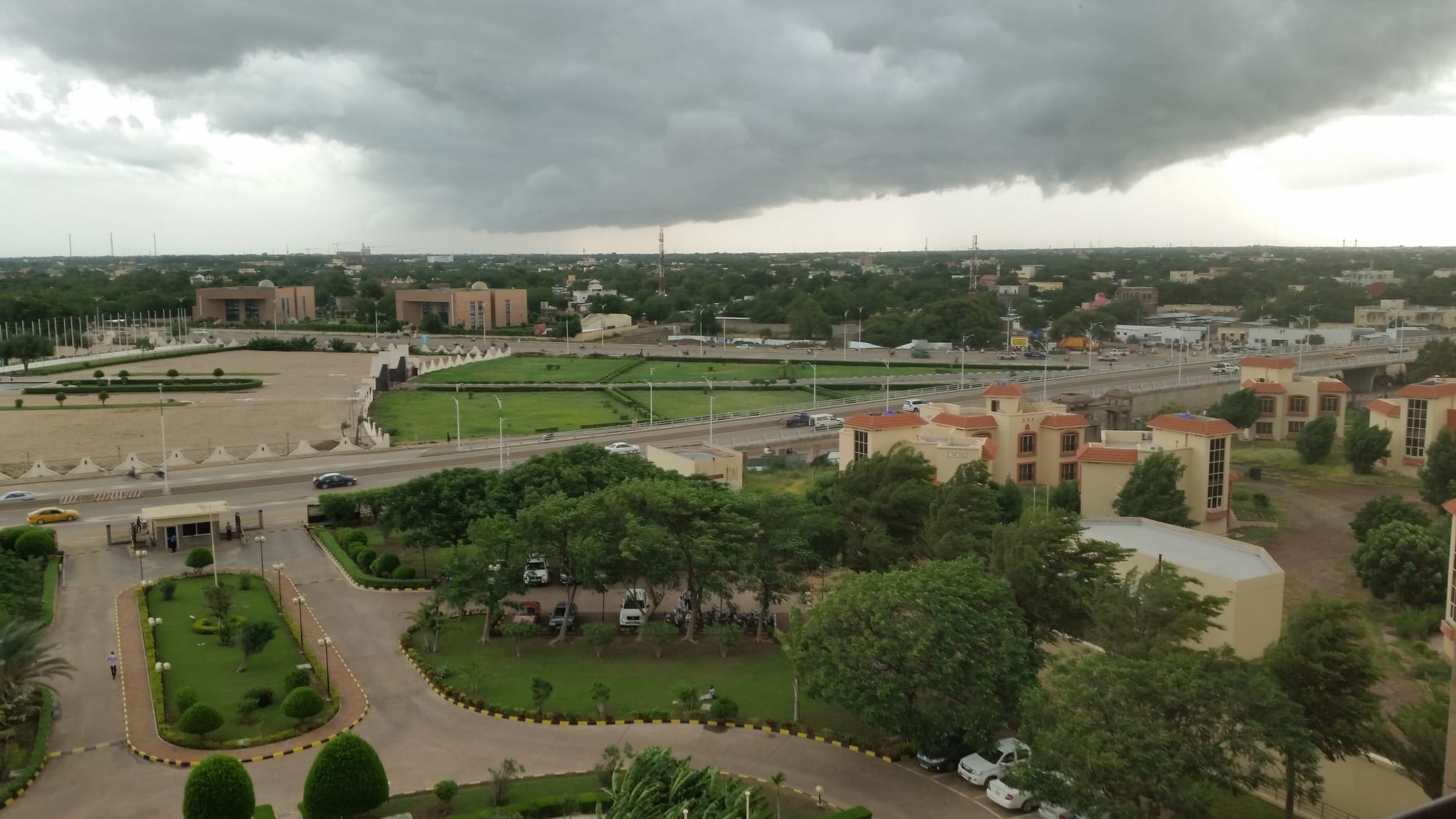
Dark storm clouds over the low green city of N'Djamena, with a wide avenue, lawns and tree-lined streets below

Chad

N'Djamena & the West

A rainy-season storm building over central N'Djamena, the capital of Chad. (Ken Doerr / Wikimedia Commons · CC BY 2.0)

Chad's western core along the Chari and Logone rivers — the capital, N'Djamena, facing Cameroon across the water, the old Baguirmi sultanate lands of Chari-Baguirmi, the southern shore of Lake Chad in Hadjer-Lamis, and the lakes, falls and cotton fields of Mayo-Kebbi on the Cameroon border.

Explore N'Djamena & the West

History

The plains south of Lake Chad were home to the Sao, a people known from walled mounds, bronze work and terracotta figures along the lower Chari and Logone; the Kotoko fishing communities of the rivers trace their descent from them. From the 16th century the Baguirmi sultanate, with its capital at Massenya, rose on the lands east of the Chari, adopting Islam and raiding southwards for captives while paying tribute in turn to its stronger neighbours, Bornu and Ouaddaï.

In the 1890s the Sudanese warlord Rabih az-Zubayr overran the region and devastated Baguirmi, whose sultan, Gaourang, turned to France for help. Rabih was killed at the Battle of Kousséri in April 1900, fought just across the Logone, and the French commander Amédée-François Lamy also died there. A post founded that year on the east bank was named Fort-Lamy in his memory; it grew into the colonial capital, and in 1973 President Tombalbaye renamed it N'Djamena, after a nearby Arab village.

Since independence the capital has been the prize in Chad's power struggles. Fighting between rival northern factions in 1979 and 1980 wrecked much of the city and emptied it of residents, and rebel columns reached its streets in 2006 and 2008. Mayo-Kebbi, meanwhile, developed as part of the cotton-growing south, with a strong Christian and traditional-religion population and its own long-standing opposition politics.

Culture & Customs

N'Djamena is Chad in miniature: Arab, Kanembu, Hadjarai and Ouaddaïan quarters sit beside neighbourhoods of southerners, and Chadian Arabic is the language of the street and the market, while French dominates offices and schools. The Muslim calendar sets the city's rhythm, with Friday prayers at the Grand Mosque and the two Eid festivals the biggest days of the year, but Christmas is also a public occasion in the southern districts.

Along the rivers, the Kotoko remain fishermen and boat people, and Arab cattle-herding groups move seasonally across Chari-Baguirmi and Hadjer-Lamis. Mayo-Kebbi is a different world: its peoples — the Massa, Moundang, Toupouri and Moussey among them — are mostly Christian or follow traditional religions. At Léré the Moundang still recognise a traditional king, the Gong of Léré, whose court keeps ceremonial customs alive, and wrestling and harvest festivals mark the dry season across the south-west.

Greetings are long and unhurried, the right hand is used for eating and giving, and among Muslim households tea is poured in several rounds for guests.

Daily Life

N'Djamena, with well over a million people, is the country's only large city, growing quickly as migrants arrive from the countryside and people displaced by conflict settle on its edges. Government, the army, aid agencies and oil money sustain its economy, alongside an enormous informal trade in goods brought over the bridge from Cameroon and Nigeria. The Grand Marché is the commercial heart, and the evening, once the heat breaks, is when the streets and riverbanks fill.

Outside the capital, life is rural. Massakory in Hadjer-Lamis and Massenya in Chari-Baguirmi are small administrative towns; Bongor, on the Logone, and Pala are the centres of Mayo-Kebbi. Villagers grow sorghum, millet, groundnuts and, in the south-west, cotton, while fishing on the Chari, the Logone and the Mayo-Kebbi lakes supplies smoked and dried fish to markets across the country.

Current pressures include power cuts and water shortages in the capital, seasonal floods — the Chari and Logone burst their banks badly in 2022 — and the displacement caused by insecurity around Lake Chad.

Food

Western Chad eats boule, the stiff millet or sorghum porridge, with sauces of okra (gombo), dried fish, meat or groundnuts, but the rivers give the region a stronger taste of fish than anywhere else in the country. Capitaine, the Nile perch, is grilled or fried whole in N'Djamena's riverside restaurants, and small fish dried in the sun are sold in heaps in every market for sauces.

Kissar, a thin fermented sorghum pancake, is eaten with stews in Arab households, and grilled mutton and goat are sold from roadside stands in the evening. Rice dishes and groundnut stews are everyday food in the capital, and breakfast is often fried dough with sweet tea.

To drink, there is karkanji, a chilled juice of hibiscus flowers sweetened with sugar and often spiced with ginger, and strong sweet tea in Muslim homes. In Mayo-Kebbi and the Christian districts of the capital, bili-bili, a home-brewed millet beer, is sold in calabashes.

Attractions & Natural Wonders

N'Djamena itself is the region's main sight: the Chari waterfront at sunset, with fishing canoes and the Cameroon bank opposite; the Grand Mosque; the Cathedral of Our Lady of Peace; the crowded Grand Marché; and the Chad National Museum. The confluence of the Chari and the Logone lies on the city's southern edge.

North of the capital, Hadjer-Lamis reaches Lake Chad's southern shore, a landscape of reed beds, papyrus, channels and seasonal fields where fishing villages follow the rise and fall of the water. The lake has shrunk dramatically since the 1960s, and security problems keep the shore largely off limits.

To the east, Chari-Baguirmi's plains lead to Massenya, the old Baguirmi capital, and towards Guéra; Zakouma National Park, famous for its elephants, lies beyond the region's eastern edge in Salamat, and N'Djamena is the base from which visitors fly or drive there.

In the south-west, Mayo-Kebbi holds the region's most attractive scenery. Lake Léré and Lake Tréné sit on the Mayo Kebbi river within the Binder-Léré reserve, known for its manatees, and downstream the river tumbles over the Gauthiot Falls before crossing into Cameroon. Further east lie Lake Fianga and the Toupouri floodplains, while Sena Oura National Park protects savannah woodland along the Cameroon border.

Cities in N'Djamena & the West

Planning basics

Budget

Almost every visit to Chad begins and ends in N'Djamena, and it is an expensive city: the international hotels are priced for oil companies, embassies and aid agencies, and even modest guesthouses cost more than in neighbouring countries. Local food in markets and roadside grills is cheap. Outside the capital, Bongor, Pala and Léré have only simple lodgings, and any trip there is priced around a hired vehicle and driver.

Daily Budget Midrange
USD 170–440 (international-standard hotel, restaurant meals, a car and driver)
Daily Budget Shoestring
USD 50–85 (simple guesthouse in N'Djamena, market food, shared taxis)

Carry euros or CFA francs in cash; card acceptance is limited to a few large hotels, and cash machines are unreliable outside the capital.

Safety

The capital has a heavy security presence and has seen political violence, including rebel assaults in 2006 and 2008, suicide bombings claimed by Boko Haram in 2015, deadly crackdowns on protests in 2022 and an armed attack on the presidential complex in January 2025. The Lake Chad shore of Hadjer-Lamis lies close to the zone where Boko Haram and Islamic State factions attack soldiers and villagers. Mayo-Kebbi is calmer, though banditry and kidnapping for ransom occur near the Cameroon border.

Globeway covers Chad so it can be understood. Avoid demonstrations and government buildings in N'Djamena, do not photograph officials or security sites, keep away from the lake shore and islands, and do not travel on rural roads after dark. Check current official travel advice before travelling.

Climate

Sahelian and very hot. N'Djamena is one of the hottest capitals in the world, with April and May regularly above 40°C before the rains break. The rainy season runs roughly June to September and is longer and wetter in Mayo-Kebbi to the south-west, where the countryside turns green; the Harmattan wind brings dust and hazy skies from about December to February.

Summer
rainy season June to September, humid and stormy, 25–35°C; the hottest weeks come just before the rains, above 40°C
Winter
dry, dusty and warm by day, 30–35°C, with nights falling to around 15°C in December and January

Transportation

N'Djamena's Hassan Djamous International Airport is Chad's main gateway. A bridge at Nguéli crosses the Chari to Kousséri in Cameroon, and paved roads run south towards Bongor and on to Moundou, although potholes and checkpoints make journeys slow. Minor roads to the lakes and villages are tracks that flood in the rains. Within the capital, shared taxis and motorbike taxis are the norm.

Hire a car with a local driver who knows the checkpoints; allow the better part of a day for N'Djamena to Bongor or Pala.

Best Time to Visit

November to February, when the heat eases, the roads are dry and the Mayo-Kebbi lakes are still full after the rains. March to May is exhausting, and the rains of July to September flood tracks and low-lying neighbourhoods of the capital.