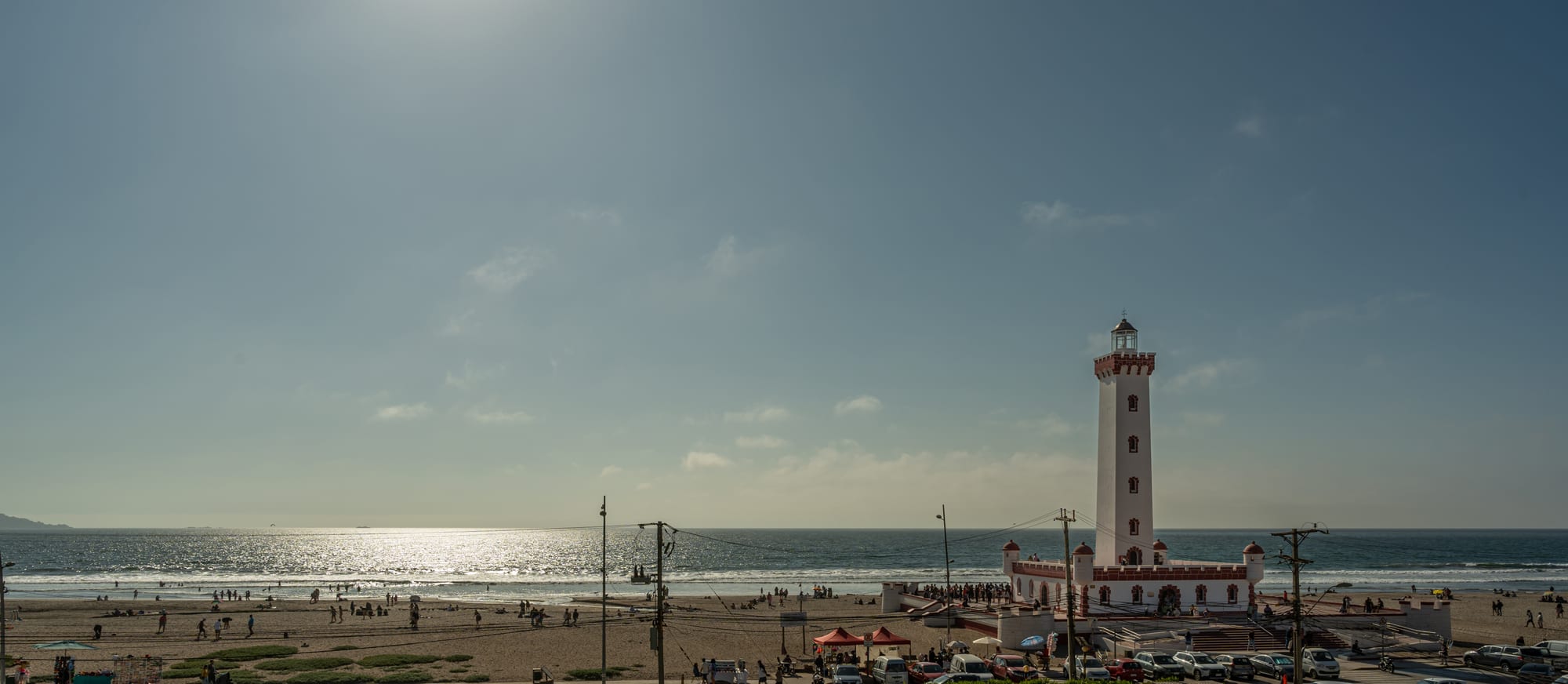
A white lighthouse with a red-trimmed base beside a wide sandy beach, with people on the sand and the Pacific shining under a hazy sky

La Serena & the Elqui Valley, Chile

La Serena

The Monumental Lighthouse at the head of the Avenida del Mar beaches in La Serena. (Rjcastillo / Wikimedia Commons · CC BY-SA 4.0)

The capital of Chile's Coquimbo Region, at the mouth of the Elqui River on the Pacific. Founded in 1544, it is Chile's second-oldest city after Santiago, rebuilt in the mid-20th century in a uniform neocolonial style. Stone churches and belfries fill its old centre, a long beach runs south to Coquimbo, and it is the gateway to the observatories and pisco country of the Elqui Valley.

Neighbourhoods

  • El Centro
    • First-time visitors
    • Historic district
    • Best for food

    The historic centre on the terraces above the sea, the largest protected traditional zone in Chile. Stone churches, the cathedral on the Plaza de Armas, La Recova market, museums and most of the city's bars and restaurants lie within a few blocks, among low buildings in the neocolonial style of the Plan Serena.

    Open in Maps
  • Avenida del Mar
    • Beaches
    • Nightlife
    • Families

    The seafront strip running about 6 km from the Monumental Lighthouse south to Peñuelas, lined with a dozen named beaches, apartment towers, hotels and restaurants. It fills with Chilean and Argentine holidaymakers in summer and is quiet for much of the rest of the year.

    Open in Maps
  • San Joaquín and the eastern hills
    • Quiet and residential
    • Students

    Residential districts climbing the hills and ocean terraces east and south of the centre, from San Joaquín, on a hill overlooking the sea, to La Florida and the university district, with views back over the bay.

    Open in Maps
  • Coquimbo
    • Local life
    • Seafood
    • Calm beaches

    The port city on the southern side of the bay, joined to La Serena in a single conurbation. It has its own character — a working harbour, a history of English settlement, the giant Third Millennium Cross on the hill — and the calmer beaches of La Herradura.

    Open in Maps

Things to do

Churches and landmarks

  • La Serena Cathedrallandmark

    The city's largest church, on the corner of the Plaza de Armas, a neoclassical stone building completed in 1856 on the site of the parish church of 1549.

    Open in Maps
  • Iglesia de San Franciscolandmark

    A stone church built with limestone from Peñuelas and timber from the Fray Jorge forest, declared a National Monument in 1977.

    Open in Maps
  • Iglesia de San Agustínlandmark

    A church first built by the Jesuits in 1672, damaged over the centuries by storm, earthquakes and fires and rebuilt each time.

    Open in Maps
  • Monumental Lighthouselandmark

    The white lighthouse built in 1950–51 under the Plan Serena at the head of the Avenida del Mar, one of the city's best-known symbols.

    Open in Maps
  • Avenida Francisco de Aguirrelandmark

    A broad avenue running from the centre to the lighthouse, lined with marble statues donated by Italy in the years of the Plan Serena.

    Open in Maps

Museums and gardens

  • Museo Arqueológicomuseum

    The archaeological museum in the centre, with more than 12,000 objects in archaeology, ethnography and palaeontology, including the pre-Hispanic cultures of the region.

    Open in Maps
  • Museo Histórico Gabriel González Videlamuseum

    The former home of the president behind the Plan Serena, now a museum of local history and fine art with objects from his life.

    Open in Maps
  • Japanese Gardenpark

    The Jardín del Corazón, a Japanese garden just west of the centre laid out by a Tokyo landscape architect for the city's 450th anniversary, with a pond full of ducks and geese.

    Open in Maps

Beaches and the seafront

  • Avenida del Mar beachesbeach

    Twelve named beaches along about 6 km of sand from the lighthouse to Peñuelas, from El Faro and Los Fuertes to Canto del Agua; the open sea can be rough, so swimmers should check conditions.

    Open in Maps
  • Totoralillobeach

    A beach about 25 km from the city, popular for swimming, fishing, diving and surfing, with many restaurants.

    Open in Maps

Markets and sport

  • La Recovamarket

    The central market, with crafts from across northern Chile, objects in lapis lazuli and combarbalita stone, dried fruit and local sweets.

    Open in Maps
  • Estadio La Portadaattraction

    The stadium of Deportes La Serena, opened in 1952 under the Plan Serena and rebuilt for the 2015 Copa América, named after the city's old colonial gateway.

    Open in Maps

Coquimbo

  • Cruz del Tercer Mileniolandmark

    An 83-metre concrete cross completed in 2001 on El Vigía hill above Coquimbo, visible across the whole bay.

    Open in Maps
  • Mohammed VI Centrelandmark

    A mosque and cultural centre in Coquimbo modelled on the Kutubiyya Mosque of Marrakesh, funded by Morocco and the city.

    Open in Maps

Short trips from the city

  • Vicuña and the Elqui Valleyattraction

    The valley town where Gabriela Mistral was born, among vineyards and pisco distilleries, with tourist observatories nearby for night-sky visits.

    Open in Maps
  • Cerro Tololo Inter-American Observatoryattraction

    One of the international research observatories in the mountains of the Elqui Valley, whose operator, like those of several others, keeps offices in La Serena.

    Open in Maps
  • Pingüino de Humboldt National Reservepark

    Three islands off the coast north of the city — Chañaral, Damas and Choros — protecting colonies of Humboldt penguins, reached by boat from the fishing villages nearby.

    Open in Maps

Eat and drink

Long-standing places and food districts in La Serena. Hours, ratings and directions come from your maps app, always current.

La Serena classics

  • La Recovamarket

    The central market is the place for the region's specialities: papayas preserved in syrup, papaya juice, dried fruit, local sweets and pisco from the Elqui Valley.

    Open in Maps
  • O'Higgins and Eduardo de la Barraneighborhood

    The densest cluster of restaurants, cafés and bars in the centre, busy with students even on weeknights.

    Open in Maps

By the sea

  • Avenida del Marneighborhood

    The beachfront has restaurants facing the sea, serving fish and shellfish, including machas a la parmesana.

    Open in Maps
  • Coquimbo's portneighborhood

    The working port next door, where fish and shellfish come ashore, is the natural place for seafood empanadas and fried fish.

    Open in Maps

Experience La Serena

History

Before the Spanish, the site was occupied by a village called Viluma. La Serena was founded by Captain Juan Bohón on the orders of Pedro de Valdivia to secure the route between Santiago and Lima; the exact date is disputed, but it is usually given as 1544, which makes it, as the city's own article puts it, the country's second oldest city after the national capital, Santiago. In January 1549 an indigenous uprising burned the settlement and killed almost all the Spaniards, and Francisco de Aguirre refounded it that August as San Bartolomé de La Serena, on the site of today's Plaza de Armas. It received the title of city by royal decree in 1552.

The colonial town suffered repeatedly. The English privateer Bartholomew Sharp partly burned and looted it in 1680, Edward Davis set fire to the convent of Santo Domingo in 1686, and an earthquake in 1730 almost destroyed it. Copper brought industry: the Lambert smelter, founded around 1840, made La Serena one of the first places in Chile touched by the Industrial Revolution. In the Revolution of 1859 the city was taken by rebels led by Pedro León Gallo, before government troops defeated them at the Battle of Cerro Grande. Iron mining brought a new boom from the 1920s.

The look of the modern city dates from 1948–52, when President Gabriel González Videla, a native of La Serena, carried out the Plan Serena, redeveloping the centre in a single neocolonial style and adding the lighthouse, the stadium and the statues of Avenida Francisco de Aguirre. Since then tourism, the universities and astronomy have driven its growth.

Culture & Customs

La Serena is known as the city of churches, or of belfries, for the many stone churches of its centre, several built of a local shell-studded limestone and some dating back centuries. It is the seat of the Archdiocese of La Serena, one of five in Chile, and its old centre is the largest protected traditional zone in the country. Houses of the late 19th century were built of Oregon pine, brought to Chile as ballast in ships calling at Coquimbo, and of adobe.

It is a university city, home to the University of La Serena and several private universities, and a centre for astronomy: the operators of La Silla, Cerro Tololo, the Gemini telescopes and Las Campanas keep offices here, and the city hosts the base facility of the Vera C. Rubin Observatory. In summer it turns into one of the country's main holiday resorts, with music festivals, concerts and fashion events; the La Serena Song Festival, created in 2004, has grown in national importance.

Football follows Deportes La Serena, nicknamed Los Papayeros after the papayas grown in the Elqui Valley, whose great rival is Coquimbo Unido from across the bay. The Elqui Valley's best-known daughter, the Nobel-winning poet Gabriela Mistral, is a regional icon, and the rivalry with Peru over pisco is taken seriously here, in the heart of Chilean pisco country.

Daily Life

The 2017 census counted about 221,000 people in the commune of La Serena, and the conurbation it forms with Coquimbo was estimated at more than 506,000 in 2020, the fourth-largest urban area in Chile. In summer the city's population roughly doubles. People live in districts spread over ocean terraces and hills: the old centre, Las Compañías to the north, San Joaquín and La Pampa to the south, La Florida and the university district to the east, and the towers of the Avenida del Mar to the west.

Tourism has become one of the most important parts of the economy, alongside universities, regional government, commerce and iron-ore mining. The centre holds the region's main financial institutions, and large malls serve the suburbs. The only railway still crossing the city carries iron ore from the El Romeral mine to the port of Guayacán in Coquimbo.

Growth brings its own problems. A real-estate boom along the beach has raised apartment towers on the seafront; housing has spread close to the airport, prompting a plan to move it near Tongoy; and drought has left recent years drier than the long-term average, while summer wildfires threaten the dry eucalyptus and scrub around the city.

Food

The papaya is La Serena's emblem: the small, fragrant Chilean papaya grown in the Elqui Valley is sold as juice, preserved in syrup and as sweets, above all at La Recova market, alongside dried fruit from the valley. Pisco, the grape brandy distilled in the Elqui and Limarí valleys, is the drink of the region, taken as a pisco sour — in Chile made with lime juice and sugar — or as a piscola with cola.

The coast supplies the rest. Machas a la parmesana, surf clams baked with parmesan cheese, are a Chilean classic popular along the coast, and seafood empanadas and fresh fish are served in Coquimbo's port and in the fishing coves along the bay. Goat's cheese from the dry hills of the region, eaten fresh or aged, appears on menus and market stalls, and kid goat, cabrito, is roasted for festivals.

Restaurants and bars gather in the centre around O'Higgins and Eduardo de la Barra, busy with students, and along the beachfront. Everyday Chilean food — empanadas de pino, completos and set lunches — fills the rest, and the Limarí valley to the south has become known for its cool-climate wines.

Planning tools

Budget

La Serena is moderately priced by Chilean standards for most of the year. In January and February the population roughly doubles, the beachfront fills and prices for rooms rise. Stargazing tours and pisco tastings in the valley are modest extra costs; a hire car or a tour is needed for the penguin reserve.

Daily Budget Midrange
USD 85–170 (boutique hotel or beachfront apartment, restaurant meals, a stargazing tour)
Daily Budget Shoestring
USD 35–65 (hostel or cabaña, market lunches, colectivos and city buses)

Outside the summer holidays, beachfront apartments and hotels are much cheaper and easy to find.

Best Time to Visit

Spring and autumn bring warm, clear days in the valley and fewer crowds. January and February are the beach season, when the city is at its busiest. Winter mornings on the coast are often grey, but the inland skies are at their clearest for astronomy.

Suggested Number of Days

Two or three days cover the old centre, the seafront and Coquimbo. Five or six allow time for nights in the valley inland and trips along the coast. The summer crowds and the moon's phase, which matters for stargazing, both affect how long is worthwhile.

First Visit
2–3 days
With Surroundings
5–6 days

Transportation

Colectivos (shared taxis), taxis and buses connect the centre with the outer districts and with Coquimbo, and since November 2024 two electric bus routes have run as part of the Red Coquimbo–La Serena de Movilidad. Buses run frequently from the main bus terminal up the Elqui Valley. The penguin reserve and the coast beyond are easiest by hire car or tour.

The Avenida del Mar and the centre are some distance apart; use a colectivo or taxi rather than walking the busy roads between them in the heat.

Airport & Station Connections

La Florida Airport has flights of about an hour from Santiago and services to Antofagasta and other northern cities. Coaches from Santiago take around seven hours on Route 5 and leave several times an hour, arriving at the bus terminal near the centre.

Walkability

The historic centre is compact and pleasant on foot, with its churches, market, museums and the Japanese garden all close together. Avenida Francisco de Aguirre leads down to the lighthouse and the beach, and the seafront promenade is good for long walks. The hillside districts and Coquimbo need transport.

Safety

Chile is one of the safer countries in South America, but petty and opportunistic crime has risen, especially in Santiago and Valparaíso — pickpocketing, bag-snatching, phone theft, and distraction scams in tourist areas, markets, and on transport. Violent crime against tourists is uncommon. In La Serena the usual risks are petty theft on the beaches, at the bus terminal and in Coquimbo's port area. The coast is exposed to earthquakes and tsunamis, and summer brings wildfires to the dry hills around the city.

Keep belongings close on the beach, swim only where conditions allow, and follow the tsunami evacuation signs. Check current official travel advice before travelling.

Climate

A cool coastal desert climate, moderated by the cold Humboldt Current. Summer mornings often start with low cloud and drizzle that clears around midday. Rain falls mainly from May to August — around 100 mm in a normal year, less in recent dry years.

Summer
December to February is mild, about 18–25°C on the coast, with morning cloud giving way to sun
Winter
June to August is cool, between about 7 and 16°C, often overcast in the mornings, with most of the year's rain

Local Customs

A tip of about ten per cent is usual in restaurants and is often suggested on the bill. Chileans greet acquaintances with a kiss on the cheek and strangers with a handshake. La Serena is the seat of an archdiocese and a city of churches, and Mass is held in many of them. Drinking alcohol in public places, including the beach, is not allowed.

Dress respectfully and keep quiet inside the churches during services; swimwear belongs on the beach rather than in the city centre.

Common Payment Methods

The currency is the Chilean peso (CLP). Cards are widely accepted in hotels, restaurants, malls and supermarkets, and cash machines are common in the centre and at the malls. Cash is useful at La Recova, in colectivos and at summer craft stalls.