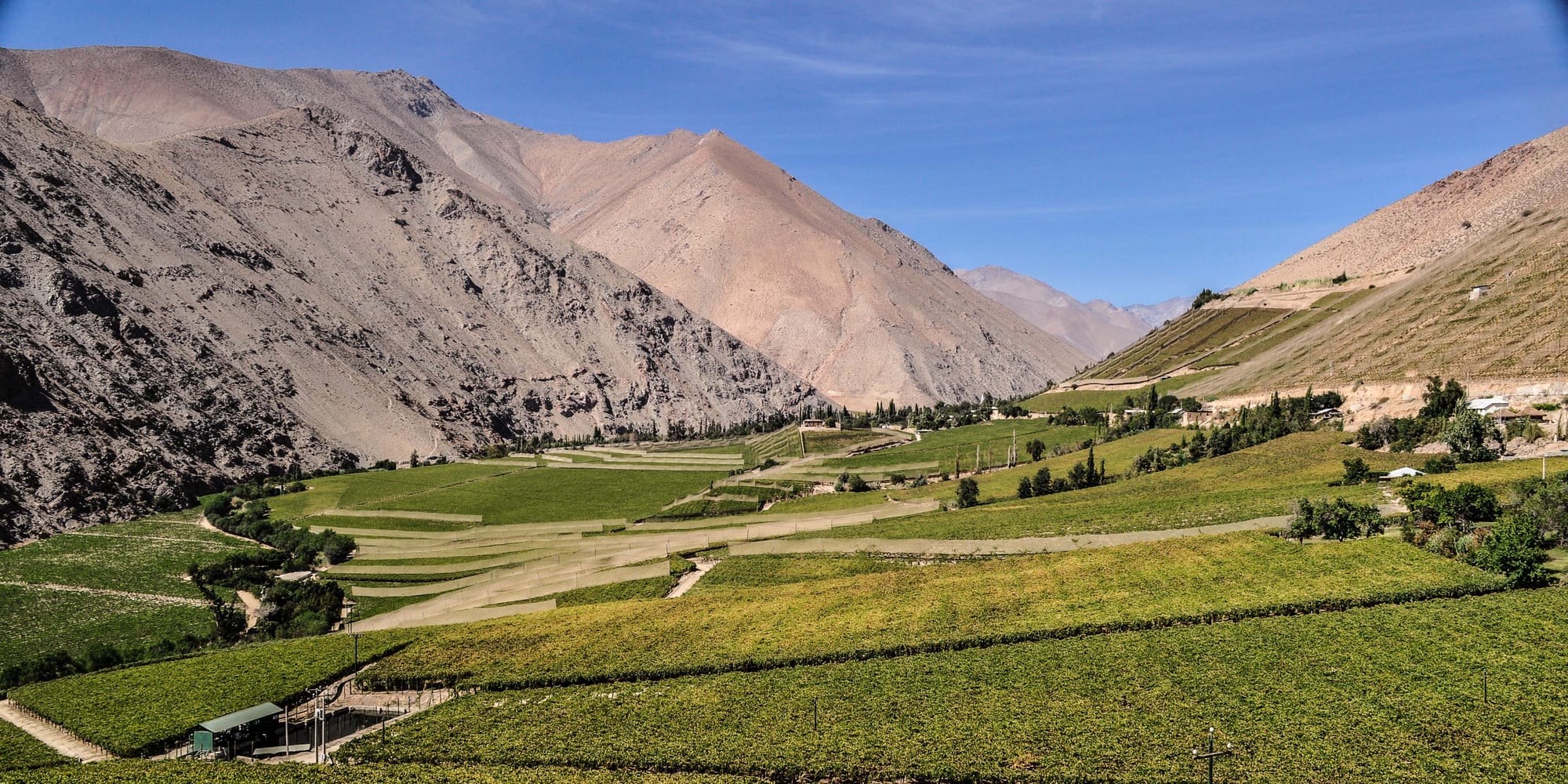
Green vineyards filling a narrow valley floor between steep bare brown mountains under a deep blue sky

La Serena & the Elqui Valley, Chile

Pisco Elqui

Vineyards in the upper Elqui Valley at Pisco Elqui. (gaspar abrilot from Santiago, Chile / Wikimedia Commons · CC BY-SA 2.0)

A small village high in the Elqui Valley, about 1,300 metres above sea level and 107 kilometres east of La Serena, where colonial estates once made some of the earliest recorded pisco. Renamed after the grape brandy in 1936, it lives from vineyards, fruit growing and tourism, with old distilleries, a shaded plaza and clear night skies.

Neighbourhoods

  • The village centre
    • First-time visitors
    • Historic district

    A few streets around the plaza, with its lawn and the church facing it. Small shops, restaurants and guesthouses sit within a few minutes' walk, and everything in the village can be reached on foot.

    Open in Maps
  • The vineyards and valley edges
    • Quiet and residential
    • Stargazing

    Vineyards of pisco and table grapes and orchards of apricots, figs and avocados climb the slopes around the village. Lodges, cabins and campsites further from the lights are the quieter choice for clear night skies.

    Open in Maps
  • Horcón
    • Crafts
    • Day outings

    A smaller settlement a few kilometres up the valley, known for its village of artisans with craft stalls. It is reached by local bus or car and has a more rural feel than Pisco Elqui.

    Open in Maps

Things to do

Pisco and the village

  • Fundo Los Nichosattraction

    A bodega and distillery built in 1868 by José Rodríguez Callejas, described as the oldest working pisco distillery in Chile, near the village.

    Open in Maps
  • Site of Hacienda La Torrelandmark

    The colonial estate in the area of present-day Pisco Elqui where pisco was made between 1727 and 1733, considered by historians among the earliest pisco distilleries anywhere.

    Open in Maps
  • Horcón artisans' villagemarket

    A cluster of craft stalls in the small settlement of Horcón, a few kilometres from Pisco Elqui.

    Open in Maps

The valley

  • Paihuanoattraction

    The small agricultural town that heads the commune to which Pisco Elqui belongs, passed on the road up from Vicuña.

    Open in Maps

Short trips from the village

  • Vicuñaattraction

    The main town of the middle Elqui Valley, where the poet Gabriela Mistral was born in 1889.

    Open in Maps
  • Cerro Tololo Inter-American Observatoryattraction

    A major research observatory on a summit above the valley, home to the Víctor M. Blanco Telescope, with the Vera C. Rubin Observatory on neighbouring Cerro Pachón.

    Open in Maps

Eat and drink

Long-standing places and food districts in Pisco Elqui. Hours, ratings and directions come from your maps app, always current.

Pisco Elqui classics

  • Distilleries around the villageneighborhood

    Family distilleries in and around the village show how pisco is made from local grapes and aged in wood, and sell it by the bottle.

    Open in Maps
  • The plaza and main streetneighborhood

    The restaurants and cafés around the plaza serve Chilean home cooking and pisco sours, and the lawn in front of the church is where people gather.

    Open in Maps
  • Fruit preserves and syrupsmarket

    Village producers make jams, syrups, juices and cakes by hand from the valley's apricots, figs, papayas and other fruit.

    Open in Maps

Experience Pisco Elqui

History

Before the Spanish arrived, the valley of the Claro River and its tributaries was home to people of the Molle and Diaguita cultures and was later drawn into the Inca sphere. After the conquest the valley became the property of Pedro de Valdivia, who passed it to Francisco de Aguirre. Notarial records show that in the 16th century both Indigenous people and Spaniards dug clay in the Quebrada de la Greda to make pottery, including the jars used for pisco, and the settlement took its first name, La Greda, from that clay.

In the 18th century large estates covered the valley. On one of them, Hacienda La Torre, in what is now Pisco Elqui, pisco was made between 1727 and 1733, and historians have described it as one of the earliest pisco distilleries anywhere; an inventory taken in 1733 lists three jars of pisco. In 1868 José Rodríguez Callejas dug a cellar in the village for a winery and distillery that became Los Nichos, the oldest working pisco distillery in Chile.

After a smallpox epidemic in 1873, residents renamed the village La Unión to remember the solidarity shown during the tragedy. In 1936 a law renamed it Pisco Elqui, on the initiative of three deputies including Gabriel González Videla, as part of Chile's effort to strengthen its claim to the pisco designation of origin. The change was controversial, and Gabriela Mistral, who had spent part of her childhood here, disagreed with it and hoped the old name would return. The village is now part of the commune of Paihuano.

Culture & Customs

Pisco is the heart of local identity. The village carries the drink's name, its slopes are planted with pisco grapes, and family distilleries invite visitors to see how the spirit is made and aged. The rivalry with Peru over who owns pisco is felt strongly here, since the village's very name was part of Chile's case.

The poet Gabriela Mistral, Chile's first Nobel laureate in literature, grew up partly in Pisco Elqui and in neighbouring Montegrande, and she is a constant presence in the valley's sense of itself. Her opposition to the renaming is part of local memory.

The Elqui Valley's clear, dark skies have made astronomy a large part of the valley's draw. Diaguita designs appear widely in the region's crafts, and the artisans' village at Horcón, a few kilometres away, has craft stalls. Life is rural and unhurried, centred on the plaza and its church, with summer bringing crowds of Chilean families on holiday.

Daily Life

Pisco Elqui has about 800 inhabitants, a number that roughly doubles in summer. It sits in foothill country at around 1,300 metres, in the commune of Paihuano, which runs a municipal office in the village for local administration.

Farming and tourism are the main sources of work. Growers produce grapes for pisco and for the table, both for Chile and for export, together with apricots, peaches, figs, avocados, plums, custard apples, papayas and citrus fruit. Several of these fruits are turned by hand into jams, syrups, juices and cakes. Guesthouses, hostels, campsites, restaurants and tour operators employ many more people, especially in the summer season.

The rhythm of the day follows the sun and the seasons: work in the fields and vineyards, quiet afternoons around the plaza, and busy evenings in summer when visitors arrive. Water is the main concern across the region, where a long drought has hit farmers hard and caused disputes between agriculture, mining and towns.

Food

Pisco is the product that defines the village: a brandy distilled from aromatic grapes grown in the valley, often aged in wooden barrels, which gives it a mellow flavour while keeping the scent of the fruit. Visitors drink it as a pisco sour, in Chile made with lime juice, or as a piscola, mixed with cola, although some of the family distillers prefer it to be drunk on its own.

The valley's fruit is the other speciality. Apricots, figs, papayas and citrus fruit are made into jams, syrups and juices sold in the village, and the small, fragrant Chilean papaya is preserved in syrup across the region. Raisins and dried peaches from the Elqui are common.

Meals are Chilean country cooking: empanadas de pino, baked beef turnovers; pastel de choclo, a pie of sweet ground corn over a meat filling; and cazuela, a clear stew. Goat's cheese from the dry hills of the region and roast kid goat, cabrito, appear on menus, and the lawn of the plaza is a favourite place to sit with a drink in the evening.

Planning tools

Budget

Pisco Elqui is moderately priced by Chilean standards, with prices rising in January and February when Chilean families fill the valley. Lodges and cabins away from the village cost more than the simple hostels and campsites in town. Distillery visits and stargazing tours are modest extra costs.

Daily Budget Midrange
USD 85–170 (valley lodge or cabin, restaurant meals, a distillery visit and a stargazing tour)
Daily Budget Shoestring
USD 35–65 (hostel bed or campsite, simple meals, local buses and shared taxis)

Bring enough cash for small shops and tastings, and book lodging ahead for the summer holidays and long weekends.

Best Time to Visit

Spring and autumn give warm, clear days and fewer visitors. January and February are the busy summer season, when the village population roughly doubles. The grape harvest falls in early autumn, and winter brings cold, clear nights suited to stargazing.

Suggested Number of Days

The village itself is small enough for a night or two. Staying longer allows time for the rest of the Elqui Valley and its observatories, and a clear moonless spell makes a longer stay worthwhile for the night sky.

First Visit
1–2 days
With Surroundings
3–4 days

Transportation

Everything in the village can be reached on foot. Buses and shared taxis run along the valley road between Pisco Elqui, Vicuña and La Serena, with more departures on Sundays and holidays. A hire car makes it easier to reach outlying lodges, distilleries and observatories.

Check the time of the last bus or shared taxi down the valley before setting out, as evening departures are limited.

Airport & Station Connections

Pisco Elqui is 107 kilometres east of La Serena, the nearest city with an airport and long-distance buses. Buses from La Serena take about two and a half hours, passing through Vicuña. By car the route follows Route 41 east to Vicuña, then a paved road up the valley through Paihuano and Montegrande.

Walkability

The village is compact and easy to explore on foot, with the plaza at its centre. Distilleries, lodges and the hills around the village are short walks or drives away along the valley road, which has little shade.

Safety

Chile is one of the safer countries in South America, but petty and opportunistic crime has risen, especially in Santiago and Valparaíso — pickpocketing, bag-snatching, phone theft, and distraction scams in tourist areas, markets, and on transport. Pisco Elqui itself is a quiet village. The main practical risks are strong sun at altitude and driving the narrow valley road after drinking at tastings.

Use sun protection and carry water on walks, and arrange transport rather than driving after tastings. Check current official travel advice before travelling.

Climate

The inland valley is sunny and dry, hotter by day and cooler at night than the coast, with very clear skies. Rain falls mainly in winter and has been scarce during years of drought. Summer is December–February.

Summer
hot and sunny, around 30°C by day in the Elqui Valley
Winter
clear and mostly dry, with nights much colder than the days — at Vicuña, down the valley, the daily range is around 18–20°C and most of the year's little rain falls in June and July

Local Customs

Pisco is a matter of local and national pride, and Chile's claim to the drink, disputed by Peru, is taken seriously. Tipping of around 10 per cent is usual in restaurants. Dress is casual. Gabriela Mistral, who spent her childhood here and in Montegrande, is revered throughout the valley.

Ask before photographing people in their homes or fields, and treat the distilleries' free tastings as an invitation, not an obligation, to buy.

Common Payment Methods

The currency is the Chilean peso (CLP). Cards are widely accepted in Chile, but a small village depends more on cash, so it is worth withdrawing pesos in La Serena or Vicuña before travelling up the valley.