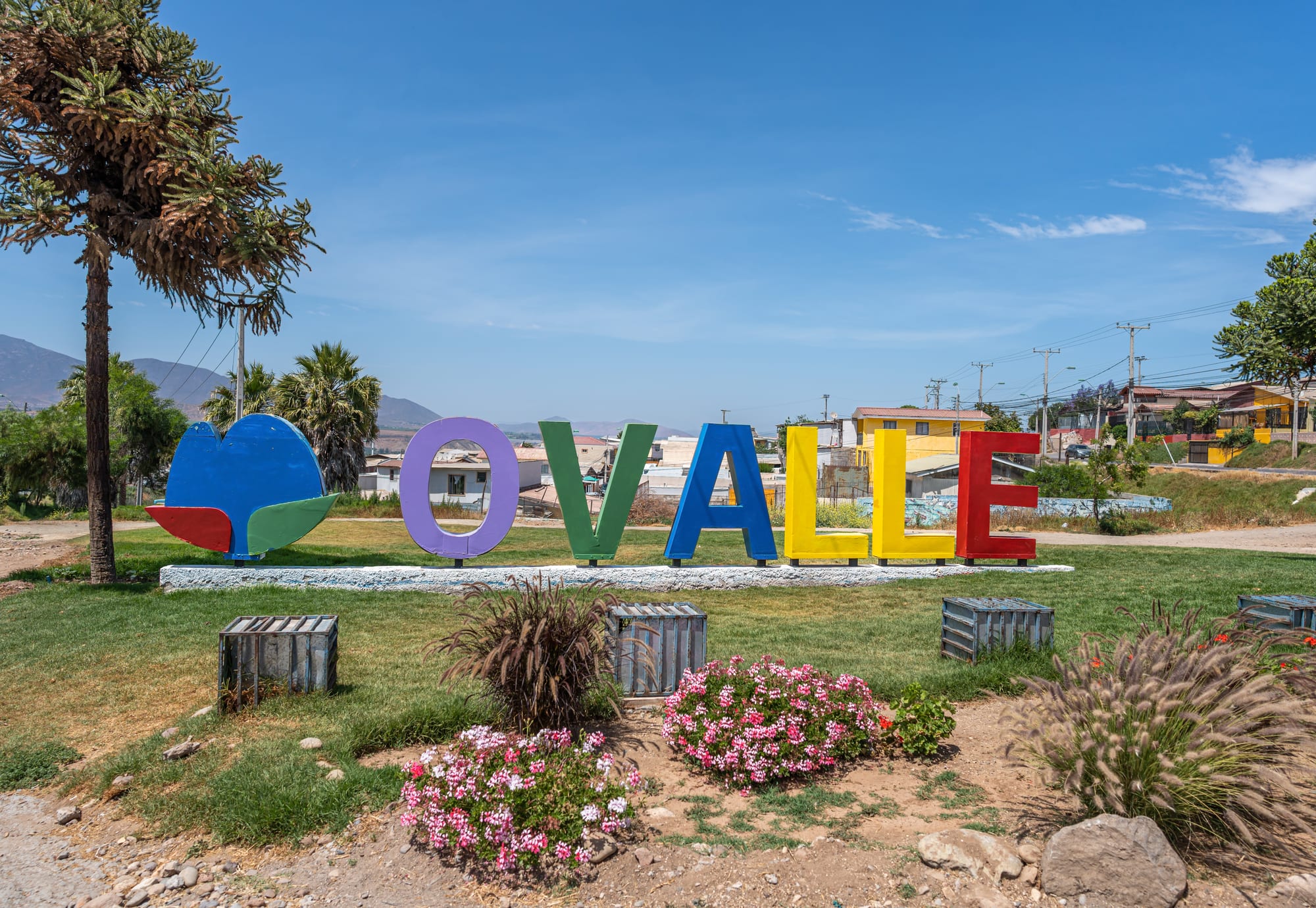
Large colourful letters spelling Ovalle on a lawn with flowerbeds, low houses and dry hills behind under a blue sky

La Serena & the Elqui Valley, Chile

Ovalle

The town-name sign in Ovalle, with dry hills behind. (Rjcastillo / Wikimedia Commons · CC BY-SA 4.0)

The capital of Limarí Province, on the Limarí River about 90 kilometres south-east of La Serena, founded in 1831 and named after the acting president José Tomás Ovalle. A green, irrigated oasis among bare hills, it is the market and service town for a valley of vineyards, orchards and goat farms, close to rock art and a fog-fed forest.

Neighbourhoods

  • The centre and Plaza de Armas
    • First-time visitors
    • Historic district
    • Close to public transport

    The grid of streets laid out after the town's founding, around a tree-shaded Plaza de Armas where book fairs, craft shows and Sunday band concerts are held. The Municipal Market, the church of San Vicente Ferrer and the Teatro Municipal are all within a few blocks.

    Open in Maps
  • The old station quarter
    • Museums
    • Arts and culture

    The former railway station, once central to the town's growth, has become the municipal cultural centre, home to the Museo del Limarí, the public library and an exhibition hall.

    Open in Maps
  • The Limarí riverside and Los Peñones
    • Families
    • Outdoors

    The river runs along the edge of the city, and the Los Peñones bathing area is where residents cool off on hot summer afternoons, with horse rides and pedal boats on the water.

    Open in Maps
  • Sotaquí
    • Local life
    • Festivals

    A small town in the commune, just outside the city, best known for its January religious festival of the Niño Dios, which draws pilgrims from across the region.

    Open in Maps

Things to do

In the town

  • Plaza de Armaspark

    The town's main square, shaded by old trees, where the municipal band plays at midday on Sundays and fairs are held through the year.

    Open in Maps
  • Museo del Limarímuseum

    An archaeological museum in the old railway station, with pottery and objects of the El Molle, Ánimas and Diaguita cultures found in excavations around Ovalle.

    Open in Maps
  • Church of San Vicente Ferrerlandmark

    The parish church facing the plaza, rebuilt and returned to the town in 2002, with a wooden altar painted to imitate marble.

    Open in Maps
  • Mercado Municipalmarket

    A historic market building a block from the plaza, known for crafts in wood, lapis lazuli and the local combarbalita stone.

    Open in Maps

Reservoirs of the valley

  • Recoleta reservoirpark

    A large irrigation reservoir north-east of the city, one of the three that make the Limarí valley so productive.

    Open in Maps
  • La Paloma reservoirpark

    An artificial lake south-east of Ovalle, built for irrigation and also used for recreation.

    Open in Maps

Short trips from the town

  • Valle del Encantoattraction

    A rocky ravine about 20 kilometres west of Ovalle with petroglyphs, rock paintings and cup-marked stones of the El Molle culture, declared an archaeological monument in 1973; the figures show best around midday.

    Open in Maps
  • Bosque de Fray Jorge National Parkpark

    A UNESCO biosphere reserve on the coastal hills west of Ovalle, where sea fog keeps alive a damp forest of a kind otherwise found far to the south.

    Open in Maps
  • Pichasca Natural Monumentpark

    A small protected area in the Hurtado river valley, in the pre-Andean foothills upstream of the Recoleta reservoir.

    Open in Maps

Seasonal events

  • Fiesta del Niño Dios de SotaquíJanuary

    A religious festival in the nearby town of Sotaquí, one of the best known in the Limarí valley.

  • Fiesta del Cabritosummer

    A food festival celebrating roast kid goat, a speciality of the goat-farming valley.

  • Fiesta de la Vendimiasummer

    The grape harvest festival, held partly on the Plaza de Armas, celebrating the valley's wine and pisco.

Eat and drink

Long-standing places and food districts in Ovalle. Hours, ratings and directions come from your maps app, always current.

Ovalle classics

  • Mercado Municipalmarket

    The historic market a block from the plaza, a place for crafts and for the valley's produce.

    Open in Maps
  • Feria Modelomarket

    One of the town's markets, in a city where the valley's small and medium producers come to sell their goods.

    Open in Maps

Wine and pisco

  • Limarí valley wineriesneighborhood

    Estates such as Tabalí and Tamaya welcome visitors to taste the valley's Chardonnay, Sauvignon Blanc and red wines, with walks to see rock art and nature.

    Open in Maps

Experience Ovalle

History

The first settled people of the Ovalle area belonged to the El Molle culture, who left petroglyphs and cup-marked stones at sites such as Valle del Encanto, where hunter-gatherers had already lived for thousands of years. The Diaguita followed, and in the 15th century the Inca took control of the valley. Under Spanish rule the Limarí valley became the main source of wealth for the Corregimiento de Coquimbo, and the land where the town now stands formed part of the colonial Hacienda Tuquí, passed down through marriages and dowries among a few landowning families.

Before 1831 the village of Barraza was the main settlement of the district. That year the provincial assembly of Coquimbo decided to found a new town on the Tuquí lands, at a strategic point between the mountains and the sea, and named it after the recently deceased vice-president José Tomás Ovalle. A governor and the first mayors were appointed that April, public buildings were laid out from 1832, and Ovalle was granted the rank of city in 1867.

The town grew as the service centre of a farming valley, helped by nearby copper and iron mines and later by large irrigation reservoirs. Earthquakes have shaped its story: on 6 April 1943 an earthquake of magnitude 8.3 centred in the commune killed 12 people and left more than 23,000 homeless, and further large quakes struck the region in 1997 and 2015. Ovalle is now the capital of Limarí Province.

Culture & Customs

Ovalle is known for fiestas that keep rural traditions alive. Summer brings the Fiesta del Cabrito, devoted to roast kid goat, and the Fiesta de la Vendimia for the grape harvest, while in January the religious festival of the Niño Dios at nearby Sotaquí draws pilgrims. Book fairs and craft shows fill the Plaza de Armas, and the municipal band plays there at midday on Sundays.

The town takes pride in its deep past. Its archaeological heritage of petroglyphs, rock paintings, pottery and cup-marked stones is notable for its variety and richness, and the Museo del Limarí, in the old railway station, displays ceremonial pottery found in excavations around the city. Diaguita designs appear widely in local crafts, and the Municipal Market sells work in wood, lapis lazuli and combarbalita, a stone quarried in the province.

Cultural life also has a modern side. The former Teatro Nacional, bought and rebuilt as the Teatro Municipal and finished in 2012, hosts an Ibero-American theatre meeting held in Ovalle since 2005, with companies from across Latin America and beyond. Football centres on the local club, Deportes Ovalle, and summer life gathers on the riverside at Los Peñones.

Daily Life

The commune of Ovalle had 111,272 inhabitants at the 2017 census, up from about 98,000 in 2002. Besides the city it covers about 120 rural localities, among them small villages along the Limarí and its tributaries and some fishing coves on the coast. Its mayor since December 2024 is Héctor Vega Campusano.

The economy rests on farming and goat herding. The Limarí is the most productive of the region's transverse valleys, thanks to irrigation from the La Paloma, Recoleta and Cogotí reservoirs that make up for the low rainfall. Farmers grow pisco and table grapes, olives, apricots, peaches and figs, and goats provide milk for cheese. The city itself lives from services and commerce, as small and medium producers from the countryside come to sell their goods. Copper and iron mines lie nearby, and wind and solar farms have been built across the commune in recent years.

Daily life follows the rhythm of a provincial market town: busy mornings around the market and the plaza, quiet hot afternoons, and summer evenings by the river. As across the region, years of drought have strained the water supply that farming depends on.

Food

The Limarí valley's goats give Ovalle its best-known foods. Fresh and aged goat's cheese is sold in markets, and cabrito, roast kid goat, is the dish of festivals, celebrated each summer at the Fiesta del Cabrito. The valley's farms also supply olives, apricots, peaches and figs, turned by hand into jams, syrups, juices and cakes.

The valley is one of the main sources of pisco grapes in Chile, and the town gives its name to a local pisco. It has also become a respected wine region, known for cool-climate Chardonnay and Sauvignon Blanc grown under clear skies near the coast, with reds doing well on the higher, warmer ground inland. Wineries such as Tabalí and Tamaya welcome visitors for tastings.

Everyday eating is Chilean country food: empanadas de pino, baked beef turnovers; pastel de choclo, a pie of sweet ground corn; and cazuela, a clear stew with meat, potato and pumpkin. Lunch is the main meal, and the Feria Modelo and the Municipal Market are the places to see what the valley grows.

Planning tools

Budget

Ovalle is a working town rather than a resort, and it is one of the cheaper bases in the Coquimbo Region. Lodging is simple and mid-priced, and set lunches and market food keep daily costs low. Trips to Fray Jorge or Valle del Encanto add the cost of a hire car or a tour.

Daily Budget Midrange
USD 80–150 (hotel, restaurant meals, a winery visit and a hire car or tour for the day)
Daily Budget Shoestring
USD 35–60 (simple guesthouse, set lunches and market food, local buses and shared taxis)

Public transport to Fray Jorge is limited, so arrange a car or tour, and check the park's opening days before setting out.

Best Time to Visit

Spring and autumn bring warm, clear days that suit walks at the rock art sites. Summer is hot, with the harvest festivals and busy riverside bathing. Winter is the rainy season, when Andean winds make nights in the valley colder than on the coast.

Suggested Number of Days

The town itself needs a day or so. Adding the rock art, the fog forest, the reservoirs and a winery stretches a stay to three or four days, more for anyone travelling by bus rather than car.

First Visit
1–2 days
With Surroundings
3–4 days

Transportation

The centre is compact and walkable. Shared taxis (colectivos) and local buses connect the town with the surrounding villages, and long-distance buses link Ovalle with La Serena and Santiago. Fray Jorge, Valle del Encanto and the wineries are easiest to reach by hire car or on a tour.

Carry water and sun protection on trips into the valley, where there is little shade.

Airport & Station Connections

Ovalle is about 90 kilometres south-east of La Serena, where La Florida Airport has flights from Santiago, and about 400 kilometres north of Santiago. Most visitors arrive by bus or car from La Serena, Coquimbo or the capital.

Walkability

The centre around the Plaza de Armas, the Municipal Market and the old station museum is easy on foot. The riverside and the outer villages need a short bus or taxi ride, and summer afternoons are hot for walking.

Safety

Chile is one of the safer countries in South America, but petty and opportunistic crime has risen, especially in Santiago and Valparaíso — pickpocketing, bag-snatching, phone theft, and distraction scams in tourist areas, markets, and on transport. Ovalle is a calm provincial town where the usual care at the bus terminal and markets is enough. The region is earthquake country: a major earthquake struck Ovalle in 1943.

Keep belongings close in markets and at bus stations, and learn the earthquake safety signs in lodgings. Check current official travel advice before travelling.

Climate

Semi-arid, with hot, dry summers and fresh, damper winters when the little rain falls. Cold winds from the Andes make winter in the valley cooler than in La Serena. Summer is December–February.

Summer
hot and dry, with temperatures between about 22°C and 33°C
Winter
fresh and the rainy season, colder than the coast; temperatures rarely fall below −5°C

Local Customs

Ovalle is known for festivals that keep rural traditions alive, from harvest and food fiestas to religious pilgrimages. Life is unhurried and conservative compared with the coast, and church festivals are taken seriously. A tip of around 10 per cent is usual in restaurants.

Dress modestly in churches, and ask before photographing people at religious festivals.

Common Payment Methods

The currency is the Chilean peso (CLP). Cards are accepted in most shops and restaurants in the centre, and there are ATMs around the plaza, but market stalls and village shops often prefer cash.