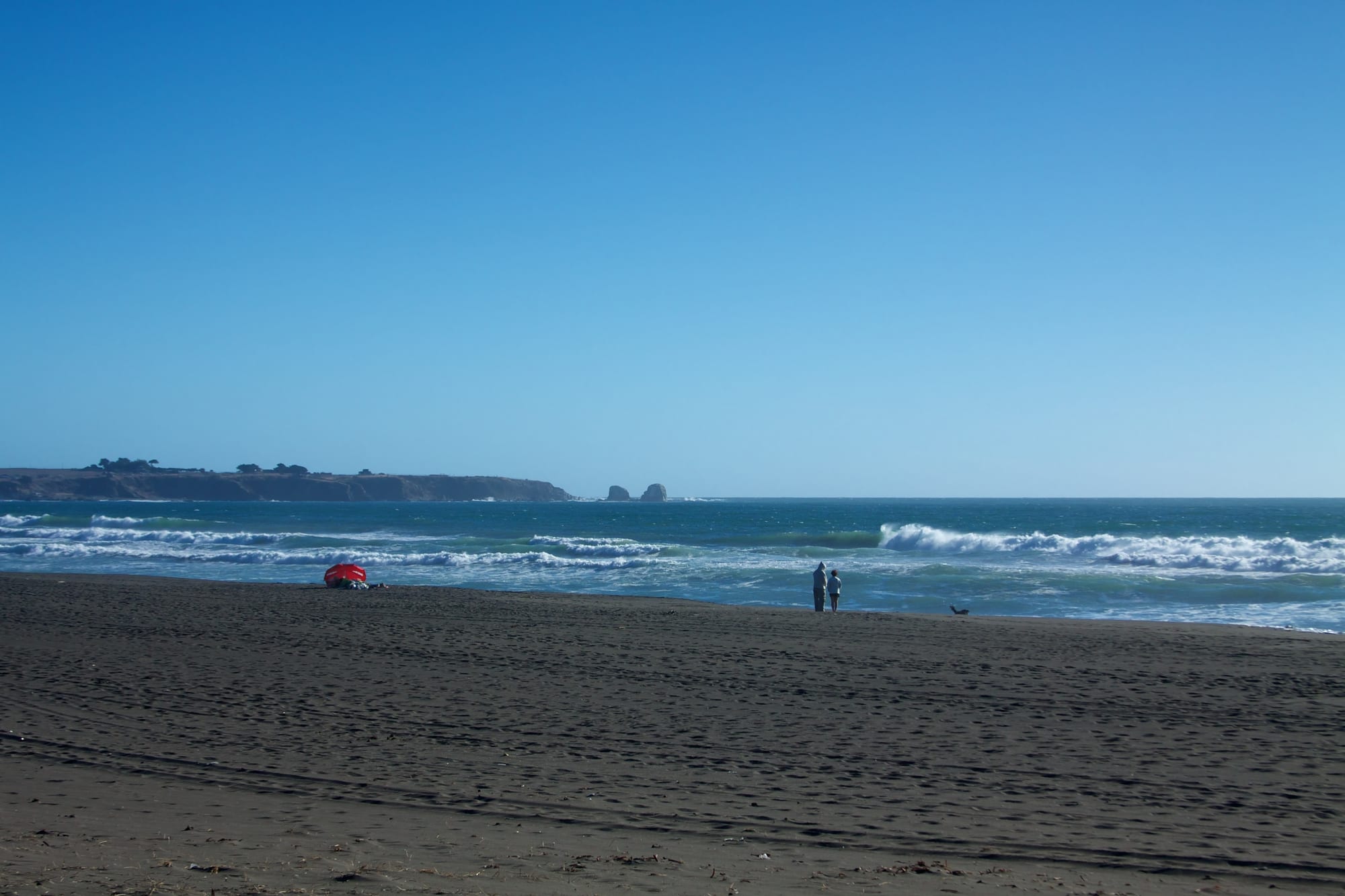
A wide dark-sand beach with breaking waves, two people at the water's edge and the headland and rocks of Punta de Lobos on the horizon

The Central Valley & Wine Country, Chile

Pichilemu

Playa Hermosa, south of Pichilemu, with the rocks of Punta de Lobos in the distance. (McKay Savage from London, UK / Wikimedia Commons · CC BY 2.0)

A surf town on the Pacific coast of the O'Higgins Region, capital of Cardenal Caro Province. Laid out as an upper-class resort by Agustín Ross from the 1880s, it kept its park, terraces and old casino, and has since become Chile's best-known surfing destination, with long dark-sand beaches and the famous wave at Punta de Lobos.

Neighbourhoods

  • The centre and Las Terrazas
    • First-time visitors
    • Historic district
    • Beaches

    The old resort laid out by Agustín Ross, with the palm-filled Ross Park, the former casino, terraces and stairs, and the main beach below. Part of it is a protected heritage zone, and shops, restaurants and the fishermen's cove are close by.

    Open in Maps
  • La Puntilla and Infiernillo
    • Surfing
    • Sea views

    The point at the southern end of the main beach, where surf schools gather and an international surf championship is held, and the rocky Infiernillo beach with its tide pools around the other side.

    Open in Maps
  • Punta de Lobos
    • Surfing
    • Nature

    A small settlement 6 kilometres south of the centre, set on grey-sand beaches below 50-metre cliffs, with the rocks where sea lions gather offshore. It is the home of Chile's most famous wave.

    Open in Maps

Things to do

The Ross resort

  • Agustín Ross Cultural Centrelandmark

    Agustín Ross's three-storey former casino, built in the early 1900s and home to one of Chile's first casinos, reopened in 2009 as the town's cultural centre and library; it is a national monument.

    Open in Maps
  • Ross Parkpark

    The park laid out by Ross in 1885 in front of the old casino, shaded by century-old Canary Island date palms; its balustrades were destroyed in the 2010 earthquake.

    Open in Maps
  • Agustín Ross Balconyviewpoint

    A lookout over the rocks at the southern end of the main beach, built by Ross in 1910 for viewing the sea.

    Open in Maps
  • Pichilemu railway stationlandmark

    The wooden terminus of the branch line from San Fernando, built around 1925 beside the Petrel lagoon and now a national monument.

    Open in Maps

Beaches and surf

  • Punta de Lobosbeach

    The point break that made Pichilemu famous, with waves of two to three metres, a beach sheltered from the south wind and a national surf championship every summer; it was named a World Surfing Reserve in 2013.

    Open in Maps
  • Playa Las Terrazasbeach

    The northernmost beach and the town's main one, in front of Ross Park, with surf schools and the fish market at the fishermen's cove nearby.

    Open in Maps
  • Playa Hermosabeach

    A long beach south of Infiernillo used for walking and fishing, with views towards the rocks of Punta de Lobos.

    Open in Maps

Short trips from the town

  • Cáhuilattraction

    A village at the mouth of the Nilahue estuary about 11 kilometres south, living from sea salt, oysters and mussels; its lagoon is used for fishing, kayaking and kiteboarding.

    Open in Maps
  • Ciruelosattraction

    A village south-east of town known for its pottery and for its church of St Andrew, dating from the mid-18th century, where Cardinal José María Caro was baptised.

    Open in Maps

Seasonal events

  • Campeonato Nacional de Surfsummer

    Chile's national surfing championship, held at Punta de Lobos every summer.

  • International surf championship at La PuntillaOctober and December

    An international surfing contest at the point at the southern end of the main beach.

  • Big-wave contest at Punta de LobosApril or May

    An international paddle-in contest for big-wave surfers, one of several held at Punta de Lobos during the year.

  • Fiestas Patriasaround 18 September

    The national holidays, celebrated day and night with traditional games, food, music and dancing.

  • Feast of St Andrew30 November

    The patron's feast at the colonial church of Ciruelos.

Eat and drink

Long-standing places and food districts in Pichilemu. Hours, ratings and directions come from your maps app, always current.

Pichilemu classics

  • Empanadas and completosrestaurant

    The town's favourite snacks — empanadas and completos, hot dogs loaded with toppings — sold in the centre around Calle Aníbal Pinto.

    Open in Maps
  • Cáhuil oystersneighborhood

    Oysters and mussels produced at Cáhuil, the estuary village that also lives from sea salt.

    Open in Maps

Food districts and markets

  • Fishermen's cove fish marketmarket

    The fish market at the fishermen's cove near the main beach, where the day's catch is sold.

    Open in Maps
  • Avenida Ortúzar and the centreneighborhood

    The old main street and the blocks around it hold many of the town's cafés and restaurants, with a widening range of food from seafood and pizza to sushi.

    Open in Maps

Experience Pichilemu

History

The Pichilemu coast was home to the Promaucaes, whose shell middens at Pichilemu and Cáhuil were studied by early Chilean archaeologists. The name comes from Mapudungun: pichi, little, and lemu, forest. In the 1540s Pedro de Valdivia granted the area to Juan Gómez de Almagro as part of the Topocalma encomienda, and colonial haciendas such as San Antonio de Petrel produced leather, jerky and tallow, while the area was densely settled, especially at Cáhuil, whose salt deposits had already been worked by the Indigenous people.

In 1875 the Ortúzar family, heirs of San Antonio de Petrel, built a dock that served for a few years as a fishing port, and the commune was created on 22 December 1891. Agustín Ross Edwards, a wealthy politician, bought a 300-hectare property in 1885 and set out to make Pichilemu a seaside resort for Santiago's upper class, with a hotel, a park, terraces and stone walls, chalets and houses furnished with materials from France and England. His casino building, from the early 1900s, housed one of Chile's first casinos, which closed in the early 1930s. After Ross's death in 1926 his heirs gave the streets, park and forest to the town. The railway from San Fernando arrived in 1926 and carried passengers until 1986.

Pichilemu became capital of the new Cardenal Caro Province in 1979, named after Chile's first cardinal, born in the town. Corruption scandals shook the municipality between 2003 and 2009. The earthquake and tsunami of 27 February 2010 caused severe damage on the coast, and a magnitude 6.9 aftershock centred just north-west of the town on 11 March 2010 killed one person.

Culture & Customs

Surfing defines modern Pichilemu. It is regarded as the prime surfing destination in Chile, and Punta de Lobos, with its big waves and cliffs, was named a World Surfing Reserve in 2013. The national championship is held there every summer, international contests come to La Puntilla, and a big-wave contest is held at Punta de Lobos each April or May. Surf schools, board shops and surf radio stations give the town an international, laid-back feel, with visitors from Chile and abroad mixing on the beaches.

Beneath it lies an older identity. Part of the centre was declared a heritage zone in 2004, and the town has several national monuments, among them the Ross Park and former casino, the wooden railway station, the El Árbol tunnel and the Caballo de Agua. The cultural centre in the old casino houses galleries and the public library. Pottery has been made in the area for more than two thousand years, and Ciruelos and El Copao are still known for their clay work; weavings, ceramics and wood carvings are sold in the centre.

The Catholic calendar remains strong in the villages, above all at the colonial church of St Andrew in Ciruelos on 30 November, and the September national holidays are celebrated with traditional games, food, music and dancing through the night.

Daily Life

Pichilemu had nearly 20,000 residents in 2024, living in the urban centre and twenty-two villages spread over about 750 square kilometres, from Cáhuil and Ciruelos to Cardonal de Panilonco. The commune's population has grown steadily since the 1970s, after decades of decline in the first half of the 20th century.

Tourism is the main industry, in the town and in villages such as Cáhuil and Ciruelos. Pine and eucalyptus plantations make forestry the other large employer, while fishing — not very important in most of the O'Higgins Region — continues from the town's cove, and Cáhuil lives from salt, oysters and mussels. A state technical college began teaching courses here in 2023. Roberto Córdova, mayor from 2009 to 2021, was elected again in October 2024.

The year swings between a packed summer, when holidaymakers fill the cabins and beaches, and a quiet winter of storms, surfers and local life. Memories of the 2010 earthquake and tsunami keep earthquake and tsunami preparedness part of local life.

Food

Pichilemu eats from the sea. The fish market at the fishermen's cove near the main beach sells the day's catch, and the town's restaurants serve the catch, alongside the empanadas and completos — loaded hot dogs — that visitors are told are the town's essential snacks. The range has widened as the town has grown, and Italian, Thai and Japanese dishes now share the streets with Chilean cooking. Even so, fish and shellfish from the cove and the estuary remain at the centre of most local menus.

The estuary at Cáhuil supplies two local specialities. Oysters and mussels are produced there, and sea salt is still produced beside it, from deposits that were already worked before the Spanish arrived.

Inland, the vineyards of the Colchagua valley are little more than an hour away, and their Carmenère and Cabernet Sauvignon are poured in local restaurants. Pisco sours remain the standard aperitif, and mote con huesillo, a cold drink of dried peaches with husked wheat, is sold in summer.

Planning tools

Budget

Pichilemu is cheaper than Santiago and much cheaper than the wine lodges inland, with plenty of cabins and simple guesthouses, a few mid-range places and little luxury accommodation. Prices rise in January and February and on big holiday weekends. Surf lessons with board and wetsuit hire are the main extra.

Daily Budget Midrange
USD 80–160 (cabin or small hotel, seafood dinners, surf lessons and board hire, taxis)
Daily Budget Shoestring
USD 35–60 (hostel or cabin, empanadas and set lunches, walking and colectivos)

Outside January and February, rooms are easier to find and cheaper; book ahead for the summer and the September holidays.

Best Time to Visit

December to March brings warm, dry weather, crowds from Santiago and the summer surf championship. The bigger swells arrive outside summer, when the big-wave contests are held and the town is quiet. Winter brings most of the year's rain and strong storms; surfing goes on in a thick wetsuit.

Suggested Number of Days

Two or three days give time to see the town and its beaches. Four or five suit anyone taking surf lessons, waiting for the right swell or exploring the lagoons and villages of the commune; surfers often stay much longer.

First Visit
2–3 days
With Surroundings
4–5 days

Transportation

The town is easy to get around on foot, by bicycle, by taxi or by colectivo, the shared taxis on fixed routes. Punta de Lobos, Cáhuil and the villages of the commune are a short drive or colectivo ride away; the coast road south to Bucalemu is paved.

A bicycle is a practical way between the centre and the beaches; colectivos and taxis cover the longer trips.

Airport & Station Connections

Buses from Santiago's Terminal Alameda take about three and a half hours via Melipilla, a shorter route than the one through San Fernando, from where buses take about two hours. San Fernando is 126 kilometres to the east. Most visitors come by car or bus from Santiago, whose Arturo Merino Benítez International Airport is the nearest. Santa Cruz is about 75 minutes away by car.

Walkability

The centre, Ross Park, the main beach and La Puntilla are all within easy walking distance, with stairs and promenades linking the town to the sand. Punta de Lobos, 6 kilometres south, is a long walk along the beaches or a short ride.

Safety

Chile is one of the safer countries in South America, but petty and opportunistic crime has risen, especially in Santiago and Valparaíso — pickpocketing, bag-snatching, phone theft, and distraction scams in tourist areas, markets, and on transport. The natural risks matter more here: the Pacific surf is powerful and cold, the town was badly damaged by the 2010 earthquake and tsunami, and summer wildfires are a risk in the region.

Learn the tsunami evacuation routes and head for high ground after any strong earthquake, choose waves to match experience and wear a wetsuit, and follow fire warnings in summer. Check current official travel advice before travelling.

Climate

A Mediterranean climate with winter rain of up to about 700 millimetres; the rest of the year is dry, often windy and sometimes foggy, and winds occasionally reach 150 kilometres an hour. Summer runs from December to February.

Summer
dry and often windy, cooler than the inland valley, where days often reach 28–33°C
Winter
cool, wet and stormy, with the region's winter temperatures mostly around 3–14°C

Local Customs

A tip of about 10 per cent is expected in restaurants when service has been satisfactory. Surf etiquette matters at the busy breaks: the surfer closest to the peak has priority, and locals expect visitors to wait their turn. Dress is casual everywhere, and the town is a mix of Chilean holidaymakers, international surfers and long-standing fishing families.

Respect the line-up at Punta de Lobos, take a lesson before paddling out on the bigger days, and leave the sea lions on the rocks undisturbed.

Common Payment Methods

The currency is the Chilean peso (CLP). Cards are taken in most restaurants, shops and lodgings in town, but colectivos, small stalls, the fish market and places in the villages want cash. There are ATMs in the centre, which charge fees.