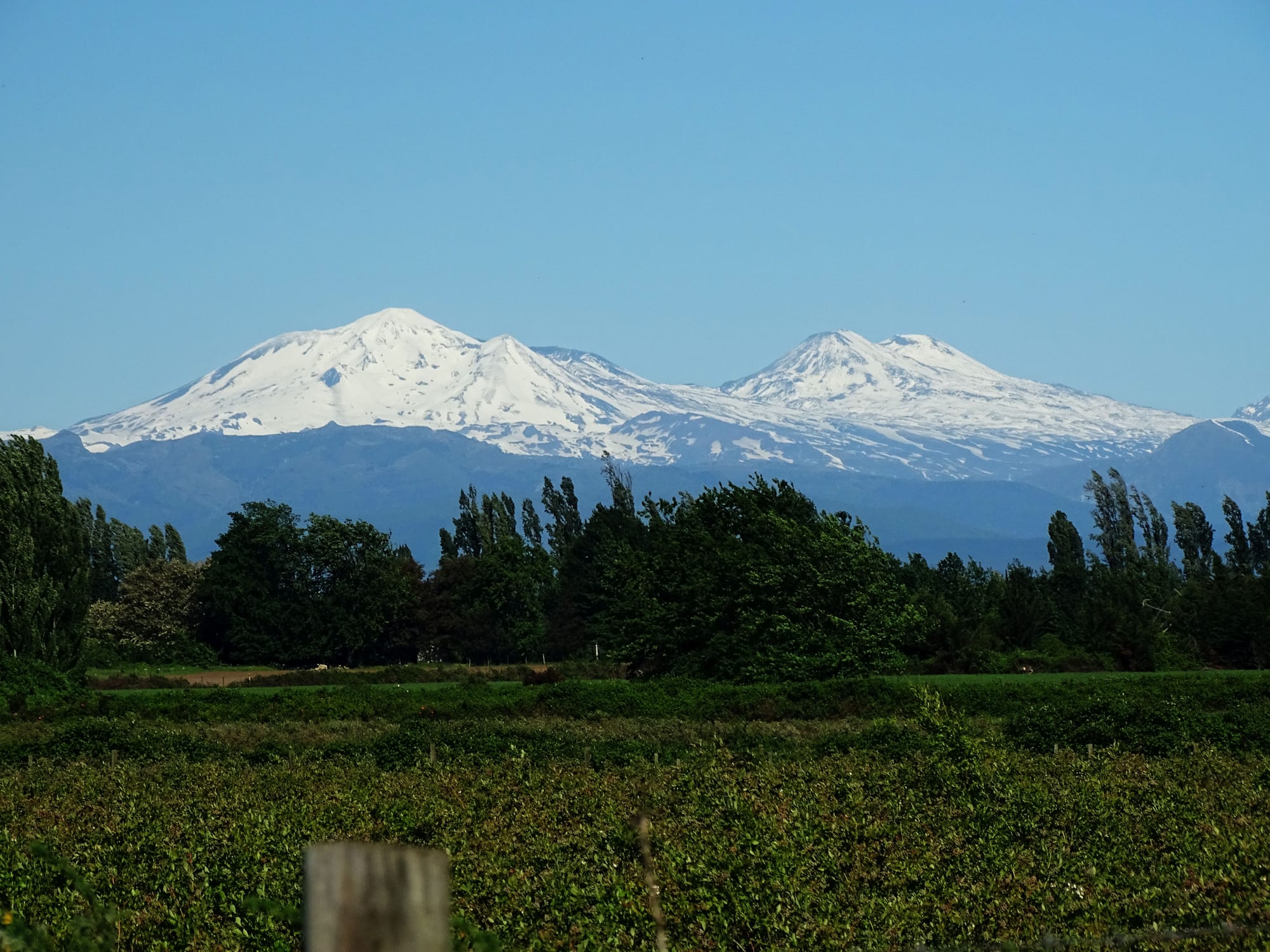
Snow-covered volcanic peaks of the Nevados de Chillán rising behind poplars and green farmland under a clear blue sky

Chile

The Central Valley & Wine Country

The Nevados de Chillán volcanic group seen across the farmland of Ñuble. (Dropus / Wikimedia Commons · CC BY-SA 4.0)

The farming and wine heartland south of Santiago, running through O'Higgins, Maule, Ñuble and Biobío from the Andes to the Pacific — a land of vineyards, orchards and huaso horsemen that ends at the Biobío river, the old frontier with the Mapuche, and at Concepción, Chile's second metropolitan area.

Explore The Central Valley & Wine Country

History

Before the Spanish, the valley was farmed by peoples the Inca called Promaucaes, and the Inca's reach ended roughly at the Maule river. South of it lay Mapuche country. Pedro de Valdivia founded Concepción in 1550, but in 1553 Mapuche forces under Lautaro killed him at Tucapel, and the Biobío river became the frontier — La Frontera — lined with Spanish forts for nearly three centuries. Concepción, first built at Penco, was destroyed several times by earthquakes and moved to its present site in the 18th century.

North of the river, the colonial valley became a country of great haciendas worked by tenant labourers, the inquilinos, the society that produced the huaso. The independence wars were fought across it: Bernardo O'Higgins was born in Chillán in 1778, patriot forces were defeated at Rancagua in 1814, and the regions around Talca and Concepción changed hands repeatedly before 1818.

In the 19th century coal mining at Lota and Coronel made the Biobío coast an industrial zone, while railways and later irrigation turned the valley into Chile's orchard. Earthquakes have shaped the modern region: the 1939 Chillán earthquake was one of the deadliest in Chilean history, and the magnitude 8.8 earthquake of February 2010, centred off Maule, and its tsunami devastated Constitución, Talcahuano and the coast. Ñuble was separated from Biobío as a region of its own in 2018.

Culture & Customs

This is the heartland of the huaso, the horseman of the central estates, and of rodeo, the national sport in which pairs of riders pin a steer against padded walls in a crescent-shaped arena, the medialuna. The national championship is held in Rancagua. Huasos ride in short jackets, flat-brimmed hats and the chamanto, a reversible woven poncho; the finest are made by women weavers in Doñihue. Cueca is danced at every rural fiesta, and the September holidays are celebrated here with particular energy.

Ñuble has a strong claim to be the cradle of Chilean music and art. Violeta Parra, the singer and folklorist, was born in San Carlos, the pianist Claudio Arrau in Chillán, and the black pottery of Quinchamalí, small glossy figures incised with white patterns, is one of Chile's best-known crafts. The harvest festivals, the Fiestas de la Vendimia, fill the plazas of Santa Cruz, Curicó and other wine towns each autumn.

Concepción has a different culture: a university city with a strong labour and left-wing tradition from its mines and factories, and a rock scene that produced the band Los Tres. In the south of Biobío, around Cañete and the Arauco province, Mapuche communities remain part of the region's life.

Daily Life

About four million people live across the four regions. Greater Concepción, including Talcahuano, San Pedro de la Paz and Coronel, has close to a million people and is Chile's second-largest metropolitan area. Rancagua, Talca, Chillán, Curicó and Los Ángeles are mid-sized cities of roughly 150,000 to 250,000, and the rest of the population lives in market towns and farming villages.

The economy is agricultural and industrial. Irrigated valleys grow cherries, apples, grapes, blueberries and other fruit for export; the wine industry is concentrated in Colchagua, Cachapoal, Curicó and Maule; and El Teniente, in the mountains above Rancagua, is one of the world's largest underground copper mines. South of the Maule, pine and eucalyptus plantations feed pulp mills and sawmills, and Talcahuano and San Vicente are fishing and industrial ports.

Seasonal work shapes the year: the fruit and grape harvests bring thousands of temporeros, many of them women and migrants, into the packing sheds. Summer wildfires, especially the great fires of 2017 and 2023, have raised debate about the plantation economy, and many small towns are losing young people to Santiago.

Food

Central Valley cooking is the country kitchen of Chile. Summer brings pastel de choclo, humitas, sweetcorn paste steamed in corn husks, and porotos granados, fresh beans stewed with corn and squash, all served with pebre or chancho en piedra, a tomato and chilli salsa ground in a stone mortar. Chillán is famous for its longaniza, a spiced pork sausage sold in the city's market, and bread baked in the embers, tortilla de rescoldo, is sold at roadside stalls.

The coast adds seafood from Talcahuano and the Biobío fishing coves: caldillo de congrio, a conger-eel soup, machas, clams and fried fish. Mote con huesillo, a sweet cold drink of dried peaches in syrup with husked wheat, is sold at roadside stands through the summer.

Wine is the region's great product. Colchagua is known for Carmenère, Cabernet Sauvignon and Syrah; Maule is one of Chile's largest wine regions and has revived old dry-farmed Carignan and País vines; and the Itata valley in Ñuble grows País and Muscat. Pipeño, a young, rustic wine traditionally made from País, is the countryside's everyday drink.

Attractions & Natural Wonders

In O'Higgins, the Colchagua valley is one of the best-known wine routes in Chile, with Santa Cruz as its base, its central plaza, the Colchagua Museum and wineries in the Apalta hills and around Lolol. The Cachapoal valley lies closer to Rancagua, and above the city the mining town of Sewell climbs a mountainside in stairways of painted wooden buildings. On the coast, Pichilemu and Punta de Lobos draw surfers.

In Maule, the wine valleys of Curicó and Maule spread around Talca, the regional capital, a grid city on the Claro river with a university and a wide central plaza. Inland, Radal Siete Tazas National Park has its chain of rock pools and waterfalls, and the high road climbs to the Laguna del Maule near the Argentine border. Constitución, at the river mouth, is known for its rock formations, including the Piedra de la Iglesia.

In Ñuble, Chillán has its busy market, its modernist cathedral built after the 1939 earthquake, and the Escuela México, whose murals by David Alfaro Siqueiros were a gift from Mexico. East of the city, the Nevados de Chillán volcanic group has hot springs, a ski area and the Las Trancas valley.

In Biobío, Concepción has the University of Concepción campus and its Latin American mural in the Casa del Arte; next door, Talcahuano has the ironclad Huáscar as a museum ship. The Biobío coast runs south to Lota's Chiflón del Diablo mine and Isidora Cousiño park, Lebu and the Mapuche museum at Cañete. Inland are the Salto del Laja falls and the Antuco volcano in Laguna del Laja National Park.

Cities in The Central Valley & Wine Country

Planning basics

Budget

The Central Valley is cheaper than Santiago and far cheaper than Patagonia. Towns such as Talca, Chillán and Curicó have inexpensive guesthouses and set-menu lunches, and Concepción is a working university city with student-level prices. The costs are in the wine country: winery tours, tastings and lodges in Colchagua are priced for foreign visitors, and a hire car is almost essential for touring the vineyards.

Daily Budget Midrange
USD 95–190 (hotel or wine lodge, tastings, restaurant dinners, a hire car)
Daily Budget Shoestring
USD 35–65 (hostel or residencial, set-menu lunches, buses)

Book winery visits ahead, and do not plan on driving after several tastings — many wineries can arrange a driver.

Safety

The valley towns and wine country are generally calm. Concepción has the usual city problems of bag and phone theft in the centre and on buses. Parts of the Arauco province in southern Biobío have seen arson attacks on forestry trucks and equipment linked to the land conflict between Mapuche groups, the state and forestry companies, rarely touching visitors. Earthquakes, tsunami on the coast and summer wildfires are the natural risks.

Learn the tsunami evacuation routes in coastal towns, follow fire warnings in summer, and keep phones out of sight in Concepción's centre. Check current official travel advice before travelling.

Climate

Mediterranean in the north of the region, with hot dry summers and mild wet winters, and steadily wetter towards the south: Concepción and the Biobío get far more rain than Rancagua. The coast is cooler and often cloudy in the mornings, and the Andes carry heavy snow in winter. Summer wildfires are a recurring hazard in the plantation forests.

Summer
hot and dry inland, often 28–33°C in the valley; cooler and breezier on the coast
Winter
cool and wet, around 3–14°C, with frost in the valley and snow in the Andes

Transportation

The Ruta 5 highway runs down the valley, and long-distance buses link Santiago with Rancagua, Talca, Chillán, Los Ángeles and Concepción, roughly three hours to Talca and six to Concepción. A passenger train runs from Santiago to Chillán through the valley towns, Concepción has a suburban rail line and an airport, and the old branch line from Talca to Constitución survives. Wineries, the coast and the mountains need a car or a tour.

Hire a car in Santiago or Talca for the wine valleys, and check road conditions and chains before driving up to the Nevados de Chillán in winter.

Best Time to Visit

March and April are the harvest months, when the valley towns hold their Fiestas de la Vendimia and the vineyards turn colour. Spring, from October to December, is green and mild. January and February are hot and bring Chileans to the beaches, and July to September is the ski season at the Nevados de Chillán.