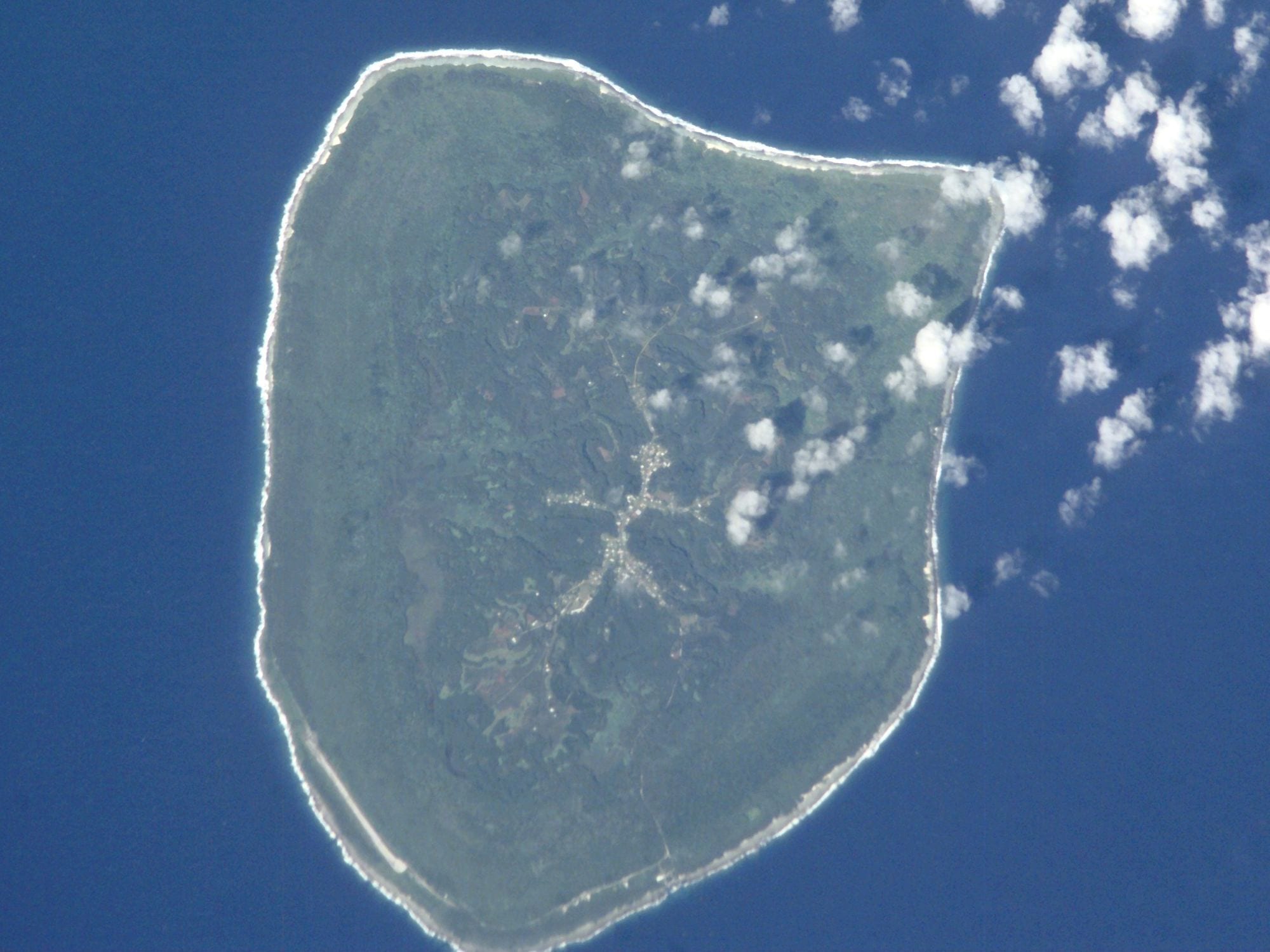
A rounded green island ringed by a narrow white reef in deep blue ocean, seen from high above with scattered small clouds

Cook Islands

Atiu

Atiu from orbit, its central plateau of villages and gardens ringed by fossil-reef limestone and a narrow fringing reef. (NASA / Wikimedia Commons · Public domain)

A raised volcanic island in the southern Cook Islands, 214 kilometres north-east of Rarotonga, known in tradition as Enuamanu, the land of the birds. A ring of fossil-reef limestone called makatea surrounds a low central plateau where five villages stand together, and the cliffs behind the coast are riddled with caves.

Neighbourhoods

  • The five villages
    • First-time visitors
    • Local life
    • Close to everything

    Areora, Ngatiarua, Teenui, Mapumai and Tengatangi sit side by side on the island's central plateau, so close together that they read as one settlement crossed by a few roads. The administration, school, clinic, churches, playing fields and the general stores are all within this compact centre, and most guesthouses are here or just outside it.

    Open in Maps
  • The makatea and the caves
    • Walks
    • Caves
    • Birdwatching

    A band of grey fossil-reef limestone, sharp underfoot and grown over with dense scrub and coconut, rings the island between the plateau and the sea. It is honeycombed with caves, some used for burials and one the nesting place of the kopeka swiftlet, and is crossed by rough tracks best walked with a guide.

    Open in Maps
  • The coast and its landings
    • Beaches
    • Quiet and residential
    • Swimming

    There is no wide lagoon here. The shore is a series of small sandy coves between limestone headlands, with a narrow reef close in, reached by tracks down from the makatea. Taunganui is the island's boat landing, and the coves are where people swim, fish and picnic.

    Open in Maps

Things to do

Caves and the makatea

  • Anatakitakiattraction

    A large limestone cave system in the makatea, reached on a guided walk, where the kopeka — a swiftlet found only on Atiu — nests in the dark and navigates by clicking.

    Open in Maps
  • The burial caves of the makateaattraction

    The limestone ring is honeycombed with caves, several of them long used for burials and treated as resting places rather than sights, entered only with a local guide.

    Open in Maps
  • The makatea walkstrail

    Rough tracks and old paths cross the fossil-reef limestone between the plateau and the coast, through pandanus, coconut and fig trees loud with birds.

    Open in Maps

Coast, villages and plantations

  • Taunganui landinglandmark

    The island's boat landing and wharf, where cargo is brought ashore by lighter from ships standing offshore.

    Open in Maps
  • Areoraneighborhood

    One of the five plateau villages, each of which has its own meeting house for village gatherings and for welcoming and feeding visitors.

    Open in Maps
  • Atiu's coffee plantationsattraction

    Coffee has been grown on Atiu since the 19th century and commercial production was revived in 1984; the plantations and the island's coffee factory are on the plateau.

    Open in Maps
  • Enua Airporttransit hub

    The island's airport, opened in 1983 with a compacted coral runway and served by light aircraft from Rarotonga, and the point where nearly every visitor arrives.

    Open in Maps

Seasonal events

  • Te Maeva Nuilate July to early August

    The national celebrations around Constitution Day, marked on Atiu with church services, sport, feasting and village dance and song teams.

  • Whale seasonJuly to October

    Humpback whales pass close to the island on their winter migration and can sometimes be seen from the cliff tops above the coast.

  • Christmas and New YearDecember and January

    The season when families return from Rarotonga, New Zealand and Australia, filling the villages for church, feasts and cricket on the fields.

Eat and drink

Long-standing places and food districts in Atiu. Hours, ratings and directions come from your maps app, always current.

Where people eat and drink

  • Village storesmarket

    Small general shops in the plateau villages stock imported New Zealand staples, while fish, taro, rukau, bananas and pawpaw come from the reef and the gardens rather than a market.

    Open in Maps
  • Guesthouse kitchensneighborhood

    With no restaurant strip on the island, most meals are cooked by the guesthouses that host visitors — reef fish, chicken, taro and rukau, and local coffee.

    Open in Maps
  • Tumunu gatheringsneighborhood

    Atiu's bush beer party, a local custom that began as a secret society and is now also offered to visitors.

    Open in Maps
  • Atiu coffeemarket

    Arabica grown, dried and roasted on the island, sold locally and on Rarotonga and served in most kitchens here.

    Open in Maps

Experience Atiu

History

Atiu's traditions call the island Enuamanu, the land of the birds, and trace its people to Polynesian voyagers whose descendants divided the land into tapere, the strips running from the centre to the sea that the five villages still represent. The island was unified in about 1760 and went on to invade and dominate the neighbouring islands of Mauke and Mitiaro; the uninhabited island of Takutea, to the north-west, belongs to the people of Atiu and is managed by them as a wildlife sanctuary. Marae and older sites survive in the scrub of the makatea.

European contact came in 1777, when Captain James Cook sighted the island on 31 March and his ships made tentative contact with its people over the following days; the Raiatean Mai was travelling with the expedition as its interpreter, but the attempt to obtain provisions failed and the ships moved on. Christianity arrived in 1823, when John Williams of the London Missionary Society converted the island's leader, Rongomatane Ngaakaara Ariki, and the scattered settlements of the tapere were resettled in one central place, the five villages of which still stand together on the plateau.

Atiu followed the rest of the group into the British protectorate of 1888 and the annexation to New Zealand in 1901. After annexation the island exported oranges, coffee and copra, but poor shipping disrupted the trade and exports collapsed in the 1950s; commercial coffee growing was revived on a small scale in 1984. A grass airstrip opened in 1977 and the present airport in 1983, bringing a modest, guesthouse-scale tourism, while the population fell by two-thirds over the past fifty years through steady migration to Rarotonga, New Zealand and Australia.

Culture & Customs

Atiu is best known across the Cook Islands for the tumunu, the bush beer party. It began as a secret society, men meeting away from the villages to drink home-brewed beer, and it survives today in a more open form that is also offered to visitors as an island experience.

Church life is otherwise as strong here as anywhere in the country. The Cook Islands Christian Church anchors the villages, Sunday hymn singing in close unaccompanied harmony is the week's high point, and Bible pageants and choir competitions mark the church calendar. Dance and drumming teams represent the island at the national festival, and tīvaevae quilting and work with pandanus and coconut fibre continue in women's sewing and fibre-arts groups.

Birds carry unusual weight in local identity, in keeping with the island's old name. The kopeka nests in the caves and is found nowhere else; the kura, or Kuhl's lorikeet, long hunted for its red feathers, was reintroduced to the island in 2007 and by 2019 numbered several hundred; and thirty young kakerori, the Rarotonga monarch, were brought here in 2001 to establish a second population as insurance against disaster on Rarotonga. Land remains in customary title, hunting and gathering rights follow family lines, and the ariki still carry ceremonial authority.

Daily Life

Only a few hundred people live on Atiu, and the number has fallen for decades as families moved to Rarotonga and across the Tasman; the island's diaspora is far larger than its resident population. Almost everyone lives in the five plateau villages, where the school, clinic, island administration, churches and stores stand within a few minutes' walk of one another.

Livelihoods combine wage work with growing food. The island administration, school, clinic, airport and power supply provide most salaried jobs; taro, bananas, pawpaw, cassava and coffee grow on the plateau and in the makatea clearings; pigs and chickens are kept behind the houses; and fishing is done from small boats outside the narrow reef rather than in a lagoon. Guesthouses and guiding add income for a handful of families, and remittances from relatives abroad support many households.

The day starts early, slows in the afternoon heat and ends early too. Shops keep short hours, the island closes almost entirely on Sunday, and the flight days structure the week, bringing mail, freight, visitors and returning relatives. The persistent difficulties are those of a small remote island: the cost and irregularity of shipping and flights, keeping young people and skilled workers, water supply, limited medical care, and exposure to cyclones.

Food

Food on Atiu comes from the garden, the reef and the deep water, with imported staples filling the gaps between ships. Taro is the foundation, boiled or baked and served with almost everything, along with kūmara, cassava, breadfruit, bananas and pawpaw. Rukau — young taro leaves cooked slowly in coconut cream — is the everyday green, and coconut in all its forms is the main seasoning and fat.

Fish is eaten fresh: tuna, wahoo and reef species grilled, curried or made into ika mata, the raw fish cured in lime juice and dressed with coconut cream that is eaten across the Cook Islands. Pork and chicken appear at celebrations, and a feast is cooked as an umukai in an earth oven of hot stones covered with leaves, brought out for church occasions, birthdays and family gatherings. Poke, a baked pudding of banana or pawpaw thickened with arrowroot and served with coconut cream, is the usual sweet.

Two local drinks define the place. Atiu coffee, arabica grown on the plateau and dried and roasted here, is served in nearly every kitchen and sold on Rarotonga. The other is the home-brewed bush beer of the tumunu, shared in rounds at the island's bush beer parties. There is no restaurant district: visitors eat what their hosts cook, which is much what the island eats.

Planning tools

Budget

Costs are simple rather than low. Accommodation is a handful of guesthouses and small lodges, often with meals and an island tour included, and there is little to spend money on beyond food, guides and transport. The flight from Rarotonga is a fixed extra, and everything imported is dearer than on the main island because it comes by light aircraft or lighter from a ship.

Daily Budget Midrange
USD 140–265 (guesthouse or lodge with meals, a guided cave walk, a hired scooter or vehicle)
Daily Budget Shoestring
USD 70–115 (simple guesthouse room, self-catering from the village stores, a borrowed bicycle)

Book accommodation and the Rarotonga flight together and well ahead, ask whether meals, transfers and a tour are included, and bring cash — there is no bank on the island.

Best Time to Visit

May to October is drier and less humid and makes the makatea walks and cave trips more comfortable. November to April is hotter, wetter and more humid, with the cyclone season, and the limestone tracks become slippery. Late July and early August bring the national festival, and Christmas fills the villages with returning families.

Suggested Number of Days

Two or three days cover the caves, the coast and the plateau at an unhurried pace. Longer stays suit walking, birdwatching and village life. The flight timetable, which runs only on some days of the week, often decides the length of a visit more than anything else.

First Visit
2–3 days
With Surroundings
4–5 days

Transportation

There is no public transport. Guesthouses meet flights and usually arrange an island tour, and scooters, bicycles and the occasional four-wheel-drive vehicle can be hired through them. The plateau roads are sealed in stretches; the tracks down through the makatea to the coast are coral, rough and steep in places, and the cave routes are walked.

Arrange transport and cave guides through the guesthouse before arriving, since nothing can be hired on the spot, and wear closed shoes — the limestone cuts.

Airport & Station Connections

Air Rarotonga flies light aircraft from Rarotonga to the island's Enua Airport on several days a week, covering 214 kilometres in under an hour. Baggage allowances are small and schedules can shift with weather and demand. Cargo ships call irregularly and unload by lighter at Taunganui; they are not a practical way for visitors to travel.

Walkability

The five plateau villages are easy to walk between — the whole centre can be crossed in half an hour — and walking is how most people get about there. The coast is a different matter: the coves lie a couple of kilometres away and down through the makatea on rough, unlit tracks, so most visitors ride or drive that part and walk from the top.

Safety

Crime is close to non-existent and the risks are physical. The makatea is sharp, broken limestone that cuts skin and turns ankles; the caves have unlit drops, loose rock and low passages and should not be entered alone; the reef is narrow with strong water movement outside it. Medical care on the island is a small clinic, with evacuation by air to Rarotonga or New Zealand for anything serious, and flights do not run every day. Cyclones are a wet-season risk.

Take a guide into the caves, wear closed shoes and carry water on the makatea, tell someone where a walk is going, and hold insurance that covers medical evacuation. Check current official travel advice before travelling.

Climate

Tropical and warm all year, a little hotter than Rarotonga, with a wetter season from November to April and a drier one from May to October. In the southern hemisphere the summer months are December to February. Showers are heavy and short, and the limestone drains water away quickly.

Summer
hot and humid — December to February days usually reach about 29 °C, with nights near 23 °C, frequent heavy showers and the cyclone season
Winter
warm and drier — June to August days are typically about 26 °C, with nights near 19–20 °C and steadier trade winds

Local Customs

This is a small, church-centred island where visitors are noticed and generally welcomed. Sunday belongs to church and family, and little else happens; modest dress is expected at services and around the villages, and swimwear stays at the coast. Greetings are exchanged with everyone passed on the road, and invitations to eat or to a tumunu are meant seriously.

Tipping is not expected, though a contribution is customary at a tumunu. Ask before photographing people, houses or church services, never enter burial caves or marae without a local guide, and treat land and plantations as someone's property.

Common Payment Methods

The currency is the New Zealand dollar, with Cook Islands coins and notes also circulating. There is no bank or reliable card payment on the island: guesthouses, guides, stores and drivers work in cash, and some accommodation asks to be settled by bank transfer beforehand. Drawing enough cash on Rarotonga before flying is essential.