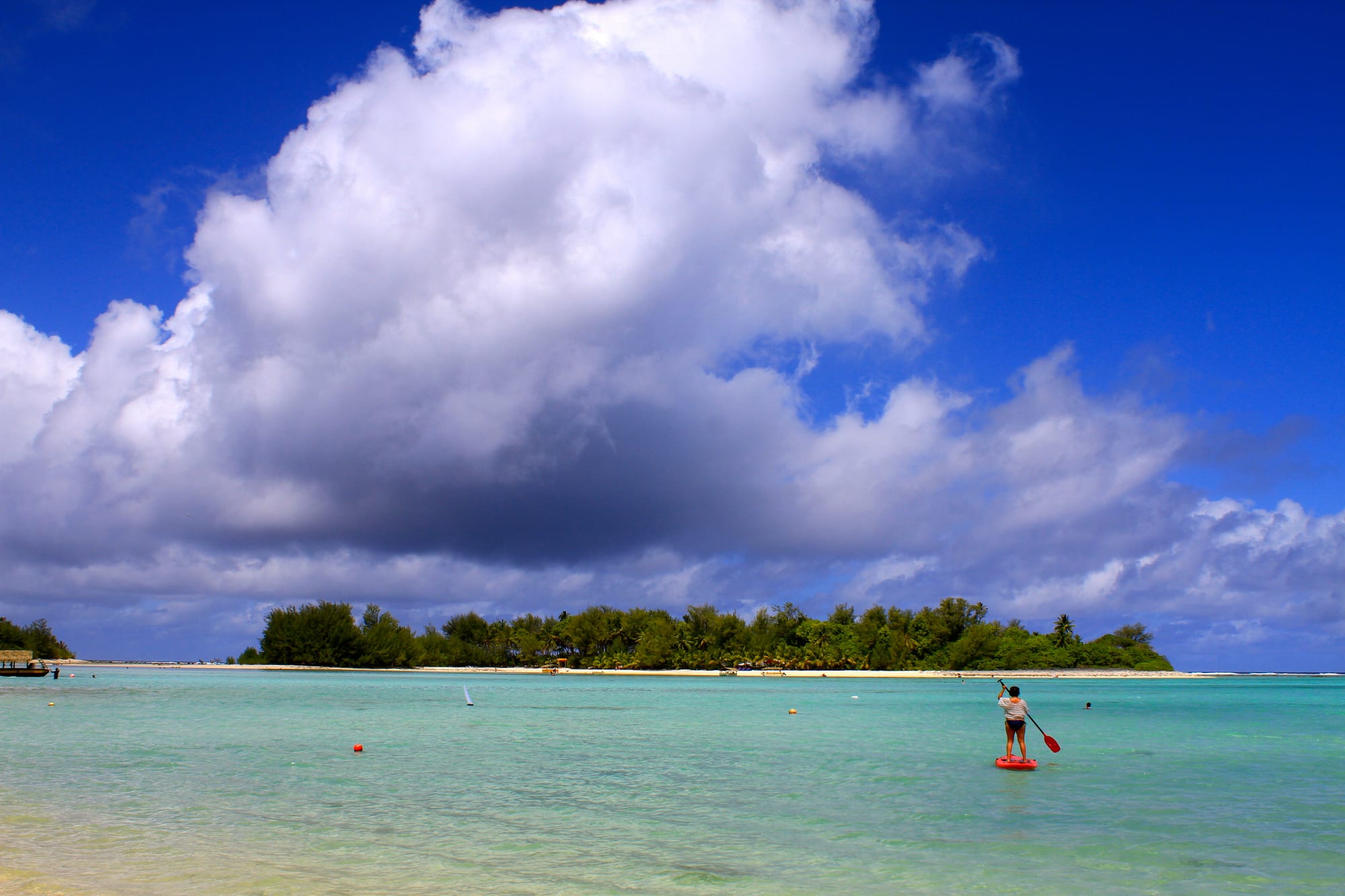
A shallow turquoise lagoon with a paddleboarder, a low palm-covered islet on the horizon and tall white clouds above

Cook Islands

Rarotonga

Koromiri islet seen across Muri Lagoon on the east coast of Rarotonga. (Christopher Johnson from Tokyo, Japan / Wikimedia Commons · CC BY-SA 2.0)

The largest and most populous of the Cook Islands, a volcanic island in the South Pacific ringed by a coral reef and a single coastal road. Jagged green peaks fill its interior, villages and resorts line the shore, and the capital Avarua on the north coast holds the government, the port and the country's main airport.

Neighbourhoods

  • Avarua
    • First-time visitors
    • Markets
    • Practical errands

    The capital and only town, strung along the north coast around a small harbour. Government offices, banks, the hospital, churches, the Punanga Nui market ground and most of the island's shops are here, and the waterfront has a handful of bars and restaurants. It is the working centre of the country rather than a resort strip.

    Open in Maps
  • Muri and Ngatangiia
    • Beaches
    • Best for food
    • Water sports

    The east coast, where the lagoon is at its widest and clearest and four small motu sit offshore. Most of the island's accommodation, kayak and sailing hire, and casual restaurants cluster here, along with food vans in the evenings. Ngatangiia beside it has a harbour and a quieter village feel.

    Open in Maps
  • Titikaveka and the south coast
    • Quiet and residential
    • Snorkelling
    • Beaches

    A stretch of shaded sand and calm, coral-rich water on the far side of the island from Avarua. Accommodation is smaller and more spread out, the reef is close in and good for snorkelling, and an old whitewashed church stands beside the coast road.

    Open in Maps
  • Arorangi
    • Sunsets
    • Local life
    • Historic district

    The land district of the west coast, its villages strung along the shore and the mission church still the centre of them. Resorts and self-catering units face west over the reef, the old church and its graveyard stand inland of the road, and the flat-topped mountain of Raemaru rises behind.

    Open in Maps
  • Nikao
    • Close to the airport
    • Sunsets

    The coastal strip in the west of Avarua district that holds the international airport, the Parliament building, the stadium and sports grounds. The shore here is rocky rather than sandy, ending at the dark headland of Black Rock, and the district is convenient for early flights and for walks along the reef edge.

    Open in Maps

Things to do

The lagoon and beaches

  • Muri Lagoonbeach

    The widest and best-known stretch of Rarotonga's lagoon, shallow and pale turquoise, with four small motu offshore — Motutapu, Oneroa, Koromiri and Taakoka — and boats running snorkelling and glass-bottom trips over the coral.

    Open in Maps
  • Titikavekaneighborhood

    A quiet south-coast village whose beach and clear inshore water are among the most popular places on the island for snorkelling straight from the sand.

    Open in Maps
  • Ngatangiianeighborhood

    An east-coast village on a reef passage and harbour, remembered in tradition as a departure point for canoe voyages south to New Zealand.

    Open in Maps

Walks and viewpoints

  • Te Rua Mangaviewpoint

    The rock needle at the centre of the island, 413 metres high and the turning point of the Cross-Island Track, reached by a steep climb through forest from the Avatiu valley.

    Open in Maps
  • Te Mangaviewpoint

    Rarotonga's highest point at 652 metres, a forested ridge summit climbed on a demanding and often muddy route.

    Open in Maps
  • Ara Metuatrail

    The ancient inland road, attributed in tradition to the ariki Toi and older than European contact, which encircles about three-quarters of the island past taro patches, marae — among them Arai Te Tonga, the most sacred on Rarotonga — and villages, and makes an easy alternative to the coast road for cycling.

    Open in Maps

Town, history and culture

  • Punanga Nui Marketmarket

    The market ground on the Avarua waterfront, created in 1996, busiest on Saturday mornings with produce, fish, cooked food, carvings and pearls, and often live music.

    Open in Maps
  • Arorangineighborhood

    The west-coast district settled from the earliest mission years, with its whitewashed Cook Islands Christian Church, the old graveyard beside it and Raemaru behind.

    Open in Maps
  • Rarotonga International Airporttransit hub

    The country's gateway at Nikao, three kilometres west of the town, where the single runway crosses the flat coastal land and people gather at the sea wall by its end to be jetblasted by departing aircraft.

    Open in Maps

Seasonal events

  • Te Maeva Nuilate July to early August

    The national festival around Constitution Day, when teams from every island bring dance, drumming, song and costume to competitions in Avarua, and the island fills with returning families.

  • Gospel DayJuly

    The anniversary of the landing of the missionary teacher Papeiha on 25 July 1823, kept with church services and village pageants of biblical stories performed in song and mime.

  • Vaka Eivalate in the year

    A week of outrigger canoe racing in the lagoon and off the coast, one of the Pacific's long-distance races, drawing paddling crews from across the region and New Zealand.

  • Whale seasonwinter

    Humpback whales breed in these waters in the southern winter, passing close to the reef and sometimes visible from the shore and from boats.

Eat and drink

Long-standing places and food districts in Rarotonga. Hours, ratings and directions come from your maps app, always current.

Markets and market food

  • Punanga Nui Marketmarket

    The Saturday morning market in Avarua, the week's main food event — reef fish, tuna, taro and rukau, tropical fruit, fresh coconuts, ika mata and cooked-food stalls.

    Open in Maps

Where people eat

  • Avarua waterfrontneighborhood

    Cafés, bakeries, takeaway counters and a few long-standing harbourside bars and restaurants along the main road through the capital.

    Open in Maps
  • Muri restaurants and roadside vansneighborhood

    The island's densest run of places to eat, from beachfront restaurants to vans selling fish and chips, poke bowls and ice cream near the lagoon.

    Open in Maps

Experience Rarotonga

History

Rarotonga was settled by Polynesian voyagers, and island tradition dates the arrival of the ancestral chiefs Tangi'ia and Karika to roughly the 13th century, with the lines of ariki descended from them still recognised today. Their generations built the inland road known as the Ara Metua and the marae that stand beside it, among them Arai-te-Tonga, and divided the island into the three districts of Te Au O Tonga, Takitumu and Puaikura that survive as the framework of village life. Ngatangiia, on the east coast, is remembered as a gathering place for canoes setting out on long southward voyages.

European contact came late. The brig Endeavour, whose master John Dibbs is credited with the European discovery of the island, called on 25 July 1823 while carrying the missionary John Williams, and the London Missionary Society evangelist Papeiha, from Bora Bora, went ashore to teach. Further missionaries followed and by 1830 the island had converted; new coastal villages, churches and a strict moral code came with them, and in 1845 the ariki prohibited the sale of land to Europeans. Avarua grew as the trading port where whalers, traders and later the administration gathered.

Britain declared a protectorate in 1888, and in 1901 the islands were annexed to New Zealand, with Rarotonga as the seat of government. An airfield built on the flat land at Nikao during the Second World War was upgraded into an international airport that opened to jet flights in January 1974, and jet flights from Auckland turned the island into a tourism economy. Rarotonga has been the political centre of a self-governing country since 1965.

Culture & Customs

Two strands run through island culture: the church and the performing arts, and they are less opposed than they might seem. Sunday hymn singing in the Cook Islands Christian Church, in dense unaccompanied harmony, is famous across the Pacific, and the whitewashed village churches are among the oldest buildings on the island. Gospel Day, the anniversary of the missionaries' landing in July 1823, brings village pageants in which biblical stories are staged with song, costume and mime.

Cook Islands drumming and dancing are fast and precise, and Rarotonga treats them competitively. Te Maeva Nui, around Constitution Day in early August, is the year's high point, when teams from each island perform in Avarua for several days. Commercial "Island Night" shows at resorts and cultural villages present shortened versions with a buffet, often accompanied by fire dancing. Women's groups make tīvaevae, large appliqué and embroidered quilts sewn collectively and given at weddings and funerals, or to cover the body of someone who has died, rather than sold.

Everyday manners are Polynesian and small-island: greet people, do not rush a conversation, remove shoes indoors, keep swimwear for the beach, and accept food when it is offered. Flower ei are handed out at arrivals and departures. Rugby league is the national sport, and the island empties towards the pitches at weekends. Land is held under customary title and rarely sold outright, which shapes everything from who runs a business to where a resort can be built.

Daily Life

Roughly 11,000 people live on Rarotonga, about three-quarters of the country's residents, spread through villages along the coastal road rather than concentrated in a city — Avarua is a small town of offices and shops rather than a place where most people live. Tourism is the largest employer, directly and through construction, transport, retail and food supply, and it sits alongside government, the hospital, schools, fishing and the pearl and fisheries administration.

The rhythm of the week is clear: work and school on weekdays, sport and socialising on Saturday after the morning market, and a quiet Sunday built around church and family meals. Many households keep a garden of taro, bananas and vegetables and fish the reef or the deeper water outside it, whatever their day job. Families are transnational, with relatives in Auckland, Sydney and Brisbane sending money home and returning for festivals and funerals.

Persistent emigration keeps the population from growing much, and employers rely on workers from elsewhere in the Pacific and from Asia to staff hotels and building sites. Other pressures are local and visible: the cost of imported food and fuel, pressure on water and sewage systems in the busiest coastal areas, and nutrient runoff and algae in the Muri lagoon, whose condition the government declared a national disaster in 2015 and has since tackled with new treatment schemes. Electricity comes from a mix of diesel generation and a growing amount of solar.

Food

Ika mata is the dish that defines the island: raw reef fish or tuna cut small, cured briefly in lime juice and dressed with coconut cream, sometimes with onion and tomato. Rukau, young taro leaves slow-cooked in coconut cream, appears beside it, along with taro and kūmara, breadfruit, and pork or chicken. The umukai, food cooked in an earth oven over hot stones, is the form a feast takes for a wedding, a birthday or a village celebration, and several places on the island stage one for visitors alongside a dance show.

Fish is the everyday protein — tuna, mahi mahi, wahoo and parrotfish — grilled, curried or sashimi-thin, and curried octopus and marinated clams turn up at family gatherings. Poke, the Cook Islands version, is a baked pudding of banana or pawpaw thickened with arrowroot and served with coconut cream, quite different from the Hawaiian dish of the same name. Coconut in every form, from drinking nuts to grated cream, is the base of most of it.

The Saturday market at Punanga Nui in Avarua is where the cooking is on show: fish stalls, taro and rukau, tropical fruit, doughnuts and cooked plates eaten standing up. Food vans park along the coast road and beside the Muri lagoon in the evenings, supermarkets stock New Zealand goods, and locally brewed beer and imported wine fill out restaurant lists.

Planning tools

Budget

Mid-range by Pacific standards and much cheaper than French Polynesia, though almost everything other than fish and root vegetables is imported and priced accordingly. Accommodation ranges from hostels and simple self-catering units to beachfront resorts, and self-catering with market and supermarket food keeps costs well below resort restaurant prices. A hired scooter is the cheapest way to get around.

Daily Budget Midrange
USD 155–310 (mid-range resort or apartment, restaurants, a lagoon cruise, some hire costs)
Daily Budget Shoestring
USD 65–105 (hostel or simple self-catering unit, market and food-van meals, the island bus or a hired scooter)

Self-cater at least some meals, shop at the Saturday market in Avarua, and remember that a day trip or overnight to Aitutaki is a separate flight and a significant extra cost.

Best Time to Visit

May to October, the drier and less humid half of the year, is the main visitor season and the calmest time on the lagoon. Late July and early August bring the Te Maeva Nui festival and the busiest weeks of the year. November to April is hotter, wetter and more humid, with the cyclone season, but also quieter and cheaper.

Suggested Number of Days

Four or five days suit a first visit, enough for the lagoon, the ring road and a walk inland. A week or more allows for slower days and a side trip by air to another island. Rain, and the Sunday closures, can shorten what is practical.

First Visit
4–5 days
With Surroundings
7–10 days

Transportation

One sealed coastal road, about 32 kilometres around, carries almost all traffic, with the older inland Ara Metua running parallel for much of the way. A bus service circles the island in both directions and is simple to use. Scooters, small cars and bicycles are widely hired, and taxis operate from the town and the airport. Nothing on the island is more than a short drive from anywhere else.

Wear a helmet on a scooter, ask the hire company what licence documents are needed before riding, and note that bus and shop hours are much reduced on Sundays.

Airport & Station Connections

Rarotonga International Airport sits at Nikao, a few kilometres west of Avarua, and is the country's only international gateway. The flight from Auckland takes roughly four hours and carries most arrivals; Air Rarotonga connects the airport with Aitutaki and the other inhabited islands, and with Tahiti. Cruise ships anchor offshore and tender passengers in, as Avatiu, the island's commercial harbour, is small.

Walkability

Avarua is small enough to cross on foot in a quarter of an hour, and each resort area — Muri, Titikaveka, Arorangi — is walkable within itself, with footpaths along parts of the coast road. Walking between districts means several kilometres of roadside in heat and humidity, often without a pavement or street lighting, so most people use the bus, a scooter or a bicycle for anything longer.

Safety

One of the safer places to travel in the Pacific, with very little violent crime; opportunistic theft from unlocked rooms, cars and beaches is the main property risk. The real hazards are in and on the water — sharp coral, strong outward currents through the reef passages, and stinging and spiny creatures in the shallows — along with scooter accidents on the ring road, sunburn and dehydration. Cyclones are a wet-season risk and serious medical cases are flown to New Zealand.

Swimming is safest inside the reef and away from the passages, reef shoes and a shuffling step help against coral and stings, and travel insurance covering medical evacuation is worth having. Check current official travel advice before travelling.

Climate

Tropical, warm all year and moderated by the sea, with a hotter, wetter period from November to April and a drier, cooler one from May to October. In the southern hemisphere the summer months are December to February. Rain often arrives as short heavy showers, and the trade winds keep the coast comfortable most days.

Summer
hot and humid — December to February days usually reach about 28–29 °C, with nights near 22 °C, heavy showers, high humidity and the cyclone season
Winter
warm and drier — June to August days are typically about 25 °C, with nights near 18–19 °C and a rougher sea on the windward side

Local Customs

Church is central to island life and Sunday is quiet, with many shops and services closed and services well attended; visitors are generally welcome at church if dressed modestly. Beachwear belongs on the beach rather than in town, shoes are removed before entering a house, and greetings and unhurried small talk matter. Flower ei, worn as necklaces or head garlands, are given as a mark of welcome and farewell.

Tipping is not expected. Ask before photographing people, church services or family gatherings, cover up away from the beach, and treat marae and burial sites as sacred ground rather than attractions to walk over.

Common Payment Methods

The currency is the New Zealand dollar, alongside distinctive local Cook Islands coins and notes that circulate on the islands and make popular keepsakes. Cards are accepted at resorts, larger restaurants and shops in and around Avarua, and there are ATMs in town and at the airport. Market stalls, food vans, buses and small village shops work in cash, so a supply of small notes is useful.