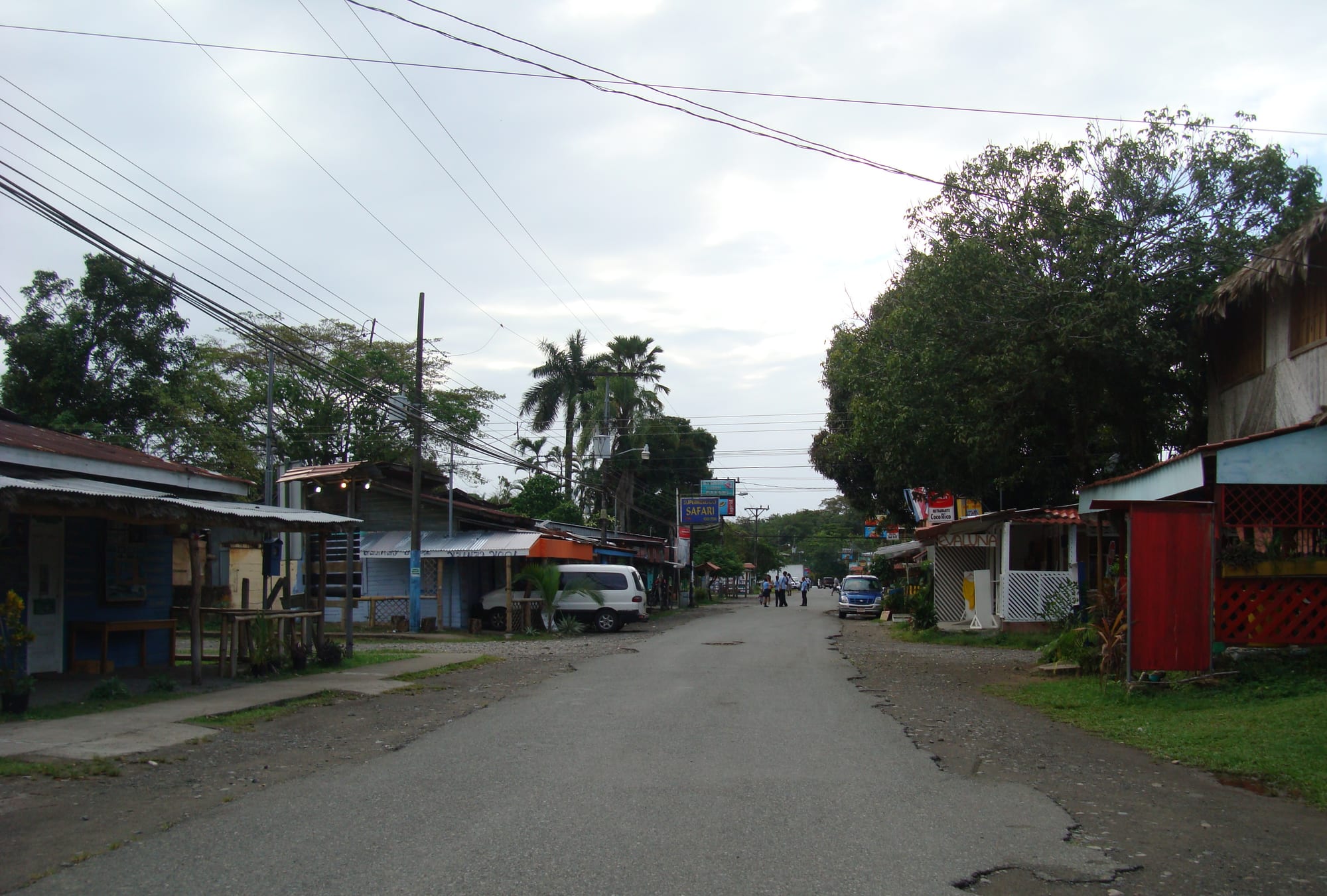
Cahuita's quiet main street under a grey sky, with low wooden shops, palm trees and a few people walking

The Caribbean Coast, Costa Rica

Cahuita

The main street of Cahuita, on Costa Rica's southern Caribbean coast. (Eric T Gunther / Wikimedia Commons · CC BY-SA 3.0)

A small beach town on Costa Rica's southern Caribbean coast, founded by Afro-Caribbean settlers who first came to the coast to hunt turtles. It grew as a fishing village and the home of calypso singer Walter Ferguson, and now lives mostly from visitors to Cahuita National Park, its reef and its forest trail beside white sand.

Neighbourhoods

  • The town centre
    • First-time visitors
    • Close to public transport
    • Best for food

    One main street runs from the highway down to the sea, with the bus terminal, a small shopping strip with a bank, and most of the restaurants and bars. Dusty side roads lead off it past guesthouses and residents' houses, and the national park entrance is at the southern edge.

    Open in Maps
  • Playa Negra
    • Beaches
    • Quiet stays
    • Beginner surfing

    The dark-sand beach that runs for several kilometres north-west of town, a short walk along the main road. Guesthouses, hostels and small hotels are spread along unpaved roads behind it, and the waves suit beginner surfers.

    Open in Maps
  • The park edge
    • Nature
    • Early starts

    The southern end of town around Kelly Creek, where the forest of the national park begins and the white-sand beach opens just inside the entrance. A few guesthouses and sodas sit close to the gate.

    Open in Maps

Things to do

Cahuita National Park

  • Cahuita National Parkpark

    A land and marine park protecting beaches, lowland forest and the most developed coral reef on Costa Rica's Caribbean coast, with sloths, howler and capuchin monkeys, coatis and green ibis.

    Open in Maps
  • The coastal trail to Puerto Vargastrail

    A forest path of about 9 km behind the beaches from the Cahuita entrance to the Puerto Vargas ranger station, best walked early, when wildlife is easiest to see.

    Open in Maps
  • Snorkelling the reefattraction

    The reef off Punta Cahuita is home to dozens of coral species and over a hundred kinds of fish; February to April usually brings the clearest water.

    Open in Maps

Beaches

  • Playa Negrabeach

    A long dark-sand beach north-west of town, good for swimming and for beginner surfers.

    Open in Maps
  • Playa Blancabeach

    The small white-sand beach just inside the park entrance, backed by palms and forest.

    Open in Maps

Short trips from the town

  • Sloth Sanctuary of Costa Ricaattraction

    A privately run rescue centre north of Cahuita that rehabilitates injured and orphaned sloths, with guided tours for visitors.

    Open in Maps
  • Puerto Viejo de Talamancaattraction

    The next town south, livelier than Cahuita, known among surfers for the powerful Salsa Brava wave and for the beaches of Playa Chiquita and Punta Uva towards Manzanillo.

    Open in Maps
  • Gandoca-Manzanillo Wildlife Refugepark

    A land and marine refuge created in 1986 beyond the village of Manzanillo, at the end of the coast road, protecting forest, wetlands and reef.

    Open in Maps

Eat and drink

Long-standing places and food districts in Cahuita. Hours, ratings and directions come from your maps app, always current.

Cahuita classics

  • Main street restaurantsneighborhood

    The small restaurants and bars along the main street serve Afro-Caribbean dishes, grilled chicken in several styles and local fish.

    Open in Maps
  • Sodas near the park entranceneighborhood

    Simple local diners close to the park gate, serving plates of rice and beans, fish and chicken.

    Open in Maps

Along the coast

  • Puerto Viejo's restaurantsneighborhood

    The busier town to the south has the coast's widest choice of Caribbean kitchens, bakeries and beach bars.

    Open in Maps

Experience Cahuita

History

Cahuita grew out of the turtle-hunting voyages of the early 19th century. Afro-Caribbean people from Bocas del Toro in Panama, the Colombian island of San Andrés and Nicaragua came each year to hunt turtles on the coast near Tortuguero, and over time some settled along the southern shore, founding Cahuita, Old Harbour (now Puerto Viejo), Grape Point (Punta Uva) and Manzanillo. The name Cahuita is linked to the sangrillo or cawa tree; in English the settlement was known as Bluff, and Spanish names replaced the English ones when the government made Spanish the national language.

For most of the 20th century it remained a small, isolated fishing village. Roads and services were slow to reach this part of Limón province, and electricity did not arrive in Cahuita until late 1976. Walter Ferguson's parents brought him here from Panama as a small child in the early 1920s, and the calypsos he wrote over the following decades turned the village's daily life into song.

In 1970 the point and its reef were protected as a national monument, and the same year Cahuita became a district of Talamanca canton. The monument became a national park in 1978, and tourism has since become the town's mainstay. In 2025 two shipwrecks long known in the park's waters were identified as Danish slave ships lost in 1710.

Culture & Customs

Cahuita is known across Costa Rica for its Afro-Caribbean character, visible in its cooking, its music and its language. Many families speak English as their everyday language and are also fluent in Spanish; Walter Ferguson, who sang almost always in English, described the town as perfectly bilingual.

Ferguson (1919–2023), known locally as Mr Gavitt and nationally as the King of Calypso, was the leading figure of calypso limonense, the calypso of the Limón coast. He wrote around two hundred songs, among them "Cabin in the Wata", "Callaloo" and "Carnaval Day", and was first recorded on vinyl in 1982 by the Smithsonian Folkways label. He rarely left the village; when he was in his eighties, producers brought a recording studio to Cahuita rather than take him to San José. His hundredth birthday in 2019 was declared National Calypso Day, and an annual international calypso festival in his name has been held in Cahuita since 2013.

The wider district is mixed. Costa Ricans of Jamaican descent live alongside Spanish-speaking ticos and Europeans who have settled on the coast, and the Bribri people live in the hills inland. Manners follow the Caribbean pattern: greetings first, an easy pace and a relaxed attitude to time.

Daily Life

Cahuita is the main village of a district of the same name, which covers about 235 square kilometres and also takes in Puerto Viejo, Cocles, Punta Uva, Manzanillo and Hone Creek. The district had 8,293 people at the 2011 census and an estimated 13,463 in 2022; the village itself is far smaller.

The town is laid out along one main street that runs from the highway to the sea, with dirt roads leading off it to houses and guesthouses. Tourism is the main source of work, through guesthouses, restaurants, guiding and snorkelling trips, and tourism taxes help to keep the Talamanca municipality afloat.

The day is set by the tropical light, with sunrise and sunset close to six o'clock all year, and life is lived outdoors. The reef has suffered: live coral cover fell sharply in the 1980s and early 1990s, blamed on sediment and agricultural runoff carried by the Estrella River, bleaching and other pressures.

Food

Cahuita's food reflects its Afro-Caribbean roots. The classic of the coast is rice and beans cooked in coconut milk, quite different from the gallo pinto of the Central Valley, served with chicken or fish in a spiced Caribbean sauce. Rondón is a rich soup of fish, plantain, heart of palm and hot Panamanian chilli cooked in coconut milk, and coconut milk, chilli and spices flavour much of the cooking.

The town is particularly known for its grilled chicken, cooked in several local variations, and for dessert crêpes filled with local bananas, strawberries and chocolate. Many restaurants serve fresh local fish, and sodas near the park entrance offer simple plates of rice, beans and meat.

Coast bakeries sell patí, turnovers of spiced minced beef, pan bon, a dark spiced bread, and coconut bread. Agua de sapo, a drink of ginger, lime and raw cane sugar, and home-made ginger beer are the traditional refreshments, and fresh coconuts are sold along the coast.

Planning tools

Budget

Cahuita is one of the cheaper bases on the Caribbean coast, with hostels, guesthouses and cabinas in every price range. Restaurant meals cost more than travellers from elsewhere in Latin America might expect, but sodas keep eating cheap, the park asks for a donation at the town entrance, and a hired bicycle covers the beaches.

Daily Budget Midrange
USD 100–200 (small hotel or beach lodge, restaurant meals, a guided park walk or snorkelling trip)
Daily Budget Shoestring
USD 40–70 (hostel or cabina, soda meals, buses and a hired bicycle)

A bicycle is the cheapest way between Playa Negra, the town and the park entrance.

Best Time to Visit

September and October are usually the sunniest months on this coast, when much of Costa Rica is at its wettest, and February to April is often fairly dry and brings the clearest water for snorkelling. Rain is possible in any month, and December and January can be wet, though the holidays bring Costa Rican visitors.

Suggested Number of Days

Two or three days suit a first visit to the town and the park. Allow four to six to add the beaches further south and the wildlife refuge near the Panamanian border, or simply to wait out a run of rainy days.

First Visit
2–3 days
With Surroundings
4–6 days

Transportation

The town is small enough to cross on foot, and many visitors hire bicycles for the beaches and outlying guesthouses. Local buses run along Route 36 between Limón and Sixaola, stopping at Cahuita and continuing to Puerto Viejo. Some roads on the edges of town are dirt and gravel, and a four-wheel-drive car helps there.

Use the bus terminal in the centre: buses passing Cahuita stop there.

Airport & Station Connections

Cahuita lies on Route 36, the highway from Limón to the Panamanian border at Sixaola. Direct buses from San José, bound for Sixaola, take about four hours or a little more, with a stop in Limón; shuttle vans also run from the capital. Limón International Airport is up the coast, and San José's international airport is the main gateway from abroad.

Walkability

Easy on foot: the main street runs straight from the highway to the sea, Playa Negra is a short walk north along the road, and the park entrance is at the southern edge of town. Side roads are unpaved and can be muddy after rain, and they are dark at night.

Safety

Costa Rica still compares well with its Central American neighbours, and crime that reaches visitors is usually petty theft or the occasional armed robbery — break-ins to parked rental cars, bag-snatching on beaches, and pickpocketing in San José. The tourist areas of Cahuita and Puerto Viejo are calmer than Limón city but have more theft than most of the country, including bag-snatching, burglaries and robberies on dark beach roads. Currents are strong on many beaches along this coast.

Avoid walking or cycling alone on unlit roads and beaches after dark, lock up belongings in accommodation, and ask locally about currents before swimming. Check current official travel advice before travelling.

Climate

Tropical, hot and humid all year, with temperatures that change little from month to month and sunrise and sunset close to six o'clock in every season. Rain falls in every month, with drier spells between the wet periods.

Summer
September–October and February–April: warmer, drier spells, around 29–31°C along the Caribbean coast, with calmer seas
Winter
July and November–January: frequent heavy rain, rough seas and occasional flooding, around 26–29°C along the Caribbean coast

Local Customs

English, in its local Creole form, is the everyday language of many Cahuita families, alongside Spanish, and greetings are expected on the street and in shops. Life moves at an unhurried Caribbean pace. The park's Cahuita entrance relies on donations rather than a set fee.

Leave a donation at the park entrance, and ask before photographing residents.

Common Payment Methods

The currency is the Costa Rican colón, and US dollars are widely accepted. The shopping strip beside the bus terminal has a bank with an ATM; some small guesthouses take cash only, in colones or dollars, so carrying cash is sensible.