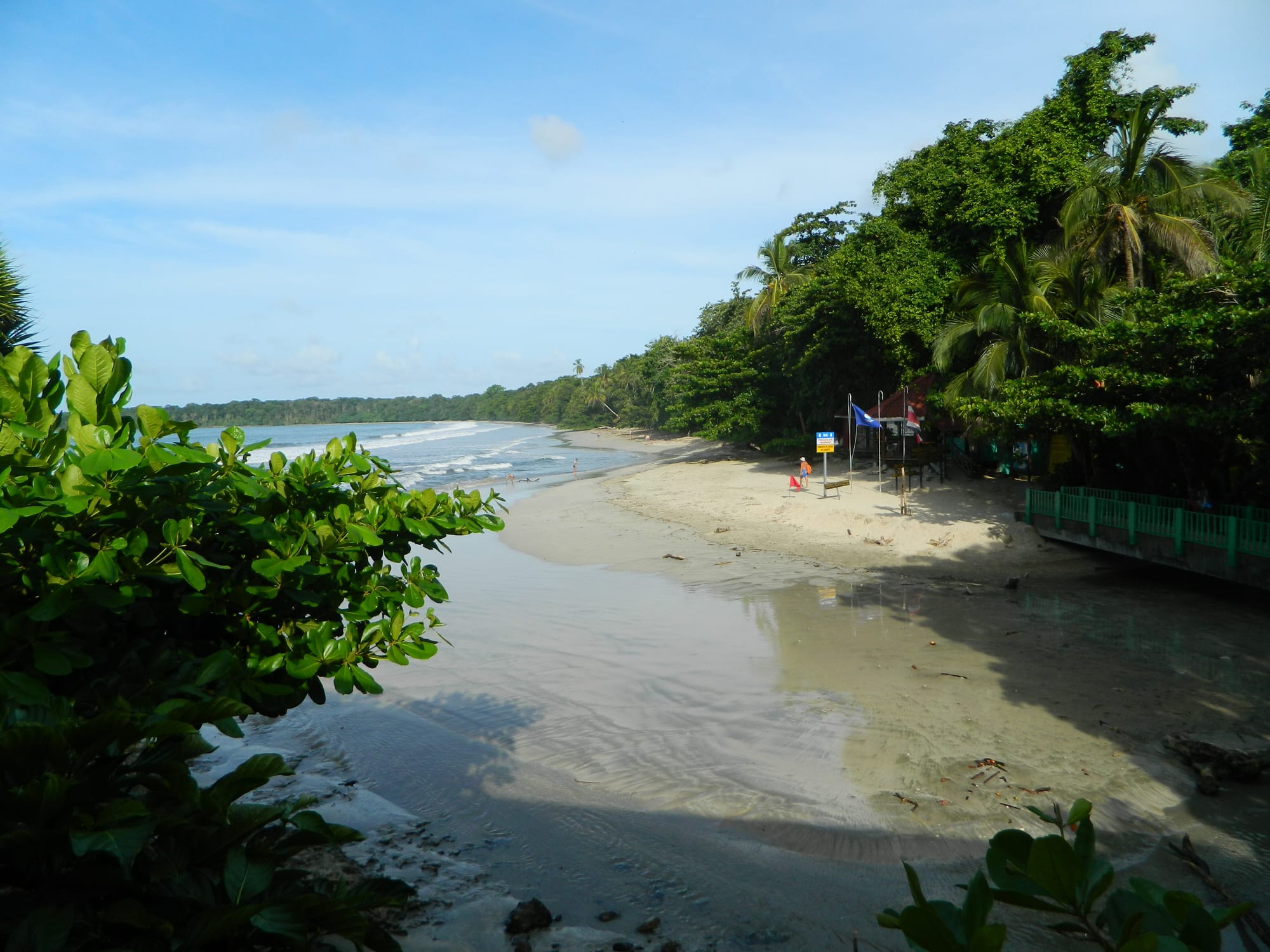
A curving sandy beach with gentle surf, backed by palms and thick green forest, seen through leaves on a sunny day

Costa Rica

The Caribbean Coast

The beach at the entrance to Cahuita National Park, on the southern Caribbean coast of Costa Rica. (Pavel Kirillov / Wikimedia Commons · CC BY-SA 2.0)

The province of Limón, Costa Rica's Caribbean side, running from the canals and turtle beaches of Tortuguero past the port city of Limón to Cahuita, Puerto Viejo and the Panamanian border — a humid lowland of rainforest and banana plantations shaped by Afro-Caribbean settlers and the Bribri and Cabécar peoples of Talamanca.

Explore The Caribbean Coast

History

The Caribbean lowlands were home to Indigenous peoples when Christopher Columbus, on his fourth voyage, anchored off the island of Uvita beside present-day Limón in 1502, the first recorded European visit to what became Costa Rica. The Spanish never controlled the coast: the Bribri and Cabécar held the Talamanca mountains, and in the colonial period the shore was visited by pirates and Miskito raiders, while a few cacao plantations near Matina were repeatedly attacked.

Modern Limón was created by the railway. In 1871 the government began a line from the Central Valley to the Caribbean so that coffee could be shipped to Europe more easily; the American builder Minor Keith completed it in 1890, using workers from Jamaica and other Caribbean islands, China and Italy, thousands of whom died of disease and accidents. Keith planted bananas along the tracks, and his businesses became part of the United Fruit Company in 1899. Limón grew into a busy port with a largely English-speaking, Protestant, Afro-Caribbean population, and Marcus Garvey worked there for the United Fruit Company in 1910.

Afro-Caribbean Limonenses were long treated as foreigners: until 1948 they were not recognised as citizens and needed permission to leave the province. Bananas remain the province's main export crop, and from the 1970s tourism grew, with Cahuita (1970) and Tortuguero (1975) among the first national parks.

Culture & Customs

Limón is the heart of Afro-Costa Rican culture, which differs sharply from the Central Valley's. Many older families speak Limonese Creole, an English-based language sometimes called Mekatelyu, alongside Spanish; Protestant churches are prominent; and the food, music and manners carry clear Jamaican roots. The Bribri and Cabécar communities of Talamanca keep their own languages and traditions in their territories.

Calypso limonense, a local style of calypso, is the coast's own music, and the Cahuita calypsonian Walter Ferguson became its best-known voice. Reggae and dancehall now dominate the bars of Puerto Viejo. The Carnaval de Limón, held around 12 October, is famous across the country, with parades, calypso and dance troupes, and 31 August is marked as the Day of the Black Person and Afro-Costa Rican Culture.

Life on the south coast has a looser, more Caribbean rhythm than anywhere else in Costa Rica. Visitors notice that English is widely spoken, greetings are expected, and a relaxed attitude to time is part of daily manners. Surfers, European settlers and backpackers have added their own layer to the coast in recent decades.

Daily Life

Limón province has around 400,000 people. Limón city, officially Puerto Limón, is the largest town, with several tens of thousands of residents, and the lowland towns of Guápiles, Siquirres and Cariari have grown on the banana and pineapple trade. Cahuita, Puerto Viejo and Manzanillo are small, and the Talamanca territories are rural and scattered.

The province produces most of Costa Rica's bananas for export, and the ports of Limón and Moín, where a large container terminal opened in 2019, handle most of the country's Caribbean trade. Tourism supports the south coast and Tortuguero, and cacao, plantains and small farms sustain Talamanca. Yet the port's role in drug trafficking has brought a sharp rise in crime to Limón city.

Days start early and slow down in the afternoon heat. Life is lived outdoors, on porches, beaches and football pitches, and music is ever present. Heavy rains bring occasional flooding, and questions of jobs, security and fair treatment by the central government dominate local politics.

Food

Caribbean cooking stands apart from the rest of Costa Rica, flavoured with coconut, thyme, ginger and hot Panamanian chilli peppers. Rice and beans, cooked in coconut milk is the classic Limón lunch and is not to be confused with the valley's gallo pinto; it comes with Caribbean-style chicken or fish in a spicy sauce. Rondón is a rich soup of fish, plantain, heart of palm and Panamanian chilli cooked in coconut milk.

Bakeries sell patí, turnovers filled with spiced minced beef, pan bon, a dark spiced bread, plantintá, a tart filled with pineapple or banana, and coconut bread and cakes. Agua de sapo, a drink of ginger, lime and raw cane sugar, and home-made ginger beer are the coast's refreshments.

Cacao grown by Bribri families and small farms around Talamanca is sold in local chocolate workshops, and fresh coconuts, breadfruit, soursop and lobster in season fill out the menu of the Puerto Viejo restaurants.

Attractions & Natural Wonders

In the north, Tortuguero National Park protects a long, roadless coast of black-sand beach, canals, lagoons and flooded forest. Green turtles nest on the beach in the second half of the year and leatherbacks earlier, visited at night with guides, while dawn boat trips on the canals reveal caimans, river otters, howler monkeys, toucans and herons. The village of Tortuguero sits on a narrow strip between the canal and the sea, and the Barra del Colorado refuge lies further north.

Limón has its seafront Parque Vargas and views out to Uvita island, where Columbus anchored. Inland, the Pacuare and Reventazón rivers run down to the lowlands through rainforest gorges famous for whitewater rafting.

South of the city, Cahuita National Park protects a forest trail beside white-sand beaches and a coral reef, with sloths, howler monkeys and snorkelling offshore. Puerto Viejo de Talamanca is the busiest town on the south coast, with the Salsa Brava reef break, beach bars and a string of beaches such as Cocles, Punta Uva and Manzanillo to the south. Beyond them the Gandoca-Manzanillo Wildlife Refuge covers forest, wetlands and reef towards the Panamanian border, and inland the Bribri territories of Talamanca offer community visits and cacao tours.

Cities in The Caribbean Coast

Planning basics

Budget

The Caribbean coast is cheaper than the Pacific beach resorts. Puerto Viejo and Cahuita have plenty of hostels, cabinas and small restaurants, and bicycles cost little to hire. Tortuguero is pricier because of its remoteness: most visitors take packages that bundle the boat transfer, lodge, meals and guided canal and turtle tours, though village guesthouses offer a cheaper alternative.

Daily Budget Midrange
USD 100–200 (beach lodge, restaurants, a guided tour, or a Tortuguero package)
Daily Budget Shoestring
USD 40–70 (hostel or cabina, soda meals, buses and a hired bicycle)

In Tortuguero, book turtle-watching with a local guide in the village; on the south coast, a rented bicycle is the cheapest way between the beaches.

Safety

Limón city has seen a sharp rise in crime and a high murder rate in recent years, as drug-trafficking groups use its port and the coast; across Costa Rica, most such violence is linked to disputes between local drug gangs. The tourist areas of Cahuita and Puerto Viejo are calmer but have more theft than most of the country, including bag-snatching, burglaries and robberies on dark beach roads. Currents are strong on many beaches, and the sea at Tortuguero can be dangerous for swimming.

Pass through Limón city by day, avoid walking or cycling alone on unlit roads and beaches after dark, and lock up belongings in accommodation. Check current official travel advice before travelling.

Climate

The Caribbean side has no real dry season. Rain falls in every month, with the wettest periods around July and from November to January, and the heat and humidity are constant. September and October, the rainiest months on the Pacific, are usually the driest and calmest here, and February to April is often fairly dry too.

Summer
September–October and February–April: warmer and drier spells, around 29–31°C, with calmer seas
Winter
July and November–January: frequent heavy rain, rough seas and occasional flooding, around 26–29°C

Transportation

Route 32 crosses the mountains from San José through Braulio Carrillo National Park to Limón in about three hours, and buses continue south to Cahuita and Puerto Viejo. The road can close after landslides in heavy rain. Tortuguero has no road: visitors take a bus or shuttle to the La Pavona dock and then a boat, travel by boat along the canals from Moín, or fly in by small plane. On the south coast, bicycles and local buses link the beaches.

Check Route 32 conditions after heavy rain, and arrange the Tortuguero boat connection in advance.

Best Time to Visit

September and October are the best months for sunshine on the south coast, when much of the rest of the country is at its wettest. Green turtles nest at Tortuguero in the second half of the year and leatherbacks earlier in the year, from about March. Limón's carnival is held in the week around 12 October. December and January can be wet, but the holidays still bring Costa Rican visitors.