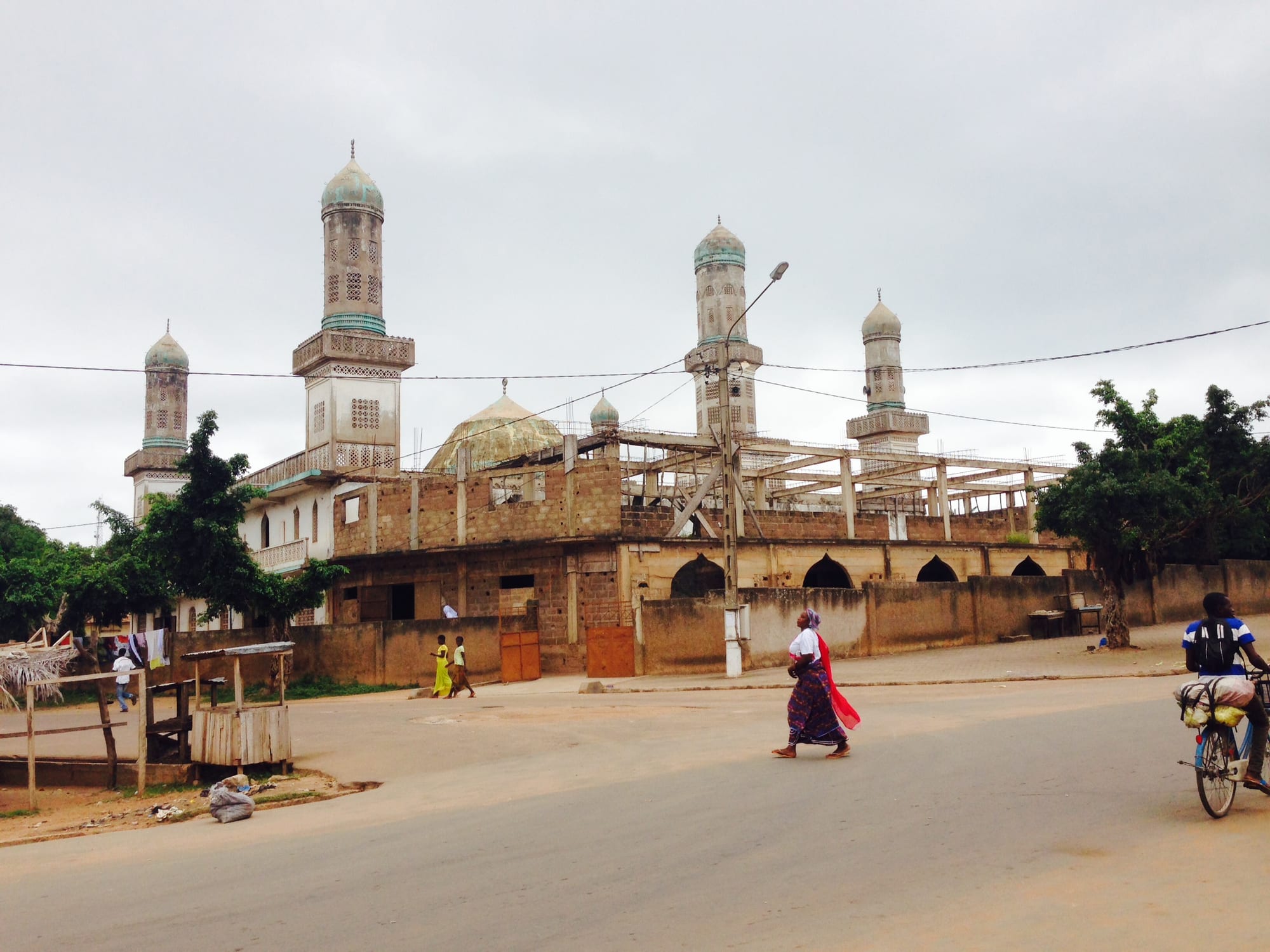
A large mosque in Bondoukou with four slender minarets and a dome above walls of mud brick, beside a quiet street

Korhogo & the North, Côte d'Ivoire

Bondoukou

The Great Mosque of Bondoukou, in the old trading quarters of the town. (Slav4|Ariel Palmon / Wikimedia Commons · CC BY-SA 3.0)

An old trading town in north-eastern Côte d'Ivoire, close to the Ghanaian border. Founded by Juula merchants who carried kola and gold between the forest and the Sahel, it became a centre of Islamic learning under the Abron kingdom of Gyaman and is known for its many mosques, Koranic schools and mud-built quarters.

Neighbourhoods

  • The old Juula quarters
    • Historic district
    • Architecture
    • First-time visitors

    The oldest part of town, a low maze of mud-brick and rendered houses, small mosques and Koranic schools where the merchant families settled. Walls, lanes and prayer times give it a character quite unlike the newer streets.

    Open in Maps
  • Centre and the market
    • Markets
    • Close to transport
    • Best for food

    The commercial heart around the great market, the mairie, the banks and the coach and shared-taxi yards, where most of the town's hotels and eating places are found.

    Open in Maps
  • The Koulango quarters
    • Local life
    • Quiet and residential

    Residential quarters of the town's original Koulango and Abron population, with family compounds, courtyards and small shops, quieter than the trading streets.

    Open in Maps
  • The outer quarters
    • Quiet and residential
    • Local life

    Newer housing spreading along the roads out of town towards the border and towards Tanda, with schools, churches, mosques and maquis along the paved axes.

    Open in Maps

Things to do

The old town

  • Great Mosque of Bondoukoulandmark

    The town's principal mosque, built in the Sudanic manner of Djenné and Timbuktu that traders brought south from the Sahel, with minarets rising above the old quarters.

    Open in Maps
  • The small mosques of the old quarterslandmark

    Bondoukou is called the town of a thousand mosques for the number of small prayer houses scattered through its merchant quarters; the Limamisso and Kamagaya mosques are among the best known.

    Open in Maps
  • The Koranic schoolsattraction

    Teaching households where boys learn to recite and write the Qur'an, a tradition that made the town a centre of Islamic learning in the region.

    Open in Maps
  • Musée des Arts et des Traditionsmuseum

    The town's museum of art and traditions, housed in the old market building, with collections on the Koulango, Abron and Juula peoples and their crafts.

    Open in Maps
  • Grand Marché de Bondoukoumarket

    The central market, trading yams, cassava, cloth, kola nuts and goods that cross the Ghanaian border a short distance to the east.

    Open in Maps

Getting around and out

  • Soko Airporttransit hub

    The airfield that serves Bondoukou, on the edge of town; the coach yards near the market carry almost everyone in and out.

    Open in Maps

Short trips from the town

  • Tandaattraction

    A market town west of Bondoukou in Abron country, a road junction for traffic heading towards Abengourou and the south.

    Open in Maps
  • Sampa border crossingattraction

    The crossing into Ghana east of Bondoukou, where lorries, traders and kola move between the two countries each day.

    Open in Maps
  • Sokoattraction

    An Akan ceremonial site in the country just east of the town, on the road towards the Ghanaian border.

    Open in Maps
  • Beghoattraction

    The excavated site of a great medieval trading town across the border in Ghana, a terminus of the routes that linked the forest goldfields to the Sahel.

    Open in Maps

Eat and drink

Long-standing places and food districts in Bondoukou. Hours, ratings and directions come from your maps app, always current.

Bondoukou classics

  • Foutou d'igname with groundnut saucerestaurant

    Pounded yam eaten by hand with a thick groundnut or palm-nut sauce, the everyday meal of the Koulango and Abron country.

    Open in Maps
  • Tô with okra saucerestaurant

    The savanna staple, a stiff maize or millet porridge with a sauce of okra or leaves seasoned with soumbala, fermented néré seeds.

    Open in Maps
  • Brochettes and grilled muttonrestaurant

    Skewers of beef and small pieces of grilled mutton with raw onion and chilli, sold from charcoal grills along the streets after dark.

    Open in Maps

Markets and food streets

  • Grand Marché de Bondoukoumarket

    Yams, maize, cassava, chillies, dried fish, shea butter and kola nuts, with cooked-food sellers and tea stalls around its edges.

    Open in Maps
  • The grills of the centreneighborhood

    Open-air grills and bars near the market where the town eats attiéké, alloco and braised fish or chicken in the evening.

    Open in Maps

Experience Bondoukou

History

Bondoukou grew out of the trade that linked the goldfields and kola forests of the Akan country to the markets of the Sahel. Juula merchants, Mande-speaking Muslims descended from Soninke Wangara traders, made the town their chief settlement after Begho, the older trading city just across what is now the Ghanaian border, was destroyed by Asante in the middle of the eighteenth century. They built quarters of mud houses, mosques and teaching households, and the town became known across the region for its scholars and its Koranic schools.

The land belonged to the Koulango, and the Abron, an Akan people who had moved north-west from the Asante country, established the kingdom of Gyaman over it, with Bondoukou as its principal town and market. The arrangement was a familiar West African one: an Akan ruling dynasty, a Koulango farming population and a Muslim merchant class that kept the trade and the learning, each with its own authority.

The kingdom was repeatedly drawn into wars with Asante, which destroyed its capital in 1740 and 1741, and at the end of the nineteenth century the region became a contested frontier between the French advancing from the west and the British in the Gold Coast. A French protectorate treaty was signed with the Abron king of Bondoukou in 1888, the town fell to the forces of Samory Touré in the years between 1895 and 1897, and the border drawn afterwards divided Gyaman between French and British territory, leaving the town a few kilometres inside Côte d'Ivoire. Bondoukou remained an administrative and market centre through the colonial period and after independence, and it is still the main town of the north-east.

Culture & Customs

Three traditions meet in Bondoukou and have done so for centuries. The Juula brought Islam, Arabic learning, long-distance trade and the Dioula language that is still the speech of the market. The Abron brought Akan kingship, with its stools and regalia, its matrilineal descent and its formal court language. The Koulango, the older population of the land, keep their own language, their farming ceremonies and their shrines.

Islam is the dominant religion and gives the town its shape: the call to prayer from dozens of small mosques, Friday gatherings, the fast of Ramadan and the sacrifice at Tabaski, when families slaughter sheep and visit through the day. Koranic schooling has long been a source of the town's reputation, and families of scholars are respected accordingly. Christian communities and traditional practice exist alongside, and in the villages masked dances and harvest rites continue.

The Ghanaian border is a cultural fact rather than a barrier. Families are divided by it, Akan kinship runs across it, traders cross daily, and Ghanaian music, football and goods are part of local life. Manners are formal and unhurried: greetings first, the right hand for giving and receiving, elders and imams addressed with care, and modest dress expected in the old quarters.

Daily Life

About 140,000 people live in Bondoukou by a 2021 estimate, which makes it a medium-sized town rather than a city, and it feels like one — low buildings, unpaved side streets and a rhythm set by the market and the mosques. Its population mixes Koulango, Abron and Juula families with Malinké, Senufo and Burkinabè settlers and a steady traffic of Ghanaian traders.

Farming and trade support almost everyone. Yams, cassava, maize and rice are grown around the town, cashew nuts have become a major cash crop across the north-east, and cocoa is farmed in the wetter country to the south. Cross-border commerce in kola, foodstuffs and manufactured goods is constant, and administration, schools and the hospital provide the salaried jobs.

Mornings are for the market and the fields, the early afternoon is quiet in the heat, and the evening brings the grills, tea stalls and conversation in front of the compounds. The issues people raise are familiar across the region: water and electricity supply, the state of the roads, work for young people, and the pull of Abidjan and of Ghana for those who leave.

Food

The cooking here sits between the savanna and the forest. Yam is pounded into foutou, a smooth dough eaten by hand with sauce arachide thick with groundnut paste, sauce graine from boiled palm nuts, or a light aubergine and tomato sauce, while tô, the stiff maize or millet porridge of the north, is eaten with okra or leaf sauces seasoned with soumbala, the pungent fermented paste of néré seeds. Rice with a meat and tomato sauce is everywhere, and shea butter is used in cooking as well as on the skin.

Grilled meat is the evening food: brochettes of beef, and mutton cut small, cooked over charcoal and served with raw onion, chilli and spice, with whole sheep roasted for Tabaski. Attiéké, the fermented cassava couscous of the south, and alloco, plantain fried in palm oil, have become standard here too, usually with braised fish or chicken.

Kola nuts are more than a crop in Bondoukou: bitter and mildly stimulating, they are chewed, offered to guests and used in ceremonies, and they were the trade that built the town. Sweet mint tea is brewed slowly in the merchant quarters, and bissap from hibiscus flowers, gnamakoudji made from ginger, and dèguè of millet in curdled milk are the usual drinks and snacks, with mangoes and cashew fruit in season.

Planning tools

Budget

Bondoukou is cheap, and there is little here to spend money on beyond a simple hotel, meals and transport. Rooms are basic and inexpensive, market food costs very little, and coach fares are low. The main extra cost is a vehicle for the surrounding villages or for the long drive north towards the national park.

Daily Budget Midrange
USD 70–160 (best hotel in town, restaurants, a car and driver for village visits)
Daily Budget Shoestring
USD 20–45 (basic hotel, market food and maquis meals, coaches and shared taxis)

Carry enough CFA francs for the whole stay; cash machines are few and cards are not accepted outside the largest hotels.

Best Time to Visit

November to February is the most comfortable time, dry and a little cooler, with roads in good condition and markets busy, though the Harmattan brings dust and hazy light. March to May is very hot, and the rains from June to October make unpaved roads and park tracks difficult.

Suggested Number of Days

A day is enough to walk the old quarters and the market at an easy pace. Two or three days suit a longer stop that takes in the surrounding villages or a crossing into Ghana, both of which depend on road transport.

First Visit
1 day
With Surroundings
2–3 days

Transportation

Motorbike taxis and shared taxis cover the town and the nearest villages for small fixed fares. Coaches and minibuses connect Bondoukou with Abidjan, Bouaké, Abengourou and the border, leaving from the yards near the market. Roads to the villages and north towards Bouna are rough and slow, particularly in the rains.

Travel between towns by day, allow time for checkpoints, and agree a price with a driver before setting out.

Airport & Station Connections

Almost everyone arrives by road. Abidjan is a long day away, roughly eight to ten hours by coach through Abengourou, and Bouaké some five hours to the west. The Ghanaian border is a short drive east, and traders cross daily.

Walkability

The town is small and flat, and the old quarters are best seen on foot: the market, the mosques and the museum are within a walk of twenty minutes or so of each other. The lanes are unpaved and dusty, shade is limited in the middle of the day, and the outer quarters are spread out enough to need a motorbike taxi.

Safety

Bondoukou is generally calm, and petty theft around the market and the coach yards is the usual concern. The town lies well south of the border districts with Burkina Faso where jihadist attacks have occurred since 2020, but the security presence across the north is heavy and checkpoints are frequent. Road conditions and night driving are the practical risks.

Use hotel or app-based transport at night in Abidjan, avoid the northern border strip, and check current advice before travelling to the west. Carry identification for checkpoints, travel by day, and do not photograph soldiers, police or border posts. Check current official travel advice before travelling.

Climate

A savanna climate on the transition to the forest zone: hot all year, with a long wet season, a dry season from November to March and Harmattan dust between December and February.

Summer
wet from about April to October, typically 21–32°C, with heavy storms and difficult rural roads
Winter
dry from November to March, typically 18–35°C, with Harmattan haze and cool mornings

Local Customs

This is a strongly Muslim town with a long scholarly tradition, and the rhythm of prayer, Ramadan and Tabaski shapes the week and the year. Dress modestly, particularly in the old quarters and near the mosques, and ask before entering a mosque or a Koranic school. Koulango and Abron chieftaincy is respected, and greetings are long and unhurried.

Ask permission before photographing people, mosques or schools, remove shoes where required, and expect a small gift or fee to be customary when visiting a village or a chief.

Common Payment Methods

The currency is the West African CFA franc (XOF), pegged to the euro. This is a cash economy; market stalls, taxis and small hotels take nothing else. Ghanaian cedis circulate informally near the border, but francs are what is needed in town, and cash machines are limited.