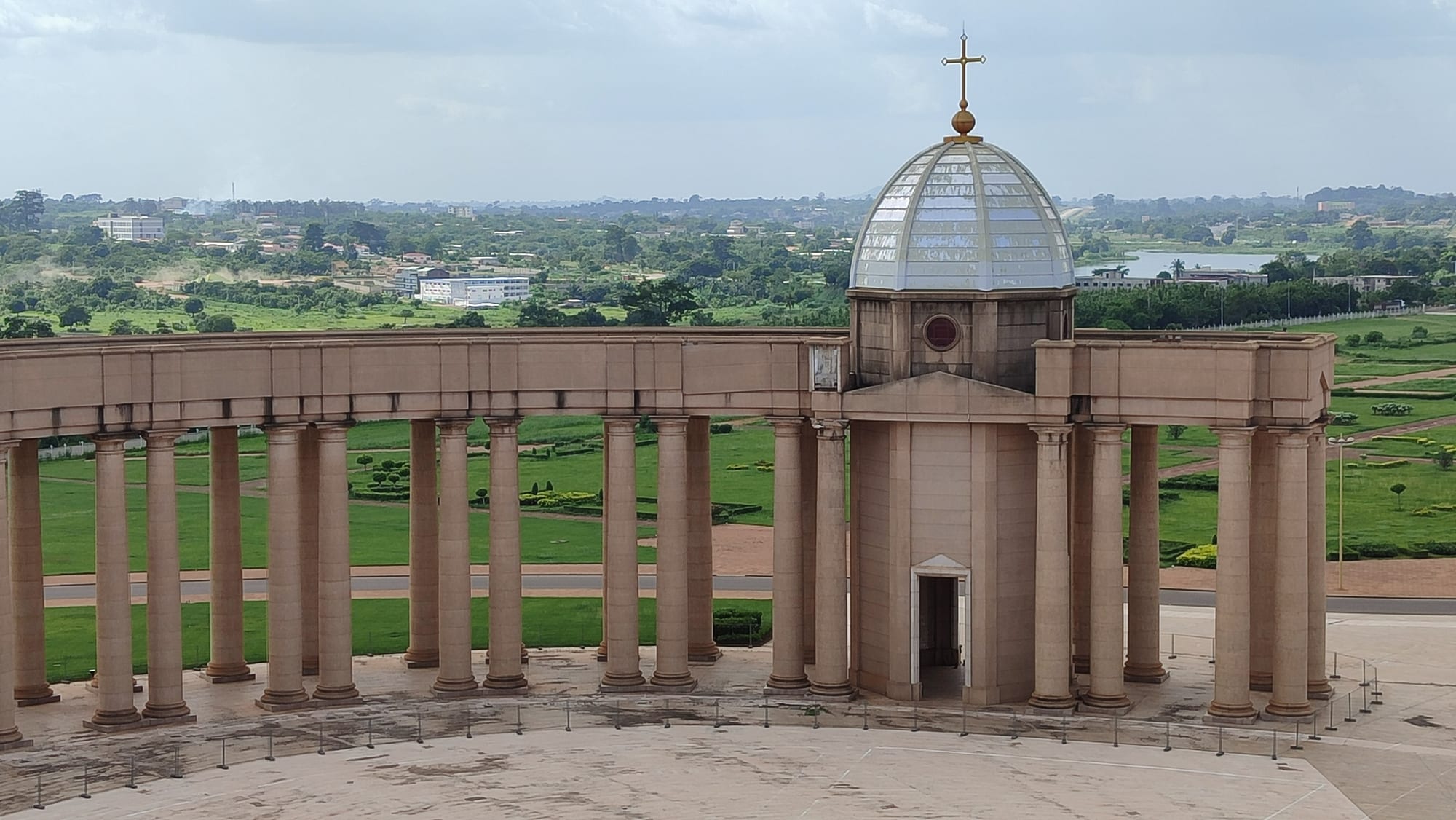
An enormous domed basilica with a colonnaded plaza, modelled on St Peter's in Rome, set among lawns and palms

Côte d'Ivoire

The Basilica of Our Lady of Peace in Yamoussoukro, completed in 1989 and among the largest churches in the world. (Didierwiki / Wikimedia Commons · CC0 (public domain dedication))

West Africa's economic powerhouse and the world's largest cocoa producer — a French-speaking country that boomed after independence, fell into civil war in the 2000s, and has rebounded fast.

Explore Côte d'Ivoire

History

The territory was a patchwork of kingdoms and stateless societies — the Baoulé and Agni in the centre and east, linked to the Akan world of present-day Ghana, the Senufo and Malinké in the north, and the Dan and Wè in the western forests, famous for their masks. Trans-Saharan and forest trade routes crossed it long before Europeans arrived.

France declared a colony in 1893 and, after decades of resistance, imposed forced labour and cash-crop farming. Félix Houphouët-Boigny, a planter and doctor, led a campaign that ended forced labour and then guided the colony to independence in 1960, which he ruled until his death in 1993. In April 1986 his government declared Côte d'Ivoire the country's formal name for all purposes and stopped recognising translations of it, though "Ivory Coast" is still widely used in English-language media.

Houphouët-Boigny's three decades brought the "Ivorian miracle": cocoa and coffee wealth, heavy investment, and stability that drew millions of migrants from poorer neighbours. When the economy faltered, tensions over land and national identity — the concept of ivoirité — hardened, producing a 2002 rebellion that split the country in two and a short but violent post-election crisis in 2010–11. Alassane Ouattara has governed since, presiding over a strong economic recovery. He was re-elected on 25 October 2025 with about 91 percent of the vote, in a contest from which several leading opposition figures were excluded and before which the government banned meetings and demonstrations against those exclusions.

Culture & Customs

Côte d'Ivoire is one of the most diverse and cosmopolitan countries in West Africa, its population drawn from dozens of ethnic groups plus large communities of Burkinabè, Malians, Guineans, Lebanese, and others. Religion is roughly split between Muslims, concentrated in the north and among migrants, and Christians in the south, with traditional practice widespread alongside both.

The country's peoples are renowned for their carved masks and masquerade — the stilt dancers of the west and the Zaouli of the Gouro of central Côte d'Ivoire are the best known — and Ivorian textile, gold, and bronze work has a long history. In music, Côte d'Ivoire gave the continent zouglou in the 1990s and then coupé-décalé, the flamboyant dance style born among Ivorians in Paris in the early 2000s that spread across francophone Africa.

Football is a unifying passion; the national team has won the Africa Cup of Nations three times, in 1992, 2015 and 2023, the last of them on home soil and a huge national moment. Hospitality, respect for elders, and long greetings shape everyday social life.

  • Côte d'Ivoire: Allies in Laughter — More than sixty peoples bound together by long greetings, old pacts of teasing friendship, masked dancers and funerals that gather whole communities — in a country where mosque, church and ancestor sit side by side

Daily Life

Abidjan, spread around a lagoon, is the economic capital and one of West Africa's largest cities — a place of high-rises in the Plateau district, sprawling working-class communes, traffic, and nightlife. Yamoussoukro, Houphouët-Boigny's home village, was made the political and administrative capital in 1983 and holds the giant basilica, but Abidjan keeps several political functions and Yamoussoukro remains far smaller.

The economy is the largest in francophone West Africa, built on cocoa — Côte d'Ivoire grew about 45 percent of the world's cocoa in 2024 — along with cashews, rubber, palm oil, coffee, oil and gas, and a growing services and construction sector. Poverty and unemployment remain widespread despite fast growth.

Daily life features the maquis, open-air eateries serving grilled fish and chicken late into the night, crowded gbaka minibuses, and busy markets, with the farming calendar and the cocoa harvest shaping the rural year.

  • Côte d'Ivoire: The Maquis Never Really Closes — Grilled fish and cold drinks served at open-air maquis eateries into the night, a packed gbaka minibus as the default way to get across town, and a rural calendar still set by the ripening of the cocoa pod

Food

Ivorian cooking is bold and starchy. Attiéké, a fermented, granular cassava couscous, is the signature side, served with grilled fish (poisson braisé), chicken, or a spicy tomato-and-onion sauce. Foutou, pounded plantain and cassava or yam, is eaten with rich sauces — sauce graine (palm nut), sauce arachide (groundnut), the aubergine-based sauce claire, or the leafy, slimy kplala, made from jute leaves. Gouagouassou is a stew of meat or fish in a vegetable sauce of aubergine and okra.

Kedjenou, a spicy stew of chicken and vegetables slow-cooked in a sealed pot with little or no added liquid, is a classic. Alloco, fried ripe plantain with a chilli-onion relish, is the universal snack, and grilled fish with piment is the maquis staple.

Bangui (palm wine), ginger juice, bissap (hibiscus), and locally brewed and imported beer are the usual drinks, along with strong coffee and, increasingly, Ivorian-grown chocolate.

  • Côte d'Ivoire: Food and the National Dish — A fermented cassava couscous eaten with grilled fish, a chicken stew sealed shut to cook in its own juices, and the world's largest cocoa producer, where chocolate plays only a small part in everyday eating

Attractions & Natural Wonders

Abidjan is the starting point for most visits, for its markets, its lagoon, the cathedral of St. Paul, the Museum of Civilisations and the contemporary art museum at Cocody, and its restaurant and music scene. Nearby, Grand-Bassam, the first colonial capital, is a UNESCO World Heritage Site of faded French buildings by the sea and hosts the Abissa festival.

Yamoussoukro's Basilica of Our Lady of Peace, modelled on St. Peter's and set in the bush, is the country's most startling sight, along with the presidential palace and its sacred crocodile lake. West of there, around the town of Man, lie forested mountains, waterfalls, the 881-metre peak known as the Dent de Man, the traditional liana bridges of the surrounding villages, and the mask-and-stilt-dancing peoples of the region.

For wildlife, Taï National Park in the southwest is one of the last large blocks of primary rainforest in West Africa, home to chimpanzees and pygmy hippos, and Comoé in the northeast is the largest protected area in West Africa, a vast savanna reserve; both are World Heritage Sites, though access is limited, and some governments advise against travel to Comoé, which lies near the northern border. The coast east and west of Abidjan has long palm-fringed beaches at Assinie and Sassandra.

Planning basics

Budget

Côte d'Ivoire is moderately priced, with Abidjan noticeably more expensive than the rest of the country for hotels and dining. Cash dominates outside the city; ATMs are common in Abidjan, Yamoussoukro, and larger towns, with Visa more widely accepted than Mastercard.

Source
Traveller reports, 2022–2024 — verify against a current source.
Daily Budget Midrange
USD 90–180 (mid-range Abidjan hotel, hired car with driver, restaurants)
Daily Budget Shoestring
USD 35–60 (basic hotel, maquis and street food, shared taxis and buses)

Carry CFA francs; euros are the easiest currency to exchange. Expect police and gendarmerie checkpoints on intercity roads.

Source: Traveller reports, 2022–2024 — verify against a current source.

Visa Requirements

Most nationalities need a visa. Côte d'Ivoire runs an e-visa system: you apply online and collect the approved visa at Port Bouet airport in Abidjan. It is normally issued within 48 hours and valid for 90 days. Check the health requirements for entry, including vaccination certificates, before you travel.

Typical Validity
Usually up to 90 days, single or multiple entry

Complete the e-visa pre-application before travelling; arrival without it is difficult.

Safety

Abidjan and the main southern cities are generally calm, with street crime — muggings, phone theft, and scams — the main concern, especially after dark and in nightlife districts. The northern border areas with Burkina Faso and Mali have seen jihadist attacks spilling over from the Sahel since 2020, with further cross-border incidents recorded as recently as 2025, and some governments advise against travel to those zones and the far west near Liberia. An armed attack on the beach resort of Grand-Bassam in March 2016 killed at least 19 people, among them foreign tourists.

Source
US Department of State, UK FCDO, and French diplomatic advisories — check for the latest wording.

Use hotel or app-based transport at night in Abidjan, avoid the northern border strip, and check current advice before travelling to the west.

Source: US Department of State, UK FCDO, and French diplomatic advisories — check for the latest wording.

Climate

Tropical. The forested south has two rainy seasons — a long one from about April to July and a shorter one in October and November — with heat and humidity year-round. The savanna north has a single rainy season from about June to October and a long dry season from about November to May, when the dusty Harmattan wind can blow.

North
one wet season; hot and hazy in the Harmattan
South
hot and humid, 25–33°C; main rains April–July

Transportation

Abidjan's Félix-Houphouët-Boigny Airport is the main gateway. A single railway runs north from Abidjan through Bouaké to Ouagadougou in Burkina Faso. Intercity coaches connect the main cities on a fairly good road network; shared taxis and gbakas (minibuses) cover shorter routes. In Abidjan, taxis and the new metro (under construction) plus buses and lagoon boats get you around.

The Abidjan–Yamoussoukro motorway is fast; roads further north and west are slower and rougher.

Best Time to Visit

December to February, the south's main dry season, is the most comfortable time and the best for road travel, though the north can be dusty. The heavy rains of May and June make some roads difficult.

Events
FECADAN, the Dan culture and mask festival in Man (June); the Abissa festival in Grand-Bassam (October–November)

Currency

The currency is the West African CFA franc (XOF), shared by the eight countries of the West African monetary union and pegged to the euro at a fixed rate of 655.957 to one euro. A reform announced in 2019 would rename it the eco, but that has not yet happened.

Symbol
FCFA
Cash To Bring
Euros, to exchange in Abidjan
Currency Code
XOF — West African CFA franc

Language

French is the official language and the medium of government, schooling, and city life. Around 70 Indigenous languages are spoken; Dioula (a Mande language) serves as a widely used lingua franca in markets and trade, especially in the north and centre. English is rarely spoken.

English
Very limited
Lingua Franca
Dioula in trade; French in the cities
Official Language
French