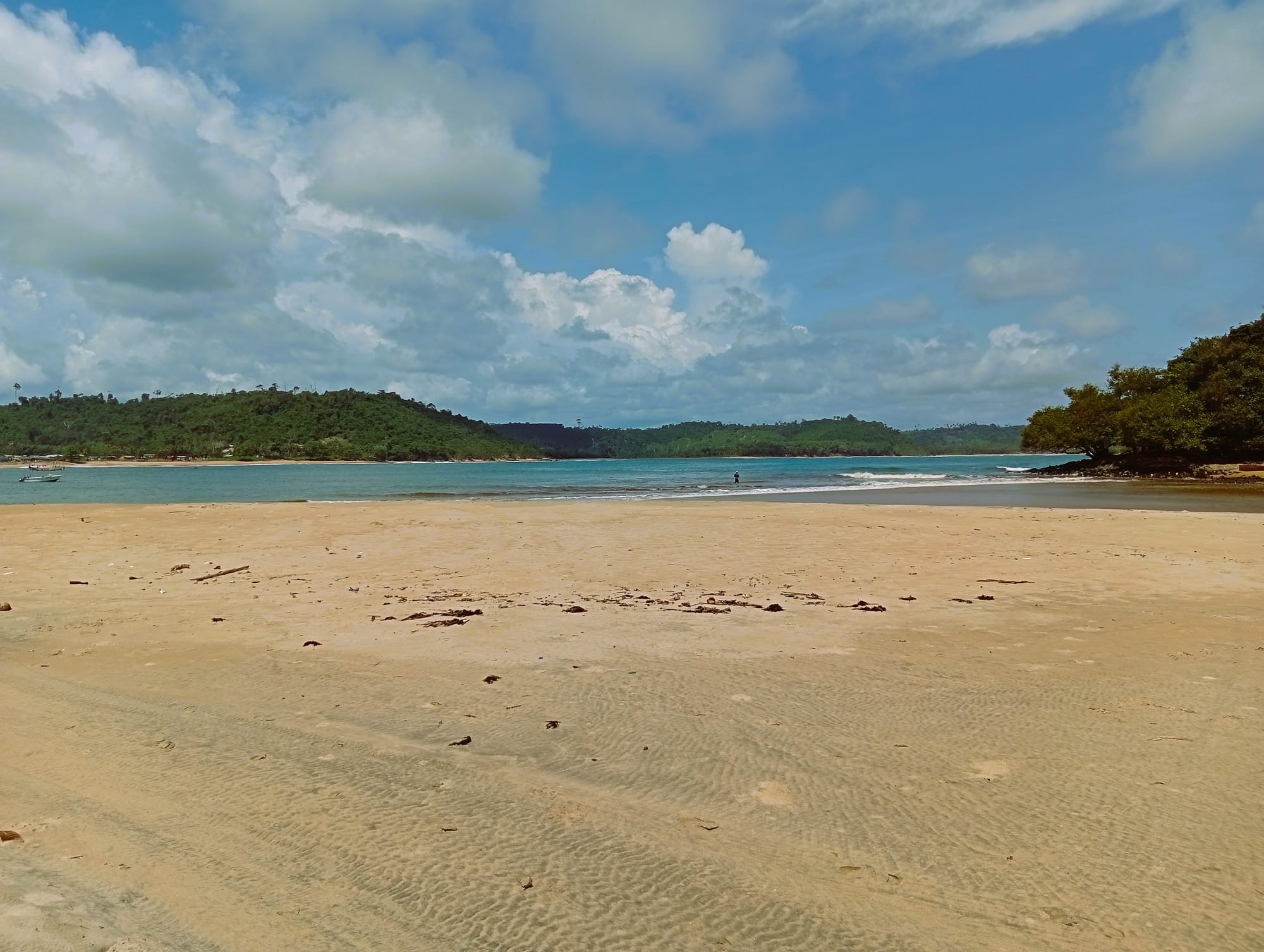
A wide, empty sandy beach curving round a turquoise bay backed by low forested hills under a blue sky with white clouds

Côte d'Ivoire

San-Pédro & the Southwest Coast

A beach at Monogaga, on the Bas-Sassandra coast of south-western Côte d'Ivoire. (Néhémienathan / Wikimedia Commons · CC BY 4.0)

The Bas-Sassandra district in Côte d'Ivoire's far south-west, running from the Sassandra river mouth to the Liberian border and inland to Soubré — a land of rocky coves, fishing towns and former rainforest turned into the country's cocoa heartland, with the cocoa port of San-Pédro and the edge of Taï National Park.

Explore San-Pédro & the Southwest Coast

History

The south-west was forest country, thinly settled by Kru-speaking peoples — Krou speakers around Tabou and Grand-Béréby, and the Neyo, Godié and Bakwé around Sassandra. From the 15th century Portuguese and later other European ships traded along this shore, and the men of the Kru coast became known as skilled sailors and dockworkers, hired aboard European vessels across West Africa.

Under French rule Sassandra became a timber and trading port at the mouth of the river that shares its name, and missions and trading houses spread along the coast. Inland the forest remained dense and hard to reach well into the 20th century, with part of what is now Taï National Park protected as a forest reserve from the 1920s.

The great change came after independence. The state built the deep-water port of San-Pédro, opened in the early 1970s, and a road network into the interior, and settlers from across Côte d'Ivoire and neighbouring West African countries poured in to clear the forest for cocoa and coffee. Soubré and the Nawa region became major cocoa and coffee areas. The fast arrival of newcomers created lasting disputes over land between them and the original inhabitants, which grew sharper during the tensions of the 2002–07 conflict and the post-election crisis of 2010–11. The region lay on the government-held side during the war, but violence in the neighbouring west and refugee movements across the Liberian border touched its border areas.

Culture & Customs

The coastal peoples belong to the Kru language family, which stretches into Liberia, and their villages keep a strong attachment to the sea, to fishing and to chiefs and lineage elders who arbitrate disputes and land. Many coastal families are Christian, alongside older beliefs in spirits of the sea and forest.

The migrant towns inland are different in character. Soubré, Méagui and the cocoa villages hold families from all over Côte d'Ivoire and West Africa alongside the Bakwé, and Dioula is the language of the market. Mosques stand beside churches, and the calendar turns on the cocoa harvest.

Along the coast, many fishing communities descend from Fanti fishermen from Ghana, whose painted wooden pirogues line the beaches at Sassandra and elsewhere. They brought their boats, their net-fishing and their fish-smoking skills, and women smoke and sell the catch in the markets.

Daily Life

San-Pédro, the capital of the district, has grown into one of the country's largest cities, with several hundred thousand people. Its economy is the port, the world's leading port for cocoa-bean exports, along with cocoa warehouses, processing plants and a sprawling informal district of migrant workers. Soubré, inland on the Sassandra river, is the other large centre and a cocoa market town. Sassandra, Tabou, Grand-Béréby, Fresco and Méagui are smaller.

Most people live from farming — cocoa above all, with rubber and oil palm plantations growing in importance — or from fishing along the coast. The Soubré hydroelectric dam on the Sassandra river, completed in 2017, and the older Buyo dam upstream supply power to the national grid.

Days start early in the plantations and on the beaches, where boats come in at dawn. The pressures of the region are deforestation, as cocoa has cut into the last forest reserves, the use of child labour on some farms, which the cocoa industry and the government are trying to tackle, and competition for land between communities.

Food

The coast eats fish above all. Grilled fish with attiéké, fermented cassava couscous, and a raw onion-and-chilli dressing is the everyday meal at the maquis of San-Pédro and Sassandra, along with smoked fish in stews and fried fish sold on the beaches. Lobster, prawns and crab are sold by fishermen in the small ports and cooked by beach restaurants.

Sauces are the backbone of home cooking. Sauce graine, made from the pulp of palm nuts, is cooked with smoked fish or meat and eaten with rice or foutou, pounded plantain and cassava. Sauce claire, based on aubergines and seasoned with akpi, and leafy sauces made with cassava leaves or other greens are common, and placali, a sticky fermented cassava dough, is eaten with them in many households. Inland, bushmeat has long been eaten, though hunting in and around the park is illegal.

Palm wine, called bangui, is tapped across the region, and coconuts, pineapples and bananas are sold by the roadside. Little of the cocoa grown here is eaten locally: most of it leaves as beans through the port.

Attractions & Natural Wonders

Taï National Park, on the western edge of the region, protects one of the largest blocks of primary tropical rainforest left in West Africa and is a UNESCO World Heritage Site. Its tall trees shelter chimpanzees noted for using tools and long studied by researchers, along with pygmy hippos, a small number of forest elephants, 11 species of primates and rare duikers such as Jentink's duiker.

Along the coast, Sassandra has the old colonial port with some buildings from the French period, a lively fishing beach at the river mouth and quiet coves nearby. Monogaga is a small coastal town with a wide beach, close to a classified forest. San-Pédro itself has its busy port, markets and the beaches just outside the town.

West of San-Pédro, Grand-Béréby has sandy beaches and beach hotels, and sea turtles nest on the beach at nearby Ménéké. Beyond it, Tabou is the last town before the Liberian border. Inland, the Sassandra river runs past Soubré, with the Nawa falls in the surrounding region, and the lake behind the Buyo dam lies further upstream.

Cities in San-Pédro & the Southwest Coast

Planning basics

Budget

Prices are lower than in Abidjan. San-Pédro has business hotels priced for the port trade, but guesthouses in Sassandra, Grand-Béréby and the smaller towns are modest, and seafood is cheap on the beaches. Beach resorts at Grand-Béréby charge more at weekends and holidays. A car and driver is the main cost, as buses do not reach most beaches. Carry cash; cash machines are found mainly in San-Pédro and Soubré.

Daily Budget Midrange
USD 85–190 (beach hotel or San-Pédro business hotel, restaurants, a hired car for the coast)
Daily Budget Shoestring
USD 35–60 (simple guesthouse, grilled fish and attiéké, coaches and shared taxis)

Withdraw enough CFA francs in San-Pédro before heading for Sassandra, Grand-Béréby or the park.

Safety

The region is generally calm and less visited than the east of the country. The sea is the main danger: strong waves and rip currents make many beaches unsafe for swimming. Roads carry heavy lorries between the port and the cocoa country, and night driving is risky. Some governments advise extra caution in the far west near the Liberian border, including around Tabou, where land disputes have caused local unrest in the past.

Swim only in sheltered bays, travel by day, and ask locally about conditions before heading towards the Liberian border. Check current official travel advice before travelling.

Climate

The south-west is the wettest part of Côte d'Ivoire, with rain in every month and the heaviest downpours from May to July. The rainforest around Taï and the Liberian border gets the most, and the coast is humid year-round with steady sea breezes. There is no true cold season; the difference is between the wetter and the drier months.

Summer
the long rains from about April to July, 24–30°C, humid, with heavy storms that can cut unpaved roads
Winter
the drier months from December to February, 25–32°C, sunny with occasional showers

Transportation

San-Pédro has an airport with flights from Abidjan, and coaches run from Abidjan along the coastal road through Sassandra in roughly six to eight hours. From San-Pédro, roads lead west to Grand-Béréby and Tabou and north to Soubré. Shared taxis cover the towns, but the beaches, fishing villages and the park's edge need a hired car or a driver, and many tracks turn to mud in the rains.

Hire a driver who knows the local tracks, and avoid driving at night, when unlit lorries and livestock share the road.

Best Time to Visit

December to March is the best time, for the beaches, for passable forest tracks and for any trip towards Taï. The long rains from May to July make rural roads muddy and the park hard to reach, and the sea is rougher. August and September bring a short drier spell on the coast before the second rains.