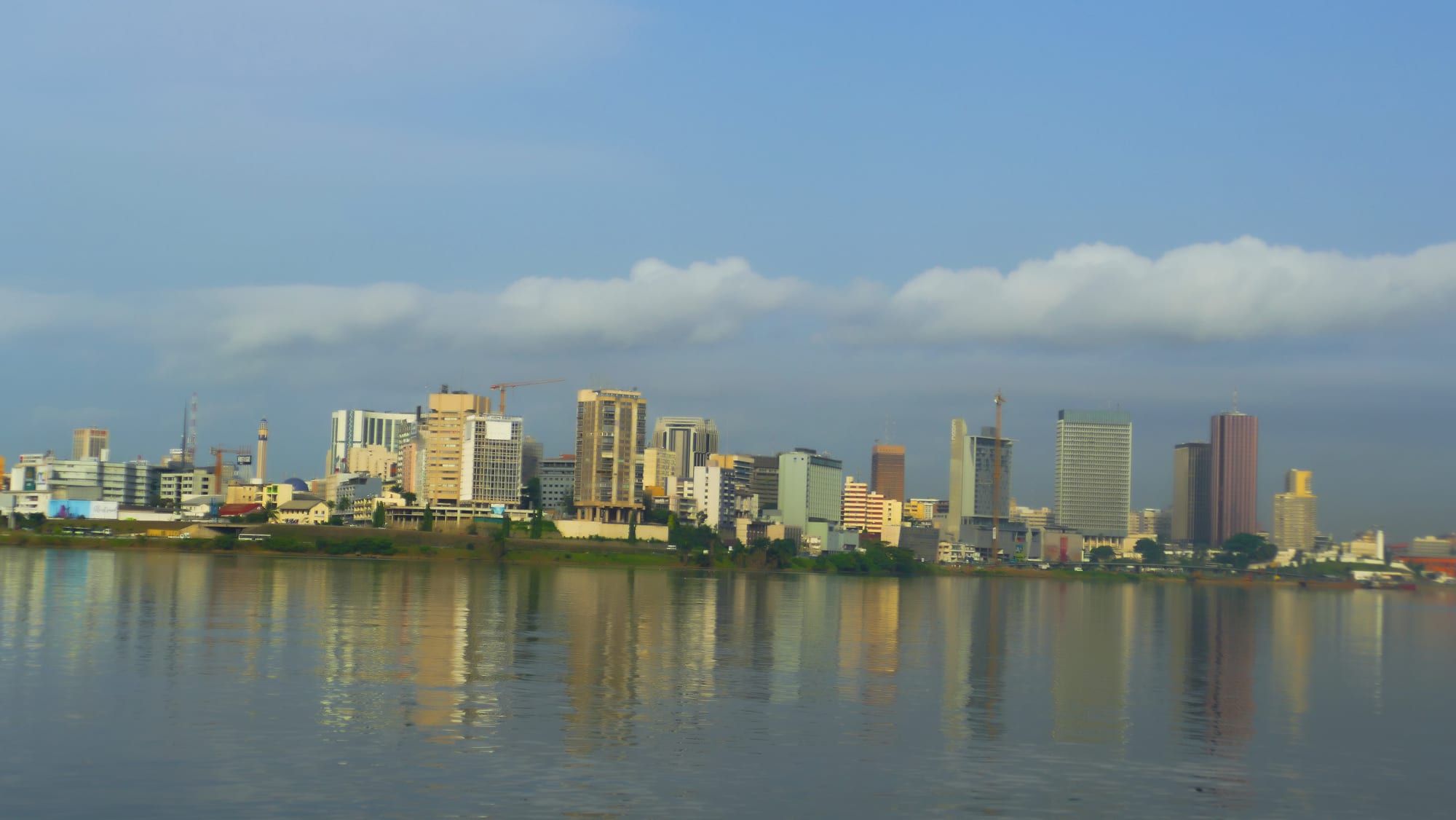
The high-rise towers of Abidjan's Plateau district reflected in the calm water of the Ébrié lagoon under a blue sky

Côte d'Ivoire

Abidjan & the Lagoons

The Plateau business district of Abidjan seen across the Ébrié lagoon. (Aman ADO / Wikimedia Commons · CC BY-SA 4.0)

Côte d'Ivoire's south-eastern coast and hinterland, strung along the Ébrié, Aby and Grand-Lahou lagoons — home to Abidjan, the economic capital and largest city, to the old colonial capitals of Grand-Bassam and Bingerville, the beach strip of Assinie and, inland, the Agni kingdom of Abengourou among the cocoa farms.

Explore Abidjan & the Lagoons

History

Before the French, this coast belonged to the lagoon peoples — the Ébrié around what is now Abidjan, the Adjoukrou at Dabou, the Avikam at Grand-Lahou, the Abouré and N'zima around Grand-Bassam — and, inland, to Akan kingdoms whose founders had migrated west from the Gold Coast. The Agni kingdoms of Sanwi, with its capital at Krindjabo near Aboisso, and Indénié, centred on Abengourou, took shape in the 18th century. European traders bought ivory, gold and palm oil along the shore, and French missionaries briefly settled at Assinie in 1687.

France signed treaties with local rulers in the 1840s and made Grand-Bassam the capital of the new colony in 1893. Yellow fever epidemics drove the administration to the higher ground of Bingerville, capital from 1900, and in 1934 the capital moved again to Abidjan, then a cluster of Ébrié villages. The Vridi Canal, cut through the sandbar in the early 1950s, gave Abidjan a deep-water port, and the city grew around it into the hub of French West Africa's trade.

Abidjan remained the capital after independence in 1960 until Yamoussoukro was named the official capital in 1983; most ministries and embassies stayed in Abidjan, which is still the economic capital. During the 2002–07 conflict the city lay in the government-held south. In the post-election crisis of 2010–11, when both Laurent Gbagbo and Alassane Ouattara claimed the presidency, Abidjan saw heavy fighting, especially in Abobo, until Gbagbo's arrest in April 2011.

Culture & Customs

The region is the most mixed part of a mixed country. Abidjan draws people from every Ivorian group and from across West Africa, and its everyday speech includes nouchi, a street slang that has grown into a creole with its own grammar. The city's nightlife, its maquis and its music scene in Yopougon and Treichville set the trends for much of francophone Africa.

Beneath the city, the older lagoon cultures persist. Ébrié villages that predate the city survive inside it, six of them in Cocody alone. The Abidji of Gomon, near Sikensi, hold the Dipri, a six-day April festival of collective trances marking the new year. At Grand-Bassam the N'zima celebrate the Abissa each year with drumming, dance and a week in which people may openly criticise their leaders.

Inland, the Agni of Indénié and Sanwi keep their royal courts, with kings carried in palanquins under umbrellas, gold regalia, stools as symbols of office and the yam festival marking the harvest. Christianity dominates in the south-east, with Catholic, Methodist and Harrist churches — the Harrist movement grew from the preaching of the Liberian evangelist William Wadé Harris in 1913–14 — alongside a large Muslim population from the north and from neighbouring countries.

Daily Life

Abidjan is one of the largest cities in West Africa, with well over 5 million people in its district. It is a city of communes: the office towers of Plateau, the residential avenues and embassies of Cocody and the Riviera, the port and old markets of Treichville, the trading hub of Adjamé, and the huge popular districts of Yopougon and Abobo. Around it lie Bingerville, Anyama and Dabou, and further out the smaller towns of Grand-Bassam, Aboisso, Agboville and Abengourou.

The economy is Abidjan's port, along with the oil refinery at Vridi, food processing, banking, construction and the regional headquarters of many companies. Inland, cocoa, rubber, palm oil and pineapples dominate the farms of Agnéby-Tiassa, La Mé and Indénié, and fishing and sand mining work the lagoons.

The day starts early to beat the traffic, with garba or bread and coffee on the way to work. Evenings belong to the maquis and the street grills. New bridges, expressways and a metro line under construction are reshaping the city, while housing costs, flooding in the rainy season and the demolition of informal settlements are the constant local issues.

Food

The lagoon coast is the home of attiéké, fermented cassava granules steamed into a light couscous. Women around Dabou and the Ébrié villages have long made it, and it is eaten with poisson braisé — whole grilled fish, often carp or capitaine, topped with onions, tomato and chilli. Abidjan's own street classic is garba, attiéké with chunks of fried tuna and a raw pepper-and-onion dressing, sold from cheap stalls.

Alloco, fried ripe plantain, is sold in the evening from street grills, often with grilled fish or chicken and a hot sauce. Kedjenou, chicken slow-cooked in a sealed pot, and foutou with sauce graine, the palm-nut sauce, appear on maquis menus alongside choukouya, grilled mutton seasoned with spice, a dish of Nigerien origin that became an Abidjan favourite. Lagoon crabs, prawns and smoked fish turn up in sauces along the coast.

Drinks are bangui, the fresh palm wine of the lagoon villages, and koutoukou, a strong palm liquor; gnamakoudji, a sweet, fiery ginger juice; bissap from hibiscus; and locally brewed lager. Pineapples and bananas from the farms inland are sold at roadside stands.

Attractions & Natural Wonders

Abidjan rewards a few days. The Plateau has the towers of the business district, St Paul's Cathedral with its cable-braced cross above the lagoon, and the Museum of Civilisations of Côte d'Ivoire with its collection of masks and statues. Treichville and Adjamé have the big markets, Cocody the university and the grand hotels, and water-buses cross the Ébrié lagoon between the communes. Banco National Park, a patch of rainforest within the city, has trails under tall trees, and on its edge the fanicos, the city's washermen, scrub clothes in the river and spread them to dry.

East of the city, Bingerville has the old governor's palace and a botanical garden, and Grand-Bassam's historic quarter, a UNESCO World Heritage Site, has colonial trading houses, the former governor's palace now serving as the National Costume Museum, and wide Atlantic beaches with shoals of fishing pirogues. Further east, Assinie is a sandbar resort of palm-fringed beaches between the Aby lagoon and the sea, and the Îles Ehotilé National Park protects small forested islands in the lagoon.

West of Abidjan, Jacqueville has quiet beaches along the barrier strip, and Grand-Lahou sits where the Bandama river meets the sea. Inland, Abengourou is the capital of the Agni kingdom of Indénié, with its royal palace and court in the middle of cocoa country close to the Ghanaian border.

Cities in Abidjan & the Lagoons

Planning basics

Budget

This is the most expensive part of Côte d'Ivoire. Abidjan's hotels in Plateau, Cocody and the Zone 4 area of Marcory are priced for business travellers, and Assinie's beach hotels charge weekend premiums. Food is the bargain: maquis and street stalls serve full meals of attiéké and grilled fish cheaply. Grand-Bassam, Abengourou and the lagoon towns cost less, and cash rules once outside Abidjan.

Daily Budget Midrange
USD 120–240 (mid-range Abidjan hotel, restaurants, app taxis, a car and driver for day trips)
Daily Budget Shoestring
USD 45–70 (basic hotel outside the centre, maquis meals, woro-woro shared taxis and buses)

Carry small notes for shared taxis and maquis, and agree the fare before setting off in any taxi that does not run on the clock.

Safety

The region is calm and the most visited part of the country. Street crime is the main concern in Abidjan — phone snatching, pickpocketing in markets and at bus stations, and scams — especially after dark and in nightlife areas. The Atlantic beaches have powerful waves and rip currents, and people drown at Grand-Bassam and Assinie every year. In March 2016 gunmen attacked beach hotels at Grand-Bassam, and security at the resorts has been tighter since.

Swim only where locals do and never alone, keep phones out of sight in the street, and use known transport at night. Check current official travel advice before travelling.

Climate

The lagoon coast is hot and humid all year, with little difference between the months in temperature and a great deal in rainfall. The long rainy season runs from about April to July, with June usually the wettest month in Abidjan, and a shorter rainy spell comes in October and November. The sea keeps the heat steady, and inland around Abengourou the air is a little drier and the nights slightly cooler.

Summer
the long rains from April to July, 24–30°C, humid, with heavy downpours and flooding in low-lying Abidjan districts
Winter
the main dry season from December to March, 25–32°C, sunny and sticky, with some Harmattan haze in January

Transportation

Félix-Houphouët-Boigny Airport at Port-Bouët is the national gateway. Within Abidjan, orange metered taxis, woro-woro shared cars, gbaka minibuses, city buses and lagoon water-buses cover the communes, though traffic on the bridges is heavy at peak hours. Grand-Bassam is about an hour east along the coastal road, Assinie roughly two hours, and Abengourou around four hours inland by coach. The coast road continues past Aboisso to the Ghana border at Noé.

Leave early for any trip out of Abidjan to avoid the bridge traffic, and use hotel or app-based cars after dark.

Best Time to Visit

December to March is the easiest time, with dry weather for the beaches of Assinie and Grand-Bassam and for road trips to Abengourou. May and June bring the heaviest rain and occasional deadly floods and landslides in Abidjan. Grand-Bassam's Abissa festival of the N'zima falls around late October and November, and August and the Christmas holidays fill the beach resorts with Abidjan families.