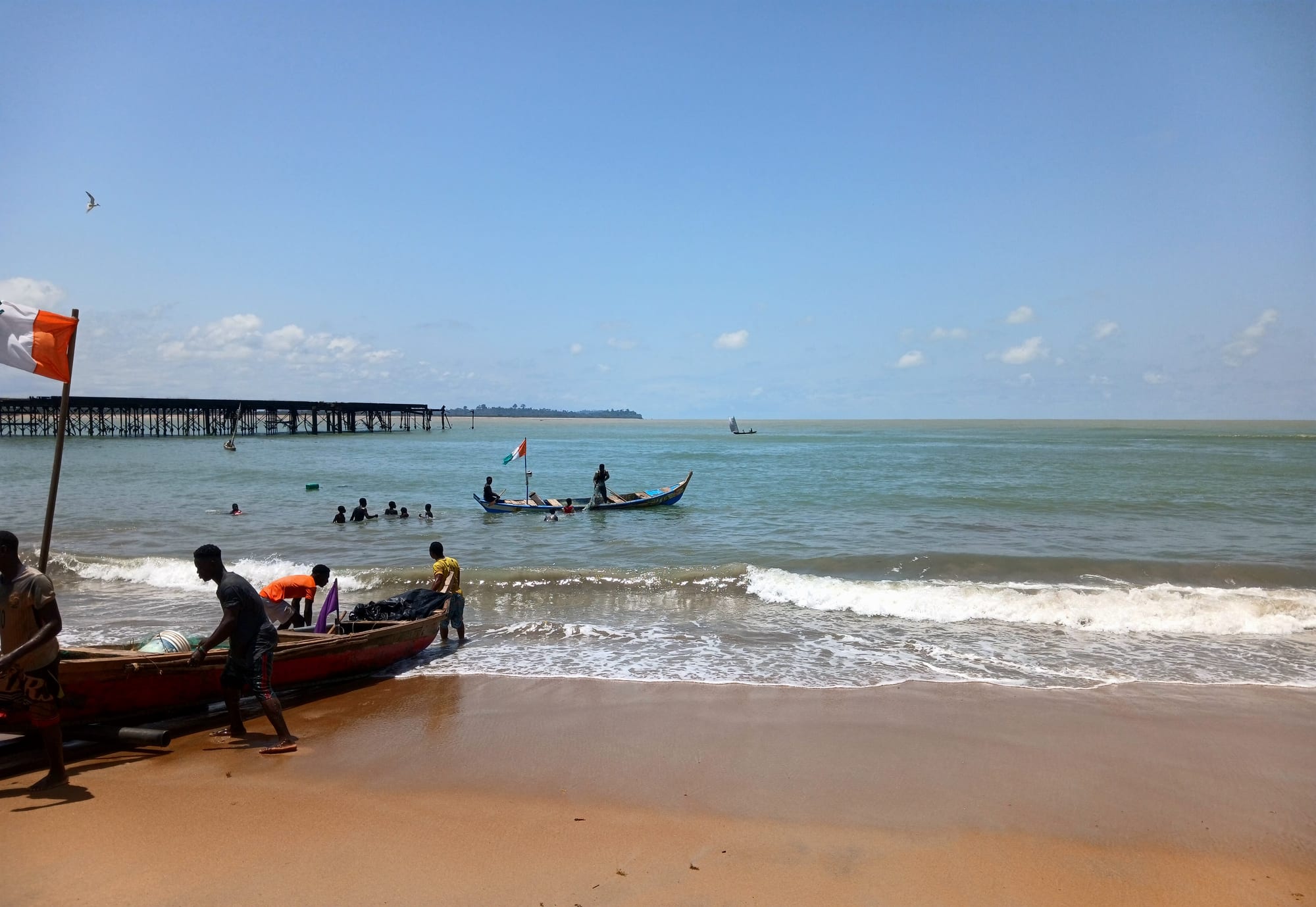
Wooden fishing pirogues on a sandy beach beside the sea, with the piles of an old wharf running out into the water

San-Pédro & the Southwest Coast, Côte d'Ivoire

Sassandra

Fishing pirogues on the beach at Sassandra, beside the remains of the colonial-era wharf. (LIPARUS18 / Wikimedia Commons · CC0)

A small town on Côte d'Ivoire's south-western coast, where the Sassandra river meets the Atlantic. The Portuguese founded it as Santo André, the British ran it after them, and the French made it a timber port; the wharf, warehouses and administrative buildings left from that period stand among the palms, some of them in ruin. Fishing and a string of beaches and coves now carry the town.

Neighbourhoods

  • The old port quarter
    • Historic district
    • First-time visitors
    • Architecture

    The headland above the river mouth, where the French built the wharf, warehouses, the administration and the residence of the colonial commandant. Several buildings are roofless or half-swallowed by vegetation, and the views over the river and the sea are the best in town.

    Open in Maps
  • The fishing beach
    • Local life
    • Best for food

    The working shore below the old port, lined with painted pirogues, drying nets and smoking ovens, many of them run by families of Fanti origin from Ghana. Fish is landed, smoked and sold here through the day.

    Open in Maps
  • The town centre
    • Markets
    • Close to public transport

    The everyday town inland from the water, with the market, shops, the shared-taxi stands and the road east towards Fresco and west towards San-Pédro. Most residents live here or in the quarters behind it.

    Open in Maps
  • The beach villages
    • Beaches
    • Quiet and residential

    Small settlements along the coast either side of the river mouth, among them Niéga, with sandy bays, coconut groves and a handful of simple places to stay or camp.

    Open in Maps

Things to do

The river and the old port

  • Sassandra Riverattraction

    One of the country's major rivers, running some 650 km from the north to reach the sea beside the town; pirogues work the lower reaches and the mangrove creeks.

    Open in Maps
  • The colonial quarter and the wharflandmark

    Warehouses, offices and the former commandant's residence built during the French period on the headland, some restored and others standing as ruins above the old wharf.

    Open in Maps
  • The fishing beach and smokehousesattraction

    Pirogues are drawn up on the sand below the town, and the catch is sorted, smoked over wood and sold within sight of the boats.

    Open in Maps

Beaches and coves

  • Poly beachbeach

    A sandy bay a short way west of the town, backed by palms and rock, and the best known of the local beaches.

    Open in Maps
  • Drewinbeach

    A fishing village and beach west along the coast, with a wide shore and a quiet setting; the surf is strong and the currents can be dangerous.

    Open in Maps
  • Niégabeach

    A beach village near the town where camping and simple accommodation have grown up beside the sand.

    Open in Maps

Short trips from the town

  • Monogagabeach

    A village beside the Monogaga Classified Forest, which covers some 350 km² across the Sassandra and San-Pédro departments, with a wide, quiet beach backed by trees.

    Open in Maps
  • San-Pédroattraction

    The planned port city of the 1970s, among the world's leading harbours for cocoa exports, with markets, beaches and the airport for the south-west.

    Open in Maps
  • Frescoattraction

    A small coastal town between a lagoon and the sea, with fishing beaches and a quieter shore than Sassandra's.

    Open in Maps

Eat and drink

Long-standing places and food districts in Sassandra. Hours, ratings and directions come from your maps app, always current.

Fish on the beach

  • Grills by the fishing beachrestaurant

    Whole fish, prawns and crab grilled over wood and served with attiéké and a raw onion-and-chilli dressing, a few steps from where the pirogues land.

    Open in Maps
  • Smoked fish standsmarket

    Women smoke the catch over wood ovens along the shore and sell it by the piece; smoked fish flavours most of the sauces cooked inland.

    Open in Maps

The town centre

  • Sassandra marketmarket

    Cassava, plantain, chillies, greens and locally made attiéké, with cheap cooked-food stalls around the edges.

    Open in Maps
  • Maquis in the centrerestaurant

    Open-air grills serving chicken, choukouya mutton and alloco in the evening, with music once the heat drops.

    Open in Maps

Experience Sassandra

History

The coast around the river mouth belonged to Kru-speaking peoples, the Neyo and Godié above all, who fished the sea and the lower river and traded along the shore. European ships had called here since the 15th century, and the men of this coast were hired as sailors and dockworkers across West Africa, work that took Kru crews far beyond their own villages and gave the region a reputation among shipping companies.

The Portuguese founded the settlement as Santo André and the British ran it after them; under French rule Sassandra became the port of the south-west. Timber floated down the river was loaded from a wharf built out over the surf, and palm oil, coffee and cocoa followed; trading houses, warehouses and an administration grew on the headland above, along with the residence of the commandant. For a time it was one of the busiest points on the Ivorian coast, and the town drew fishing families from Ghana, whose descendants still work the beach.

Its decline was decided elsewhere. When the state built the deep-water port of San-Pédro, which opened in the early 1970s, the wharf at Sassandra lost its purpose, and the trade, the lorries and the money went west. The colonial quarter was left to weather, some of it collapsing, and the town fell back on fishing, farming and small-scale trade. Visitors came in time for the beaches and the ruins, a trade interrupted by the conflict that split the country from 2002 and by the crisis of 2010–11, and resumed slowly since.

Culture & Customs

Sassandra is a Kru town with a mixed population. The Neyo and Godié are the original inhabitants, and their lineage elders and chiefs still arbitrate land and family matters, with observances tied to the sea, the river and forbidden places along the shore. Christianity is widespread, with Catholic and evangelical churches through the town, alongside older beliefs and a Muslim minority among traders and migrants from the north.

The fishing beach has a culture of its own. Families of Fanti origin from Ghana settled here generations ago, bringing the large painted pirogues, net-fishing methods and the smoking of the catch, and the division of labour is clear: men go out and land the fish, women buy, smoke and sell it. Boats are named and painted with slogans, and the return of the fleet organises the day for much of the town.

Daily manners are unhurried and formal in the West African way — greetings before business, respect for age, patience with negotiation. Football is followed closely, and the maquis provide the evening entertainment with grilled fish, coupé-décalé and zouglou. Visitors are noticed in a town this size, and a greeting and a word of French go a long way, particularly on the beach and around the old port, where guides offer their services.

Daily Life

The sub-prefecture counted about 88,000 people at the 2021 census, a modest place by Ivorian standards and a quiet one compared with San-Pédro along the coast. Most households live from fishing, from farming in the villages behind the town — cassava, plantain, rubber, oil palm and cocoa — or from trade, with a small number employed in the local administration, schools and health services.

The day begins on the water. Pirogues go out before dawn and come back through the morning, the catch is sorted and smoked on the beach, and the market is busiest early. Afternoons are slow in the heat, and the evening belongs to the street grills and the maquis. Rain governs the calendar more than temperature, with the long wet season cutting tracks and keeping boats ashore.

The town's difficulties are those of a place that lost its purpose: work is scarce and young people leave for San-Pédro and Abidjan, buildings of real historical value are decaying for lack of money to restore them, and coastal erosion is taking sand from the beaches. Tourism is the hope most often discussed, and it remains small and seasonal.

Food

Fish dominates the table. Whole fish from the sea or the river mouth — capitaine, carp, tilapia, barracuda, sole — is grilled over wood and eaten with attiéké, the fermented cassava couscous, under a dressing of raw onion, tomato and chilli. Prawns, crab and, when the boats find them, lobster are cooked the same way. Smoked fish from the beach ovens is the ingredient that makes the sauces, and it travels inland to markets across the region.

Home cooking follows the south-west. Sauce graine, made from the pulp of palm nuts, is simmered with smoked fish or meat and eaten with rice or foutou, pounded plantain and cassava; sauce claire is built on aubergine and seasoned with akpi; and cassava leaves and other greens make the leafy sauces. Placali, a sticky fermented cassava dough, is the everyday accompaniment in many households. Kedjenou, chicken sealed in a pot with peppers and tomato, marks celebrations.

Snacks and drinks are those of the coast: alloco, ripe plantain fried in palm oil with a chilli-onion relish; garba, attiéké with fried tuna; bangui, the palm wine tapped from the groves behind the beach, and koutoukou distilled from it; gnamakoudji ginger juice; bissap from hibiscus; coconut water; and cold local lager. Pineapples, bananas and mangoes are sold along the road into town.

Planning tools

Budget

Sassandra is inexpensive. Guesthouses in the town and simple places on the beaches are modest, and fish bought or eaten at the shore costs very little. The main expense is transport, since the coves and villages along the coast are not served by buses and need a hired car, a motorbike taxi or a boat. There is little to spend money on beyond food, rooms and travel.

Daily Budget Midrange
USD 85–190 (beach hotel, restaurants, a hired car for the coast)
Daily Budget Shoestring
USD 30–55 (simple guesthouse or beach camp, grilled fish and attiéké, shared taxis)

Bring CFA francs from San-Pédro or Abidjan; cash machines here are few and unreliable, and nothing outside a hotel takes cards.

Best Time to Visit

December to March is the driest and easiest stretch, with calmer seas and passable coast roads, and a shorter dry spell falls in August and September. The long rains from May to July are heavy on this coast and turn the unpaved tracks to the beaches into mud.

Suggested Number of Days

A day covers the old port, the beach and the town. Two or three suit anyone who wants the coves and fishing villages along the coast as well, and travel times rather than distances decide how much fits in.

First Visit
1 day
With Surroundings
2–3 days

Transportation

The town is small enough to walk, and motorbike taxis and shared cars cover the rest of it. Shared taxis and minibuses run along the coastal road to San-Pédro and east towards Fresco, and coaches on the Abidjan route pass through. Reaching the beaches, the coves and the villages across the river needs a hired car, a motorbike or a pirogue.

Hire a driver who knows the local tracks, and avoid driving at night, when unlit lorries and livestock share the road.

Airport & Station Connections

Sassandra lies on the coastal road roughly 65 km east of San-Pédro and about 270 km west of Abidjan, five to seven hours by coach from the capital and about an hour and a half from San-Pédro. The town has a small airport of its own, and San-Pédro's is the one with flights to Abidjan. Shared taxis serve the town through the day, and the junction on the main road is a short ride from the centre.

Walkability

The town is compact and walking is the natural way around it: the market, the beach and the old port quarter are within a couple of kilometres of one another, though the headland involves a climb. Pavements are few, the sand is the easiest route between beach quarters, and the heat and humidity make midday walks hard work.

Safety

The town is quiet and crime against visitors is uncommon, with petty theft on the beach the usual concern. The sea is the real danger: the Atlantic here has powerful surf and rip currents, and the river mouth adds strong outflows, so swimming is safe only in sheltered coves. Pirogues rarely carry life jackets, and coastal tracks are rough and unlit at night.

Swim only in sheltered bays, travel by day, and ask locally about currents and the state of the coastal tracks before setting out. Check current official travel advice before travelling.

Climate

Hot and humid throughout the year on a coast that is among the wettest in the country, with sea breezes and rain in most months. The heaviest downpours fall between May and July, with a drier spell around August and September.

Summer
the long rains from May to July, 24–30°C, humid, with storms and a rough sea
Winter
the drier months from December to February, 25–32°C, sunny with occasional showers

Local Customs

French is the working language, with Neyo, Godié and other Kru languages spoken in the town and villages and Dioula in the market. The fishing beach is a workplace: boats, nets and drying racks belong to families, and permission should be asked before walking among them or taking photographs. Greetings come before any request, and elders are addressed first.

Ask before photographing people, boats or the catch, dress modestly away from the beach, and agree the price of a boat trip or a guide in advance. Tipping is not expected.

Common Payment Methods

The currency is the West African CFA franc (XOF), pegged to the euro. The town runs on cash: the market, the maquis, the boatmen and the taxis take nothing else, and the few cash machines cannot be relied on. Mobile money is used for small payments, and larger withdrawals are best made in San-Pédro.