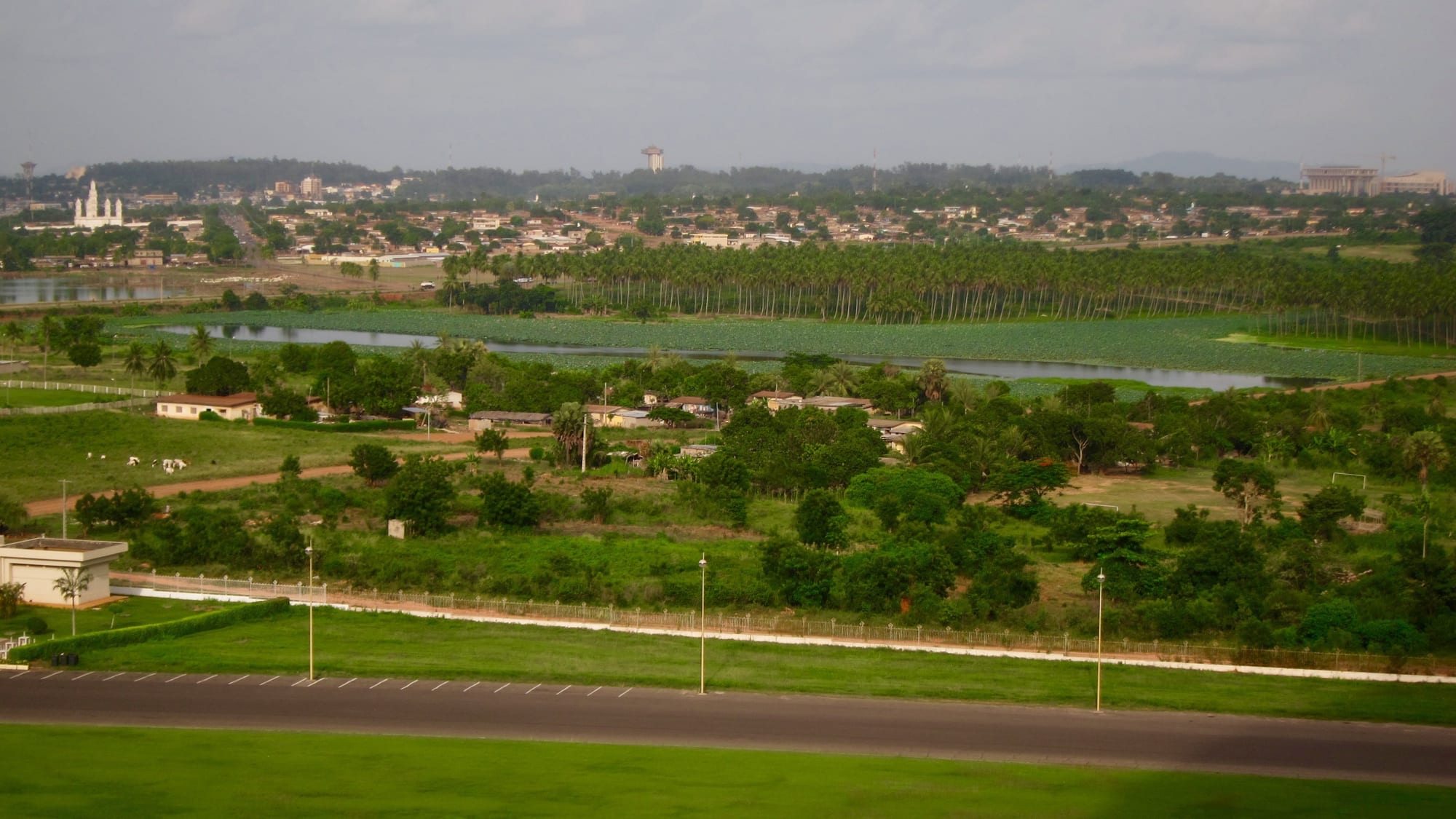
A green view over Yamoussoukro from above, with a lake, a long line of palms and low town buildings under a hazy sky

Yamoussoukro, Man & the Centre-West, Côte d'Ivoire

Yamoussoukro

Yamoussoukro seen from the Basilica of Our Lady of Peace, with the town's lakes and palm rows in front of it. (Mickaël T. / Wikimedia Commons · CC BY 2.0)

Côte d'Ivoire's official capital, in the Baoulé savanna about 240 kilometres north-west of Abidjan. Félix Houphouët-Boigny turned his home village into a planned city of eight-lane avenues, lakes and monuments, and made it the capital in 1983. Its dome, palace lakes and polytechnic sit in a town that is still far smaller and quieter than the coast.

Neighbourhoods

  • Assabou
    • First-time visitors
    • Monuments
    • Close to the basilica

    The administrative quarter laid out with the capital, where the great boulevards, government buildings and the Houphouët-Boigny Foundation stand. It is the most spacious and the most obviously planned part of town, with long verges and little street life away from the offices.

    Open in Maps
  • Habitat
    • Local life
    • Best for food
    • Markets

    A busy residential quarter of low concrete houses, small shops and maquis, where much of the town's evening life happens. Grilled fish and chicken stalls set up along the streets after dark.

    Open in Maps
  • Millionnaire
    • Local life
    • Nightlife

    One of the older and denser quarters, known for its bars and eating places and for a name that long outlasted whatever inspired it. It is a good place to see the working town behind the monuments.

    Open in Maps
  • Dioulakro
    • Markets
    • Quiet and residential

    The quarter associated with the town's Dioula traders, with a market feel, mosques and small commerce. Dioula is heard here as much as Baoulé or French.

    Open in Maps
  • Kokrenou
    • Quiet and residential
    • Local life

    A residential quarter of family compounds and courtyards near the centre, with corner shops, tailors and schools. The rhythm is domestic rather than commercial.

    Open in Maps

Things to do

Famous landmarks

  • Basilica of Our Lady of Peacelandmark

    The domed basilica modelled on St Peter's in Rome, consecrated by Pope John Paul II in September 1990 and listed by Guinness World Records as the largest church in the world, at 30,000 square metres and 158 metres tall, with vast stained-glass windows and a marble plaza.

    Open in Maps
  • Félix Houphouët-Boigny Foundation for Peace Researchlandmark

    A marble conference and research institution founded by the first president, set in gardens on one of the capital's broad avenues.

    Open in Maps
  • Institut National Polytechnique Félix Houphouët-Boignyattraction

    The country's main engineering and agronomy school, a campus of the 1970s and 1980s that gives the town a large student population.

    Open in Maps
  • Presidential Palace and its lakeslandmark

    The walled presidential residence beside artificial lakes that are home to crocodiles; the grounds are closed, and the lakes are viewed from the road outside.

    Open in Maps
  • Grand Mosque of Yamoussoukrolandmark

    The main mosque of the town, built between 1963 and 1968 at Houphouët-Boigny's initiative, serving a large Muslim population drawn from the north and from neighbouring countries.

    Open in Maps

Streets, markets and green space

  • Boulevard Houphouët-Boignyattraction

    The central axis of the planned capital, an avenue of several lanes and hundreds of street lamps that is famous for being far wider than the traffic it carries.

    Open in Maps
  • Yamoussoukro central marketmarket

    The town's main market, selling yams, plantain, smoked fish, cloth and household goods, and busiest in the morning.

    Open in Maps
  • Yamoussoukro International Airporttransit hub

    An airport built to international dimensions, one of only two in Africa whose runway could take Concorde, about 14 km from the centre.

    Open in Maps

Short trips from the city

  • Lake Kossouattraction

    The country's largest lake, a reservoir on the Bandama river, edged by Baoulé fishing and farming villages, with canoes drawn up in the reeds.

    Open in Maps
  • Kossou Damlandmark

    The embankment dam that created the lake in 1973, about 32 km north-west of the town; some 75,000 Baoulé people were displaced, and its power station has a capacity of 174 megawatts.

    Open in Maps
  • Sakassouattraction

    The capital of the Baoulé kingdom founded about 1730 by Queen Abla Pokou, some 70 km north of Yamoussoukro, and the seat of the monarchy to this day.

    Open in Maps

Eat and drink

Long-standing places and food districts in Yamoussoukro. Hours, ratings and directions come from your maps app, always current.

Yamoussoukro classics

  • Foutou with sauce clairerestaurant

    Pounded yam or plantain eaten by hand with a light aubergine-based sauce, the everyday dish of the Baoulé centre and served in most small eating houses.

    Open in Maps
  • Kedjenourestaurant

    Chicken or guinea fowl sealed in a pot with tomato, onion and chilli and cooked slowly in its own steam, the celebratory Ivorian dish.

    Open in Maps
  • Poisson braisé with attiékérestaurant

    Grilled fish with fermented cassava couscous, chilli and onion, the standard order at the open-air maquis that fill up after dark.

    Open in Maps

Markets and food streets

  • Yamoussoukro central marketmarket

    Yams in many varieties, plantain, smoked fish, groundnut paste and peppers, with cooked-food sellers along the edges.

    Open in Maps
  • The maquis of Habitatneighborhood

    Streets of open-air grills where fish, chicken and alloco are cooked over charcoal and eaten at plastic tables well into the night.

    Open in Maps

Experience Yamoussoukro

History

Yamoussoukro began as NʼGokro, a Baoulé village of a few hundred people in the savanna between the Bandama and NʼZi rivers, and took its later name from Yamousso, a village queen who was an ancestor of Félix Houphouët-Boigny. He was born here in about 1905 into a chiefly planter family, trained as a medical assistant, built a career in cocoa farming and trade-union politics, and led the country to independence in 1960 as its first president.

From the 1960s onwards he redirected national money towards his birthplace. Engineers laid out a grid of multi-lane boulevards with hundreds of street lamps, dug ornamental lakes, and built a polytechnic institute, hotels, a conference foundation, an airport with a runway sized for the largest aircraft, and a golf course, all on a scale the population did not need. In March 1983 Yamoussoukro was declared the political and administrative capital, though most ministries, embassies and business stayed in Abidjan, where they largely remain.

The Basilica of Our Lady of Peace, built between 1985 and 1989 and consecrated by Pope John Paul II in September 1990, was the culmination and the most argued-about of these projects, paid for, the president said, from his own means. He died in 1993, and his funeral was held in the basilica. Yamoussoukro lay close to the line that divided the country during the conflict of the 2000s but was held by the government side, and it has grown steadily since reunification, above all as a university town.

Culture & Customs

This is the heart of Baoulé country, and Baoulé identity shapes the town: the language is heard everywhere alongside French, chieftaincy still carries weight, and funerals are major social events that bring families back from Abidjan for days of drumming, dancing and feasting. Baoulé carving — portrait figures, goli masks and the figures of spirit spouses — comes from villages within a short drive, and woven strip cloth is worn at ceremonies and gifted at weddings.

The town is also a capital, and that gives it a second character: official ceremonies, visiting delegations, conferences at the Houphouët-Boigny Foundation, and the memory of the first president, whose name is attached to the polytechnic, the foundation and much else. Catholic life is unusually visible for a town of this size because of the basilica, which draws pilgrims and hosts ordinations, while the Grand Mosque serves a large Muslim community of northern and migrant origin, and the two coexist quietly.

Student life gives the place its youth. The polytechnic and the teacher-training and agricultural schools fill the maquis and the football pitches, and small music venues play coupé-décalé and zouglou. Manners are formal by Ivorian standards: greetings are long, elders are deferred to, and the right hand is used for giving and receiving.

Daily Life

The 2014 census counted 361,893 people in Yamoussoukro, a figure that covers the whole autonomous district — its single commune shares the district's borders — as well as the town itself; the built-up city is considerably smaller and feels it. The population is mostly Baoulé, with Dioula traders, northern migrants and communities from Burkina Faso and Mali, and a student body that swells the town in term time.

Administration, education and farming carry the economy. The district offices, the polytechnic and the schools are the big employers, and around them are the market trades, transport, hotels and the building sector. Beyond the boulevards the land is farmed for yams, cassava, plantain, rice and increasingly cashews, and fishing works Lake Kossou to the north-west.

The day starts early and pauses in the afternoon heat. Mornings belong to the market and the schools; evenings to the maquis, where grilled fish and chicken appear on the charcoal and the plastic chairs fill. The town's enduring problem is its unfinished ambition: the avenues, hotels and public buildings were designed for a capital that never fully arrived, so maintenance, water and electricity supply, street lighting and jobs for graduates are the issues people raise.

Food

Yam is the staple. It is pounded with plantain or cassava into foutou, a smooth elastic dough eaten by hand and dipped into sauce claire, a light aubergine and tomato sauce, or sauce graine, made from boiled palm nuts, or sauce arachide, thick with groundnut paste. The Baoulé country grows dozens of yam varieties and the market piles them up by the hundred in the months after the harvest.

Kedjenou is the dish for celebrations: chicken or guinea fowl with tomato, aubergine, onion and chilli sealed in a covered pot and cooked slowly so that it steams in its own juices, traditionally shaken rather than stirred. The everyday alternative is grilled food — poisson braisé, whole fish scored, spiced and cooked over charcoal, or chicken, served with attiéké, the granular fermented cassava couscous that stands in for rice, and a fierce relish of chilli, onion and tomato. Alloco, ripe plantain fried in palm oil, is the snack bought on any street corner.

To drink, there is bangui, the palm wine tapped in the villages and sold in bottles and calabashes, ginger juice, bissap made from hibiscus flowers, strong sweet coffee and Ivorian beer. Roadside sellers offer roasted maize, groundnuts, mangoes in season and small bags of water, and the maquis stay open long after the offices have emptied.

Planning tools

Budget

Yamoussoukro is cheaper than Abidjan. The town has a number of hotels built for conferences and official visits, which keeps mid-range rooms available and reasonable, and maquis meals cost very little. The main extra cost is transport: the sights are spread along wide avenues, and reaching Lake Kossou or the Baoulé villages means hiring a car and driver.

Daily Budget Midrange
USD 80–170 (comfortable hotel, restaurants, a car and driver for trips out of town)
Daily Budget Shoestring
USD 30–55 (simple hotel, maquis meals, shared taxis)

Carry CFA francs in small notes; cash machines exist in the centre but cards are rarely accepted outside the larger hotels.

Best Time to Visit

November to March, the dry season, is the most comfortable time for walking and for road travel to the lake and the villages. The Harmattan can leave the sky hazy from December to February. Rain falls mainly between April and October, heaviest around May and June.

Suggested Number of Days

A day or two covers the capital's monuments at an unhurried pace, since the distances between them are long and the town is quiet. Add a day for the lake and the Baoulé villages nearby, or for using Yamoussoukro as a base on the way north or west.

First Visit
1–2 days
With Surroundings
3 days

Transportation

Shared taxis and motorbike taxis are the everyday transport, and the orange town taxis can be hired by the hour or the day. The avenues are far too long to cover on foot in the heat, so most visitors arrange a vehicle for a half day. Coaches to Abidjan, Bouaké, Daloa and Man leave from the bus stations in the centre.

Agree the fare before getting into a shared taxi, and expect police checkpoints on the roads out of town.

Airport & Station Connections

The motorway from Abidjan reaches Yamoussoukro in about three hours, and frequent coaches make the run all day. Bouaké is roughly an hour and a half further north, and Man a long half-day drive west. Yamoussoukro International Airport sits about 14 km from the centre, and most arrivals are by road from Abidjan.

Walkability

The town was planned for cars. Pavements exist along the main boulevards but the blocks are enormous, shade is scarce and the basilica, the palace lakes and the market are kilometres apart. Within a single quarter such as Habitat walking is easy and pleasant in the evening.

Safety

Yamoussoukro is among the calmer towns in the country, with petty theft and pickpocketing in the market the main concerns. The wide avenues are poorly lit at night and traffic moves fast. The area around the presidential palace is guarded, and photographing it or other official buildings is not allowed.

Use hotel or app-based transport at night, avoid the northern border strip, and check current advice before travelling to the west. Keep valuables out of sight in the market, do not photograph the palace, military or police, and carry identification. Check current official travel advice before travelling.

Climate

A savanna-edge tropical climate, drier than the forest south. Days are hot through the year, nights mild, and the sky turns hazy in the Harmattan months.

Summer
wet and humid from April to October, typically 22–31°C, with heavy afternoon storms in May and June
Winter
dry from November to March, typically 20–35°C, with Harmattan dust and cooler mornings

Local Customs

Greetings matter and are unhurried: a handshake and enquiries about family come before business. Elders and chiefs are addressed first. Dress is modest in town, and shoulders and knees should be covered at the basilica and the mosque. Both Christian and Muslim observance is strong, and Friday prayers and Sunday mass shape the week.

Tipping is not expected but small change is appreciated; ask before photographing people, and never photograph the presidential palace, soldiers or checkpoints.

Common Payment Methods

The currency is the West African CFA franc (XOF), pegged to the euro. Cash rules: market stalls, taxis and maquis take nothing else. Cash machines are available in the centre and larger hotels take cards, but small notes are essential for daily spending.