History · Côte d'Ivoire
Why does Yamoussoukro, Côte d'Ivoire, have a basilica billed as the world's largest church?
Félix Houphouët-Boigny made his home village the capital and gave it a basilica modelled on St Peter's; whether it is truly the largest depends on the measure.
By Globeway Editorial · 2 November 2026
The short answer
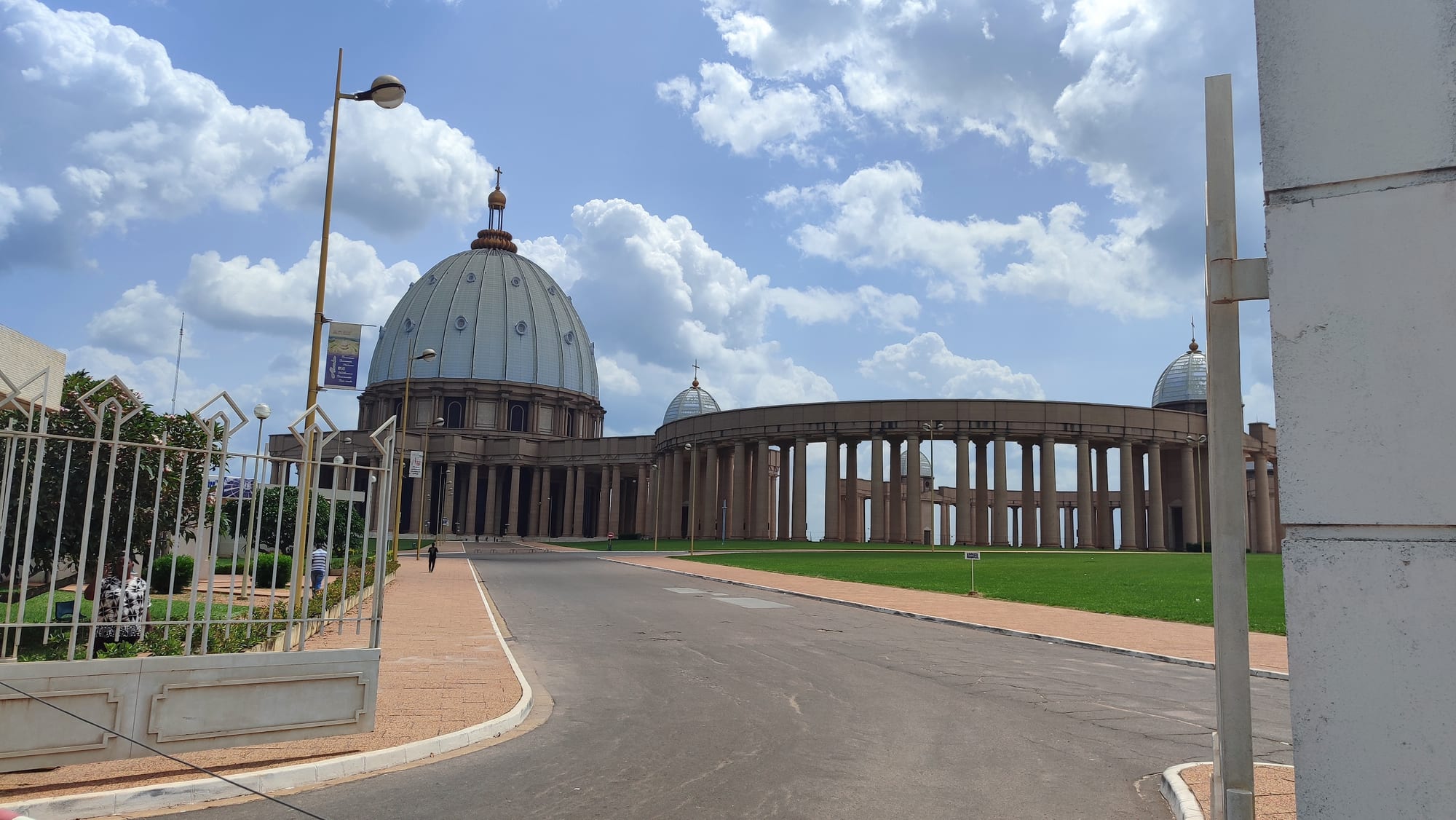
The Basilica of Our Lady of Peace stands in Yamoussoukro because it was the birthplace of Félix Houphouët-Boigny, who led Côte d'Ivoire from independence in 1960 until his death in 1993. In 1983 he made his home village the country's capital, and as part of the new city he built a basilica modelled on St Peter's in Rome, partly as a memorial to himself. It was built between 1985 and 1989 and consecrated by Pope John Paul II in 1990.
Two parts of the question need correcting. Yamoussoukro was a village of about 500 people in 1950, but it is no longer small: by the 2014 census it had 361,893 people and was the country's third most populous city. And "largest" is a matter of measurement. Guinness World Records lists the basilica as the largest church in the world, with an area of 30,000 square metres, but that figure includes a rectory and a villa that are not strictly part of the church. St Peter's Basilica remains the largest church by interior measure, and it holds about 60,000 people against 18,000 in Yamoussoukro.
A chief's son who became president
Houphouët-Boigny was born, probably in 1905 according to his official biography, into a family of hereditary chiefs of the Baoulé people in the village then called N'Gokro. It took the name Yamoussoukro from his great-aunt, Queen Yamousso; "kro" means town in Baoulé. In 1915, as a schoolboy at Bingerville, he converted to Christianity, which he saw as a modern religion, and was christened Félix. He worked as a medical aide, a planter and a union leader, and in 1960 led the colony to independence from France.
His three decades in power brought what became known as the "Ivorian miracle": stability and growth built on coffee and cocoa and on close ties with France. In March 1983 he moved the capital from Abidjan to Yamoussoukro, about 240 kilometres to the north-west. It was the fourth time the capital had moved in a century, after Grand-Bassam in 1893, Bingerville in 1900 and Abidjan in 1933. At state expense he gave his birthplace a polytechnic institute, an international airport and other new buildings. Abidjan, though, kept much of the government's work and remains the economic capital.
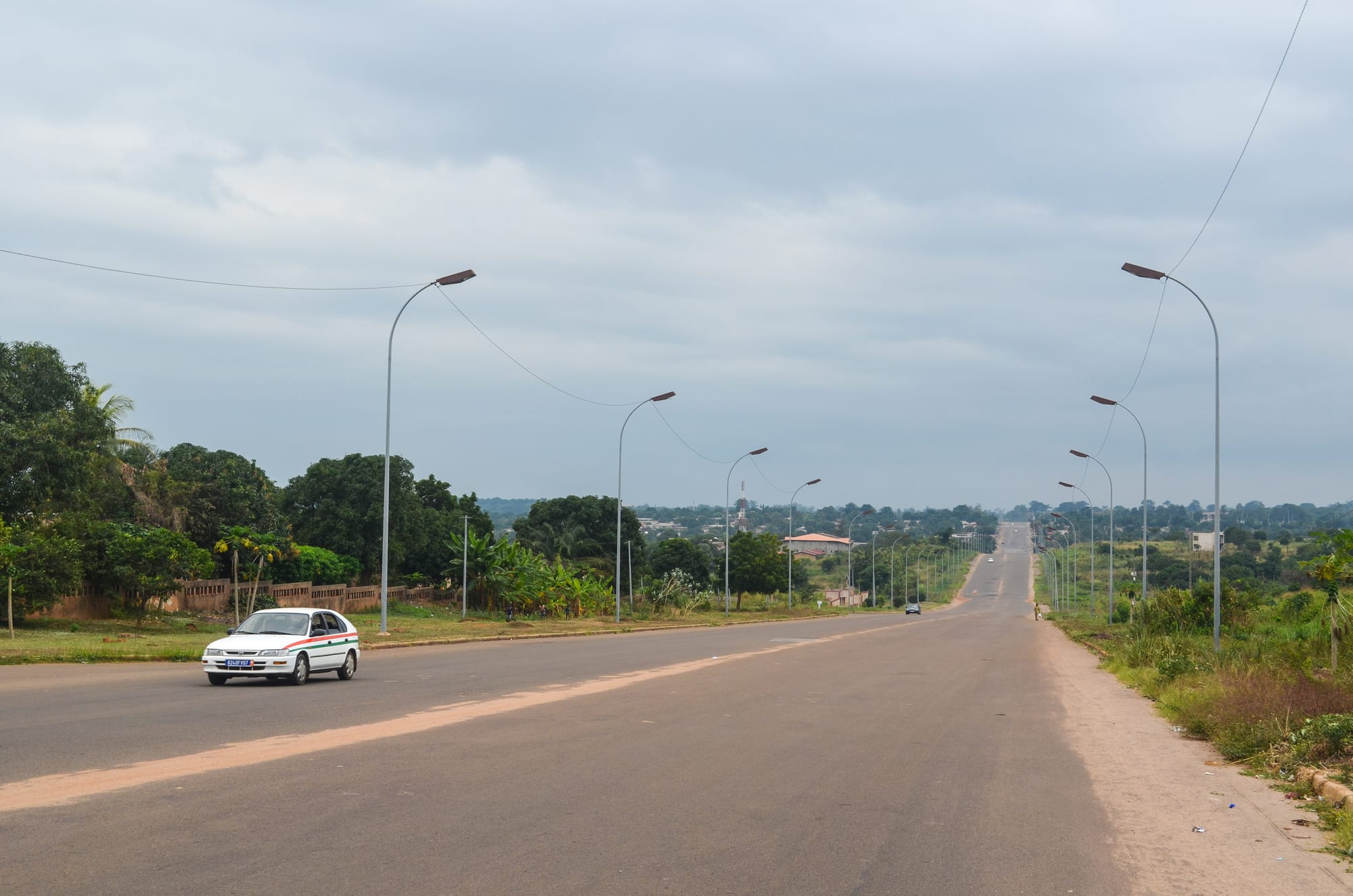
Yamoussoukro became the legal capital in 1983, but most of the country's economic activity stayed in Abidjan.
St Peter's, reimagined in the savanna
The basilica was the most lavish of the new capital's projects. The architect, Pierre Fakhoury, took the dome and the encircling plaza from St Peter's without making a copy. The cornerstone was laid on 10 August 1985 and the French firm Dumez built it. Its dome is more than twice as wide as St Peter's, 90 metres across against 41, but it sits on a lower base, so the building's overall height of 158 metres is slightly less, crowned by a larger cross.
The materials came from far away. The marble was imported from Italy, and France Vitrail International, near Paris, made about 8,400 square metres of stained glass in 18,500 panels, the largest such order ever placed. Inside, the nave seats 7,000 people on pews of iroko wood, with standing room for 11,000 more. Many of the larger columns are hollow, hiding lifts and pipes that carry rainwater down from the roof. In 1989 Guinness recognised the basilica as the widest Christian building in the world, at 150 metres against 115 for St Peter's.
One stained-glass window shows Christ's triumphal entry into Jerusalem, with Houphouët-Boigny himself kneeling beside Jesus. He believed the basilica would become a place of pilgrimage for Catholics across Africa.
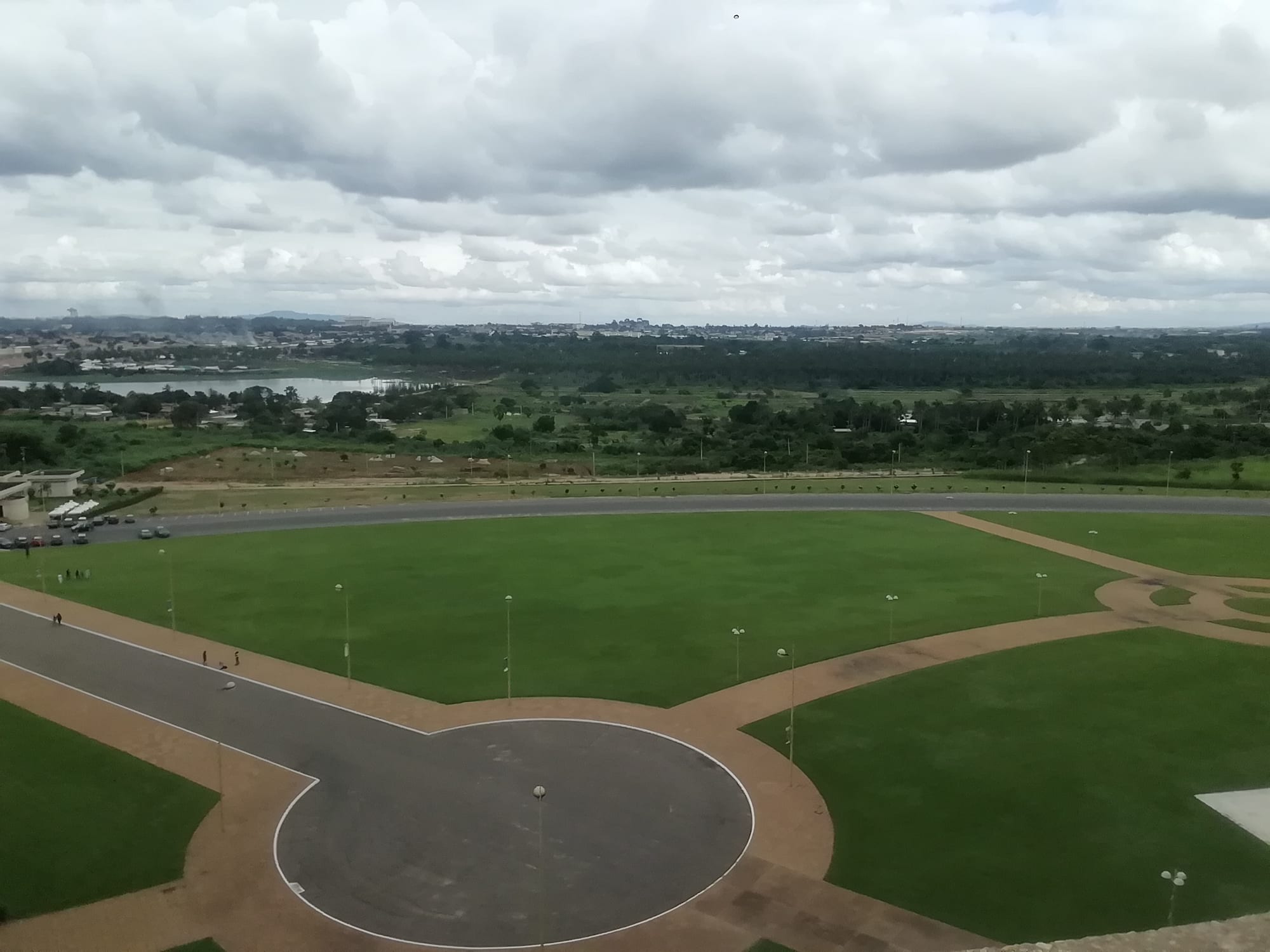
The basilica stands amid wide open grounds, and its setting helped earn it the nickname "basilica in the bush".
The "basilica in the bush"
The timing made the project controversial around the world. After a sharp fall in coffee and cocoa prices in 1980, Côte d'Ivoire was in an economic and financial crisis while the basilica rose. Estimates of its cost vary widely, from US$175 million to US$300 million and as high as US$600 million. Houphouët-Boigny said it had been paid for out of his personal fortune. Several Western news agencies dubbed it the "basilica in the bush".
He offered it to the Catholic Church as a gift. Pope John Paul II accepted it and consecrated it on 10 September 1990, on the condition that a hospital also be built nearby. Work on the hospital was frozen during the Ivorian civil war that began in 2002, and it was completed only in the 2010s. Houphouët-Boigny died on 7 December 1993, and his funeral was held in the basilica on 7 February 1994, with 7,000 guests inside and tens of thousands outside.
So is it really the largest?
Churches can be measured by area, volume, length, width, height or seating, and several claim the title depending on the yardstick. Yamoussoukro's record rests on its overall footprint and its width. By the space inside the walls, St Peter's Basilica is larger, with an interior area of about 15,160 square metres, and it holds more than three times as many people. The two buildings also differ in status: Yamoussoukro's basilica is not a cathedral. The seat of the local bishop is the smaller Cathedral of Saint Augustine, less than 3 kilometres away.
Visiting the basilica today
The basilica rises above French-style gardens, and its oval plaza is ringed by 128 columns, each 21 metres tall. It is run by Polish Pallottine priests, at a cost of about US$1.5 million a year, and it is the country's most startling sight. Yamoussoukro has a tropical wet and dry climate, with a long wet season from March to October and a shorter dry season, shaped by the dusty harmattan wind, from November to February.