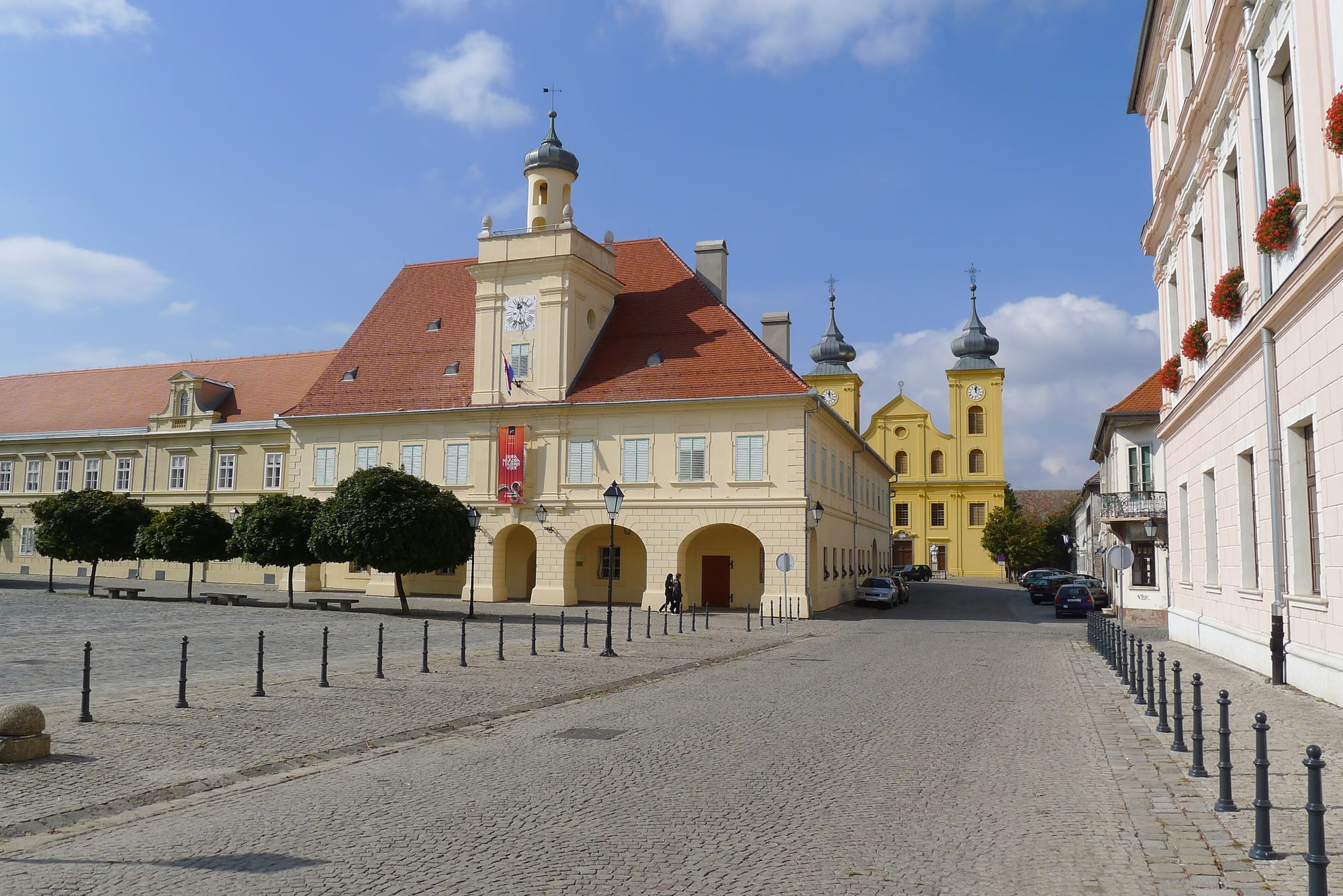
Cobbled baroque square with a cream building topped by a clock tower and a yellow twin-towered church behind it

Slavonia & the East, Croatia

Osijek

Holy Trinity Square in Tvrđa, Osijek, with the City Guard building and the Church of St Michael behind. (Ciocolli / Wikimedia Commons · CC BY-SA 4.0)

The largest city of Slavonia, on the south bank of the Drava 25 km above its meeting with the Danube. Roman Mursa, then an Ottoman trading town, it was rebuilt by the Habsburgs around the baroque fortress of Tvrđa and grew rich as a Central European market city. Shelled in 1991–92 and since restored, it is now a university city with trams and a long riverside promenade.

Neighbourhoods

  • Tvrđa
    • Historic district
    • Nightlife
    • Museums

    The 18th-century Habsburg fortress town east of the centre, laid out around Holy Trinity Square and its plague column. Its baroque barracks and palaces hold university faculties, schools, the Museum of Slavonia and the Archaeological Museum, and at night its bars and clubs make it the centre of Osijek's nightlife.

    Open in Maps
  • Gornji grad (Upper Town)
    • First-time visitors
    • Close to public transport
    • Shopping

    The city centre, founded in 1692, around the triangular Ante Starčević Square, where the two tram lines meet. The Co-cathedral, the Croatian National Theatre, the Secession buildings of European Avenue and the main shopping streets are here, with the riverside promenade a short walk north.

    Open in Maps
  • Donji grad (Lower Town)
    • Quiet and residential
    • Local life

    A residential district east of Tvrđa, founded in 1698 and settled mainly by people from the Baranja marshes, with low houses, parks and riverside paths.

    Open in Maps
  • Retfala
    • Quiet and residential
    • Sport

    The western district that grew in the 19th century, home to the classical Pejačević Castle.

    Open in Maps
  • The left bank
    • Families
    • Parks and the river

    The north bank of the Drava, reached by the pedestrian suspension bridge, with the city zoo, the Copacabana river beach and pools, and open country beyond leading into Baranja.

    Open in Maps

Things to do

Famous landmarks

  • Tvrđaneighborhood

    The fortress town built from 1712 after the Ottomans were driven out, the best-preserved baroque ensemble in Croatia, with the plague column of 1730 at the centre of Holy Trinity Square.

    Open in Maps
  • Osijek Co-cathedrallandmark

    The red-brick neo-Gothic church of St Peter and St Paul, built in 1898 on the initiative of Bishop Strossmayer, whose 94-metre spire dominates the Upper Town.

    Open in Maps
  • Ante Starčević Squarelandmark

    The city's triangular main square, known simply as Trg, where the two tram lines cross.

    Open in Maps
  • European Avenuelandmark

    The street of Secession mansions linking the Upper Town with Tvrđa, described as perhaps the most beautiful in Osijek.

    Open in Maps
  • Croatian National Theatrelandmark

    The city's theatre, opened in 1866 and completed in 1907, damaged in the 1990s and reopened after restoration in 1994.

    Open in Maps
  • Pejačević Castlelandmark

    A classical manor in Retfala built for the Pejačević noble family, one of several of their country houses in Slavonia.

    Open in Maps

Museums

  • Museum of Slavoniamuseum

    Founded in 1877 through private donations and housed in Tvrđa, the largest general museum in Croatia, with collections reaching back to Roman Mursa.

    Open in Maps
  • Osijek Archaeological Museummuseum

    Opened in 2007 in the City Guard building and Brožan House on Holy Trinity Square.

    Open in Maps
  • Museum of Fine Artsmuseum

    Paintings, drawings and sculpture from the late Baroque to the present, with a strong collection of 19th- and early 20th-century Croatian art.

    Open in Maps

Parks and the river

  • Osijek Zoo and Aquariumpark

    The largest zoo in Croatia, on 11 hectares along the left bank of the Drava.

    Open in Maps
  • The Drava promenadetrail

    The riverside walk along the south bank past the old winter port, cafés and parks, with the pedestrian suspension bridge of the 1980s crossing to the left bank.

    Open in Maps

Sport

  • Opus Arenaattraction

    NK Osijek's 13,000-seat football stadium, opened in July 2023.

    Open in Maps
  • Gradski vrt Hallattraction

    The multi-purpose arena built for the 2009 World Men's Handball Championship, which has since hosted a Davis Cup tie.

    Open in Maps

Short trips from the city

  • Kopački Rit Nature Parkpark

    The floodplain where the Drava meets the Danube, one of Europe's great wetlands, with white-tailed eagles, black storks and red deer, explored by boat, horse-drawn wagon or on foot.

    Open in Maps
  • Biljeattraction

    A village just north-east of the city on the edge of Kopački Rit, where Prince Eugene of Savoy built a hunting lodge, Bilje Castle; a popular bike ride from Osijek.

    Open in Maps
  • Zmajevacattraction

    A Baranja village known for its vineyards, wine roads and many wine cellars.

    Open in Maps
  • Batinaattraction

    A port village on the Danube with a memorial site to the Battle of Batina, fought there in November 1944.

    Open in Maps
  • Đakovo Cathedrallandmark

    Bishop Strossmayer's red-brick cathedral of 1866–82 in Đakovo, south-west of the city, near the town's Lipizzaner stud.

    Open in Maps

Seasonal events

  • International Festival of Tambura Musiclate spring

    A long-running festival that draws tambura ensembles from across Croatia and the region, celebrating Slavonia's string-band tradition.

  • Osijek Summer NightsJune to August

    Osječke ljetne večeri, a season of open-air cultural and entertainment events on the city's streets and promenades.

  • Day of the City of Osijek2 December

    The city's day, marked with cultural and artistic programmes and public events.

Eat and drink

Long-standing places and food districts in Osijek. Hours, ratings and directions come from your maps app, always current.

Osijek classics

  • Kulen and Slavonian charcuteriemarket

    Kulen, the thick paprika-flavoured pork sausage of Slavonia, served with other sausages, ham, bacon and dairy products — the core of the local table.

    Open in Maps
  • Fiš paprikaš and čobanacrestaurant

    Two cauldron dishes of the region: a fiery red paprika stew of river fish, and čobanac, a spicy stew of several meats.

    Open in Maps
  • Osijek beermarket

    Osječko and Esseker, the two beers of the city brewery, which is known for producing the first beer in Croatia.

    Open in Maps

Food districts and markets

  • City marketmarket

    The open-air market in the centre of the city, busy with farmers' produce, cheese, charcuterie and traditional tablecloths.

    Open in Maps
  • Tvrđa bars and restaurantsneighborhood

    The cafés, bars and restaurants that fill the old fortress town by day and night.

    Open in Maps
  • Drava promenade cafésneighborhood

    Riverside cafés and bars along the promenade and in the old winter port.

    Open in Maps

Experience Osijek

History

People have lived here since the Neolithic, but the city's story begins with Mursa, a Roman settlement garrisoned by the Seventh Legion, which built a bridge over the Drava; Hadrian made it a colony in 133. Several decisive battles were fought nearby, and after the Western Empire fell Slavs settled the plain. Osijek itself is first recorded in 1196, and it grew as a market town linking the Pannonian plain with the Balkans.

The Ottomans sacked the town on the eve of the Battle of Mohács in 1526 and held it for over 150 years, rebuilding it in an oriental style. In 1566 Suleiman the Magnificent had an eight-kilometre wooden bridge built across the Drava and its marshes, considered a wonder of its age. Habsburg forces took Osijek in 1687, and between 1712 and 1715 built Tvrđa, a new fortress town, while the Upper and Lower Towns grew up around it; the three were united in 1786. German settlers gave the town a dialect of its own, Essekerisch, and in 1809 it became a Free Royal City, for a time the largest in Croatia. Theatres, printing houses, the Museum of Slavonia and Secession mansions followed.

After the Second World War the German-speaking population was expelled, and the Yugoslav decades brought new districts, a university and food industries. During the war of 1991–95 the city was shelled for months; about 800 people died in the shelling between August 1991 and June 1992 alone, and the cathedral and theatre were badly damaged. Since then the centre has been rebuilt and restored.

Culture & Customs

Osijek is the cultural capital of Slavonia, and its identity mixes the Central European and the Slavonian. The baroque squares of Tvrđa and the Secession facades of European Avenue recall the Habsburg town of Esseg, where German was widely spoken, while tambura music, the plucked string sound of the Slavonian plain, is kept alive by bands such as Pajo Kolarić, founded in 1954, and an international festival every spring.

The Croatian National Theatre, the Museum of Slavonia, the Museum of Fine Arts and the daily newspaper Glas Slavonije anchor cultural life, and the university fills the city with students, who give Tvrđa its busy nightlife. In summer, Osijek Summer Nights brings open-air events to the streets and promenades, and the Day of the City falls on 2 December.

Sport matters too. NK Osijek, followed by its supporters Kohorta, moved into the new Opus Arena in 2023; the Gradski vrt Hall hosted the 2009 World Men's Handball Championship; and the Pannonian Challenge extreme sports festival draws skateboarders and BMX riders every year. Hospitality is a matter of pride, with plum brandy and generous portions offered to guests.

Daily Life

Osijek had 96,313 residents at the 2021 census, making it the fourth-largest city in Croatia and the administrative seat of Osijek-Baranja County. It is the economic, educational and cultural hub of Slavonia, with the Josip Juraj Strossmayer University, founded in 1975, at its heart. People live in the Upper and Lower Towns, in 20th-century districts such as Sjenjak, Novi Grad and Jug II, and in surrounding villages such as Tenja, Višnjevac and Josipovac.

Industry shrank sharply in the 1990s, when many factories closed, but some major employers remain: the Saponia chemical works, the area's largest industrial plant, the Osijek brewery, a sugar refinery and the Kandit confectionery factory. The city is also the centre of an important farming region, with institutes for livestock breeding and sugar beet research.

Life follows a steady continental rhythm: an early start, lunch as the main meal, coffee on the square, and Saturdays at the market. In summer people head for the Copacabana river beach and the promenade; in winter fog settles over the Drava. Like the rest of Slavonia, the city has long lost people to economic emigration.

Food

Osijek is known as a centre of Croatian gastronomy, built on the game and farm produce of the surrounding plain. Kulen, a thick pork sausage flavoured with red paprika, is the emblem of the region, served with other sausages, ham, bacon and dairy products. Boiled dumplings and venison appear on local menus, and the hearty stews are čobanac, a spicy stew of several meats, sometimes including game, and fiš paprikaš, a hot paprika-based stew of carp or mixed river fish.

Both stews are traditionally cooked outdoors in a cauldron over an open fire, and portions are large. Sweet breads rolled with walnuts or poppy seeds, orahnjača and makovnjača, are standard Croatian baking.

The city brewery, known for producing the first beer in Croatia, makes Osječko and Esseker. Wine comes from the surrounding region: Graševina is the most planted white grape in Croatia, and Baranja villages such as Zmajevac are known for their vineyards and wine cellars. Rakija is distilled from plums, as šljivovica, and from other fruit.

Planning tools

Budget

Osijek is among the cheapest cities in Croatia, and prices do not swing with the seasons as they do on the coast. Rooms, meals and drinks cost far less than in Dalmatia, portions are large, and the river beach, promenade and Tvrđa cost nothing. A hire car or a tour adds to the bill for trips into Baranja and Kopački Rit.

Daily Budget Midrange
USD 100–170 (good hotel, restaurant meals with wine, museum tickets, a park boat trip or hire car)
Daily Budget Shoestring
USD 45–75 (hostel or private room, set lunches and market food, trams and buses)

Set weekday lunches are the best value, and one plate of fiš paprikaš often feeds two.

Best Time to Visit

Late spring and early autumn, when the weather suits the city, the wetlands and the wine villages alike; September brings the grape harvest. Summer brings the Summer Nights events and the river beach, but also heat and mosquitoes by the water. Winter is cold, averaging around freezing.

Suggested Number of Days

One or two days are enough for the city itself. Three or four allow for the wetlands, wine villages and towns of the surrounding plain, which are easiest to reach with a car.

First Visit
1–2 days
With Surroundings
3–4 days

Transportation

Osijek has one of only two tram systems in Croatia, running since 1884, with two lines meeting at Ante Starčević Square and linking the railway station, the centre and Tvrđa. Frequent buses fill the gaps and reach the surrounding villages. The city is flat, with cycle routes such as the ride to Bilje, and taxis serve the station and airport.

Hire a car for Baranja's wine villages and Kopački Rit, and agree a driver before cellar visits — the drink-drive limit is strictly enforced.

Airport & Station Connections

Osijek Airport is about 20 km east-south-east of the city, with few flights; buses and taxis link it with the centre. Most people arrive from Zagreb: the A5 motorway links the city with the A3, and trains from the capital take around three hours. The railway and bus stations stand side by side at the edge of the centre, with buses to Vukovar, Novi Sad, Belgrade, Pécs and Tuzla.

Walkability

Flat and easy on foot. The Upper Town, the promenade and Tvrđa are linked by a pleasant riverside walk or by European Avenue, and the suspension bridge carries walkers across the Drava to the zoo and the beach. The trams help for the station and the outer districts.

Safety

Croatia is a very safe country for visitors, with low levels of violent crime. Osijek is calm and low in crime, and the war remains a serious subject. The minefields left by the war of the 1990s have been cleared: Croatia was declared free of mines in February 2026.

Use repellent near the rivers from May to September, stay on marked paths in the forests and wetlands, and take care on rural roads at dusk. Check current official travel advice before travelling.

Climate

Warm summers and cold winters, with an average temperature of about 11°C over the year. Records in the city reach above 40°C in summer and below −27°C in winter.

Summer
in Osijek, warm, averaging about 21°C, with record highs above 40°C
Winter
in Osijek, cold, averaging about 0°C, with record lows below −25°C

Local Customs

Slavonians are known for their hospitality, which often begins with a glass of plum brandy. Lunch is the main meal. Tipping is voluntary: rounding up for drinks and 5–10 per cent for a meal with good service. The war is still a raw subject, and nationalist talk or symbols are best avoided.

A greeting of 'dobar dan' (good day) is welcome; dress modestly in churches and ask before photographing people.

Common Payment Methods

The currency is the euro, adopted on 1 January 2023 in place of the kuna. Cards are accepted in the city; markets and village wine cellars prefer cash, and ATMs are easy to find in the centre.