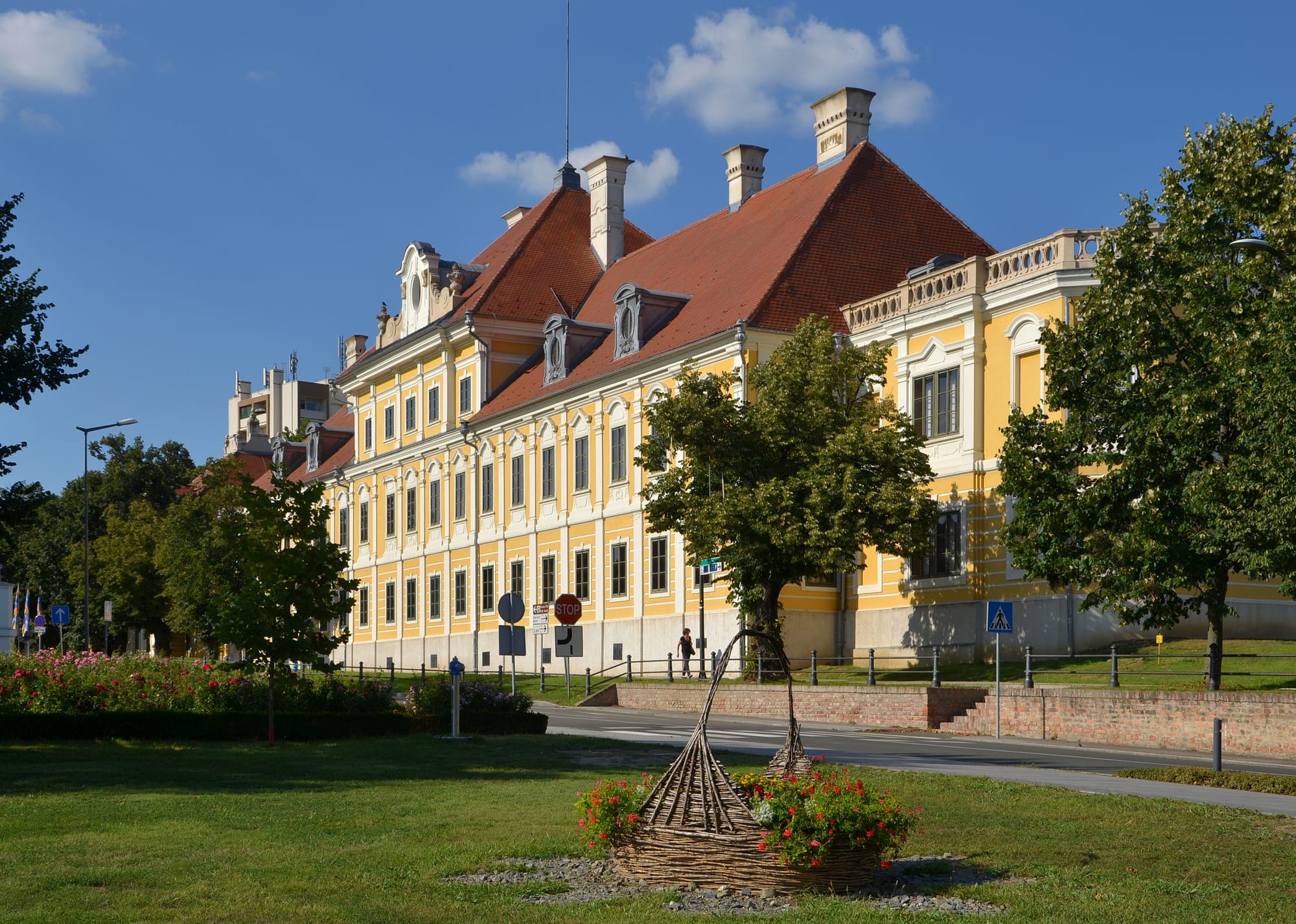
Long yellow baroque manor with a red tiled roof and white window frames behind trees and a lawn

Slavonia & the East, Croatia

Vukovar

Eltz Manor in Vukovar, the restored baroque seat of the Eltz counts and home of the city museum. (Pudelek / Wikimedia Commons · CC BY-SA 4.0)

A Danube town where the Vuka meets the great river, home to Croatia's largest river port. A medieval royal free town, then the baroque seat of the Eltz counts and an industrial centre built on the Borovo shoe works, it was destroyed in the 87-day siege of 1991. Rebuilt since, it keeps its shell-scarred water tower as a memorial.

Neighbourhoods

  • Centar
    • First-time visitors
    • Historic district
    • Walking

    The baroque core around the mouth of the Vuka, with Eltz Manor, the Franciscan church and the Danube waterfront. All the main sights are within a short walk.

    Open in Maps
  • Borovo Naselje
    • Local life
    • Industrial heritage

    The northern suburb built as the workers' village of the Bata shoe factory, later Borovo. The factory recalls the town's industrial peak, and the railway station is here.

    Open in Maps

Things to do

Landmarks and memorials

  • Vukovar water towerlandmark

    A water tower of 1968 riddled with shell holes in 1991, kept as a memorial and a symbol of the war.

    Open in Maps
  • Church of Saints Philip and Jameslandmark

    The baroque Franciscan church built from 1723 to 1732, extensively damaged in 1991 and since restored.

    Open in Maps
  • Vukovar Hospital memorialmuseum

    The working hospital whose basement, the only part used during the siege, is now a museum; 93 of its patients were among the victims of the Vukovar massacre.

    Open in Maps
  • Memorial Cemetery of the Victims of the Homeland Warlandmark

    The cemetery where many who died during and after the siege are buried, the end point of the Column of Remembrance walk from the hospital each 18 November.

    Open in Maps
  • Dudik Memorial Parkpark

    A Second World War memorial to 455 people executed during the war, with a monument by Bogdan Bogdanović built from 1978 to 1980.

    Open in Maps

Museums

  • Eltz Manor and the City Museummuseum

    The 18th-century baroque palace of the Eltz counts, shown on the old 20-kuna note, heavily damaged in 1991 and restored to its pre-war appearance; it houses the city museum.

    Open in Maps
  • Vučedol Culture Museummuseum

    A museum at the Vučedol archaeological site on the Danube bank just downstream, telling the story of the Copper Age culture whose bird-shaped Vučedol Dove is the city's emblem.

    Open in Maps

Short trips from the town

  • Vučedolattraction

    The archaeological site on the loess bank of the Danube that gave its name to a Copper Age culture of around 3000 BC.

    Open in Maps
  • Vinkovciattraction

    The neighbouring town to the south-west, Roman Cibalae, home of the Vinkovačke jeseni folklore festival each September.

    Open in Maps
  • Ilokattraction

    Croatia's easternmost town, on a hill above the Danube, with the Odescalchi castle, whose wine cellars are among the most famous in Croatia, and an Ottoman tomb and bathhouse.

    Open in Maps

Seasonal events

  • Remembrance Day18 November

    The national day of remembrance for the fall of Vukovar, when a remembrance procession walks from the hospital to the memorial cemetery; the town is given over to mourning, not tourism.

Eat and drink

Long-standing places and food districts in Vukovar. Hours, ratings and directions come from your maps app, always current.

Vukovar classics

  • Fiš paprikašrestaurant

    The fiery red paprika stew of carp or mixed river fish, traditionally cooked in a kettle over an open fire.

    Open in Maps
  • Kulenmarket

    The thick, paprika-red smoked pork sausage of Slavonia.

    Open in Maps
  • Ilok winesmarket

    Wines from Ilok, whose castle cellars are among the most famous in Croatia, a short drive down the Danube.

    Open in Maps

Food districts

  • Danube waterfront cafésneighborhood

    Cafés and restaurants along the riverside near the mouth of the Vuka, looking out over the Danube.

    Open in Maps

Experience Vukovar

History

The bank of the Danube here has been inhabited for some 5,000 years. At Vučedol, just downstream, a Copper Age culture flourished around 3000 BC; the bird-shaped ritual vessel found there in 1938, the Vučedol Dove, is now the town's symbol. Romans planted the first vineyards and guarded the river frontier, and Slavs settled the area in the 6th century. Medieval Vukovo, seat of a large county, received the privileges of a royal free town in 1231, and by the late 14th century it was one of the largest towns in Slavonia.

The Ottomans took Vukovar in 1526 and held it until the end of the 17th century, leaving it almost empty. In 1736 the Eltz counts bought the estate and for two centuries shaped the town's economy and culture, building the baroque manor that still stands. Croats returned and Germans, Hungarians, Jews, Ruthenians, Slovaks and Ukrainians settled, making Vukovar a multinational town and the trading centre of western Syrmia, with steamers on the Danube from 1840 and a railway from 1878. In 1931 the Bata shoe factory, later Borovo, opened, and by the late 1980s it employed more than 22,000 people.

In 1991 the town was at the centre of the war. The Battle of Vukovar lasted 87 days, from 25 August to 18 November, and left the town in ruins, in damage compared with the worst in Europe since the Second World War; it was followed by the killing of at least 200 prisoners of war and civilians at Ovčara. After a period of UN administration the region was peacefully reintegrated into Croatia in 1998, and much of the town has been rebuilt since, though many ruins remain.

Culture & Customs

Vukovar is a place of memory. Each 18 November, the national day of remembrance, a procession of remembrance walks from the hospital to the memorial cemetery, and the water tower, the hospital museum and the memorial cemetery keep that memory present all year. The town is also marked by an earlier war: Dudik Memorial Park commemorates people executed in the Second World War, with a monument by the architect Bogdan Bogdanović.

It remains an ethnically mixed town. Serbs made up just under 30 per cent of the population at the 2021 census, and children attend separate Croatian and Serbian classes. The status of the Serbian Cyrillic script has long been debated; in November 2023 the government ended mandatory bilingualism in the town after the census showed the Serb share below one third.

Culture reaches beyond the war. The Vučedol Culture Museum presents the town's deep past, Eltz Manor houses the city museum, and the Vukovar Film Festival, devoted to films from the Danube region and neighbouring countries, is held each late August, its screenings once staged on a barge on the river. Like the rest of Slavonia, Vukovar keeps up tamburica music, and the autumn pig slaughter, when kulen is made, remains a household tradition across the region.

Daily Life

At the 2021 census the town had 22,616 residents and the municipality 23,536, making it the seat of Vukovar-Syrmia County and its second-largest town after Vinkovci. People live in the rebuilt centre, in districts such as Mitnica, Sajmište and Lužac, and in Borovo Naselje to the north.

The economy has never recovered the scale of the Yugoslav years, when Borovo and other industries gave the town one of the highest standards of living in the country. Borovo still makes shoes, at a fraction of its former size, and the river port, Croatia's largest, handles goods on the Danube. Farming, public services and a modest tourism, partly drawn by memorial visits and Danube cruise ships, make up much of the rest.

Days follow the Slavonian rhythm: an early start, lunch as the main meal, coffee on the square and Sundays for church, football and family. The town's shared life between Croats and Serbs is calm but often separate, with divided institutions and separate schooling.

Food

Vukovar eats in the Slavonian way, built on pork, paprika and river fish. The emblem of the region is kulen, a thick sausage of pork, garlic and plenty of red paprika, smoked and air-dried for months, a product of the autumn pig slaughter.

The Danube supplies the fish for fiš paprikaš, a fiery red paprika stew of carp or mixed river fish, traditionally cooked in a kettle over an open fire. Čobanac, a shepherd's stew of several meats sometimes including game, is simmered slowly in a cauldron in the same way. Sweet breads rolled with walnuts or poppy seeds, orahnjača and makovnjača, are standard Croatian baking.

Wine comes from Ilok just downstream, whose castle wine cellars are among the most famous in Croatia, and Graševina is the most planted white grape in the country. Rakija is distilled from plums, as šljivovica, and from other fruit, and portions everywhere assume a hearty appetite.

Planning tools

Budget

One of the least expensive towns in Croatia, with prices that hardly change through the year. Rooms, meals and drinks cost far less than on the coast, and many of the memorials are free. Beds become scarce only around 18 November, when the town fills for the remembrance walk.

Daily Budget Midrange
USD 95–160 (good hotel, restaurant meals with wine, museum tickets, a hire car or taxi to Vučedol)
Daily Budget Shoestring
USD 45–70 (guesthouse or private room, set lunches, regional buses)

Portions are large — one fiš paprikaš often feeds two — and Ilok's cellars are an easy add-on by car.

Best Time to Visit

May and June, and September and October, are warm and settled; autumn brings the grape harvest in nearby Ilok and the Vinkovci folk festival. July and August are hot, with mosquitoes along the river. Around 18 November the town is devoted to remembrance rather than sightseeing. Winter is cold.

Suggested Number of Days

A single day covers the town and its memorials at a respectful pace. Two or three days allow time for the river and the surrounding towns and wine country, which are easiest to reach by car or bicycle.

First Visit
1 day
With Surroundings
2–3 days

Transportation

The town centre is best explored on foot, with the main sights a short walk apart. Buses link Vukovar with Osijek about hourly, and with Vinkovci and Ilok, and taxis or bicycles reach Vučedol downstream. The EuroVelo 6 Danube cycle route passes through the town between Osijek and Ilok.

Carry a passport near the Serbian border, which lies just across the Danube outside the Schengen Area.

Airport & Station Connections

Vukovar lies about 34 km south-east of Osijek, the regional hub with an airport and rail and bus connections to Zagreb. Buses run from Osijek, Zagreb, Vinkovci and Ilok, and daily to Novi Sad and Sombor in Serbia. Infrequent trains from Osijek and Vinkovci stop at Borovo Naselje, north of the centre. River cruise ships on the Danube call at the town.

Walkability

Compact and flat in the centre, with the Danube waterfront, the Franciscan church and Eltz Manor close together. The memorial cemetery and Borovo Naselje are further out, and Vučedol is best reached by taxi or bicycle.

Safety

Croatia is a very safe country for visitors, with low levels of violent crime. Vukovar is calm and low in crime, but the war remains a raw subject here and in the villages around it, and relations between communities are still delicate; nationalist talk or symbols are best avoided.

Treat memorial sites as places of mourning, and use repellent near the river in summer. Check current official travel advice before travelling.

Climate

Warm summers and cold winters; the town's own weather station has recorded 39.8°C, and nearby Osijek averages about 11°C over the year.

Summer
in nearby Osijek, warm, averaging about 21°C, with record highs above 40°C
Winter
in nearby Osijek, cold, averaging about 0°C, with record lows below −25°C

Local Customs

Vukovar is a mixed Croatian and Serbian town, and children attend separate Croatian and Serbian classes. Visitors are expected to be quiet and respectful at the memorials. Tipping is voluntary: rounding up for drinks and 5–10 per cent for a meal with good service.

Ask before photographing people, especially at memorials, and dress modestly in churches.

Common Payment Methods

The currency is the euro, adopted on 1 January 2023 in place of the kuna. Cards are accepted in the town; markets and village cellars may prefer cash.