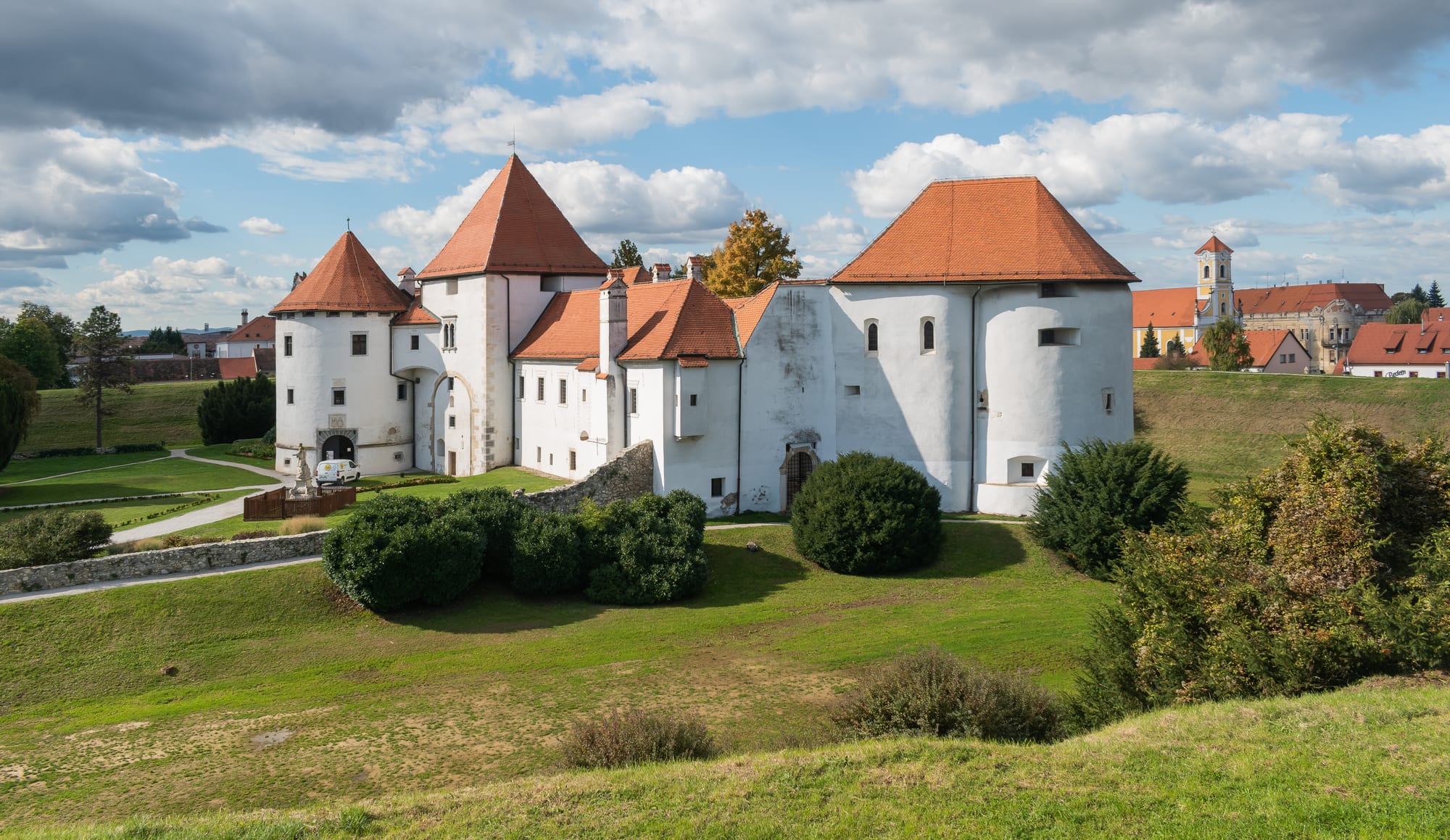
White fortress with round towers and steep orange roofs on a grassy earthwork, with town houses and a church tower behind

Zagreb, Varaždin & Central Croatia, Croatia

Varaždin

The Old Town fortress of Varaždin, ringed by its grassed earthworks, on the north-western edge of the centre. (Krzysztof Golik / Wikimedia Commons · CC BY-SA 4.0)

A baroque town near the Drava in northern Croatia, about 80 km north-east of Zagreb, rebuilt in stone after a great fire in 1776 ended its brief years as the seat of Croatia's government. Pastel palaces, churches and a white moated fortress fill its compact centre, and a park-like cemetery, a late-summer street festival and baroque music give it a reputation well beyond its size.

Neighbourhoods

  • The baroque centre
    • First-time visitors
    • Historic district
    • Cafés

    The old walled town inside the inner ring, a grid of pastel baroque and rococo palaces, churches and squares around the town hall on King Tomislav Square. It is compact, largely pedestrian, and full of café terraces; during Špancirfest the whole ring becomes a festival ground.

    Open in Maps
  • Around the Old Town fortress
    • Museums
    • Parks

    The north-western edge of the centre, where the white fortress stands inside its grassed earthworks and moat, with the town museum inside and Stančić Square and the Sermage Palace gallery in front. Green open space surrounds it, a short walk from the main squares.

    Open in Maps
  • The wider town
    • Quiet and residential
    • Local life

    Beyond the ring lie residential streets, the park-like town cemetery to the west, the university buildings, the bus station on the western side of town and the railway station on the eastern side about 2 km from the bus station, with the Drava to the north.

    Open in Maps

Things to do

The baroque town

  • Old Town fortress (Stari Grad)museum

    The town's medieval fortress, begun in the 14th century and given its rounded Gothic towers in the 15th; owned by the Erdődy family until 1925, it now houses the town museum.

    Open in Maps
  • Varaždin Cathedrallandmark

    A former Jesuit church built in the 1640s, known for its baroque entrance and 18th-century altar, which became the cathedral of the new Diocese of Varaždin in 1997.

    Open in Maps
  • Town halllandmark

    The town hall, still in use, where the Purgari, the town's ceremonial guard in historic uniform, change the guard in a weekly ceremony.

    Open in Maps
  • Croatian National Theatre in Varaždinlandmark

    The town theatre of 1873, designed by the Viennese architects Hermann Helmer and Ferdinand Fellner.

    Open in Maps
  • Sermage Palacemuseum

    A palace in front of the fortress with a colourful façade of black and red medallions, home to the Gallery of Old and Contemporary Masters and its more than 5,300 works.

    Open in Maps
  • Herzer Palacemuseum

    A palace in the centre housing the town museum's entomological collection, The World of Insects, with more than 4,500 exhibits.

    Open in Maps

Parks and quiet places

  • Varaždin cemeterypark

    Founded in 1773 and remodelled between 1905 and 1947 by Herman Haller into a park of large trees and alleys, now protected as a cultural and natural monument.

    Open in Maps

Short trips from the town

  • Varaždinske Topliceattraction

    A small spa town near Varaždin, known since Roman times, when it was Aquae Iasae, for its hot springs.

    Open in Maps
  • Trakošćan Castlelandmark

    A castle in the hills to the west, dating back to the 13th century, considered the best preserved in Croatia.

    Open in Maps

Seasonal events

  • Špancirfestlate August to early September

    A ten-day street festival, held since 1999, that turns the inner town into a zone of concert stages, street performers, craft stalls and food.

  • Varaždin Baroque Eveningslate September to early October

    A festival of baroque music first held in 1971, with concerts in the town's churches and halls alongside exhibitions and other baroque-themed events.

Eat and drink

Long-standing places and food districts in Varaždin. Hours, ratings and directions come from your maps app, always current.

Varaždin classics

  • Cafés of the baroque centrecafe

    Numerous cafés line the squares and streets of the old town, the place for a long coffee or an evening glass of gemišt, white wine mixed with mineral water.

    Open in Maps
  • Restaurants in the old townrestaurant

    Restaurants in the centre serve the hearty cooking of northern Croatia, with local pastries such as Varaždinski klipići and Zagorski štrukli.

    Open in Maps

Experience Varaždin

History

Varaždin first appears in writing on 20 August 1181, when King Béla III mentioned the nearby thermal springs in a legal document, and in 1209 King Andrew II declared it a free royal borough. It became the economic and military centre of northern Croatia, and against Ottoman raids it was organised around its fortress as a moated water castle. From the end of the 16th century the fortress belonged to the Erdődy family, who kept it until 1925. In the late 16th century the town was the seat of the Slavonian Military Frontier.

Fire shaped the town as much as war. Great fires in 1582, 1648 and 1665 each destroyed much of it, yet Varaždin kept growing. In the mid-18th century it became the seat of Croatia's government, hosting the Sabor and the Royal Croatian Council founded by Empress Maria Theresa. On 25–26 April 1776 a fire that began in a western suburb destroyed more than half the town's houses; the nobility and the government left for Zagreb, but merchants and artisans rebuilt, and by 1780 the number of homes was back to its earlier level. Wooden houses were then banned inside the walls, and brick chimneys became compulsory.

In the 19th century crafts, trade, silk and brick-making flourished, and the theatre and music school were founded. The 20th century made Varaždin the industrial centre of north-western Croatia, with the Tivar textile works from 1918, later Varteks. On 12 July 1941 the Ustaše declared Varaždin free of Jews, the first city in Croatia to be so declared. In 1991 the town saw only a few days of fighting, when the large Yugoslav army barracks surrendered after a siege.

Culture & Customs

Varaždin is often called the best preserved and richest historic town in continental Croatia, and it is seeking a place on the UNESCO World Heritage List. Its identity is bound up with the baroque: the palaces, churches and town hall, and the Varaždin Baroque Evenings, a festival of baroque music held every autumn since 1971. In 2023 Varaždin became the first Croatian city named a UNESCO Creative City of Music.

At the end of each summer Špancirfest, a ten-day street festival begun in 1999, fills the inner town with concert stages, street performers, craftspeople and food stalls, and draws visitors from across Croatia and neighbouring countries. The town also hosts VAFI, an international animation film festival for children and young people, held since 2010. On ceremonial occasions, and in a weekly changing of the guard at the town hall, the Purgari, a historic town guard, appear in uniform, and in the warmer months the police patrol the centre by bicycle.

The town cemetery is a source of particular pride. Founded in 1773, it was transformed between 1905 and 1947 by Herman Haller, who replanned it as a park of trees and alleys where residents could walk; it is now protected as a cultural and natural monument. A local folk custom, the christening of a new bridge, survives here and in some nearby towns, and the town has strong clubs in handball, basketball and other sports.

Daily Life

At the 2021 census the City of Varaždin, with its surrounding settlements, had about 44,000 people, about 36,000 of them in the town itself. It is the seat of Varaždin County, one of the most densely populated in Croatia, and like the country as a whole the county lost people between the last two censuses.

The town was one of the few in Croatia whose industry was not directly damaged in the 1990s war. Textiles, led by Varteks, food processing, led by Vindija, metalworking and construction are joined by a well-developed IT, financial and banking sector, encouraged by a free investment zone. Education is a growing part of town life: University North, founded with Koprivnica, has operated in both towns since 2015, and two faculties of the University of Zagreb have campuses here.

Life is relaxed and organised around the compact centre, where people meet over coffee on the squares, shop in the old streets and walk in the cemetery and the fortress grounds. Varaždin Arena, near the Drava, was one of the venues of the World Men's Handball Championship in 2009 and again in 2025.

Food

Varaždin eats in the tradition of northern Croatia, close to the cooking of Zagorje and Međimurje. Varaždinski klipići are the town's own pastry, listed among the classic pastries of the country. Zagorski štrukli — dough filled with cottage cheese, sour cream and eggs, boiled or baked, savoury or sweet — are found on many menus, and cottage cheese with cream, sir i vrhnje, is a staple of the region. Bučnica, a pie of summer squash and cottage cheese, and zlevanka, a simple baked cornmeal pastry with fillings, are other home-style dishes of the north.

Across the Drava, Međimurje has its own cheese, turoš, and its own celebrated cake, Međimurska gibanica, layered with apple, poppy seed, walnut and cottage cheese fillings. Stews of vegetables with a little meat or sausage, known as varivo or čušpajz, are everyday food, and potato-dough dumplings filled with plums are a favourite sweet.

The region's drink is gemišt, white wine mixed with mineral water, and the vineyards of Zagorje and Međimurje supply the town's wine. Numerous cafés fill the centre, and the restaurants of the old town serve this northern home cooking.

Planning tools

Budget

Varaždin is noticeably cheaper than Zagreb, and far cheaper than the coast in summer. Rooms are the main cost and fill quickly during Špancirfest at the end of August; otherwise prices are steady through the year. The centre is small enough that transport costs little once in town.

Daily Budget Midrange
USD 100–190 (mid-range hotel, restaurant meals, museum tickets, a hire car for day trips)
Daily Budget Shoestring
USD 50–80 (hostel or private room, bakery food and set lunches, buses)

Book well ahead for Špancirfest; the cemetery, the squares and the fortress grounds cost nothing to see.

Best Time to Visit

May to October. The end of August brings Špancirfest, the town's biggest event, and late September and early October the Baroque Evenings. Spring and early autumn are pleasant for walking the centre and the cemetery; winters are cold and often foggy.

Suggested Number of Days

One day covers the compact centre; two allow a slower pace and time for the museums. Three or four days allow for the castles, spas and wine hills of the surrounding countryside, which need a car.

First Visit
1–2 days
With Surroundings
3–4 days

Transportation

The centre is best covered on foot. Varaždin is a hub for regional, intercity and international buses, and its railway station is one of the most important in northern Croatia, with lines towards Zagreb, Čakovec and Koprivnica, though all are single-track and the trains are slow. The town is ringed by a bypass, and a car is the practical way into the hills.

Take the bus rather than the slow train from Zagreb, and drive only for the countryside.

Airport & Station Connections

Zagreb, about 80 km to the south-west, is the usual gateway, and Zagreb Airport is the nearest with scheduled flights; Varaždin's own aerodrome handles only private and business flying. Buses from Zagreb run often and take around 90 minutes. The bus station is on the western side of town, the railway station on the eastern side.

Walkability

Very walkable. The baroque centre is compact and largely pedestrian, and the fortress, the squares and the main churches are a few minutes apart. The cemetery is a short walk west, and the stations are within walking distance of the centre.

Safety

Croatia is a very safe country for visitors, with low levels of violent crime. Varaždin is a quiet provincial town; the busiest time is Špancirfest, when the centre is crowded and bags need watching. Winter fog and ice can make roads in the area hazardous.

Keep an eye on belongings in the festival crowds and allow extra time on foggy winter roads. Check current official travel advice before travelling.

Climate

A humid continental climate with four distinct seasons: warm summers and cold winters.

Summer
across the continental north, warm to hot, typically 26–33°C, humid, with evening thunderstorms
Winter
across the continental north, cold, around -4 to 4°C, foggy in the lowlands, with snow most years

Local Customs

Varaždin is proud of its baroque heritage and its music, and the ceremonial Purgari guard in front of the town hall is part of that identity. Coffee on a terrace is the centre of social life. Greet shop staff on entering, and dress modestly in churches.

Keep voices down in the cemetery, which is still a working burial ground, and in churches during services.

Common Payment Methods

The currency is the euro, used since 2023. Cards and contactless payment are widely accepted, and ATMs are easy to find in the centre; carry a little cash for small cafés and market stalls.