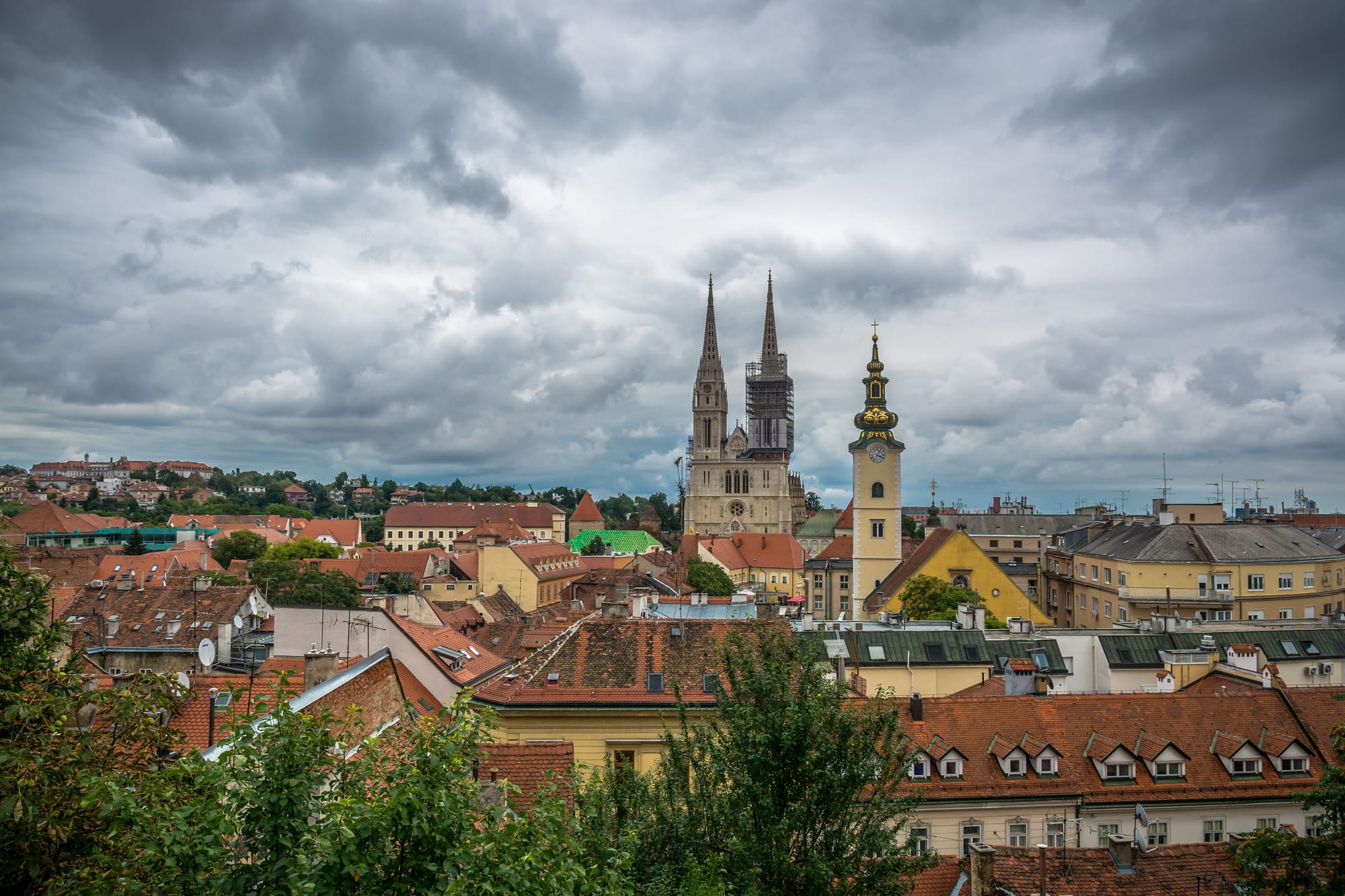
Red-tiled roofs of central Zagreb under a cloudy sky, with the twin cathedral spires and a yellow church tower rising behind

Zagreb, Varaždin & Central Croatia, Croatia

Zagreb

Zagreb Cathedral and the rooftops of Kaptol, seen from the Upper Town. (Nikolai Karaneschev / Wikimedia Commons · CC BY 3.0)

Croatia's capital and largest city, on the Sava at the foot of Medvednica — grown from two rival medieval hill towns, the bishop's Kaptol and the merchants' Gradec, united in 1850. Below them spreads a grid of Austro-Hungarian squares and parks, and the city now holds the country's government, the University of Zagreb and a lively café culture, with about a quarter of Croatia's people living in the metropolitan area.

Neighbourhoods

  • Gornji Grad (Upper Town)
    • First-time visitors
    • Historic district

    The old hilltop town of Gradec, a quiet grid of baroque palaces, government buildings and museums around St Mark's Church and its tiled roof. The Lotrščak Tower fires its noon cannon here, the Stone Gate shrine draws a steady stream of candle-lighters, and the Strossmayer promenade looks out over the Lower Town.

    Open in Maps
  • Kaptol
    • Historic district
    • Cafés and bars

    The bishop's town on the neighbouring hill, dominated by the cathedral and the archbishop's palace. Between Kaptol and Gradec, the line of the old Medveščak stream became Tkalčićeva Street, now lined with cafés and bars, and Dolac market sits just below the cathedral.

    Open in Maps
  • Donji Grad (Lower Town)
    • Museums
    • Close to public transport
    • Nightlife

    The 19th-century city laid out south of Ban Jelačić Square, with the U-shaped chain of parks and squares known as the Green Horseshoe, the national theatre, the main museums and galleries, and the central railway station. Most hotels, shops and the busiest café streets are here.

    Open in Maps
  • Trešnjevka
    • Local life
    • Quiet and residential

    A large residential district in the western part of the city, home to the Dom sportova arena. It gives a view of everyday Zagreb a few tram stops from the main square.

    Open in Maps
  • Maksimir
    • Parks
    • Sport

    The eastern district built around Maksimir Park, a landscaped urban forest with lakes and the city zoo, and the stadium of Dinamo Zagreb across the road. Tree-lined streets of villas and flats make it one of the greener parts of the city.

    Open in Maps
  • Novi Zagreb
    • Modern architecture
    • Contemporary art

    The planned city south of the Sava, built from the 1950s on, with large socialist-era housing blocks such as Mamutica, the Museum of Contemporary Art, Zagreb Arena and the lakes of Bundek park.

    Open in Maps

Things to do

Famous landmarks

  • Zagreb Cathedrallandmark

    The neo-Gothic cathedral on Kaptol, rebuilt by Hermann Bollé after the 1880 earthquake with two spires over 108 metres high; one spire was damaged in the 2020 earthquake, and as of 2026 the cathedral was still under reconstruction.

    Open in Maps
  • St Mark's Churchlandmark

    The Gothic parish church of Gradec, known for its roof of coloured tiles showing the coats of arms of Zagreb and the Kingdom of Croatia, Dalmatia and Slavonia.

    Open in Maps
  • Lotrščak Towerviewpoint

    A 13th-century tower of the Gradec walls, named after a bell once rung before the gates closed; since 1877 the Grič cannon has been fired from it every day at noon.

    Open in Maps
  • Stone Gatelandmark

    The last surviving gate of medieval Gradec, now a shrine to the Virgin Mary where people light candles before a painting said to have survived a fire in 1731.

    Open in Maps
  • Ban Jelačić Squarelandmark

    The central square of the city, where the Upper and Lower Towns meet, with an equestrian statue of the 19th-century ban Josip Jelačić and trams passing through.

    Open in Maps
  • Zagreb Funiculartransit hub

    A short funicular from 1890 linking Tomićeva Street in the Lower Town with the Upper Town, one of the shortest public funiculars in the world.

    Open in Maps

Museums

  • Museum of Broken Relationshipsmuseum

    An Upper Town museum of objects donated by people from around the world, each with the story of a relationship that ended.

    Open in Maps
  • Croatian Museum of Naïve Artmuseum

    A collection of the self-taught painting tradition associated with the village of Hlebine, displayed in a palace in the Upper Town.

    Open in Maps
  • Nikola Tesla Technical Museummuseum

    A large museum of engines, vehicles, aircraft and electricity, founded in 1954, with a model mine about 300 metres long and a study devoted to Nikola Tesla; one of the most visited museums in the country.

    Open in Maps
  • Museum of Contemporary Artmuseum

    Croatia's main museum of modern and contemporary art, in a building in Novi Zagreb opened in 2009.

    Open in Maps
  • Mimara Museummuseum

    An art museum in the Lower Town built on the collection donated by Ante Topić Mimara, opened to the public in 1987.

    Open in Maps

Parks and green spaces

  • Mirogoj Cemeterylandmark

    The city's central cemetery, set among long ivy-covered arcades and domes north of the centre, where Croatians of every faith and many famous figures are buried.

    Open in Maps
  • Maksimir Parkpark

    A landscaped park and urban forest in the east of the city, founded by Bishop Maksimilijan Vrhovac, with lakes, pavilions and the Zagreb Zoo, opened in 1925.

    Open in Maps
  • Jarunpark

    A lake in the south-west with shingle beaches, a rowing course, a path for running and cycling around the water, and summer bars and clubs.

    Open in Maps
  • Medvednicatrail

    The wooded mountain behind the city, with hiking paths, a cable car and ski runs on Sljeme, its 1,035-metre summit topped by the Zagreb TV Tower.

    Open in Maps
  • Medvedgradviewpoint

    A 13th-century fortress on the slopes of Medvednica, partly restored in the late 20th century, with a view over the city from above 500 metres.

    Open in Maps

Markets and streets

  • Dolac Marketmarket

    The main farmers' market, on a raised square just above Ban Jelačić Square, known for its red parasols, with a covered fish market alongside.

    Open in Maps
  • Tkalčićeva Streetneighborhood

    A street of low, colourful houses along the old stream bed between Kaptol and Gradec, now one long line of café terraces and bars.

    Open in Maps

Short trips from the city

  • Samoborneighborhood

    A small town a short way west of Zagreb, at the edge of the Žumberak hills, with a compact old centre.

    Open in Maps

Seasonal events

  • Advent in ZagrebDecember to early January

    The city's Christmas season, with markets, food stalls, concerts and lights in the squares and parks of the centre.

  • INmusic Festivallate June

    One of the largest open-air music festivals in Croatia, held on the shores of Jarun lake.

  • Day of the City of Zagreb16 November

    The city's annual holiday, celebrated with festivities, especially at Jarun lake.

Eat and drink

Long-standing places and food districts in Zagreb. Hours, ratings and directions come from your maps app, always current.

Food districts and markets

  • Dolac Marketmarket

    Fruit, vegetables, cheese, cream and flowers on the open square, meat and dairy in the hall below, and fish in the separate fish market — the place to see what the city cooks.

    Open in Maps
  • Restaurants around Dolac and Kaptolneighborhood

    The lanes around the market and the cathedral hold a cluster of restaurants and bistros serving Zagreb home cooking — roast meats with mlinci, štrukli and sarma.

    Open in Maps

Cafés and bars

  • Tkalčićeva Streetneighborhood

    The city's best-known café and bar street, busy from morning coffee to late at night.

    Open in Maps
  • Flower Square and the Lower Town caféscafe

    The terraces around Preradović Square and along Bogovićeva, Gajeva and Preradovićeva streets are the stage for the Saturday-morning špica.

    Open in Maps

Experience Zagreb

History

Zagreb's name first appears in connection with 1094, when the Hungarian king Ladislaus founded a diocese here on his return from a campaign against the Kingdom of Croatia. Two towns grew up on neighbouring hills above the Sava: Kaptol, the settlement of the clergy around the cathedral, and Gradec, a fortified town of craftsmen and merchants. In 1242 King Béla IV, who had sheltered in Gradec from the Mongols, granted it the Golden Bull, giving its citizens self-government and their own courts. The two towns, divided by the Medveščak stream, quarrelled for centuries over rents and property, and the bishop twice excommunicated the people of Gradec.

Zagreb nonetheless became the political centre of the Croatian lands, where the Sabor met, and in 1669 the Jesuits founded the academy that grew into the University of Zagreb. In 1850 Gradec, Kaptol and the surrounding settlements were united into one city under its first mayor, Janko Kamauf. After the earthquake of 1880 a building boom lasting until the First World War gave the Lower Town the layout it has today, and the first horse-drawn tram ran in 1891. In the 1920s the population grew by 70 per cent, the largest boom in the city's history.

After the Second World War, working-class districts spread towards the Sava, and from the mid-1950s Novi Zagreb was built on the far bank, with the airport and the freight railway hub further south. Zagreb became the capital of independent Croatia in 1991. On 22 March 2020, during the COVID-19 pandemic, a magnitude 5.5 earthquake — the strongest since 1880 — damaged many buildings in the historic centre, including the cathedral and the arcades of Mirogoj.

Culture & Customs

Zagreb's culture is Central European in style: theatre, opera at the Croatian National Theatre, museums and galleries, and above all the café. Coffee is taken slowly, and the špica, the late-morning Saturday coffee with friends in the cafés of the centre, for which people dress up, is the city's best-known social ritual. In the Upper Town the Grič cannon has fired from the Lotrščak Tower at noon every day since 1877, and members of the Order of the Silver Dragon re-enact the old conflicts between Gradec and Kaptol for visitors on St Mark's Square.

The villages on the slopes of Medvednica, such as Šestine, Gračani and Remete, keep older traditions, including folk costume, the red Šestine umbrella and decorated gingerbread. The city's museums range from the national collections in the Lower Town to the Museum of Broken Relationships, a Zagreb idea that has since opened a second permanent home in Chiang Mai. In December the Advent season fills the squares with markets, concerts and lights, and in June the INmusic festival brings international bands to Jarun lake.

Sport is followed passionately. Dinamo Zagreb, the country's best-known football club, plays at Maksimir Stadium, and the city also has leading basketball, handball and water polo clubs. Sljeme, the summit of Medvednica, has ski runs and held its first international ski championship race in January 2005. The city celebrates its own day on 16 November.

Daily Life

About 767,000 people lived in the city at the 2021 census, and the metropolitan area, which takes in Zagreb County, has about 1.1 million — roughly a quarter of Croatia's population. Most residents are Croats, with Serb, Bosniak, Albanian, Romani and other smaller communities. Beyond the historic centre, people live in the older districts of the Lower Town, Trešnjevka and Maksimir, in the hillside neighbourhoods below Medvednica, in Sesvete to the east, and in the large housing estates of Novi Zagreb across the river such as Mamutica.

The city is the country's economic centre, home to government, the university, banks and most national companies. In August 2025 the average monthly net salary in Zagreb was about €1,446, and unemployment at the end of 2025 was around 4.6 per cent. Tomislav Tomašević of the green-left party We Can! was elected mayor in 2021 and re-elected in 2025, and since 2024 residents have been able to propose and discuss neighbourhood projects through participatory budgeting.

The day runs on trams and coffee: a morning market trip to Dolac or a neighbourhood market, a long coffee on a terrace, and evenings out on Tkalčićeva or in the Lower Town. Summer weekends empty towards Jarun or the coast, winter weekends towards Sljeme. Repairs to buildings damaged in the 2020 earthquake continue to shape the historic centre.

Food

Zagreb cooking belongs to the hearty Central European tradition of continental Croatia. Turkey, duck or goose is roasted and served with mlinci, thin sheets of flat pasta soaked in the roasting juices. Zagrebački odrezak, the city's famous cutlet, is a kind of cordon bleu, and faširanci are fried patties of minced meat with onion and breadcrumbs. Sarma — sauerkraut leaves rolled around minced pork and rice — is served with mashed potato.

Štrukli, dough filled with cottage cheese and boiled or baked, is a speciality of the city and the surrounding Zagorje, and bučnica is a related strudel filled with pumpkin. For dessert there is kremšnita, a slice of custard between layers of flaky pastry, and orehnjača, a walnut roll.

Dolac, the main market just above Ban Jelačić Square, supplies much of the centre with fruit, vegetables, cheese and cream from the surrounding countryside, with fish in its own market hall alongside. The restaurants around Dolac and Kaptol serve this home cooking, while the cafés of Tkalčićeva and the Lower Town are where the city drinks its coffee and, in the evening, its wine and beer.

Planning tools

Budget

Zagreb is the most expensive place in continental Croatia but far cheaper than Dubrovnik or Hvar in summer, and its prices change little through the year except during the Advent season, when rooms fill. Market food, set lunches and a good network of trams keep daily costs down; museum tickets and evening meals in the centre are the main extras.

Daily Budget Midrange
USD 120–230 (mid-range hotel, restaurant dinners, museum tickets, taxis)
Daily Budget Shoestring
USD 55–90 (hostel or private room, market food and set lunches, trams)

Book rooms well ahead for December; much of the Upper Town, the markets, Mirogoj and the parks cost nothing to see.

Best Time to Visit

May to June and September to October bring warm days and the busiest café terraces without the summer heat. July and August are hot, and many residents leave for the coast. December is the Advent season, with markets and lights across the centre, and the city's busiest time for visitors outside summer.

Suggested Number of Days

Two to three days suit a first visit to the city itself. Four or five allow time for the mountain behind the city and for outings into the surrounding hills and towns. The compact centre means little time is lost in getting around.

First Visit
2–3 days
With Surroundings
4–5 days

Transportation

Trams are the backbone of public transport, run by the city company ZET along with buses, the Upper Town funicular and the cable car up Medvednica. The centre is flat south of the Upper Town and well suited to cycling. Taxis and ride-hailing apps are widely used; a car is a burden in the centre, where parking is zoned and metered.

Validate a paper ticket in the machine on boarding; a single ticket covers changes between trams and buses in one direction within its time limit.

Airport & Station Connections

Zagreb Airport, the busiest in Croatia and the hub of Croatia Airlines, is at Velika Gorica, about 10 km south-east of the central station, and is linked to the centre by airport bus and taxi. Zagreb is the hub of the country's railways and intercity buses, with connections to the coast, Slovenia, Hungary and the rest of Central Europe.

Walkability

The historic centre is very walkable: Ban Jelačić Square, Dolac, the cathedral and the Upper Town lie within a few minutes of one another, and the Lower Town's parks and museums are on a flat grid. The climb to the Upper Town is short but steep, which the funicular avoids. Maksimir, Jarun, Mirogoj and Novi Zagreb are a tram or bus ride away.

Safety

Croatia is a very safe country for visitors, with low levels of violent crime. Zagreb has less petty crime than most European capitals, though bags need watching on crowded trams and in the Advent crowds. The city lies near the Žumberak–Medvednica fault zone and occasionally experiences earthquakes; the one in 2020 damaged many buildings in the historic centre, and repairs continue in places.

Keep bags closed on trams and at the Advent markets, use marked taxis or apps, and expect scaffolding around some older buildings. Check current official travel advice before travelling.

Climate

A continental climate with four clear seasons: warm summers, cold winters, and morning fog common from mid-October to January, especially near the Sava and the foot of Medvednica. Snow falls on about 29 days a year on average, usually starting in early December.

Summer
warm, with a summer average of about 20°C and temperatures above 30°C on around 15 days a season
Winter
cold, averaging about 1°C from December to February, with fog and regular snow

Local Customs

Coffee is a social event rather than a quick drink, and the špica — a Saturday-morning coffee with friends in the centre, for which people dress well — is a city ritual. Greet shop staff on entering. Dress modestly in churches, including the cathedral.

Keep voices down at Mirogoj and in churches during services, and ask before photographing people at the markets.

Common Payment Methods

The currency is the euro, used since 2023. Cards and contactless payment are accepted almost everywhere, and ATMs are common across the centre; some cash is useful for market stalls and small bakeries.