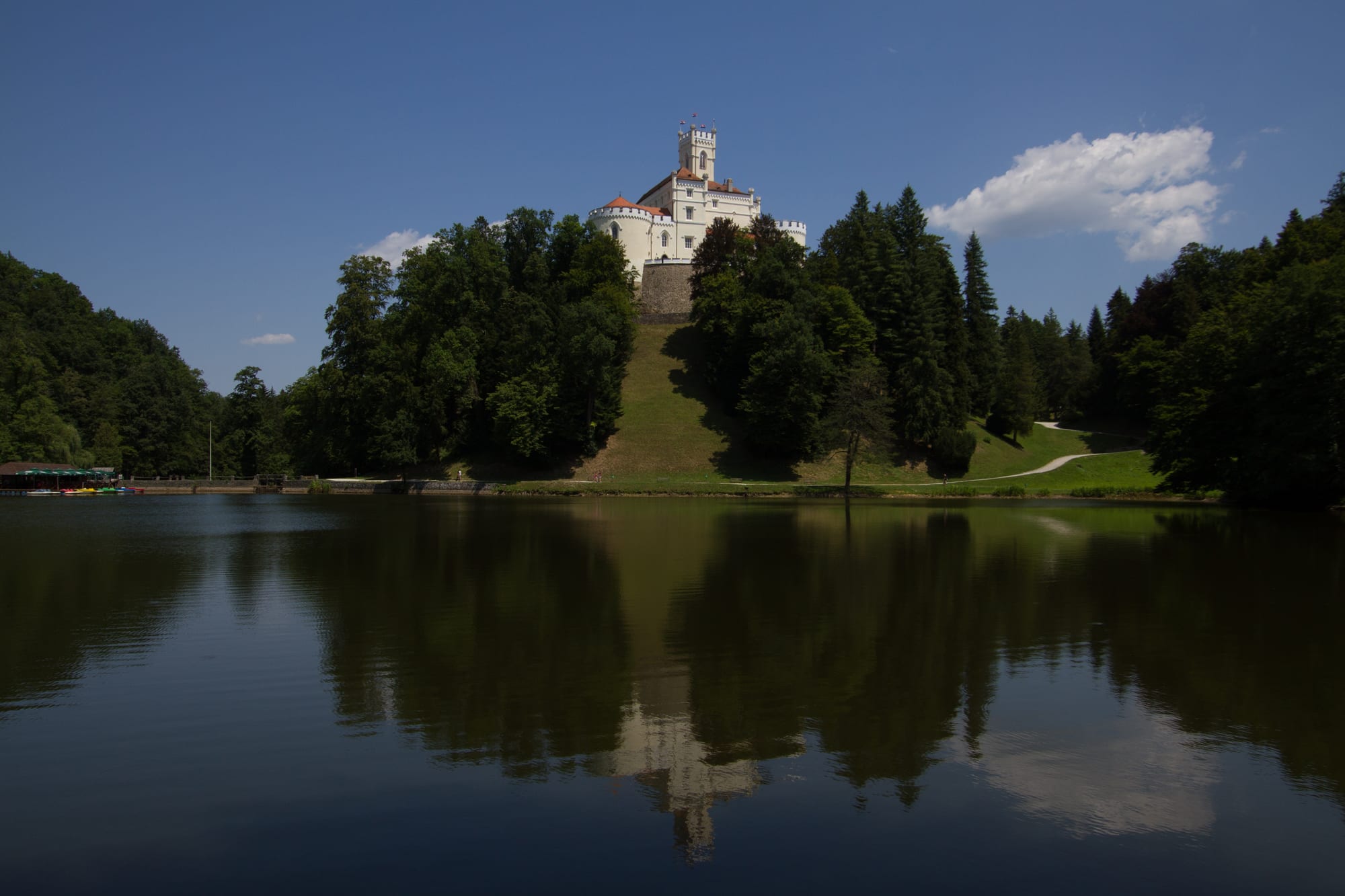
White hilltop Trakošćan Castle above wooded slopes, reflected in the still water of its lake under a blue sky

Croatia

Zagreb, Varaždin & Central Croatia

Trakošćan Castle and its lake in the hills of Varaždin County, north of Zagreb. (Andro Galinovic / Wikimedia Commons · CC BY-SA 4.0)

Croatia's continental core, with the capital at the foot of Medvednica, the vineyard hills of Zagorje and baroque Varaždin to the north, Međimurje between the Mura and the Drava, and the Sava floodplain and the fortress town of Karlovac to the south — a Central European country of castles, spas and storks rather than sea.

Explore Zagreb, Varaždin & Central Croatia

History

The story starts at Krapina, where in 1899 Dragutin Gorjanović-Kramberger dug hundreds of Neanderthal bones, some 130,000 years old, out of Hušnjakovo hill. Roman Siscia, a fortified town and later a provincial capital with its own mint, stood where the Kupa meets the Sava. Medieval Zagreb grew on two hills — Kaptol, where King Ladislaus of Hungary founded a bishopric in 1094, and Gradec, chartered as a free royal town by Béla IV in 1242 after the Mongol invasion — which feuded across the Medveščak stream at the Bloody Bridge and merged only in 1850. Varaždin, chartered in 1209, was the seat of Croatia's government from 1767 until a fire in 1776 sent it to Zagreb.

For two centuries the region was the Ottoman frontier: Karlovac was founded in 1579 as a six-pointed star fortress named for Archduke Charles of Styria, and the Ottomans were defeated at Sisak in 1593. The peasant revolt of 1573 ended with its leader Matija Gubec executed in Zagreb, and the Zrinski lords of Čakovec were broken in 1671 when Petar Zrinski and Fran Krsto Frankopan were beheaded for conspiring against Vienna. Međimurje, across the Drava, was long governed as part of Hungary.

Zagreb led the 19th-century national revival under Ljudevit Gaj of Krapina, and after the 1880 earthquake the cathedral was rebuilt in neo-Gothic style and the Lower Town laid out on a grid. Josip Broz Tito was born at Kumrovec in Zagorje in 1892. From 1941 to 1945 Zagreb was the capital of the Ustaše puppet state, whose largest camp stood at Jasenovac on the Sava. In the 1991–95 war Karlovac and Sisak were front-line towns, the Banovina behind them was held by rebel Serbs until August 1995, and rockets hit Zagreb in May 1995. Earthquakes in March and December 2020 damaged the capital's Upper Town and wrecked Petrinja, Sisak and Glina, where rebuilding continues.

Culture & Customs

This is Kajkavian country. The dialect that says kaj for "what" runs from Zagreb through Zagorje, Varaždin and Podravina to Međimurje, and though the standard language is built on the Štokavian of the south, Kajkavian survives in song, in Zagreb slang and in the Festival of Kajkavian Song held at Krapina since 1966. The Međimurska popevka, the region's plaintive folk song, joined UNESCO's intangible heritage list in 2018, and the licitar — the glossy red gingerbread heart sold at every fair — was listed in 2010 as a craft of northern Croatia. Zagreb's old families call themselves purgeri, from the German for burghers, and the Saturday-morning špica, coffee taken slowly on Bogovićeva and Tkalčićeva streets in one's best clothes, is a civic ritual.

The countryside runs on the vineyard calendar. Every Zagorje and Međimurje family with a slope has a klet, a vineyard cottage, and on 11 November, Martinje, the must is "baptised" as new wine amid a good deal of it. Marija Bistrica's shrine of the Black Madonna draws hundreds of thousands of pilgrims a year. Varaždin stages the Baroque Evenings festival of early music each autumn, held since 1971, and the ten-day Špancirfest street festival at the end of August. Samobor's fašnik carnival, first recorded in 1828, is among Croatia's oldest, and the village of Hlebine near Koprivnica produced the naive painters — Ivan Generalić foremost — whose paintings of peasant life fill a museum in Zagreb.

Football divides the region from the coast: Dinamo Zagreb's rivalry with Hajduk Split is the country's "eternal derby", and the Bad Blue Boys are a fixture of the capital. Manners are Central European — a formal dobar dan, a handshake, wine offered as gemišt with sparkling water, and a settled sense that the coast is somewhere one goes on holiday.

Daily Life

Around 770,000 people live in the City of Zagreb and roughly 1.1 million in its wider area — more than a quarter of the country. The next towns are far smaller: Velika Gorica, beside the airport, about 61,000; Karlovac about 50,000; Varaždin 44,000; Sisak 40,000; Samobor and Bjelovar about 36,000 each; Koprivnica and Čakovec under 30,000. Međimurje is the most densely settled county in Croatia after the City of Zagreb, its villages running into one another between the two rivers, while Bjelovar-Bilogora and the Banovina south of Sisak are losing people fast.

Zagreb is the seat of government, banking, the University of Zagreb (founded 1669) and companies such as Pliva pharmaceuticals and Končar electrical engineering. Outside it, work is industrial and agricultural: Podravka at Koprivnica, maker of the Vegeta seasoning since 1959; Vindija dairy and Varteks clothing at Varaždin; the Karlovačko brewery, open since 1854, at Karlovac; steel and an oil refinery at Sisak; furniture and metal workshops across Međimurje; dairy farms around Bjelovar; and spa hotels in Zagorje. Thousands commute daily into Zagreb from all of these.

The day begins early — offices by eight, the gablec, a cheap set lunch, around noon — and pauses for coffee at every opportunity. Zagreb's centre lives by tram, its outskirts by car, and on summer weekends the motorway to the coast fills as the city empties. The pressures are those of a capital: housing costs, short-term lets in the Lower Town and hundreds of buildings still scaffolded after the 2020 earthquake, while Petrinja and the Banovina wait on reconstruction and young people from Sisak and Bjelovar leave for Zagreb, Germany or Ireland.

Food

Continental Croatia eats like its Austrian and Hungarian neighbours, with a heavier hand. Zagorski štrukli — dough rolled thin around fresh cheese, eggs and cream, then either boiled in soup or baked under a crust — are the region's signature and the dish every Zagreb household has an opinion on. Purica s mlincima, roast turkey with mlinci, sheets of baked dough softened in the roasting juices, is the Sunday and Christmas meal. Around them come zagorska juha, a potato and mushroom soup with cream; buncek, pork hock; krvavice and češnjovke, blood and garlic sausages sold at the winter fairs; kotlovina, pork, sausage and potatoes cooked outdoors in a wide pan; and sir i vrhnje, fresh cheese with cream, sold by farm women at the Dolac market.

Each town has its sweet. Samobor's kremšnita is a wobbling custard slice eaten in the main square, ideally with a glass of bermet, the town's bitter aromatised wine, and a jar of its grape mustard, muštarda, to take home. Međimurska gibanica layers poppy seed, fresh cheese, walnut and apple in one cake, zlevanka is a plain cornmeal cake, Varaždin makes klipići rolls, and pumpkin-seed oil, dark green and nutty, dresses salads from Zagorje to the Mura. Podravina's prga, a dried cheese, is the local curiosity.

The wines are white and northern: Graševina, Sauvignon and Rhine Riesling from the Zagorje–Međimurje hills, Pušipel — the local name for Furmint — around Štrigova, Škrlet, a native grape grown mainly in Moslavina, and the wines of Plešivica near Jastrebarsko. Everyday drinking is gemišt, white wine cut with sparkling water, or beer from Karlovac's Karlovačko and Zagreb's Ožujsko, with rakija, honey-sweetened medica and the mead-like gvirc for cold days.

Attractions & Natural Wonders

Zagreb's Upper Town is a small hill of baroque streets: St Mark's Church with its tiled coats of arms, the Lotrščak tower, whose cannon has fired at noon since 1877, the 1890 funicular, the Stone Gate shrine, the Museum of Broken Relationships and the Museum of Naive Art. On Kaptol, the twin hill, stands the cathedral, its spires under repair since the 2020 earthquake; below lie the Dolac market, the cafés of Tkalčićeva and the Lower Town's "Green Horseshoe" of parks, with the Croatian National Theatre and the Mimara. Further out are the arcades of Mirogoj cemetery, and Medvednica rises directly behind the city, with a cable car to Sljeme. To the west, Samobor sits beneath the wooded Samoborsko gorje, a ruined 13th-century castle above the town.

Varaždin is the country's best baroque town: a grid of pastel palaces around the moated Stari Grad castle, which holds the town museum. Trakošćan, further west, is a white 19th-century remodelling of a medieval castle above an artificial lake. The Zagorje hills hold Veliki Tabor's round towers, the Krapina Neanderthal Museum, Tito's birth house at Kumrovec, the Marija Bistrica shrine and thermal spas at Krapinske, Tuheljske and Varaždinske Toplice, the last built over Roman baths. Beyond the Drava, Međimurje's wine country climbs to Štrigova, with Čakovec's Zrinski castle nearby.

Eastward along the Drava are the Hlebine gallery of naive art and the small dunes of the Đurđevački pijesci. South of Zagreb the Sava spreads into Lonjsko Polje Nature Park, some 500 square kilometres of floodplain oak forest and pasture where storks nest on the wooden houses of Čigoć and Krapje; Sisak's triangular fortress stands where the Kupa meets the Sava, and the concrete Stone Flower at Jasenovac marks the camp. Karlovac keeps the outline of its star fort and two swimming rivers, the Mrežnica and the Korana. On the road south towards Plitvice, at Slunj, the Slunjčica drops into the Korana over travertine steps at Rastoke, a village of watermills built across the falls.

Cities in Zagreb, Varaždin & Central Croatia

Planning basics

Budget

Zagreb is the most expensive place in continental Croatia, but it is well below Dubrovnik or Hvar in summer and its prices barely move with the seasons, except during Advent in December. Varaždin, Karlovac, the Zagorje spas and Međimurje are noticeably cheaper again, and a set lunch, a gablec, in a Zagreb workers' restaurant remains one of the country's best deals.

Daily Budget Midrange
USD 110–220 (mid-range or spa hotel, restaurants, museum tickets, a hire car for the countryside)
Daily Budget Shoestring
USD 50–85 (hostel or private room, gablec set lunches, trams and regional buses)

Book Zagreb rooms early for Advent; outside the capital, spa hotels in Zagorje bundle pools and half-board at modest rates.

Safety

Very safe, with less petty crime than most European capitals, though bags need watching on trams and in the Advent crowds. The particular hazards are inland ones: ticks, which can carry encephalitis, live in the region's forests from spring to autumn; winter fog and ice make the motorways hazardous; and earthquake repairs still close some pavements in Zagreb's Upper Town. The minefields left along the 1990s front line around Karlovac and in the Banovina south of Sisak have been cleared: Croatia declared itself mine-free in February 2026.

Use tick repellent for forest walks, allow extra time on foggy winter motorways, and expect scaffolding around the cathedral and older churches. Check current official travel advice before travelling.

Climate

Fully continental, unlike the coast: cold, grey winters with fog lying in the Sava and Drava valleys and snow most years, hot and humid summers with afternoon thunderstorms, and short, bright springs and autumns. Zagreb averages about 1°C in winter; Medvednica and the Zagorje hills are a few degrees cooler and keep their snow longer.

Summer
warm to hot, 26–33°C, humid, with heatwaves past 35°C and evening storms
Winter
cold, -4 to 4°C, foggy in the lowlands, snow on Medvednica and often in the towns

Transportation

Zagreb's airport lies 10 kilometres southeast of the centre, and the city is the hub of the country's railways and bus lines. Trains reach Karlovac, Sisak and Koprivnica, but the line to Varaždin is slow and buses along the A4 motorway are quicker, continuing to Čakovec. Buses also run to Samobor. Zagreb runs on trams, with a cable car up Medvednica. Lonjsko Polje, Rastoke, Trakošćan and the wine hills need a car.

Take the bus rather than the train to Varaždin and Međimurje, and drive only for the countryside — Zagreb's centre is walkable and parking is zoned and metered.

Best Time to Visit

May to June and September to October, when the hills are green or golden, the grape harvest is on and Varaždin holds Špancirfest in late August and the Baroque Evenings in the autumn. Storks are on their nests in Lonjsko Polje from April to August. Zagreb's Advent market runs through December, and 11 November, Martinje, is the day to be in a Zagorje or Međimurje vineyard. August is hot and the capital half-empty as residents head to the coast.