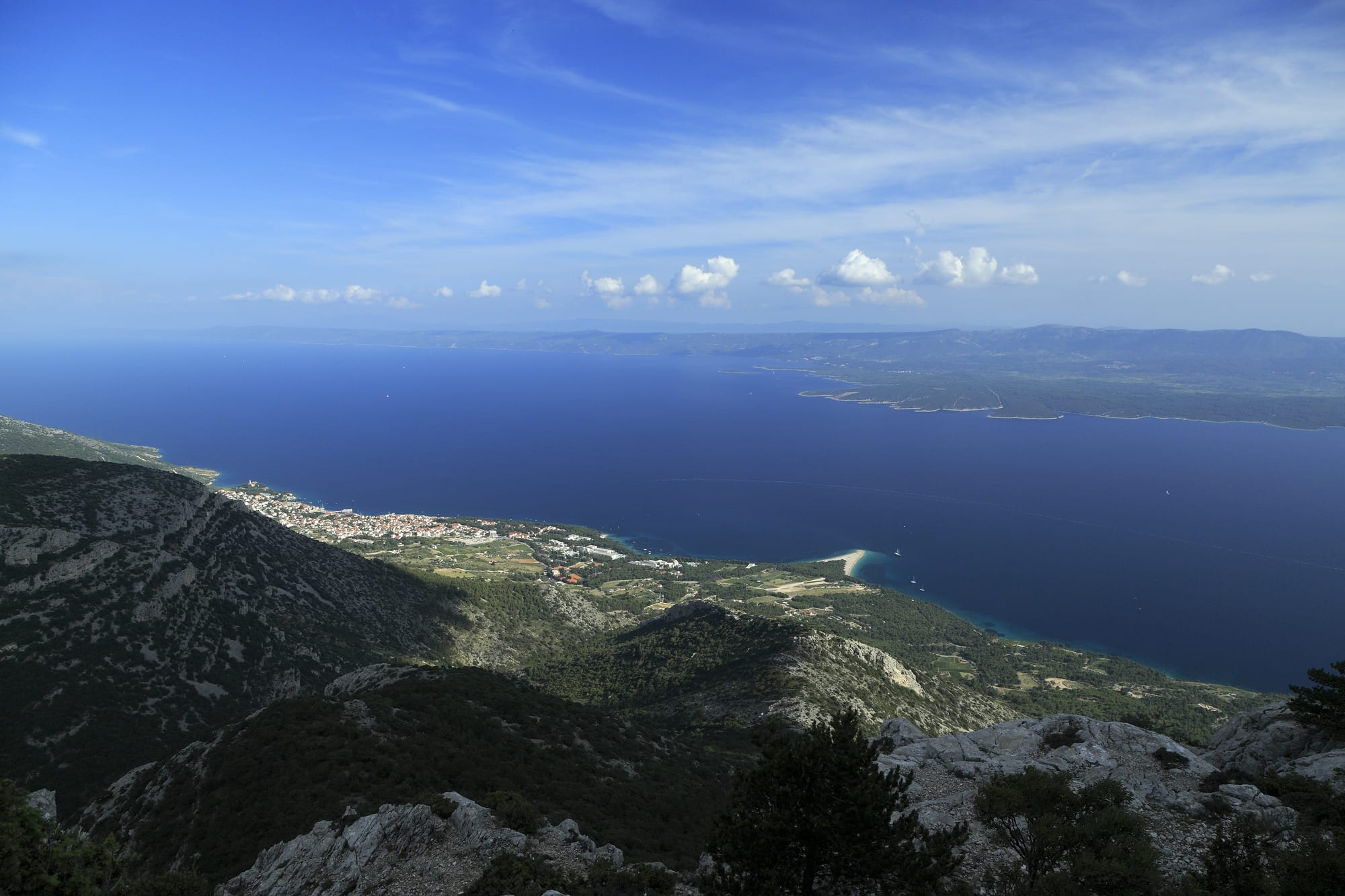
View from a rocky summit over the town of Bol and the pale Zlatni rat spit to a deep-blue channel and the island of Hvar

Croatia

Dalmatia

Bol and the Zlatni rat beach on Brač, seen from the summit of Vidova gora, with the island of Hvar across the channel. (Falk2 / Wikimedia Commons · CC BY-SA 4.0)

Croatia's southern coast, running from the island of Pag to the Montenegrin border beneath the wall of the Dinaric mountains — the Roman and Venetian stone cities of Zadar, Šibenik, Split and Dubrovnik, the islands of Brač, Hvar, Vis and Korčula offshore, and a sparsely peopled karst hinterland around Knin, Sinj and Imotski.

Explore Dalmatia

History

Dalmatia is named after the Delmatae, an Illyrian people of the hinterland; Liburnian seafarers held the north around Zadar, and Greeks from Syracuse and Paros planted colonies on Vis and at Pharos, today's Stari Grad on Hvar, in the 4th century BC. Rome made Salona, outside modern Split, the capital of its province of Dalmatia, and the emperor Diocletian, born nearby, built the seaside palace to which he retired in AD 305. When Avars and Slavs destroyed Salona in the 7th century its survivors moved inside the palace walls and founded Split, while refugees from Epidaurum founded Ragusa, the future Dubrovnik.

The early Croatian state grew up just inland, around Nin, Knin and Biograd, but after the crown passed to Hungary in 1102 the coastal towns were fought over by Hungary and Venice — which had Zadar sacked by the Fourth Crusade in 1202 and bought the royal claim to Dalmatia in 1409. Venice ruled from Zadar to Korčula until 1797, facing an Ottoman frontier a few kilometres inland after Klis fell in 1537. Dubrovnik alone stayed free: a merchant republic from 1358, paying tribute to the sultan, which introduced quarantine in 1377, lost much of the city to the earthquake of 1667 and was abolished by Napoleon's marshal Marmont in 1808.

After a French interlude Austria governed Dalmatia from Zadar until 1918 and defeated the Italian fleet off Vis in 1866; phylloxera then ruined the vineyards and much of the local economy. Zadar was Italian between the wars and was bombed by the Allies in the Second World War, and Tito directed the Partisans from a cave on Vis in 1944. In 1991 rebel Serbs based at Knin cut the region off from Zagreb, Zadar and Šibenik were shelled and Dubrovnik was besieged for seven months; Operation Storm retook Knin in August 1995. The motorway reached Split in 2005, and the Pelješac Bridge, opened in 2022, joined Dubrovnik to the rest of the country by road.

Culture & Customs

Dalmatians define themselves against the inland north — slower, louder, more Mediterranean — and then against each other. Islanders are Boduli to the mainlanders and hinterland people Vlaji to the coast; Split and Dubrovnik regard one another with the wariness of old rival city-states; and everyone claims fjaka, the heat-induced state of doing nothing, as a regional art. Speech is thick with Venetian loanwords — pomidor, šugaman, pjat — and the old island dialects are Čakavian. Split's devotion to Hajduk, the football club founded in 1911, and to its supporters' group Torcida, founded in 1950 and the oldest in Europe, is close to a civic religion.

Tradition is performed rather than preserved, and much of it is on UNESCO's intangible heritage list. Klapa groups sing unaccompanied harmony on stone squares all summer and compete at Omiš each summer. At Sinj, on the Sunday of the first full weekend in August, riders in 18th-century uniform gallop at an iron ring with a lance in the Alka, held since the Ottoman siege of 1715 failed. On Hvar the Za Križen procession sets out from six villages on the night of Maundy Thursday, each cross-bearer walking 25 kilometres before dawn, and Dubrovnik has honoured its patron St Blaise every 3 February for a thousand years. The list also covers the needle lace of Pag, the agave-thread lace of Hvar's Benedictine nuns and the silent circle dance of the hinterland. Korčula, for its part, dances the Moreška, a mock battle fought with real swords.

Stone is the other inheritance: Brač's white limestone built Diocletian's palace, and Pučišća still has a stonemasons' school. Religion is Catholic and visible, with processions on saints' days in every port; the Orthodox Serb villages of the hinterland largely emptied in 1995.

Daily Life

About 800,000 people live in the four counties, more than half of them in Split-Dalmatia. Split, with some 160,000 residents and a conurbation running through Solin and Kaštela to Trogir, is Croatia's second city and the coast's ferry hub, shipyard and university town. Zadar has about 70,000 people, Šibenik and Dubrovnik a little over 40,000 each, and the hinterland centres — Sinj, Knin, Imotski, Metković — are smaller still. Brač, Hvar and Korčula each have between 10,000 and 15,000 permanent residents; Vis has about 3,300.

Tourism is the economy, to a degree that worries economists: a season of little more than four months pays for the year. Around it survive Zadar's shipping companies and maraschino distillery, tuna and sea-bass farms, the Neretva delta's mandarin orchards, the port of Ploče, Brač's quarries, Ston's salt pans and oyster beds, and olive oil and wine everywhere. The heavy industry of the Yugoslav era has largely gone — Šibenik's heavy industry, much of Split's shipbuilding — and the hinterland has long sent its workers abroad.

The day starts with a long coffee on the waterfront, the riva, and a walk through the produce and fish markets, breaks for marenda, a mid-morning meal, slows in the afternoon heat and revives with the evening stroll. Two winds set the mood: the bura, cold, dry and clear from the mountains, and the jugo, a damp south-easterly blamed for headaches and bad tempers. The strains are those of success. Dubrovnik's walled town is crowded with visitors, and the city staggers cruise-ship arrivals to spread them through the week; in Split and on Hvar flats have become rentals and young families are priced out; and on the smaller islands schools shut, winter ferries thin out and the population ages.

Food

Dalmatian cooking rests on olive oil, fish, chard and patience. The everyday meal is fish grilled over vine cuttings or poached lešo, with blitva — chard and potatoes in olive oil — alongside; the fishermen's dishes are brudet, a mixed fish stew eaten with polenta, and gregada, Hvar's version with potatoes, onion and olive oil. Vis and Komiža bake pogača, a flat pie of salted sardines; the Poljica villages behind Omiš make soparnik, a thin chard pie baked under embers; Sinj rolls arambašići, small cabbage parcels of hand-chopped beef and pork, for the Alka; and the Neretva delta stews eels and frogs together. Mali Ston bay has long farmed flat oysters, eaten raw on the quay with lemon.

The hinterland supplies the meat: lamb on the spit, vitalac — skewered lamb offal — on Brač, and pršut, which unlike Istria's is smoked before the bura dries it, with Drniš the best-known source. Pag's hard sheep's cheese takes its flavour from herbs salted by wind-blown sea spray. Sweets are modest and old: rožata, Dubrovnik's caramel custard scented with rose liqueur, candied orange peel, dried figs, Ston's cake of macaroni, nuts and chocolate, and fritule and kroštule at every festival.

Plavac Mali is the great red grape, at its densest on the sea-facing slopes of Dingač and Postup on Pelješac and at Ivan Dolac on Hvar; researchers traced its parent, Crljenak — the Zinfandel of California — to a vineyard at Kaštela in 2001. Whites are island specialities: Pošip and Grk on Korčula, Bogdanuša on Hvar, Vugava on Vis, with Babić reds from Primošten's stone-walled plots. Zadar has distilled maraschino from marasca cherries since the 18th century, prošek is the sweet wine for guests, travarica the herb brandy, and wine cut with still water is bevanda.

Attractions & Natural Wonders

In the north, Zadar's peninsula holds a Roman forum, the round 9th-century church of St Donatus and, on the quay, Nikola Bašić's Sea Organ, played by the waves; nearby are Nin's salt pans and tiny pre-Romanesque church, the bare, lunar island of Pag, and the twin limestone gorges of Paklenica National Park, cut into the seaward face of Velebit. Offshore, Kornati National Park is a maze of 89 treeless islands and reefs with sheer cliffs facing the open sea, reached by boat from Murter or Zadar.

Šibenik's Cathedral of St James, built wholly of stone between 1431 and 1536 and ringed with more than seventy carved heads, is a World Heritage Site. Upstream, Krka National Park runs from the seventeen travertine steps of Skradinski buk to the monastery islet of Visovac and the Roški slap falls; Knin's fortress and Dinara, Croatia's highest mountain, lie beyond.

Split lives inside Diocletian's Palace — the Peristyle, the cathedral made from the emperor's mausoleum, the vaulted cellars — between the Riva and the pine woods of Marjan, with Roman Salona, the fortress of Klis and the island town of Trogir close by. South run the Cetina gorge at Omiš, the Makarska Riviera under Biokovo's 1,762-metre wall, and Imotski's Red and Blue Lakes. Brač has the shifting shingle spit of Zlatni rat below Vidova gora; Hvar its Venetian harbour town, the Pakleni islets and the Greek-surveyed Stari Grad Plain; Vis the Blue Cave of Biševo.

Korčula's walled town, laid out like a fishbone, faces the Pelješac peninsula, whose Dingač vineyards end at Ston's long medieval walls. Mljet National Park encloses two saltwater lakes and an island monastery. Dubrovnik is best understood from its 1,940-metre circuit of walls and from Mount Srđ; Stradun, the Rector's Palace and the Franciscan pharmacy of 1317 lie within, and Lokrum, the Elaphiti islands, Trsteno's arboretum and Cavtat are a short boat or bus ride away.

Cities in Dalmatia

Planning basics

Budget

The most expensive part of Croatia in summer. Dubrovnik and Hvar town charge the highest prices in the country, and Split, Makarska and the island ports are not far behind in July and August, when Krka's entry ticket also peaks. The hinterland towns, the Neretva valley and the months from October to May are far cheaper. Ferries are inexpensive for foot passengers and costly with a car.

Daily Budget Midrange
USD 160–320 (apartment or mid-range hotel, konoba dinners, catamarans, park tickets and a boat trip)
Daily Budget Shoestring
USD 70–110 (hostel or private room, bakery and market food, buses and foot-passenger ferries)

Eat the mid-morning marenda menu, an inexpensive cooked meal on the coast, and book island rooms early for July and August.

Safety

Very safe. The nuisances are pickpockets in the summer crush of Dubrovnik and Split, overcharging in a few beach clubs and taxis, and fines in Split, Hvar and Dubrovnik for walking the old town in swimwear or drinking in the street. The real hazards are natural ones: heat and sun, sea urchins on rocky shores, polished limestone paving that is slippery when wet, summer wildfires, and sudden bura or jugo seas for kayakers and small boats. The Adriatic coast road is winding and impatiently driven. Former front-line areas inland of Zadar, Šibenik and Dubrovnik have been cleared of mines, and Croatia declared itself mine-free in February 2026.

Wear water shoes on rocky beaches, carry water on the walls and island trails, check the wind forecast before any boat trip, and keep bags closed in the old-town crowds. Check current official travel advice before travelling.

Climate

Mediterranean, and sunnier than the northern Adriatic: Hvar records around 2,800 hours of sunshine a year. Summers are hot and almost rainless, with the afternoon maestral breeze cooling the coast; winters are mild and wet. Behind the coastal ranges the hinterland is more extreme — Knin can reach 40°C in July and August and sees frost and some snow in winter. The cold, gusty bura and the damp south-easterly jugo disrupt ferries and close bridges for a day or two at a time.

Summer
hot, dry and sunny, 28–34°C, reaching 40°C inland at Knin; sea 23–27°C
Winter
mild and rainy on the coast and islands, 6–13°C; colder inland, with frost and occasional snow

Transportation

Split, Dubrovnik and Zadar have busy airports, and the A1 motorway runs from Zagreb past Zadar, Šibenik and Split to Ploče. Since 2022 the Pelješac Bridge has carried traffic on to Dubrovnik without crossing the strip of Bosnian coast at Neum. Buses are the backbone — Split to Dubrovnik takes four to four and a half hours, Zadar to Split about three — while the only useful railway is the slow line from Zagreb through Knin to Split. Split is the ferry hub for Brač, Hvar, Vis, Šolta, Korčula and Lastovo; Zadar serves Ugljan, Pašman and Dugi Otok, Orebić has the short crossing to Korčula, and Dubrovnik's port of Gruž serves the Elaphiti islands and Mljet. The Kornati are reached only by excursion or private boat.

Buy catamaran tickets online several days ahead in July and August — they sell out and carry no cars — and treat Split's harbour as the base for island-hopping.

Best Time to Visit

May, June, September and early October: the sea is warm from June into October, the ferries run their full timetables and the old towns are passable. July and August bring heat, peak prices, full ferries and crowds that Dubrovnik and Split struggle to absorb, but also the festivals — the Dubrovnik Summer Festival from 10 July to 25 August, the Alka at Sinj in early August, klapa at Omiš. From November to March many island hotels and restaurants close and catamarans are few, though Dubrovnik and Split are quiet, mild and at their most local, and St Blaise's day falls on 3 February.