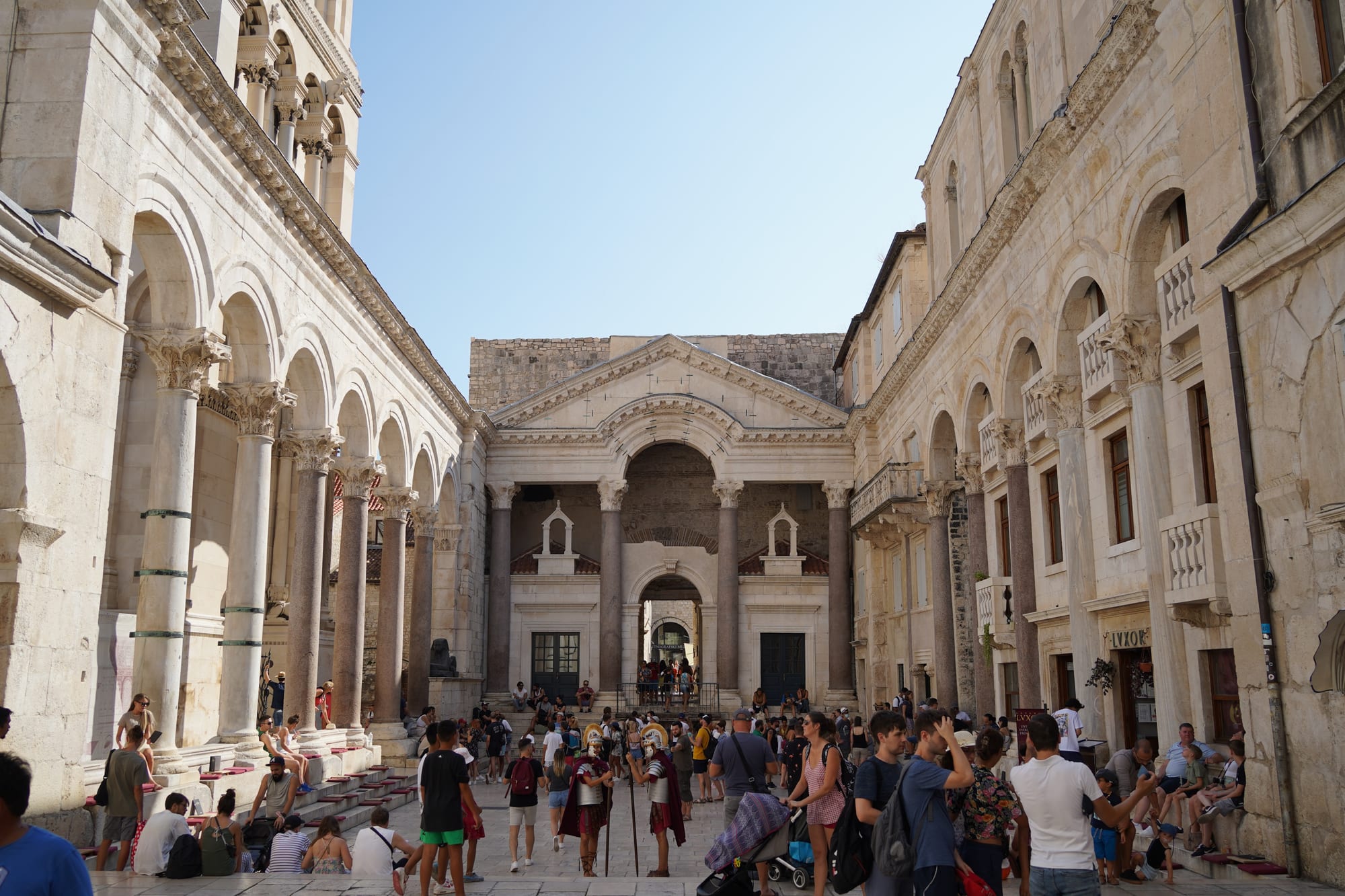
The Peristyle of Diocletian's Palace in Split, a stone courtyard lined with Roman arcades and full of visitors

Dalmatia, Croatia

Split

The Peristyle, the colonnaded central court of Diocletian's Palace in Split. (TimeTravelRome / Wikimedia Commons · CC BY 2.0)

Croatia's second city and the largest on its coast, on a peninsula between Kaštela Bay and the Split Channel. Its old town grew inside the seaside palace the Roman emperor Diocletian built around AD 300, and today some 160,000 people live around it in a busy port, university and ferry hub for the Dalmatian islands.

Neighbourhoods

  • Diocletian's Palace and the Old Town
    • First-time visitors
    • Historic district
    • Nightlife

    The Roman palace walls enclose a still-inhabited maze of lanes, courtyards, bars and shops around the Peristyle and the cathedral. West of the Iron Gate, the medieval town spreads around Narodni trg, the square locals call Pjaca, and the palm-lined Riva runs along the seafront in front.

    Open in Maps
  • Varoš
    • Local life
    • Quiet stays
    • Close to Marjan

    One of the oldest parts of the city, on the slopes west of the old town towards Marjan, where the city's farmers and fishermen once lived. Its stepped lanes of stone houses lead up to the park on the hill.

    Open in Maps
  • Bačvice
    • Beaches
    • Nightlife

    The sandy, shallow town beach a short walk from the ferry port and bus station, the home of picigin and a busy spot in summer.

    Open in Maps
  • Žnjan
    • Beaches
    • Families
    • Quiet and residential

    A district in the east of the city with Split's largest beach, mostly pebble, and a promenade of more than 2 kilometres linking it with Trstenik beach.

    Open in Maps

Things to do

Diocletian's Palace

  • Diocletian's Palacelandmark

    The fortress-like retirement palace of the emperor Diocletian, begun in 293, whose walls, gates and halls became the core of the medieval city and are still lived in.

    Open in Maps
  • Cathedral of Saint Domniuslandmark

    Diocletian's mausoleum, turned into a cathedral in the 7th century, with a 57-metre Romanesque bell tower in front.

    Open in Maps
  • Temple of Jupiterlandmark

    A small Roman temple built with the palace, converted in late antiquity into a baptistery of St John the Baptist.

    Open in Maps
  • Vestibulelandmark

    A circular Roman hall 17 metres high, once domed, whose acoustics draw klapa groups to sing in summer.

    Open in Maps
  • Golden Gatelandmark

    The palace's northern gate, at the end of the Roman road to Salona, reopened in 1857 after centuries hidden by houses.

    Open in Maps

Museums and galleries

  • Split Archaeological Museummuseum

    The oldest museum in Croatia, founded in 1820, with some 150,000 objects including stone inscriptions from Salona, Roman glass and gems.

    Open in Maps
  • Ivan Meštrović Gallerymuseum

    The villa the sculptor Ivan Meštrović designed for himself on the Marjan peninsula, now showing his sculpture, drawings and furniture.

    Open in Maps
  • Gallery of Fine Artsmuseum

    Croatian art from the 14th century to the present, including works by Vlaho Bukovac, Meštrović and Emanuel Vidović, in the old hospital building.

    Open in Maps
  • Museum of Croatian Archaeological Monumentsmuseum

    The only museum in Croatia devoted to the early medieval Croats, with stone carvings and Latin inscriptions of the 7th to 15th centuries.

    Open in Maps

The waterfront and Marjan

  • Rivaneighborhood

    The palm-lined seafront promenade below the palace's southern wall, laid out after 1807 and pedestrianised in the 1990s, lined with cafés.

    Open in Maps
  • Marjanpark

    A 178-metre wooded hill and park covering the western end of the peninsula, a favourite place for walks and running, with views over the old town and islands.

    Open in Maps
  • Bačvice beachbeach

    The shallow, sandy city beach where picigin, a local game of keeping a small ball in the air in shallow water, has been played since 1908.

    Open in Maps
  • Stadion Poljudattraction

    Hajduk Split's stadium, with room for about 35,000, built for the 1979 Mediterranean Games.

    Open in Maps

Short trips from the city

  • Salonalandmark

    The ruins of the Roman capital of Dalmatia in Solin, once a city of 60,000, whose refugees founded medieval Split inside the palace.

    Open in Maps
  • Fortress of Klislandmark

    A fortress on a pass above the city that guarded the route inland, used as a filming location for Game of Thrones.

    Open in Maps
  • Trogirneighborhood

    A town whose historic centre, on a small island beside Čiovo, is a UNESCO World Heritage Site for its Venetian architecture; the airport bus continues there.

    Open in Maps
  • Omišneighborhood

    A coastal town south-east of Split where the Cetina River meets the sea, and where the Dalmatian klapa festival is held each summer.

    Open in Maps

Seasonal events

  • Picigin on New Year's Day1 January

    Players keep up the tradition of a game of picigin at Bačvice on New Year's Day, whatever the weather.

  • Split FestivalJuly

    A pop music festival held since 1960, one of the leading Croatian music festivals.

  • Ultra EuropeJuly

    The European edition of the Ultra electronic music festival, held in Split since 2013, with parties on Brač, Hvar and Vis.

  • Split Summer Festivalsummer

    Theatre, opera and concerts staged in historic settings such as the Peristyle.

Eat and drink

Long-standing places and food districts in Split. Hours, ratings and directions come from your maps app, always current.

Markets

  • Pazarmarket

    The farmers' market close to the old town, with fruit, vegetables and more.

    Open in Maps
  • Ribarnicamarket

    The city's fresh fish market, in the centre.

    Open in Maps

Cafés and food districts

  • Riva caféscafe

    Outdoor cafés along the seafront promenade, where the city takes its long morning coffee.

    Open in Maps
  • Old Town konobasneighborhood

    Small taverns in the lanes of the palace and the medieval town, serving Dalmatian dishes such as pašticada and grilled fish.

    Open in Maps

Experience Split

History

Split began as Aspálathos, a Greek colony of Issa — today's Vis — founded in the 3rd or 2nd century BC to trade with the Illyrian Delmatae. Nearby Salona became the capital of the Roman province of Dalmatia, and from 293 the emperor Diocletian, a native of the area, built a fortified seaside palace at Aspálathos, to which he retired in 305. When Avars sacked Salona in 639, survivors took refuge on the islands and, around 650, settled inside the palace walls; the mausoleum became a cathedral, and the city of Spalatum was born.

For centuries Split passed between Byzantium, Hungary and Venice, which held it from 1420 to 1797. It became a trading port on the routes inland through the Klis pass, and its poet Marko Marulić wrote Judita (1501), regarded as the first modern work of Croatian literature. Austria took it in 1797; after a French interlude from 1806 that laid out the Riva, Austrian rule returned in 1815 and the city stagnated.

After 1918 Split became Yugoslavia's most important port. Italy annexed it in 1941, and it became a centre of resistance; Hajduk Split joined the Partisans. Under socialist Yugoslavia the population tripled as factories, shipyards and the headquarters of the Yugoslav Navy arrived. In 1991 Croatia declared independence and, after months of tension, the Yugoslav army left its bases in the city in January 1992. Recession followed, but since the 2000s tourism, the motorway to Zagreb, completed in 2005, and new building have driven a recovery.

Culture & Customs

Split prides itself on continuity — its historic core, on the UNESCO list since 1979, has been lived in since late antiquity. Marulić gave it a literary tradition, and in modern times Miljenko Smoje's television series Malo misto and Velo misto captured its humour and its changes. Music runs deep: the city has produced composers such as Franz von Suppé and Jakov Gotovac, singers like Oliver Dragojević and Severina, and a strong hip hop scene, while klapa, the unaccompanied harmony singing added to UNESCO's list in 2012, is heard in the palace's Vestibule. The Split Festival of pop music has run since 1960, and the Split Summer Festival stages theatre and opera in the Peristyle.

Residents call Split the sportiest city in the world. Hajduk, founded in 1911, is followed with devotion, and its supporters' group Torcida, founded in 1950, is the oldest in Europe. KK Split won the EuroLeague three years running from 1989 to 1991; the city has produced Wimbledon champion Goran Ivanišević, high jumper Blanka Vlašić and generations of water polo players. Picigin, a game played in shallow water at Bačvice since 1908, is the local pastime.

The old city families, the Fetivi, are proud of their Čakavian speech; islanders and, above all, newcomers from the hinterland have reshaped the city since the war, and the jokes between them are part of local life. The feast of St Domnius, Sveti Duje, the patron saint, falls on 7 May, the day the city presents its annual awards.

Daily Life

The city had about 160,500 residents in 2021, and some 310,000 people live in the metropolitan area, which takes in Kaštela, Solin, Trogir, Omiš and Sinj. Croats make up about 96 per cent of the population. The University of Split, founded in 1974, has around 18,000 students on the country's largest campus. Many people live in the high-rise suburbs that spread east across the peninsula in the Yugoslav era.

The economy has never fully recovered the industrial base of the Yugoslav years, when Split's output per head was well above the national average. Brodosplit, the largest shipyard in Croatia, still employs around 2,300 people, and fishing, olive oil, wine, paper and chemicals survive, but trade and tourism now dominate. The city recorded about 965,000 tourist visits in 2023, the port handles around five million passengers a year, and the Croatia Boat Show has been held here since 1998.

The day is shaped by the waterfront: a long coffee on the Riva, a trip to the green market and the fish market, a swim at Bačvice or below Marjan, and the evening stroll. More than half the city's residents use the buses, mostly to reach the centre.

Food

Pašticada, a Dalmatian dish of beef braised in a sweet and sour sauce with prunes and wine, is usually served with gnocchi or home-made pasta. Soparnik, a thin pie of Swiss chard and onion between two sheets of dough, is the best-known speciality of Poljica, between Split and Omiš, and is traditionally baked under embers. Grilled fish with blitva, Swiss chard, alongside is a staple of the coast, and brudet is a fish stew usually served with polenta or toasted bread. Black risotto, coloured with cuttlefish ink, is on many menus.

Two markets feed the city: Pazar, the green market, and Ribarnica, the fish market. Pršut, Dalmatian smoked ham, and Pag's sheep's milk cheese are common starters.

Wine comes from the islands and hinterland. Plavac Mali is the primary red grape of the Dalmatian coast, and researchers traced its parent, Crljenak — the Zinfandel of California — to a vineyard at nearby Kaštela in 2001. Prošek is the sweet dessert wine of southern Dalmatia, travarica the herb brandy, and bevanda, wine cut with still water, is the everyday drink.

Planning tools

Budget

Split is at its most expensive in July and August, when rooms in and near the palace cost the most. Private rooms and apartments are plentiful, and staying outside the centre or visiting in spring or autumn saves a good deal. Foot-passenger ferries to the islands are inexpensive.

Daily Budget Midrange
USD 160–310 (apartment or mid-range hotel, konoba dinners, museum entries and catamaran trips)
Daily Budget Shoestring
USD 70–110 (hostel or private room, bakery and market food, city buses and foot-passenger ferries)

Visit in spring or autumn for lower room rates, and book catamaran seats a few days ahead in summer.

Best Time to Visit

May, June, September and early October bring warm weather and swimming without the worst of the crowds. July and August are hot and packed, with the music festivals and the busiest ferries. Winter is mild and quiet, with only occasional cold bura days, and the city carries on its normal life as a regional capital.

Suggested Number of Days

Two or three days cover the palace, the old town and the waterfront. Four to six suit those who also want the nearby coast and islands, for which Split is the natural base. Ferry timetables, especially outside summer, can add time.

First Visit
2–3 days
With Surroundings
4–6 days

Transportation

Central Split is compact and best seen on foot. Promet Split runs the city and regional buses, divided into fare zones, with the local bus terminal at Sukoišan about a kilometre from the centre; bus 37 goes to the airport and Trogir, and bus 60 to Omiš. Ferries and catamarans to Brač, Hvar, Šolta, Vis, Korčula and beyond leave from the port beside the old town. There is no tram.

Long-distance buses, trains and ferries all leave from the same stretch of waterfront south-east of the palace, so allow time to find the right quay or platform.

Airport & Station Connections

Split Airport is 19 kilometres from the city in Kaštela, with flights to Zagreb and many seasonal routes; a shuttle bus runs to the main bus station in about 30 minutes. The railway station, long-distance bus station and ferry port sit together by the harbour, with trains to Zagreb, buses along the coast and ferries to Ancona.

Walkability

The palace, the medieval town, the Riva and the port are all within a ten-minute walk of each other, on smooth stone that can be slippery after rain. Marjan is reached by stepped streets through Varoš. The high-rise suburbs to the east are spread out and best reached by bus.

Safety

Croatia is a very safe country for visitors, with low levels of violent crime. In Split the nuisances are pickpockets in the summer crowds and on-the-spot fines for walking the old town in swimwear or shirtless; heat, sun and polished paving are the practical hazards.

Keep bags closed in the palace lanes and on the Riva, cover up beyond swimwear in town, and carry water in summer heat. Check current official travel advice before travelling.

Climate

A hot-summer Mediterranean climate with more than 2,600 hours of sunshine a year. Summers are hot and fairly dry; winters are mild and wet, though the bura can make them feel cold. Snow is rare. November is the wettest month and July the driest.

Summer
hot — July averages highs of around 31°C
Winter
mild — January averages lows of around 6°C, with rain and bura spells

Local Customs

Split people divide themselves into the old city families, the Fetivi, the islanders, Boduli, and those whose families came from the hinterland, Vlaji, and the city's speech, football and humour are strong parts of its identity. Hajduk is close to a civic religion. Tipping is voluntary: rounding up for drinks, and 5–10 per cent for a meal with good service.

Cover up in churches and inside the palace streets, avoid open drinking on the street.

Common Payment Methods

The currency is the euro, adopted in 2023 in place of the kuna. Cards are accepted almost everywhere and ATMs are common; carry some cash for market stalls, small kiosks and island shops.