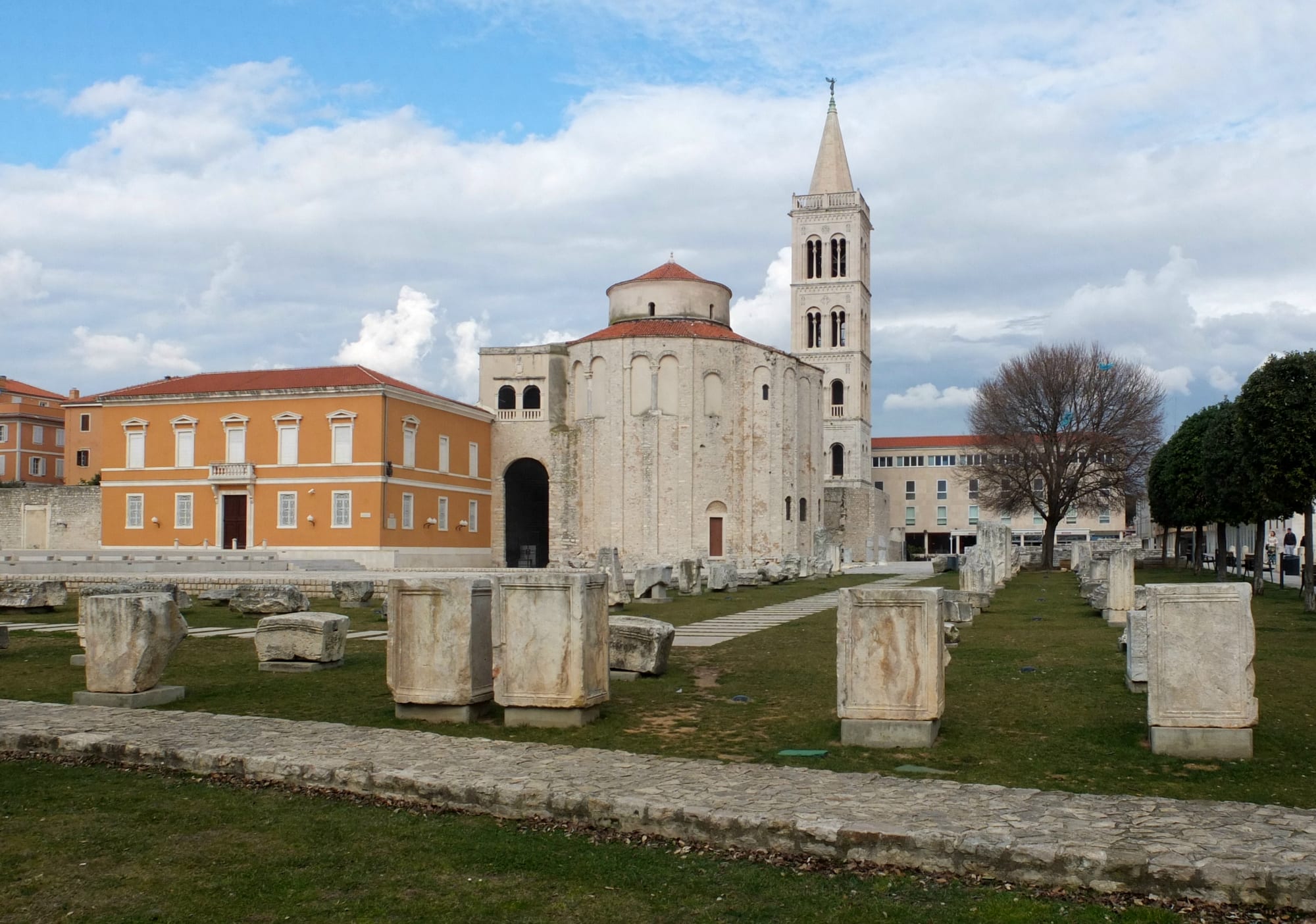
Roman stone fragments on a grassy forum before the round stone Church of St Donatus and a tall white bell tower

Dalmatia, Croatia

Zadar

The Roman Forum of Zadar, with the Church of St Donatus and the bell tower of the cathedral behind. (Palauenc05 / Wikimedia Commons · CC BY-SA 4.0)

The main city of northern Dalmatia, built on a narrow peninsula facing the islands of Ugljan and Pašman. Liburnian Iader became a Roman colony, then the capital of Byzantine and Venetian Dalmatia; Allied bombing destroyed most of it in the Second World War. Today a Roman forum, Romanesque churches and Venetian walls share the shoreline with the wave-played Sea Organ.

Neighbourhoods

  • Poluotok (the old town)
    • First-time visitors
    • Historic district
    • Walking

    The walled peninsula that was Roman Iader, laid out on a grid around the forum and crossed by Kalelarga, the main street. Romanesque churches, the Archaeological Museum, cafés and the seafront with the Sea Organ are all within a few minutes' walk, and the city walls became raised promenades in the 19th century.

    Open in Maps
  • Arbanasi
    • Quiet and residential
    • Local life

    A suburb founded by Catholic Albanian refugees who arrived in 1726–33, settled under Archbishop Vicko Zmajević. Today it is a residential district, a short walk or bus ride from the old town.

    Open in Maps
  • Borik and Puntamika
    • Beaches
    • Families

    The coast about 5 km from the old town, where the large Borik hotel complex and a marina stand by the sea. Local buses connect it with the centre.

    Open in Maps
  • Voštarnica and the newer city
    • Shopping
    • Close to public transport

    The districts that grew up behind the peninsula from the 19th century onwards, now largely residential. Less picturesque, but where much of daily life takes place.

    Open in Maps

Things to do

Famous landmarks

  • Church of St Donatuslandmark

    A massive round church begun in the 9th century on the edge of the Roman forum, the largest pre-Romanesque building in Croatia, now used for concerts.

    Open in Maps
  • Zadar Cathedrallandmark

    The Cathedral of St Anastasia, the largest church in Dalmatia, a three-nave Romanesque building mostly of the 12th and 13th centuries on the site of an early Christian basilica; its bell tower gives a view over the roofs.

    Open in Maps
  • Roman Forumlandmark

    The largest Roman forum on the eastern side of the Adriatic, founded under Augustus, where column fragments and stone blocks lie on the grass and locals sit among the ruins.

    Open in Maps
  • Church of St Chrysogonuslandmark

    A Romanesque church consecrated in 1175, dedicated to the city's patron saint and the last surviving part of a large medieval Benedictine abbey.

    Open in Maps
  • St Mary's Church and the Gold and Silver of Zadarmuseum

    A Benedictine convent founded in 1066 beside the forum, with a Romanesque bell tower of 1105 and a permanent exhibition of church gold and silverwork.

    Open in Maps
  • Land Gatelandmark

    The ceremonial entrance to the walled town, built in 1543 to a design by the Venetian architect Michele Sanmicheli.

    Open in Maps

Museums

  • Archaeological Museummuseum

    Founded in 1830 and arranged by period over three floors, from prehistory and the Liburnians through Roman Iader to post-Roman times.

    Open in Maps
  • Museum of Ancient Glassmuseum

    A museum of the history of glass, from early jewellery and decorative pieces to Roman amphorae and bottles and contemporary glass art, with glass-blowing demonstrations.

    Open in Maps

The waterfront

  • Sea Organattraction

    Marble steps on the western quay with pipes underneath, through which the waves play a continuous, shifting music.

    Open in Maps
  • Monument to the Sunattraction

    A 22-metre circle of glass plates set into the waterfront beside the Sea Organ, with solar modules underneath and lights that come on at night.

    Open in Maps

Sport and nights out

  • Krešimir Ćosić Hallattraction

    The indoor arena of KK Zadar, the city's basketball club, which also hosts concerts and other events.

    Open in Maps

Short trips from the city

  • Ugljanattraction

    The first island of the Zadar archipelago, across the Zadar Channel and linked by bridge to Pašman, reached by ferry from the city.

    Open in Maps
  • Ninattraction

    A small town on its own islet north of Zadar, once the seat of a medieval diocese and of the princes of Dalmatia, with salt pans nearby.

    Open in Maps
  • Lake Vranapark

    The largest lake in Croatia, a nature park on the border of Zadar and Šibenik-Knin counties.

    Open in Maps
  • Telašćicapark

    A deep bay in the south-eastern part of the island of Dugi Otok, protected as a nature park and a sheltered harbour for boats.

    Open in Maps
  • Paklenica National Parkpark

    Two karst canyons cut into the southern slopes of Velebit near Starigrad, popular for hiking and climbing.

    Open in Maps
  • Kornatipark

    An archipelago of 89 islands, the densest in the Mediterranean, much of it protected as a national park and visited on boat excursions.

    Open in Maps
  • Krka National Parkpark

    The travertine falls and pools of the Krka river above Šibenik, protected as a national park.

    Open in Maps
  • Plitvice Lakes National Parkpark

    A World Heritage chain of tufa lakes and waterfalls in the karst of central Croatia, on one of the bus routes towards Zagreb.

    Open in Maps

Seasonal events

  • Musical Evenings in St Donatussummer

    A series of classical concerts held since 1961 inside the round church, whose acoustics suit early and chamber music.

Eat and drink

Long-standing places and food districts in Zadar. Hours, ratings and directions come from your maps app, always current.

Zadar classics

  • Maraschinomarket

    The liqueur distilled from marasca cherries, made industrially in the city since 1759 and today produced by the Zadar company Maraska.

    Open in Maps
  • Pag cheesemarket

    Paški sir, the hard, strongly flavoured sheep's milk cheese from the island of Pag north of the city.

    Open in Maps

Cafés and bars

  • Kalelarga cafésneighborhood

    The main street of the peninsula, running from Narodni trg to the forum, lined with café terraces where much of the city meets for long coffees.

    Open in Maps
  • The Arsenalrestaurant

    An 18th-century Venetian warehouse for the war fleet beside Three Wells Square, reopened in 2005 as an indoor venue for the city's cultural and entertainment life.

    Open in Maps
  • Old town konobasneighborhood

    Small taverns on the side streets of the peninsula serving grilled fish, black risotto and Dalmatian home cooking.

    Open in Maps

Experience Zadar

History

Zadar began in the 9th century BC as a Liburnian settlement on a small stone islet joined to the mainland by a narrow isthmus, and by the 7th century BC it was trading with Phoenicians, Etruscans and Greeks. Rome made Iader a municipium in 59 BC and, after the town backed Caesar in the civil war, a colony in 48 BC. It gained a street grid, baths, a forum and an aqueduct of about 40 km from Lake Vrana. When Salona was destroyed in the 7th century, Zadar became the seat of Byzantine Dalmatia, and it became a naval power to rival Venice.

That rivalry shaped its medieval story. Zadar swore allegiance to Venice in 998, rebelled again and again, and turned to the Hungarian crown in 1183. In 1202 the Venetians diverted the Fourth Crusade to besiege and plunder the city. Louis I of Hungary took it in 1357, but in 1409 Ladislaus of Naples sold Zadar and his claim to Dalmatia to Venice for 100,000 ducats. As the capital of Venetian Dalmatia facing the Ottomans, it became the largest fortified city in the region, and in 1396 the Dominicans founded the university.

After Venice fell, Zadar was Austrian, briefly French, then Austrian again, serving as capital of the Kingdom of Dalmatia until 1918. The Treaty of Rapallo gave it to Italy in 1920 as the enclave of Zara. Allied bombing from November 1943 to October 1944 destroyed about 80 per cent of its buildings — it has been called the "Dresden of the Adriatic" — and most of its Italian population left after the war. The city was shelled again from 1991, and its land link with the rest of Croatia was restored in 1993.

Culture & Customs

Zadar was a centre of the Renaissance on the Adriatic. The sculptor Giorgio da Sebenico was born here, and in the 15th and 16th centuries the city produced both Italian humanists and Croatian writers: Petar Zoranić wrote Planine, the first Croatian novel. Under French rule it printed the first Dalmatian newspaper, in Italian and Croatian, the first time Croatian appeared in a newspaper. That mixed inheritance still shows in the place names and in a small Italian community of a few hundred people.

The modern city is known as much for two pieces of contemporary design as for its churches: Nikola Bašić's Sea Organ and Monument to the Sun on the western tip of the peninsula, where crowds gather for the sunset. Music is part of the summer calendar, from the concerts in St Donatus, held since 1961, to an international choirs competition. A small rowing-boat ferry has crossed the harbour for some 800 years.

Sport is a local passion. KK Zadar is one of Croatia's best-known basketball clubs and fills the Krešimir Ćosić Hall, and the city is the hometown of the footballer Luka Modrić, made an honorary citizen in 2019. Faith is visible too, as the seat of an archdiocese, and St Chrysogonus is the city's patron saint. Like the rest of the coast, Zadar runs on a relaxed rhythm, and the walk along the seafront at dusk is a fixture of the day.

Daily Life

Zadar had 70,779 residents at the 2021 census, making it the fifth-largest city in Croatia and the second-largest in Dalmatia; ethnic Croats make up about 95 per cent. Most people live outside the peninsula, in districts such as Arbanasi, Voštarnica, Smiljevac, Bokanjac, Borik and Puntamika, while the old town is increasingly given over to visitors in summer.

The economy rests on tourism alongside seaborne trade, fish farming and food production. The shipping company Tankerska plovidba, the food company Cromaris and the maraschino maker Maraska are based here, and the University of Zadar, refounded as an independent university in 2003, has more than 6,000 students. The airport at Zemunik has grown quickly on low-cost flights, and the port of Gaženica handles ferries to the islands and Italy.

The day starts with coffee on a terrace and slows in the afternoon heat before the evening walk along the seafront. Many families have ties to the islands of the archipelago, which ferries serve daily. Since 2020 the city has had no passenger railway, so buses and cars carry almost everyone. Šime Erlić was elected mayor in 2025.

Food

Zadar's own contribution to the table is maraschino, the liqueur distilled from slightly sour marasca cherries, which grow on the Ravni Kotari farmland north-east of the city. Distilling here dates back centuries; in 1759 the Venetian merchant Francesco Drioli began industrial production in what was then Zara, and his factory held royal warrants from the courts of Austria, Great Britain and Italy before closing in 1980. Maraska still makes maraschino in the city today.

The rest of the menu is Dalmatian. Fish is grilled, chard, blitva, is one of the commonest ingredients of Dalmatian cooking, and brudet, a stew of several kinds of fish, is eaten with polenta. Pag cheese, the hard sheep's milk cheese of the island to the north, is served with pršut, the smoked, dry-cured ham of Dalmatia. Black risotto, a seafood dish, and pašticada, beef braised in sweet wine and prunes, are Dalmatian staples on konoba menus.

Coffee culture fills the terraces of Kalelarga and the seafront. Wine comes from across Dalmatia, and at the end of a meal a glass of maraschino or a herb brandy is a local way to finish.

Planning tools

Budget

Zadar costs less than Dubrovnik, Hvar or Split, but prices on the peninsula and along the seafront rise sharply in July and August. Apartments and private rooms are the usual way to stay, and the quieter months from October to May are much cheaper. Boat excursions to the Kornati and park tickets for Krka or Plitvice are the main extra costs.

Daily Budget Midrange
USD 140–280 (apartment or mid-range hotel, konoba dinners, a boat excursion or park ticket)
Daily Budget Shoestring
USD 60–100 (hostel or private room, bakery and market food, local buses and foot-passenger ferries)

The forum, the Sea Organ, the Monument to the Sun and the walls cost nothing; in high summer a stay outside the peninsula is often cheaper.

Best Time to Visit

May, June and September give warm weather and a swimmable sea without the July and August crowds, when prices peak and the excursion boats fill. Sunsets over the islands are a reason to come at any time of year. In winter the city is quiet, mild and wet, and many island ferries run reduced timetables.

Suggested Number of Days

Two or three days cover the city itself at an easy pace. The number grows with the islands and national parks within reach, which are best treated as separate outings; four to six days allow for several of them.

First Visit
2–3 days
With Surroundings
4–6 days

Transportation

The old town is walked. Buses run by Liburnija cover the city and its suburbs and all meet at the bus station, which also handles intercity services. A small rowing-boat ferry crosses the harbour between the peninsula and the far side. Jadrolinija ferries and catamarans leave the harbour for Ugljan, Dugi Otok and the other islands, while larger ferries use the port of Gaženica south of the centre. A hire car suits the national parks.

Zadar has no passenger trains; buses or a car are the only ground transport.

Airport & Station Connections

Zadar Airport is at Zemunik Donji, east of the city, with many seasonal European flights; airport buses run to the bus station and the old town. Intercity buses link Zadar with Zagreb in about three and a half hours, as well as with Split, Šibenik, Rijeka and Pula. The A1 motorway passes close to the city, and ferries cross to Ancona in Italy.

Walkability

The peninsula is compact, flat and largely car-free, with the forum, churches, museums and seafront all a few minutes apart. A footbridge over the harbour links it with the newer districts. The beaches at Borik and the bus station are better reached by bus. Polished stone paving becomes slippery after rain.

Safety

Croatia is a very safe country for visitors, with low levels of violent crime. In Zadar the usual nuisances are pickpockets in the summer crowds on the peninsula. The natural hazards matter more: summer heat and sun, sea urchins on rocky shores, slippery stone paving and sudden winds for anyone on a kayak or small boat.

Wear water shoes on rocky beaches, check the wind forecast before any boat trip and use marked taxis or apps. Check current official travel advice before travelling.

Climate

Mediterranean, with mild, wet winters and very warm summers. October and November are the wettest months and July the driest; snow falls on only one or two days a year, and often not at all.

Summer
very warm, with July and August highs around 29–30°C and frequent days above 30°C
Winter
mild and wet, with January averaging around 8°C; frost is rare and short-lived

Local Customs

Life follows the coastal rhythm of long coffees and an evening stroll along the seafront. Tipping is voluntary: rounding up for drinks and 5–10 per cent for a meal with good service. Swimwear belongs on the beach rather than in the old town or churches, where shoulders and knees should be covered.

A greeting of 'dobar dan' (good day) is welcome; ask before photographing people, and dress modestly inside churches.

Common Payment Methods

The currency is the euro, adopted on 1 January 2023 in place of the kuna. Cards are accepted almost everywhere; some cash is useful for markets, small konobas and island shops.