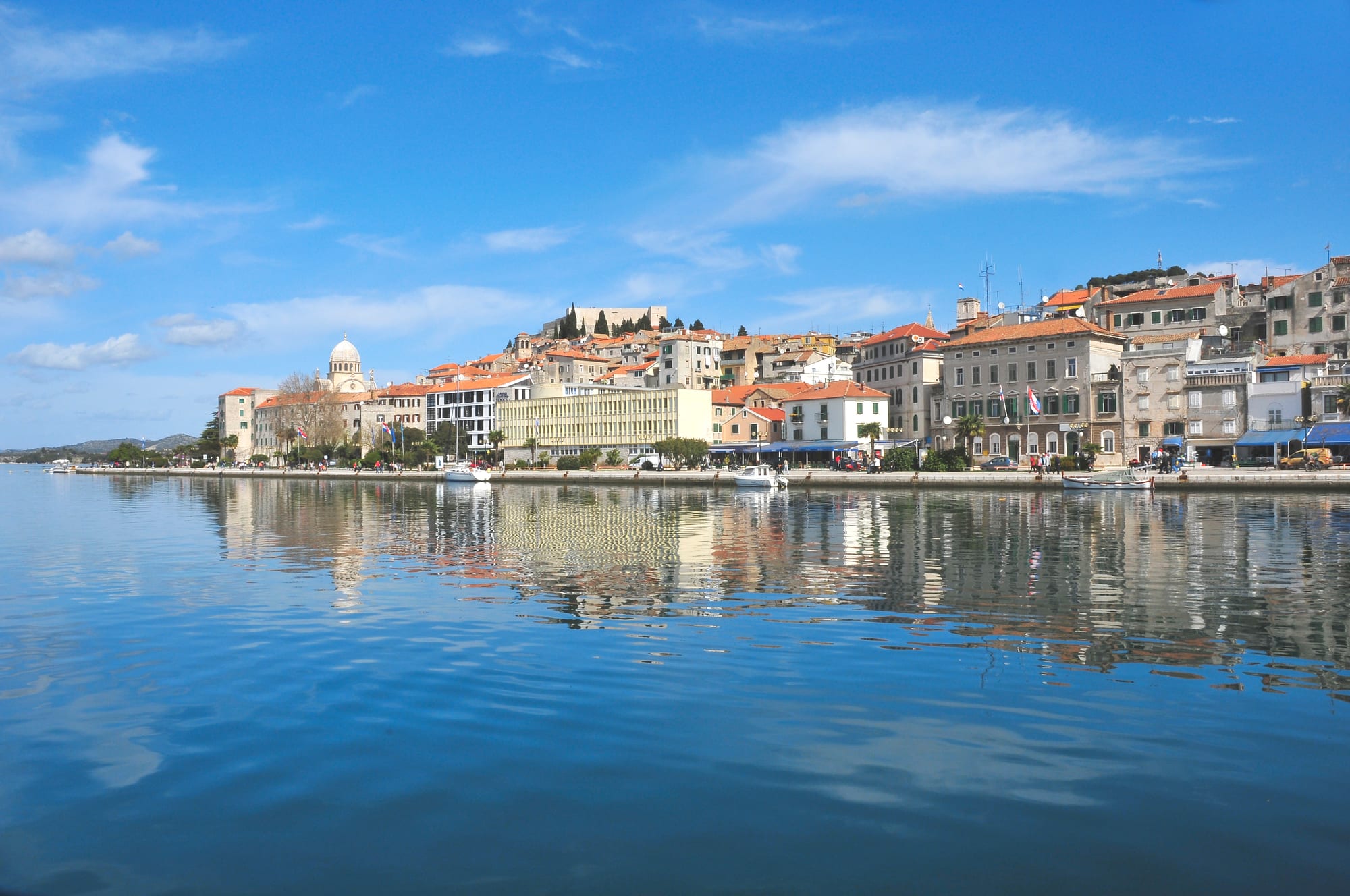
Pale stone buildings and a domed cathedral along a calm bay that mirrors the town under a blue sky

Dalmatia, Croatia

Šibenik

The old town of Šibenik along the shore of its bay, with the dome of the Cathedral of St James on the left. (LBM1948 / Wikimedia Commons · CC BY-SA 4.0)

A stone city climbing the hillside above a sheltered bay where the Krka reaches the Adriatic. Unlike its Roman neighbours, Šibenik grew from a Croatian fortress first recorded in 1066, became a Venetian frontier town against the Ottomans and later an industrial port. Today its World Heritage cathedral, four fortresses and steep lanes draw visitors on their way to Krka's waterfalls.

Neighbourhoods

  • The old town
    • First-time visitors
    • Historic district
    • Walking

    A maze of stone lanes and stairways rising from the waterfront to St Michael's Fortress, with the cathedral square, the old city hall, churches and old noble houses. Kalelarga, officially King Tomislav Street, is the main shopping street, and the bus station is a few minutes' walk away.

    Open in Maps
  • Šubićevac and the hills
    • Viewpoints
    • Quiet and residential

    The residential slopes above the old town, crowned by the 17th-century fortresses of St John and Barone, with the city's football stadium nearby. The climb is steep, but the views over the roofs, the bay and the islands are the best in the city.

    Open in Maps
  • Crnica
    • Local life
    • Sport

    A district where the La Dalmatienne factory worked until 1931, now a mix of homes, a school and sports grounds, including the city's open-air swimming pool. It shows the working side of Šibenik.

    Open in Maps
  • Brodarica and the southern shore
    • Beaches
    • Islands

    The coast south of the city, where the small mainland village of Brodarica faces Krapanj, a low, tiny island only 300 metres offshore. Brodarica is one of the beach spots around the city.

    Open in Maps

Things to do

Famous landmarks

  • Cathedral of St Jameslandmark

    Built entirely of stone between 1431 and 1536 by Juraj Dalmatinac, Nikola Firentinac and others, with a stone dome and a frieze of more than 70 carved human heads around the apses; a World Heritage Site since 2000.

    Open in Maps
  • St Michael's Fortresslandmark

    The medieval fortress on the hill where the city began, now an open-air stage of about a thousand seats with views over the bay and the mouth of the Krka.

    Open in Maps
  • St John's Fortresslandmark

    A star-shaped fort built in 58 days in 1646 by the townspeople against an expected Ottoman attack, 115 metres above the old town.

    Open in Maps
  • Barone Fortresslandmark

    The second fort built in the same emergency of the Cretan War, which helped the city hold off a siege by a large Ottoman army soon after.

    Open in Maps
  • St Nicholas Fortresslandmark

    A 16th-century Venetian sea fortress on an islet at the entrance to the channel leading into the bay, part of a World Heritage listing of Venetian defences since 2017.

    Open in Maps

Walks and the waterfront

  • St Anthony Channeltrail

    The narrow strait of more than two kilometres linking the bay to the open sea, with a walking and cycling trail along its shore towards St Nicholas Fortress.

    Open in Maps
  • Šibenik waterfrontviewpoint

    The palm-lined riva below the old town, with the statue of King Petar Krešimir IV between the park and the start of the promenade.

    Open in Maps

Short trips from the city

  • Zlarinattraction

    A car-free island of figs and cypresses a short ferry ride from the city, known for its coral-working tradition.

    Open in Maps
  • Krapanjattraction

    One of the smallest inhabited islands in the Adriatic and the lowest, long known for its sponge industry.

    Open in Maps
  • Prvićattraction

    A small island in the Šibenik archipelago, served by local ferries from the city.

    Open in Maps
  • Krka National Parkpark

    The travertine waterfalls and pools of the Krka about 18 km north of the city, including Skradinski buk and the monastery islet of Visovac.

    Open in Maps
  • Jaruga Hydroelectric Power Plantattraction

    The plant beside Skradinski buk whose system lit Šibenik's streets with alternating current from 1895; its 1903 successor still generates power.

    Open in Maps
  • Skradinattraction

    A small town upriver on the Krka, at the entrance to the national park.

    Open in Maps
  • Primoštenattraction

    A town down the coast south of Šibenik, known for its vineyards, where Babić grows on historic stone terraces.

    Open in Maps
  • Lake Vranapark

    The largest lake in Croatia, a nature park with a rich bird life on the border of Šibenik-Knin and Zadar counties.

    Open in Maps
  • Kornatipark

    The densest archipelago in the Mediterranean, west of Šibenik, much of it a national park visited on boat excursions.

    Open in Maps

Seasonal events

  • International Children's Festivalsummer

    Held since 1958, with children's workshops, plays and other activities that draw performers from around the world to the theatre, the stage between the cathedral and the city hall, and the streets and squares.

  • Dalmatian Chanson Eveningssecond half of August

    A festival of Dalmatian popular song, Večeri dalmatinske šansone, held in the city in late summer.

  • Summer concerts at St Michael's Fortresssummer

    International and Croatian artists perform on the open-air stage inside the medieval fortress above the city.

  • Medieval fairlate September

    A festival of medieval crafts, costumes and stalls in the streets of the old town.

Eat and drink

Long-standing places and food districts in Šibenik. Hours, ratings and directions come from your maps app, always current.

Šibenik classics

  • Drniš pršutmarket

    The smoked, bura-dried ham of Dalmatia; Drniš pršut, from inland of Šibenik, is considered one of the finest.

    Open in Maps
  • Babić wine from Primoštenmarket

    Red wine from the Babić grape, grown around Šibenik and on the historic stone terraces of Primošten just down the coast.

    Open in Maps

Food districts and cafés

  • Kalelarganeighborhood

    The main street of the old town, King Tomislav Street, with shops, small squares and café terraces.

    Open in Maps
  • Old town konobasneighborhood

    Small taverns on the lanes and stairways around the cathedral serving grilled fish, brudet and other Dalmatian home cooking.

    Open in Maps
  • The rivaneighborhood

    The seafront below the old town, lined with cafés and restaurants looking across the bay.

    Open in Maps

Experience Šibenik

History

Šibenik is unusual on the Dalmatian coast: it was not founded by Greeks, Illyrians or Romans but grew up as a Croatian fortress, probably in the 9th century, on the hill now crowned by St Michael's Fortress. It first appears in a charter issued by King Petar Krešimir IV at Christmas 1066, which is why it is called Krešimir's town. Venice, Byzantium and Hungary fought over it for the next century; it gained town status in the 12th century and, after a long struggle with Trogir, its own diocese in 1298.

Venice took the city in 1412 after a three-year war and made it the seat of the Adriatic salt monopoly. Facing the Ottomans just inland, Šibenik built the Cathedral of St James between 1431 and 1536 and ringed itself with forts: St Nicholas at the harbour entrance in the 16th century, then St John and Barone in 1646, raised by the townspeople in 58 days each before an Ottoman army besieged the city during the Cretan War. Until the 17th-century plague it was the largest city on the eastern Adriatic coast.

Austrian rule followed Venice's fall in 1797. Ante Šupuk, elected in 1872 as the first Croat mayor, modernised the city, and on 28 August 1895 Šibenik became the first city in the world to light its streets with alternating current, from the Jaruga plant on the Krka. Italy occupied the city after the First World War and again from 1941 to 1943. In September 1991 it was attacked for six days, damaging the cathedral dome, and was defended; the region was retaken in August 1995. The industry built in the 20th century largely closed afterwards.

Culture & Customs

The cathedral is the city's pride: a building raised entirely of stone, without mortar or wood, whose frieze of more than 70 carved heads is considered a set of portraits of people from Dalmatia of its time. Šibenik also remembers Faust Vrančić, the bishop and inventor born here in 1551 and credited with one of the earliest parachute designs.

Music and theatre run through the summer. The International Children's Festival, held since 1958, fills the theatre and squares with young performers from around the world; the Dalmatian Chanson Evenings bring popular song in August; and the stage inside St Michael's Fortress hosts international artists. The theatre itself, built by the townspeople in 1870 without public money, was damaged in 1991 and has been restored. Klapa singing is part of local life, and the orange-and-black Šibenik cap is the city's emblem.

Sport is taken seriously. Šibenik is the hometown of the basketball player Dražen Petrović, one of Europe's greatest players, and of a long line of water polo players and footballers, and local clubs play at Šubićevac and in the city's pools. Like the rest of Dalmatia, the city keeps a slow rhythm of coffee and the evening walk along the riva.

Daily Life

At the 2021 census the urban settlement had 31,115 people and the wider city 42,599, making it the third-largest town in Dalmatia and the seat of Šibenik-Knin County. Most residents live in the districts that climb the hills behind the old town and spread along the bay, and the island of Krapanj, among others, belongs to the city.

Until the 1980s Šibenik was a strong industrial centre: the TEF and TLM factories and its port was among the largest in Yugoslavia. TEF closed in the 1990s and its works were removed, and the war damaged TLM. Today the city is the county's administrative, educational and economic centre, and tourism draws on the World Heritage cathedral and fortress and on Krka just upstream.

The old town fills with visitors in summer and empties in winter, when the city returns to its residents. Island families move between Šibenik and their houses on Zlarin, whose population rises several times over from March to October. The city has no airport of its own, and plans for one in the hinterland have been approved but not built.

Food

Šibenik eats in the Dalmatian way. Fish is grilled, chard, blitva, is one of the commonest ingredients of Dalmatian cooking, and brudet, a stew of several kinds of fish, is eaten with polenta. From the hinterland comes pršut, the dry-cured ham that in Dalmatia is smoked before the bura dries it, and Drniš pršut, from inland of Šibenik, is considered one of the finest.

The konobas of the old town lanes serve this everyday Dalmatian cooking, and the surrounding country has long been given over to vineyards and olive groves.

Wine comes from the coast around the city: Babić, a red grape grown around Šibenik and on the historic stone terraces of Primošten just to the south, is the local grape, grown in northern Dalmatia for hundreds of years. Prošek is the sweet dessert wine, travarica the herb brandy, and wine cut with still water, bevanda, is drunk with meals.

Planning tools

Budget

Šibenik is cheaper than Split or Dubrovnik, and much of the city's appeal — the lanes, the waterfront, the channel walk — is free. Prices rise in July and August. Apartments and private rooms are the usual way to stay, and foot-passenger ferries to the islands are inexpensive.

Daily Budget Midrange
USD 140–270 (apartment or mid-range hotel, konoba dinners, fortress and park tickets)
Daily Budget Shoestring
USD 60–100 (hostel or private room, bakery and market food, buses and island ferries)

Visit Krka early or late in the season for fewer people.

Best Time to Visit

May, June, September and early October bring warm weather and fewer people. July and August are hot, crowded and the busiest time at Krka, but also the season of the children's festival, the chanson evenings and fortress concerts. Winter is mild and quiet, with fewer ferries.

Suggested Number of Days

One or two days cover the compact old town and its fortresses. The national park, the islands of the archipelago and the coast to either side each deserve their own outing, so a stay of three to five days suits anyone using the city as a base.

First Visit
1–2 days
With Surroundings
3–5 days

Transportation

The old town is walked, and everything in the centre lies within about half an hour on foot. Local buses reach the outskirts and nearby villages, and regional buses run to Vodice, Pirovac and Biograd na Moru. Ferries from the city quay serve Zlarin, Prvić, Kaprije, Žirje and other islands. A slow branch railway joins the Zagreb–Split line at Perković. A car or an organised trip is easiest for Krka.

Wear shoes with grip — the old town is built on stairways of polished stone.

Airport & Station Connections

Šibenik has no airport. Split Airport, about 50 km away, and Zadar Airport, about 70 km away, are the nearest. Intercity buses link Šibenik with Zagreb, Zadar, Split and beyond, and the A1 motorway passes just inland. Long-distance ferries use Split and Zadar.

Walkability

Very walkable but steep. The bus station is about five minutes from the old town, and the main sights are close together, though reaching the fortresses means climbing many steps. The waterfront and the channel trail are flat.

Safety

Croatia is a very safe country for visitors, with low levels of violent crime. In Šibenik the main risks are natural ones: summer heat on the fortress climbs, slippery stone steps, sea urchins on rocky beaches and sudden winds for small boats and kayaks.

Carry water when climbing to the fortresses, wear water shoes on rocky shores and check the wind forecast before a boat trip. Check current official travel advice before travelling.

Climate

Mediterranean, with hot, dry summers and mild, humid winters. July and August are the hottest months, January and February the coldest.

Summer
hot and dry, with July highs averaging around 30°C
Winter
mild and humid, with January and February the coldest months; the record low is −11.0°C, in February 1956

Local Customs

The orange-and-black Šibenik cap is a symbol of the city. Tipping is voluntary: rounding up for drinks and 5–10 per cent for a meal with good service. Swimwear belongs on the beach rather than in the old town or the cathedral, where shoulders and knees should be covered.

A greeting of 'dobar dan' (good day) is welcome; ask before photographing people, and dress modestly inside churches.

Common Payment Methods

The currency is the euro, adopted on 1 January 2023 in place of the kuna. Cards are accepted almost everywhere; some cash is useful for markets, small konobas and island shops.