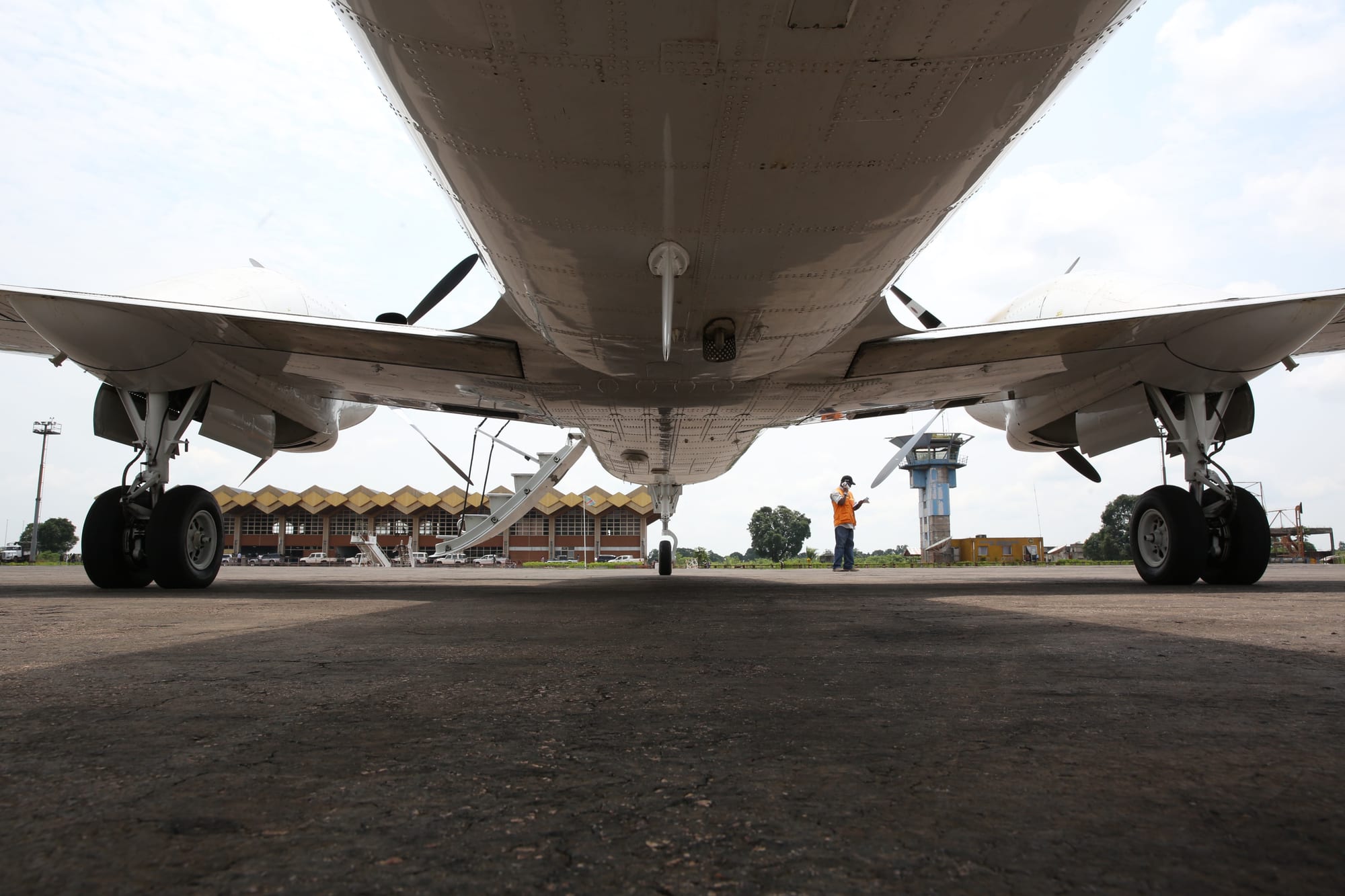
A parked propeller aircraft framing the yellow-roofed terminal and blue control tower of Gbadolite airport across the apron

Mbandaka & the Northwest, Democratic Republic of the Congo

Gbadolite

The terminal and control tower of Gbadolite airport, built during Mobutu Sese Seko's rule in northern DR Congo. (MONUSCO Photos / Wikimedia Commons · CC BY-SA 2.0)

A town in the northern forests of Nord-Ubangi province, near the Ubangi River and the border with the Central African Republic. It was the home area of Mobutu Sese Seko, who built palaces, a hydroelectric dam and an outsized airport here; the palaces stand in ruins. This page is written to explain the town, not to encourage travel.

Neighbourhoods

  • The town centre
    • First-time visitors
    • Markets
    • Local life

    The administrative and trading heart of Gbadolite, with the market, provincial offices, churches and most of the shops along a handful of wide avenues. It is where road transport to Gemena and the border starts and where the town's limited accommodation is found.

    Open in Maps
  • Kawele
    • History
    • Ruins

    The residential quarter a few kilometres from the centre that holds Mobutu's main compound, now roofless and stripped. Broad tarmac roads and street lighting poles built for the presidential motorcade still run between forest and gardens.

    Open in Maps
  • The airport quarter
    • Quiet and residential
    • Transport

    The area around the airport, laid out on the same generous scale as the rest of the town's state-built infrastructure. Villas built for officials and staff stand among plots of cassava and palm, and much of the land has returned to bush.

    Open in Maps

Things to do

The Mobutu-era town

  • The ruined palaceslandmark

    The remains of the presidential residences built for Mobutu Sese Seko, looted and gutted after his fall in 1997 and now overgrown shells of marble, concrete and empty pools.

    Open in Maps
  • Gbadolite Airporttransit hub

    The airport built to serve the presidential town, with a runway able to take Concorde during the Mobutu years, set at the village of Moanda about 6 km south-west of the town and now used by occasional flights.

    Open in Maps

Short trips from the town

  • Mobayi-Mbongoattraction

    A small town on the Ubangi River north of Gbadolite, site of the hydroelectric station opened in 1989, some of whose power is exported across the river to the Central African Republic.

    Open in Maps
  • Mobayeattraction

    The town on the opposite, Central African bank of the Ubangi, facing Mobayi-Mbongo across the water at a long-standing river crossing.

    Open in Maps

Eat and drink

Long-standing places and food districts in Gbadolite. Hours, ratings and directions come from your maps app, always current.

Markets and food streets

  • Gbadolite marketmarket

    The town's central market, where cassava, plantain, groundnuts, palm oil, smoked fish and forest produce are sold, along with goods trucked in from Gemena and the river.

    Open in Maps
  • Grill stalls and bars of the centreneighborhood

    Small kitchens and braziers along the main avenues grill fish, goat and chicken and serve them with fufu, rice or fried plantain, with bottled beer and palm wine alongside.

    Open in Maps

Experience Gbadolite

History

Gbadolite was a small settlement in the Ngbandi country of the northern Ubangi forests, about 12 km south of the river that marks the border with what is now the Central African Republic. Its transformation began with one man: Joseph Désiré Mobutu, born in 1930 at Lisala and raised partly in this district, who took power in the Congo in 1965 and renamed himself Mobutu Sese Seko and the country Zaire.

From the 1970s he turned his home village into a second capital. State money built a series of palaces, including the vast residence at Kawele with its marble, fountains and formal gardens; power came from a hydroelectric station on the Ubangi at Mobayi-Mbongo, opened in 1989; and an airport was laid out with a runway able to take Concorde. Heads of state, businessmen and diplomats were received here, and the town acquired the nickname "Versailles of the Jungle" while the rest of the country's infrastructure decayed.

The arrangement ended with Mobutu himself. As the rebellion that would depose him advanced in 1997, he left Gbadolite and the country, dying in exile in Morocco later that year; the palaces were looted and stripped within days. During the Second Congo War the north-west was fought over by the rebel Movement for the Liberation of the Congo, led by Jean-Pierre Bemba, who was born in Nord-Ubangi, and Gbadolite changed hands. Since then the town has served as an ordinary provincial centre, becoming the capital of the new Nord-Ubangi province when Equateur was divided in 2015, with the ruins as its most visible inheritance.

Culture & Customs

This is Ngbandi country, the people from whom Mobutu came, living alongside Ngbaka, Ngombe and other communities of the Ubangi. Lingala is the shared language of trade and the street, French belongs to administration and schooling, and local languages are spoken at home and in village affairs. The border makes the area bilingual in another sense as well: Sango, the language of the Central African Republic, is heard among traders who cross the river.

Church life dominates the week. Catholic and Protestant missions established themselves here in the colonial period and still run schools, clinics and choirs, and revival churches have grown alongside them. Customary chiefs and clan elders retain authority in land disputes, marriages and funerals, and obligations to the extended family shape household budgets.

Mobutu's legacy is part of the local identity in a way outsiders often find surprising. Many older residents remember the years when the town had reliable electricity, paved roads, a hospital with equipment and aircraft coming and going, and speak of that period with a nostalgia that sits uneasily beside the record of the state he ran. Music, Congolese rumba above all, plays from bars and shopfronts in the evening; football is the shared enthusiasm; and social life revolves around the market, the church and the long conversation.

Daily Life

Gbadolite is a small provincial capital, and most of the people of the surrounding territory live in villages and outlying quarters rather than in a dense urban centre. The town is spread out along avenues built for a scale of traffic that never came, with cassava plots and palm trees between the buildings.

The economy is agricultural. Households grow cassava, plantain, maize, groundnuts and rice, tap palm oil, keep small livestock and gather forest products; coffee, which was once a commercial crop of the Ubangi, has largely declined. Trade runs towards Gemena and across the river, and provincial administration, churches, schools and the organisations that work in the area provide the small number of salaried jobs.

The day begins early in the fields and the market and slows through the afternoon heat. Electricity is intermittent even though the dam at Mobayi-Mbongo stands a short distance away, and many households depend on solar panels or generators; water is drawn from wells and standpipes. Isolation is the defining condition: roads that fail in the rains, flights that come irregularly, thin medical services, and the high cost of anything manufactured that has to be brought in from Kinshasa or across the border.

Food

Cassava is the foundation of every meal, pounded into fufu or fermented and wrapped in leaves as chikwangue, and its leaves are stewed with palm oil and smoked fish as pondu. Plantain, makemba in Lingala, is boiled, fried or roasted; rice, maize and groundnuts fill out the table; and palm oil gives sauces their deep orange colour.

Protein comes from the rivers and the forest. Fish from the Ubangi and its tributaries is grilled fresh, stewed, or smoked on racks for keeping and selling, and is often cooked in leaf parcels with onion, tomato and chilli. Groundnut sauces are common in this northern country, edible caterpillars are gathered in season, wild mushrooms and honey come out of the forest, and goat or chicken appears on festive days. Pili-pili chilli is added to almost everything, either in the pot or as a paste at the table.

Palm wine is tapped in the villages and drunk the same day, still fermenting; maize and cassava spirits are distilled locally; and bottled lager, trucked or flown in, is the drink of the bars along the main avenues. Strong sweet tea and coffee are taken in the morning, a reminder of the plantations that once worked this part of the Ubangi.

Planning tools

Budget

Gbadolite has no tourist economy at all. Lodging means a basic hotel or a mission guesthouse charging in US dollars, market food is inexpensive, and the significant costs are the flight in, fuel and any vehicle hired locally. There are no reliable cash machines.

Daily Budget Midrange
USD 100–250 (basic hotel, meals, local transport), with boat charters and flights on top
Daily Budget Shoestring
USD 40–80 (basic room, market food, shared transport)

Bring clean, undamaged US dollar notes for the entire stay; nothing here can be paid for by card.

Best Time to Visit

The drier months from about December to February are the easiest for road travel around Nord-Ubangi, when the dirt roads to Gemena and the border harden. The long wet season from March to November brings heavy storms and can cut the roads for days at a time.

Suggested Number of Days

The town and the Mobutu-era buildings take a day or so to see. Anything beyond that depends on transport to the river and the border country, and on flights, which are infrequent and change at short notice.

First Visit
1–2 days
With Surroundings
2–3 days

Transportation

Getting around is on foot, by motorbike taxi and by shared pickup. The broad avenues laid out in the Mobutu years are wide but broken up, and unlit at night. Roads out of town to Gemena and to the Ubangi are dirt and deteriorate badly in the rains; a four-wheel-drive vehicle and a local driver are the normal arrangement.

Agree fares before setting off, avoid road travel after dark, and expect checkpoints where documents are inspected.

Airport & Station Connections

Gbadolite Airport, a few kilometres south-west of the town, is the practical way in, with occasional flights; schedules are irregular. Overland, rough roads link the town to Gemena and to the Ubangi crossings towards the Central African Republic, journeys of many hours that depend entirely on the weather.

Walkability

The centre is small, flat and walkable, though the distances built into the town's planning are longer than its size suggests, and Kawele is a few kilometres out. Verges take the place of pavements, streets are dust or mud by season, and there is little lighting after dark.

Safety

Nord-Ubangi is far from the conflict in the east and is generally quiet, but it is isolated, with very limited medical care and a long journey to any hospital able to treat a serious problem. Instability across the border in the Central African Republic affects the Ubangi frontier, and petty theft and demands from officials at checkpoints occur.

Most governments advise caution throughout the DR Congo; travel here should be organised with a reliable local contact, with evacuation and medical cover arranged. Take malaria precautions, carry document copies, and ask permission before entering or photographing the former presidential sites. Check current official travel advice before travelling.

Climate

Tropical and close to the northern edge of the equatorial belt: hot and humid, with a long wet season from about March to November and a drier spell from December to February. Rain usually comes as heavy afternoon storms rather than all-day drizzle.

Summer
hot and wet, generally about 21–32°C, with frequent heavy storms
Winter
drier from December to February, about 20–34°C, with hazy, dusty air

Local Customs

Lingala is the common language, with French in offices and schools and Ngbandi and other local languages spoken at home. Churches are central to community life and Sunday mornings are given over to services. Greetings are unhurried and elders are addressed first.

Ask before photographing people, and do not photograph the airport, soldiers, checkpoints or government buildings. Dress modestly; tipping is not customary but small payments for help are normal.

Common Payment Methods

The Congolese franc is the currency for everyday purchases and US dollars are used for rooms, transport and larger sums. Cards are not accepted and cash machines cannot be relied on, so all money for the visit has to be brought in cash, in clean notes.