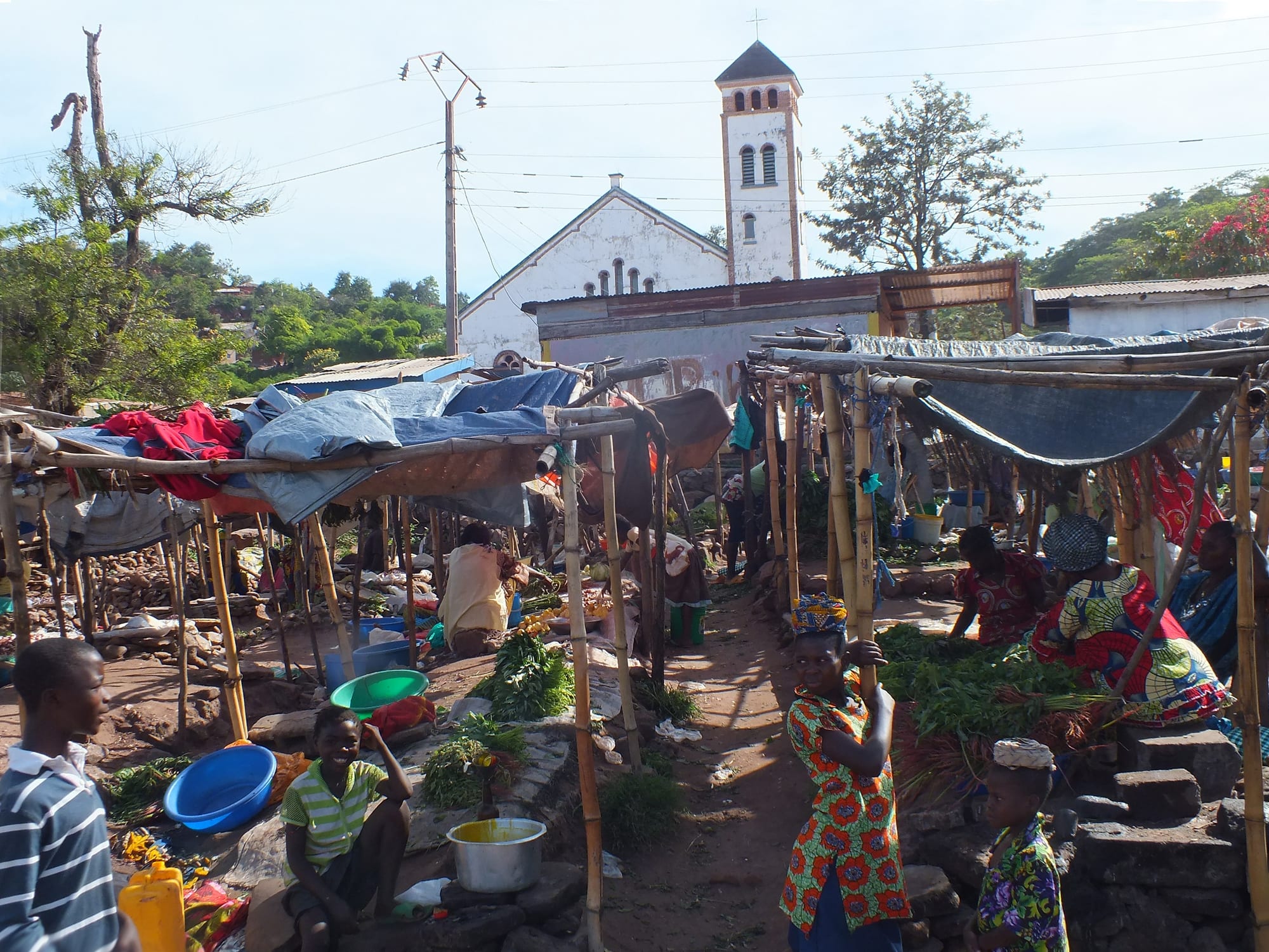
Open-air market stalls of bamboo poles and tarpaulins with vegetables laid out, and a white church with a bell tower behind

Lubumbashi & Katanga, Democratic Republic of the Congo

Kalemie

The market in the centre of Kalemie, below the bell tower of the Maindeleo church. (Orrling / Wikimedia Commons · CC BY-SA 3.0)

A lakeside port and the capital of Tanganyika province, on the western shore of Lake Tanganyika at the point where the Lukuga river drains the lake westwards. Founded in the late nineteenth century and long known as Albertville, it is the end of a railway from the Katangese interior and a crossing point for boats to Tanzania.

Neighbourhoods

  • The centre and the lakefront
    • First-time visitors
    • Markets
    • Lake views

    The low grid of administrative buildings, churches, shops and provincial offices between the lake and the hills, with the market at its heart. Most of the surviving colonial-era buildings and the few guesthouses are here, a short walk from the shore.

    Open in Maps
  • The port and railway quarter
    • Local life
    • Boats and transport

    The working end of town, where the pier, warehouses and the railway terminus stand together. Cargo, fuel and passengers move through it when boats and trains are running, and traders and porters make their living around it.

    Open in Maps
  • Katuku and the hillside quarters
    • Local life
    • Quiet and residential

    Residential quarters climbing the slopes behind the town, built of brick and sheet metal with small plots and shaded lanes. The higher ground gives long views over the lake towards the mountains on the Tanzanian side.

    Open in Maps
  • The southern beach quarter
    • Beaches
    • Local life

    The sandy shore south of the centre, where fishing boats land and women dry the catch in the sun beside a beachside market. It is a working shoreline rather than a resort, and the busiest place in town at dawn.

    Open in Maps

Things to do

The lake and the river

  • Lake Tanganyikaattraction

    The world's second-deepest lake and its longest freshwater lake, more than 600 kilometres from end to end, whose clear water, fish and mountainous eastern shore define the town.

    Open in Maps
  • Lukuga Riverattraction

    The lake's only outflow, leaving Lake Tanganyika at Kalemie and running west to join the Lualaba, the upper Congo.

    Open in Maps
  • The lakeshore beachesbeach

    Long stretches of pale sand north and south of the town, used by fishing crews and for drying the catch, with the Tanzanian mountains visible across the water on clear days.

    Open in Maps

Around the town

  • The central marketmarket

    The open market in the middle of town, selling lake fish fresh and dried, cassava, maize flour, beans and goods brought in by boat and truck.

    Open in Maps
  • Kalemie Airporttransit hub

    The airport serving Kalemie, just outside the town, with domestic services.

    Open in Maps

Eat and drink

Long-standing places and food districts in Kalemie. Hours, ratings and directions come from your maps app, always current.

Kalemie classics

  • Lake Tanganyika fishrestaurant

    Fresh lake fish grilled over charcoal or stewed with tomato and onion, and ndakala, the tiny dried fish sold by the cupful, are the foundation of eating here.

    Open in Maps
  • Ugali and cassava-leaf stewsrestaurant

    Stiff maize or cassava ugali served with pounded cassava leaves, beans or fish sauce is the everyday meal in small eating houses around the market.

    Open in Maps

Markets and the beach

  • The central marketmarket

    Produce from the countryside and the lake, along with sugarcane, palm oil, rice and imported goods that arrive by boat from Tanzania.

    Open in Maps
  • The beach fish marketmarket

    The shoreline south of the centre, where boats land at first light and the catch is sold fresh or laid out on racks to dry in the sun.

    Open in Maps

Experience Kalemie

History

Kalemie began as Albertville, a military post founded on 30 December 1891 by Captain Alphonse Jacques' anti-slavery expedition, financed by the Belgian Anti-Slavery Society, on the western shore of Lake Tanganyika. Its purpose was strategic: the lake was the route by which Swahili-Arab traders from Zanzibar had reached the eastern Congo, and a post here staked a claim to the shore. The first site lay about 15 kilometres south of the Lukuga and was abandoned after the slave traders left; the name passed to the post of M'Toa north of the river, where the town stands today and grew as a lake port and administrative centre.

During the First World War the lake became a theatre of the campaign against German East Africa. Belgian and British forces operated from Albertville against German vessels on Tanganyika in 1915 and 1916, and artillery pieces from that campaign have survived as monuments in the town. The railway reached Albertville in 1915 and the port was built the following year, linking the copper region to the lake steamers and on to Kigoma and the Tanganyikan railway to the Indian Ocean — a link in the long-imagined routes across the continent.

The town was renamed Kalemie in 1971 during Mobutu's authenticity campaign. Its railway, port and industries declined with the rest of the country's infrastructure, and the wars from the late 1990s brought occupation by rebel forces and heavy disruption. Communal violence between Twa and Luba communities in 2016 and 2017 drove many thousands into camps around the town. Kalemie became the capital of the new Tanganyika province when Katanga was divided in 2015.

Culture & Customs

Kalemie belongs as much to the lake world as to Katanga. Swahili is spoken here in a form close to that of the Tanzanian shore, and the town's trading links run east across the water to Kigoma as readily as west to Kabalo and Lubumbashi. Boats bring rice, sugar, cloth and manufactured goods in one direction and fish and passengers in the other, and families are often spread across both shores.

The province is home to Luba and Tabwa communities, to Bembe and Hemba people along the lake, and to Twa forest communities inland, whose relations with their Luba neighbours broke down badly in the middle of the last decade. The Hemba and Tabwa are known for sculpture — ancestor figures and masks that are well represented in museum collections abroad — and Luba traditions of carving and oral history reach into this part of the province.

Catholic and Protestant churches are central to the town, and a Muslim community has existed along the lake since the days of the Zanzibar trade. Football, church choirs and youth associations organise much of social life, and United Nations peacekeeping has long been part of the town's fabric. Evenings are quiet by the standards of the mining cities: bars near the market and along the lakefront, music from speakers on the beach, and an early start for anyone going out on the water.

Daily Life

Kalemie is a small provincial capital whose numbers move with the arrival and departure of displaced families from the countryside, and camps have stood on the edge of the town for years. The built-up area is small, low and spread between the lakeshore, the market and the slopes behind, and much of the housing is self-built.

Fishing is the backbone of the local economy. Crews go out at night with lamps to catch the small fish the lake is known for, and the catch is sold fresh or dried on racks along the shore for sale far inland. Trade through the port, small-scale farming of cassava, maize and beans, palm oil, and work for aid organisations and provincial government make up most of the rest. The town's own manufactures include cement, food products and textiles.

Electricity and water are unreliable, the roads inland are rough, and the railway and lake services are irregular, which keeps the price of everything brought in high. Daily routines follow the lake and the sun: boats in at dawn, the market busiest in the morning, a slow hot afternoon, and lamps and generators in the evening. Displacement, food insecurity and outbreaks of cholera are recurring concerns for provincial and humanitarian authorities.

Food

Fish dominates the table in Kalemie. Lake Tanganyika supplies both large fish such as Nile perch and the small pelagic species dried by the sackful along the beach: ndakala, tiny dried fish cooked into sauces with tomato, onion and palm oil, and larger fish grilled whole over charcoal or simmered in a stew. Drying racks and smoking fires are part of the shoreline landscape.

The staple is ugali, a stiff dough of cassava or maize flour eaten by hand, and cassava appears in every form — as flour, boiled as a root, and as leaves pounded and cooked slowly with palm oil or groundnut into the stew known across the country as sombe or pondu. Rice is more common here than on the plateau, brought in by boat from across the lake, and beans, sweet potatoes, plantains and maize fill out the plate. Mangoes, papayas and sugarcane are sold at the roadside in season.

Grilled goat and chicken with fried plantain or chips are the treat at the bars near the market. Bottled Congolese lager is drunk in the town, home-brewed maize and cassava beers in the villages, and strong sweet tea through the day, a habit shared with the Swahili coast that the lake traders came from.

Planning tools

Budget

Kalemie is modest by Congolese standards, with simple guesthouses rather than business hotels, though the few rooms used by aid organisations are priced in US dollars and are not cheap for what they are. Almost everything manufactured has to be brought in by boat, truck or plane, so imported goods cost considerably more than in Lubumbashi.

Daily Budget Midrange
USD 150–300 (the better guesthouses, a hired vehicle and driver, restaurant meals)
Daily Budget Shoestring
USD 40–70 (simple guesthouse, market food, shared transport)

Bring clean US dollars and Congolese francs in cash; there is no reliable card payment and cash machines cannot be counted on.

Best Time to Visit

The dry season from about May to September brings the calmest weather, the easiest roads and the most dependable boat movements. The rains from October to April are heavy, and the lake can be rough, which affects the small craft that carry most passengers and cargo.

Suggested Number of Days

The town itself is small and can be seen in a day. Longer stays are dictated by transport: flights, boats and trains are infrequent, and anyone travelling on to the interior or across the lake should allow considerable slack.

First Visit
1 day
With Surroundings
2–3 days

Transportation

Kalemie is small enough to cross on foot or by motorbike taxi, and shared taxis run along the main road. Beyond the town, movement is by boat along Lake Tanganyika, by the railway running inland towards Kabalo and the Katangese network, which operates slowly and irregularly — the line towards Kindu, cut by heavy rains in February 2024, was reopened to traffic in December of the same year — and by rough roads that become difficult in the rains.

Timetables for boats and trains are approximate at best, and journeys beyond the town need local advice on the current condition of the routes.

Airport & Station Connections

Kalemie Airport lies just outside the town and takes domestic flights. Boats work up and down Lake Tanganyika and across to the Tanzanian port of Kigoma, and the railway from the Katangese interior terminates at the lakeside. Road journeys from the Copperbelt are long and slow.

Walkability

The centre, the market, the port and the lakefront are all within a short walk of one another on flat ground, which makes Kalemie one of the easier Congolese towns to get around on foot. Roads are largely unpaved and dusty or muddy by season, the residential quarters climb steep slopes behind the town, and walking after dark is not usual.

Safety

Kalemie is away from the fighting in the Kivus, but Tanganyika province has its own troubles. Violence between Twa and Luba communities in 2016 and 2017 displaced large numbers of people, and camps for the displaced remain in and around the town; militia activity has recurred in the countryside to the north and west. In the town itself the practical risks are opportunistic theft, road accidents, waterborne disease and the hazards of overloaded boats on the lake.

Most governments advise caution throughout the DR Congo; the Copperbelt cities are the most practical part of the region, and the rural north and the parks need local guidance. Photographing the port, the airport, soldiers or police causes serious trouble. Check current official travel advice before travelling.

Climate

Lower and warmer than the Katangese plateau, Kalemie sits at around 800 metres beside a very large body of water, which keeps it humid. The rains fall from about October to April, often as violent evening storms, and the dry season from May to September is sunny and a little cooler.

Summer
the rainy season, October to April: hot and humid, roughly 20–31°C, with heavy storms
Winter
the dry season, May to September: warm days near 28°C, cooler nights and lake breezes

Local Customs

Swahili is the everyday language, in a Congolese form close to that spoken across the lake in Tanzania, with French for administration. Greetings are formal and never rushed. Dress is modest, churches and mosques both have congregations here, and the fishing day begins very early. People should always be asked before being photographed, and official buildings, the port and the airport should not be.

Tipping is not expected but small amounts are welcome; permission from local authorities is often needed before photographing around the port or taking a boat.

Common Payment Methods

The Congolese franc is used for everyday purchases and the US dollar for rooms, vehicles and larger payments, with notes needing to be clean and recent. Tanzanian shillings circulate a little through cross-lake trade. Card payment is effectively unavailable, cash machines are unreliable, and mobile money is the common way to move money.