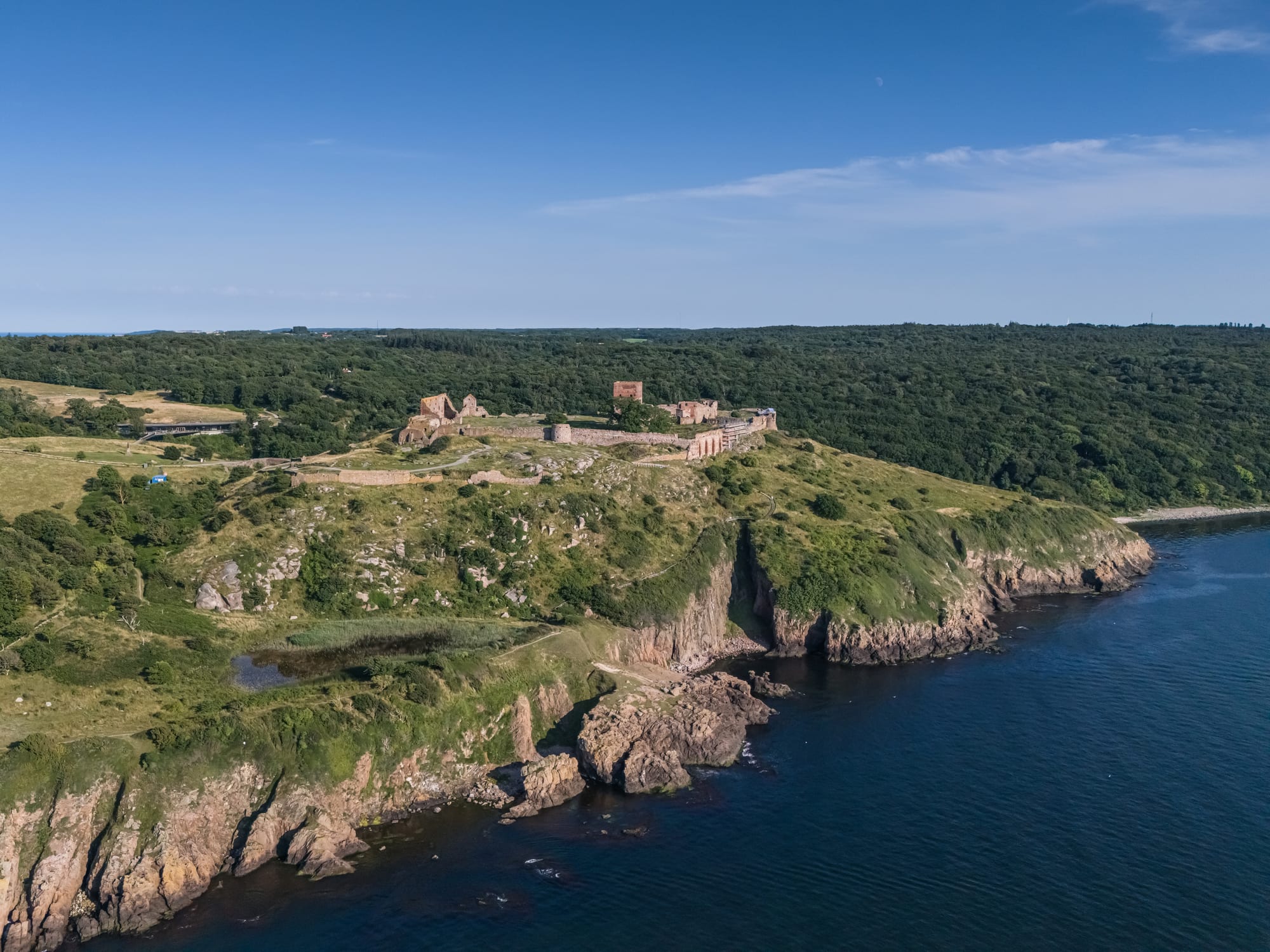
Aerial view of a ruined castle on a green headland above rocky cliffs and dark blue sea, with forest behind

Copenhagen & Zealand, Denmark

Bornholm

The ruins of Hammershus above the cliffs at the northern tip of Bornholm. (A.Savin / Wikimedia Commons · FAL)

A granite island in the Baltic, south of Sweden and far to the east of the rest of Denmark, fought over for centuries by Danes, Swedes and Lübeck. Known as the 'sunshine island' and the 'rock island', it has round churches, the ruin of Hammershus, herring smokehouses and fishing towns, white sand in the south, and lives on tourism, farming and crafts.

Neighbourhoods

  • Rønne
    • First-time visitors
    • Close to public transport
    • Museums

    The island's largest town and seat of government, on the west coast, where the ferries and the airport are. Cobbled streets, half-timbered houses and museums recall its long history as a herring port.

    Open in Maps
  • Gudhjem and the north coast
    • Scenery
    • Best for food
    • Walks

    Steep, picturesque streets run down to Gudhjem's small fishing harbour, known for its smokehouses. Westward lie the granite cliffs of Helligdomsklipperne, the twin town of Allinge-Sandvig and the Hammeren headland with Hammershus.

    Open in Maps
  • Svaneke and the east coast
    • Historic district
    • Crafts
    • Quiet and residential

    Denmark's easternmost town, a well-preserved little harbour town of about 1,100 people known for its glass workshops and brewery. Further south, Nexø is the island's second town and largest fishing port.

    Open in Maps
  • Dueodde and the south coast
    • Beaches
    • Families

    The southern tip, where the granite gives way to sand: the very fine white sand of Dueodde, backed by pine plantations planted in the 18th century to stop it drifting, and smokehouse villages such as Snogebæk and Arnager along the coast.

    Open in Maps
  • Almindingen and the interior
    • Nature
    • Walks
    • Cycling

    The forested heart of the island — one of Denmark's largest forests, with the rift valley of Ekkodalen, the island's highest point at Rytterknægten and a herd of European bison.

    Open in Maps

Things to do

Castles and round churches

  • Hammershuslandmark

    The ruin at Hammeren on the northern tip, Scandinavia's largest medieval fortification, partly demolished around 1750 and partly restored around 1900.

    Open in Maps
  • Østerlars Churchlandmark

    The largest, and possibly the oldest, of the island's four round churches, 5 km south of Gudhjem.

    Open in Maps
  • Nylars Churchlandmark

    A 12th-century round church near Rønne, built with a defensive role in mind, with 13th-century frescoes inside.

    Open in Maps

Coast and nature

  • Helligdomsklipperneviewpoint

    The Sanctuary Rocks, granite cliffs about 22 metres high on the north coast, named after a medieval holy spring.

    Open in Maps
  • Jons Kapelviewpoint

    A 41-metre rock bluff on the west coast north of Hasle, carved by the sea when its level was much higher and named after a hermit who lived there.

    Open in Maps
  • Dueoddebeach

    The protected beach on the southern tip, known for its very fine, wind-blown white sand, with the island's tallest lighthouse.

    Open in Maps
  • Almindingenpark

    A 3,800-hectare forest in the centre of the island, the third-largest in Denmark, where European bison were brought from Poland in 2012.

    Open in Maps
  • Ekkodalentrail

    Echo Valley, Denmark's longest rift, running 12 km through Almindingen towards the north-east coast.

    Open in Maps

Museums

  • Bornholm Art Museummuseum

    Paintings by artists with connections to Bornholm from the early 19th century to the present day, above the Sanctuary Rocks north-west of Gudhjem.

    Open in Maps
  • Bornholm Museummuseum

    The island's museum of cultural history in Rønne.

    Open in Maps

Short trips from the island

  • Christiansøattraction

    The small Ertholmene archipelago 18 km north-east of Gudhjem, a naval fortress until 1855 and Denmark's easternmost point, reached by boat from Gudhjem.

    Open in Maps

Seasonal events

  • Folkemødetmid-June

    A four-day political festival held in Allinge since 2011, where party leaders, organisations and the public meet to debate across party lines.

Eat and drink

Long-standing places and food districts in Bornholm. Hours, ratings and directions come from your maps app, always current.

Bornholm classics

  • Smokehousesrestaurant

    The island's herring smokehouses in seaside towns and villages such as Gudhjem, Snogebæk, Arnager, Allinge and Hasle, selling smoked herring and other fish; the larger ones serve seafood buffets.

    Open in Maps
  • Sol over Gudhjemrestaurant

    The island's best-known open sandwich: smoked herring on rye with chives and a raw egg yolk as the 'sun' on top.

    Open in Maps

Food towns

  • Svanekeneighborhood

    The little east-coast town where Svaneke Bryghus opened in 2000 as one of Denmark's first microbreweries.

    Open in Maps
  • Rønneneighborhood

    The main town's harbour and old streets hold the widest choice of cafés and restaurants on the island.

    Open in Maps

Experience Bornholm

History

Bornholm's position in the middle of the Baltic made it a prize for centuries. It was usually ruled by Denmark, but at times by Sweden and by Lübeck: in 1525 Frederick I pawned the island to the Hanseatic city for 50 years in return for its support in winning the Danish throne. The great fortress of Hammershus on the northern tip, Scandinavia's largest medieval fortification, and round churches such as Nylars, built with a defensive role in mind, show how often it had to defend itself.

In 1658 Denmark ceded Bornholm to Sweden under the Treaty of Roskilde, with the rest of the Scanian lands. A revolt broke out the same year, ending with Villum Clausen's shooting of the Swedish commander Johan Printzensköld on 8 December, and the islanders handed their island back to the Danish king. Bornholm and the tiny Ertholmene archipelago are today the last Danish territory left in the Scanian lands east of the Øresund. Industry came in the 19th century with clinker works at Hasle from 1843, and granite, quarried for centuries, is still cut near Rønne.

The Second World War ended late here. Soviet aircraft bombed Rønne and Nexø on 7–8 May 1945, leaving about 3,000 people in Rønne homeless and damaging most of the houses in Nexø; Soviet troops landed on 9 May, the German garrison of about 12,000 surrendered, and the Red Army stayed until 5 April 1946. Sweden helped to rebuild the two towns. In the Cold War the island was a radar base watching the Eastern Bloc, and in 1953 a Polish pilot defected by landing a MiG-15 here. In September 2022 both Nord Stream gas pipelines were damaged by explosions close to the island.

Culture & Customs

The island's separateness shows in its speech: many inhabitants speak bornholmsk, a dialect of Danish with three grammatical genders, closely related to the Scanian dialect of southern Sweden, and the 1658 revolt is remembered as the moment the islanders chose Denmark.

Crafts are central to Bornholm's identity. Ceramics made from the island's own clay, glass-blowing in Svaneke and small glass workshops across the island, textiles and the tall-cased Bornholm clocks made on the island from 1745 to 1900 give it a reputation far beyond its size. The Bornholm Art Museum above the Sanctuary Rocks shows painters with connections to the island.

Each June Folkemødet, a four-day political festival begun in 2011 and modelled on Sweden's Almedalen Week, brings party leaders, organisations and the public to the small harbour town of Allinge to debate across party lines. Sailing and water sports suit the island's coast, and football is played at stadiums in Rønne and Nexø.

Daily Life

The island had about 39,000 inhabitants in January 2025. Rønne, the main town and seat of the regional municipality, has about 13,600 people; Nexø, the second town, about 3,600; and the rest live in small towns such as Hasle, Allinge-Sandvig, Gudhjem and Svaneke, in villages and on farms. Since 2003 the whole island has formed a single municipality.

Dairy farming, glass and pottery workshops and tourism, above all in summer, are the main sources of work. Nexø remains the largest fishing port and has a distillery, and granite is still quarried just east of Rønne. Visitors come mainly from Denmark, Germany, Sweden and Poland, and the ferries, catamarans and flights are the island's lifelines.

Life follows the seasons. Summer fills the harbours, beaches and holiday homes, while spring and autumn are quieter and cheaper. The sea still matters strategically: in 2017 Danish military intelligence decided to build a listening tower almost 90 metres high near Østermarie to monitor radio traffic across the Baltic.

Food

Smoked herring is the island's signature. The smokehouses — røgerier — of seaside towns and villages such as Gudhjem, Snogebæk, Arnager, Allinge and Hasle smoke herring and sell it alongside other fish and seafood, and the larger ones serve seafood buffets. The classic way to eat it is Sol over Gudhjem, "sun over Gudhjem": an open sandwich of smoked herring on rugbrød, dark rye bread, with chives and a raw egg yolk, the sun, on top. Since 2009 the name has also been used for a cooking contest between top chefs.

The mild, sunny climate lets a local variety of fig, Bornholms Diamant, grow on the island. Beer has been brewed in Svaneke since 1750, with a short break, and its brewery opened in 2000 as one of Denmark's first microbreweries; Nexø has a spirits distillery.

Beyond the smokehouses, eating out is concentrated in Rønne's harbour and old streets and in the summer cafés of Gudhjem, Svaneke and Allinge. Danish staples — smørrebrød, frikadeller, pan-fried meatballs, and the bakeries' wienerbrød, the flaky pastry known abroad as a "Danish" — are found everywhere.

Planning tools

Budget

Bornholm costs less than Copenhagen out of season but fills up and grows pricey in July and August. The crossing is the main extra cost. Smoked fish from the smokehouses, bakery food, buses and a hired bike keep a day reasonable; restaurant dinners and alcohol are expensive.

Daily Budget Midrange
USD 250–430 (holiday cottage or mid-range room, restaurant dinners, museum tickets, a hire car)
Daily Budget Shoestring
USD 110–170 (camping or hostel, smokehouse and supermarket food, buses and a hired bike)

Book the crossing and accommodation early for July and August; a bus day ticket or a hired bike is a cheap way around the island.

Best Time to Visit

June and September, before and after the summer holiday crowds; mid-June also brings Folkemødet to Allinge. July and August are warmest and busiest. The rock stores the summer heat, so the weather stays fairly warm until October; winter is grey and quiet.

Suggested Number of Days

Three or four days covers the main towns, coasts and churches by car or bus. A week allows the island to be explored by bike at an easy pace, with time for the beaches and a boat trip out to the smaller islands.

First Visit
3–4 days
With Surroundings
5–7 days

Transportation

The island is easy to get around by car, bus or bicycle. The local BAT buses link the towns, and there are many places to hire a bike — cycling is the easiest way to explore. A car makes it easier to reach remote churches and coves.

A 24-hour bus ticket can be good value for several trips in a day; bring a bike on the crossing or hire one in Rønne or the other towns.

Airport & Station Connections

From Copenhagen, buses and trains connect with the ferry from Ystad in southern Sweden, and a ferry also sails daily from Køge, south of Copenhagen. Ferries link Rønne with Sassnitz in Germany and Świnoujście in Poland, and in summer Allinge-Sandvig with Simrishamn in Sweden. Bornholm Airport, 5 km south-east of Rønne, has flights to Copenhagen and elsewhere.

Walkability

The small towns — Rønne, Gudhjem, Svaneke, Allinge — are easy on foot, though Gudhjem's streets are steep. Between them distances are long, and a bike, bus or car is needed.

Safety

Denmark is a very safe country with low levels of violent crime. On Bornholm the practical risks are natural ones: steep, slippery granite on the coastal cliffs and bluffs, and swimming from rocky shores.

Keep back from cliff edges and wear proper footwear on the coastal paths, and swim at sandy beaches where the water is calm. Check current official travel advice before travelling.

Climate

An oceanic climate moderated by the surrounding Baltic. The island is called the sunshine island, summers are sunny with little rain, and because the granite stores the summer heat the weather stays quite warm until October.

Summer
sunny and mild — slightly less warm than the rest of Denmark, with sparse rain and rare intense heat; the island's yearly mean temperature is 9.0°C
Winter
grey and blustery — slightly milder than the rest of Denmark, whose yearly mean is 8.9°C, with short days

Local Customs

Manners are informal, as across Denmark, and tipping is not expected. Many islanders speak bornholmsk, a distinct Danish dialect, and are proud of the island's separate history; visitors from Germany, Sweden and Poland are common in summer.

Respect private land and grazing animals on walks, and keep voices low inside the churches.

Common Payment Methods

The currency is the Danish krone (DKK). Cards are the usual way to pay and cash is rarely needed; many businesses also take MobilePay, though it requires Danish identification. ATMs are widely available, even in small towns.