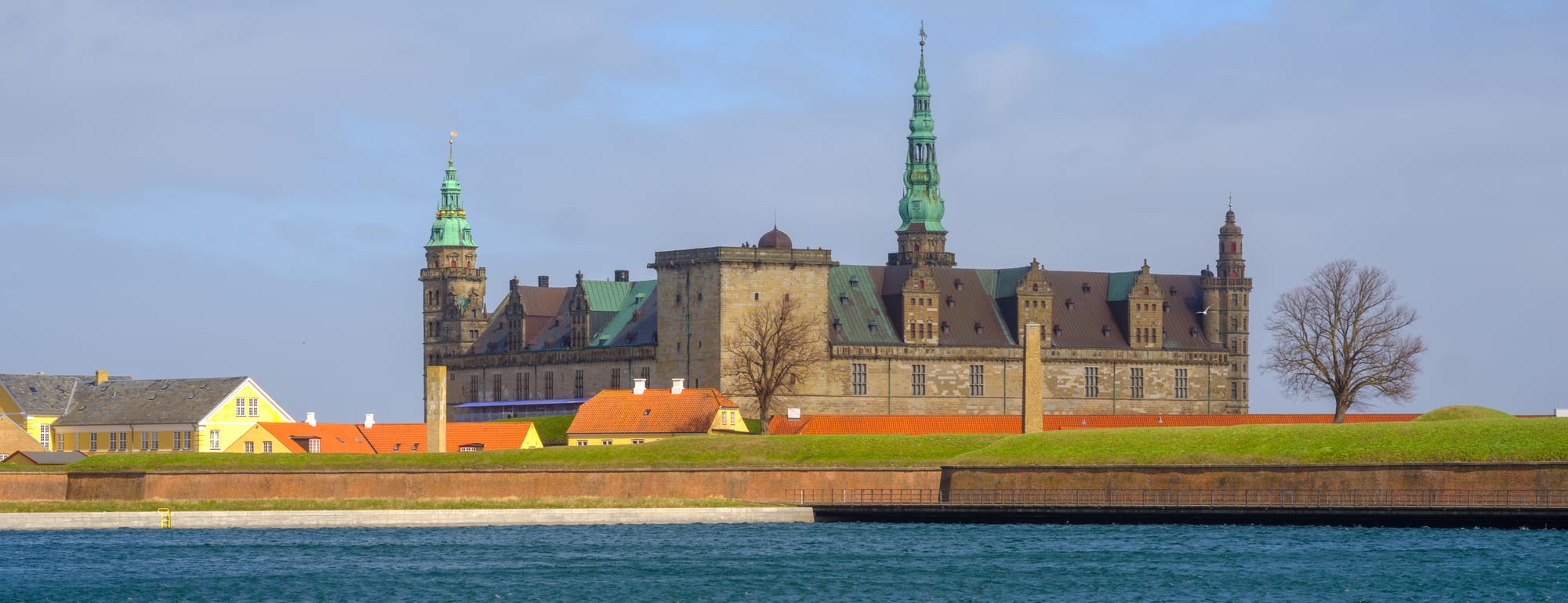
Kronborg's sandstone walls and green copper spires behind grassy ramparts across blue harbour water

Copenhagen & Zealand, Denmark

Helsingør

Kronborg Castle seen across the harbour in Helsingør. (ArildV / Wikimedia Commons · CC BY-SA 4.0)

A harbour town at the narrowest point of the Øresund, just 4 km from Helsingborg in Sweden. For four centuries every passing ship paid the Sound Dues here, which built Kronborg — Shakespeare's Elsinore — and a merchant old town. After its shipyard closed in 1983, the docks were turned into a cultural harbour of museums and a culture centre.

Neighbourhoods

  • The old town
    • First-time visitors
    • Historic district
    • Close to public transport

    The medieval centre north-west of the station, around St Olaf's Cathedral and the Carmelite priory. The wealth of the Sound Dues still shows in the grand, often colourful merchants' houses along narrow streets such as Stengade, a few of them still cobbled.

    Open in Maps
  • Kronborg and the Culture Harbour
    • Museums
    • Waterfront
    • Arts and culture

    The former shipyard between the town and the castle, rebuilt as Kulturhavn Kronborg: the Culture Yard's stages and library, the maritime museum sunk around a dry dock, restored ramparts and harbourside walks leading out to Kronborg.

    Open in Maps
  • Marienlyst and the north coast
    • Beaches
    • Quiet and residential

    The districts north along the Øresund — Grønnehave, Højstrup, Marienlyst and on towards Hellebæk and Ålsgårde — with Marienlyst Castle and its garden, villas and a shoreline road with views to Sweden.

    Open in Maps
  • Snekkersten and Espergærde
    • Quiet and residential
    • Close to public transport

    Seaside suburbs to the south, each with a station on the coast line to Copenhagen, with houses close to the water.

    Open in Maps

Things to do

Castle and museums

  • Kronborglandmark

    Frederick II's Renaissance fortress of 1574–85 on the tip of Zealand, a UNESCO World Heritage Site since 2000, with a sleeping statue of Holger Danske in its casemates.

    Open in Maps
  • M/S Maritime Museum of Denmarkmuseum

    Danish trade and shipping from the 15th century to today, in underground galleries designed by Bjarke Ingels Group around the old shipyard's dry dock, opened in 2013.

    Open in Maps
  • Kulturværftetattraction

    The Culture Yard, opened in 2010 in the former shipyard buildings, with stages for concerts and theatre, exhibitions and the town's main library.

    Open in Maps

The old town

  • St Olaf's Cathedrallandmark

    The town's main church, with a history going back to around 1200 and a building completed in 1559, a cathedral since 1961.

    Open in Maps
  • Carmelite Priorylandmark

    A Carmelite friary founded in 1430, the finest complete medieval monastic complex surviving in Denmark.

    Open in Maps
  • Marienlyst Castlelandmark

    A royal pavilion of 1587 rebuilt in neoclassical style in 1759–63, owned by the town since 1851, with a garden open to the public and views over the Øresund.

    Open in Maps

Short trips from the town

  • Helsingborg and Kärnanattraction

    Across the Sound in Sweden, the medieval tower that, with Kronborg, once controlled the entrance to the Baltic — a short ferry crossing away.

    Open in Maps
  • Gurre Castlelandmark

    The excavated and restored ruins of a medieval royal castle near Gurre Sø, on the outskirts of the town.

    Open in Maps
  • Hornbækbeach

    A seaside resort town 12 km north-west, known for its holiday homes and broad sandy beaches.

    Open in Maps
  • Louisiana Museum of Modern Artmuseum

    Scandinavia's most visited museum of modern and contemporary art, down the coast at Humlebæk.

    Open in Maps

Seasonal events

  • Shakespeare at Hamlet's CastleAugust

    A theatre festival at Kronborg where Danish and international companies perform Shakespeare's plays, usually including Hamlet.

  • Garfish seasonMay–July

    When the garfish, hornfisk in Danish, run along the Øresund, anglers line the town's piers and breakwaters.

Eat and drink

Long-standing places and food districts in Helsingør. Hours, ratings and directions come from your maps app, always current.

Food districts

  • Old town streetsneighborhood

    Cafés, bakeries and restaurants in the merchants' houses of the old centre north-west of the station.

    Open in Maps
  • The harbourneighborhood

    Places to eat along the busy harbour and around the Culture Yard, between the ferry terminal and Kronborg.

    Open in Maps

Experience Helsingør

History

Helsingør takes its name from the "neck" of the Øresund, the narrowest point of the strait between Zealand and what is now southern Sweden. The town as it is known today was founded in the 1420s by Eric of Pomerania, who built the stronghold of Krogen on the point and, in 1429, introduced the Sound Dues, a toll on every ship using the strait. Because the toll was paid here, it brought the town immense wealth; between 1479 and 1581 the number of ships passing through grew six and a half times, and merchant houses grew up in the streets near the harbour.

Frederick II rebuilt Krogen as the Renaissance castle of Kronborg in 1574–85. A fire in 1629 destroyed much of it, Christian IV rebuilt it, and in 1658 the Swedes besieged and captured it and carried off many of its treasures. Shakespeare set Hamlet in the castle, using the town's anglicised name, Elsinore. The Sound Dues were finally abolished in 1857 under the Copenhagen Convention, a heavy blow that was followed by decades of slow growth. In 1785 the castle ceased to be a royal residence and became army barracks.

The shipyard, Helsingør Værft, then dominated the town for a century, covering the whole area between the centre and Kronborg until it closed in 1983. In October 1943 the town was one of the most important crossing points for the rescue of Denmark's Jews, when fishing boats, rowing boats and ferries carried more than 7,200 Jews and 680 others to Sweden over three nights. After the shipyard closed, the town turned to culture and tourism: Kronborg became a UNESCO World Heritage Site in 2000, the Culture Yard opened in 2010 and the maritime museum moved into the old dry dock in 2013.

Culture & Customs

Hamlet is never far away. The play was first staged at Kronborg in 1816, by soldiers of the garrison, for the 200th anniversary of Shakespeare's death, and later Hamlets at the castle include Laurence Olivier, John Gielgud, Derek Jacobi, David Tennant and Jude Law. Each August the Shakespeare at Hamlet's Castle festival brings Danish and international companies to perform in and around the courtyards. Kronborg also guards a national legend: a statue of Holger Danske, Ogier the Dane, sleeps in its casemates.

Music has deep roots too. The Baroque composer Dieterich Buxtehude, later a major influence on Johann Sebastian Bach, served as an organist in the town from 1660 to 1668. Today the Culture Yard, built into the shipyard halls, hosts concerts, theatre and the annual Clickfestival, and the town keeps its own theatre on the harbour square.

The Sound shapes local identity. Helsingborg is so close that the two towns share a long history, and the ferries between them are the busiest in the world. Anglers fill the piers through the year, and when the garfish run between May and July the breakwaters are crowded. The style is informal, like the rest of Denmark, but the town is proud of its own long story as the gatekeeper of the Baltic.

Daily Life

Helsingør Municipality had about 64,000 residents in 2026, spread between the old town and a string of seaside suburbs and villages: Snekkersten and Espergærde to the south, and Grønnehave, Højstrup, Marienlyst, Hellebæk, Ålsgårde and the resort of Hornbæk to the north. The coast line links the town with Copenhagen, with trains every 20 minutes.

The economy has changed completely since the shipyard closed after substantial losses in 1983. Tourism around Kronborg and the Culture Harbour, the ferry traffic to Helsingborg, local services and commuting now carry the town, and the old dockyard area has become its public front room, with the library, stages and harbourside walks.

The ferry sets the rhythm of the harbour, with more than 70 departures each way every day across the Sound. A fixed link, the HH tunnel to Helsingborg, is in the early planning stage. Summer draws holidaymakers to the beaches and holiday homes along the north coast, while winter is quiet, with the castle grounds and harbour mainly left to dog walkers and anglers.

Food

Helsingør eats much as the rest of Denmark does. Lunch means smørrebrød, the open sandwich on dense rye topped with herring, liver pâté, roast pork, shrimp or egg, and the hearty staples include frikadeller, pan-fried meatballs, and stegt flæsk, fried belly pork with parsley sauce. Bakeries sell wienerbrød, the flaky pastry known abroad as a "Danish".

The town's own flavour comes from the sea and the harbour. The waters of the Sound are popular with anglers all year, and garfish, hornfisk in Danish, arrive in numbers in late spring. Cafés and restaurants line the harbour and the area around the Culture Yard, and the old town's merchant houses hold bakeries and small restaurants along streets such as Stengade.

As elsewhere in Denmark, beer and akvavit are the traditional drinks, and the short ferry crossing puts the cafés and restaurants of Helsingborg, on the Swedish side, within easy reach as well.

Planning tools

Budget

Helsingør costs less than central Copenhagen, and most visitors come for the day by train from the capital. The castle and the maritime museum are the main entry costs; the old town, the harbour walks and the Marienlyst garden are free. Restaurant meals and alcohol remain expensive.

Daily Budget Midrange
USD 250–430 (mid-range room, restaurant dinners, Kronborg and museum tickets, regional trains)
Daily Budget Shoestring
USD 110–170 (hostel or budget room, bakery and supermarket food, local trains)

Trains from Copenhagen run every 20 minutes, so staying in the capital and visiting for the day is easy.

Best Time to Visit

May to September, for the long days, the harbour and the beaches to the north; August brings Shakespeare at Kronborg. Spring and autumn are quieter at the castle, and winter is dark and windy on the exposed tip of Zealand.

Suggested Number of Days

Most visitors see the town in a day from Copenhagen. Two or three days allow time for the north coast, a crossing to Sweden or the other castles of North Zealand, without rushing.

First Visit
1 day
With Surroundings
2–3 days

Transportation

The town centre, the harbour and the castle are all walkable from the station. Local trains run north along the coast to Hornbæk and Gilleleje and inland to Fredensborg and Hillerød, and six more stations serve the town and its suburbs. A network of local and regional buses fills the gaps.

Use the Rejsekort on the trains and buses; two companies, Forsea and Sundbusserne, run the ferries to Helsingborg.

Airport & Station Connections

The station is the end of the coast line from Copenhagen, with trains every 20 minutes, and sits beside the ferry terminal. The car ferries to Helsingborg in Sweden, 4 km across the Sound, are the busiest in the world, with more than 70 departures each way every day. The train from Copenhagen Central Station takes about 45 minutes.

Walkability

Very walkable. The old town lies just north-west of the station, and Kronborg is a short walk north along the harbour. Marienlyst and the northern beaches are better reached by local train or bike.

Safety

Denmark is a very safe country with low levels of violent crime. In Helsingør the main things to watch are traffic around the busy ferry terminal, cyclists in the cycle lanes, and slippery stones on the harbour piers and breakwaters in wet or icy weather.

Watch for cars queuing for the ferries near the station, and take care on the castle ramparts and the harbour walls in wind or rain. Check current official travel advice before travelling.

Climate

Maritime and windy, with the Øresund smoothing out the extremes and rain possible in any season. Daylight is long in summer and short in winter.

Summer
mild — in nearby Copenhagen, July is the warmest month, with average daytime highs of 21°C
Winter
cold, grey and blustery — in nearby Copenhagen average temperatures stay above 0°C, with snow mainly from late December to early March

Local Customs

Manners are informal and first-name, as across Denmark, and tipping is not expected. Anglers on the piers are part of town life, and a fishing licence is required for fishing here, as nearly everywhere in Denmark.

Keep out of cycle lanes on foot; inside the cathedral and the priory church, keep voices low during services.

Common Payment Methods

The currency is the Danish krone (DKK). Cards are the usual way to pay and cash is rarely needed; many businesses also take MobilePay, though it requires Danish identification. ATMs are widely available.