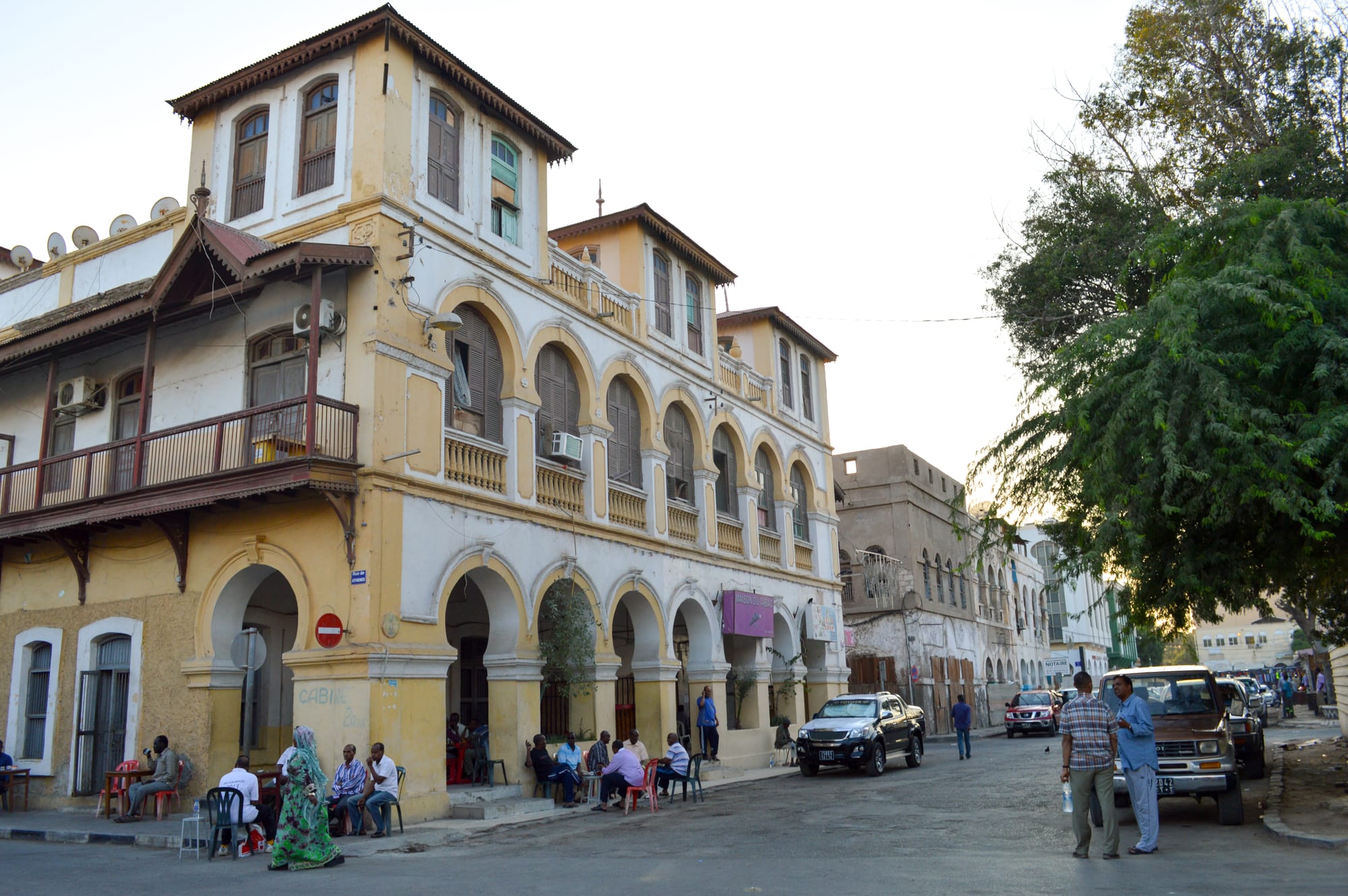
A two-storey colonial building with arcades and shuttered windows on a street corner, people sitting in the shade and pickups passing

Djibouti

Djibouti City

Arcaded colonial buildings around Place Menelik in the European quarter of Djibouti City. (Francisco Anzola / Wikimedia Commons · CC BY 2.0)

The capital and only large city of Djibouti, built by France from 1888 on a hot peninsula at the mouth of the Gulf of Tadjoura. It grew as the sea outlet of the railway to Addis Ababa and lives today from its container port, its free-trade zones and the foreign military bases nearby. This page is written to explain the city, not to encourage travel.

Neighbourhoods

  • The European quarter
    • First-time visitors
    • Historic district
    • Cafes

    The grid of streets laid out by the French around Place Menelik, with arcaded two-storey buildings, shuttered windows and shaded pavements. Most of the older hotels, banks, airline offices and restaurants are here, within walking distance of the waterfront.

    Open in Maps
  • The African quarter
    • Markets
    • Local life

    The denser quarter inland of the colonial grid, built around the central market and a web of small streets of workshops, tea stalls and traders. It is the busiest part of the city in the early morning and again after dark, when the heat drops.

    Open in Maps
  • Heron and the seafront
    • Quiet and residential
    • Sea views

    The seafront district around Heron Beach, facing the gulf. It is lower-built and quieter than the centre and used by residents for evening walks by the water.

    Open in Maps
  • Ambouli
    • Close to the airport
    • Local life

    A residential district south of the centre along the Ambouli wadi, beside the international airport and the road inland. A small village stood here, about 3 km south of the peninsula, before the French arrived.

    Open in Maps
  • Balbala
    • Local life

    The large, mostly self-built district that grew west of the Ambouli river from 1966, when access to the city was restricted, and now houses most of the capital's population, an estimated 554,000 people in 2024. It is residential rather than a place visitors spend time in.

    Open in Maps

Things to do

Landmarks and streets

  • Hamoudi Mosquelandmark

    A mosque built around 1906 by Haji Hamoudi, among the older standing mosques in the capital, with room for up to 1,000 worshippers.

    Open in Maps
  • Place Meneliklandmark

    The arcaded square at the heart of the French-built quarter, lined with colonial buildings and shaded pavements.

    Open in Maps
  • Central Marketmarket

    The main market of the African quarter, where produce, spices, cloth and household goods are traded through the cooler hours.

    Open in Maps
  • Port of Djiboutitransit hub

    The port the city was built for, handling the great majority of landlocked Ethiopia's imports and exports; the newer Doraleh container terminal lies west of the old harbour.

    Open in Maps
  • Djibouti–Ambouli International Airporttransit hub

    The country's international airport, about 6 km from the centre and the arrival point for almost all visitors.

    Open in Maps

Beaches and the water

  • Khor Ambadobeach

    A beach on the coast near the city, within easy reach of the capital by road.

    Open in Maps
  • Plage de la Siestabeach

    A beach within the city, one of the closest places to swim from the centre.

    Open in Maps
  • Moucha Islandattraction

    A small coral island about 15 km offshore at the mouth of the Gulf of Tadjoura, ringed by a coral reef and the smaller Maskali islets, about an hour from the city by boat.

    Open in Maps

Short trips from the city

  • Lake Assalattraction

    A crater salt lake roughly two hours west by road, ringed by white salt flats and black lava, whose surface lies around 155 metres below sea level — the lowest point in Africa.

    Open in Maps
  • Artaattraction

    A small town in the Mountains of Arta about 40 km west, known for its mild climate; juvenile whale sharks gather close to shore around Arta Bay in the cooler months.

    Open in Maps
  • Tadjouraneighborhood

    The whitewashed old port on the north shore of the gulf, about 35 km across the water and reached by road around the bay or by boat.

    Open in Maps
  • Day Forest National Parkpark

    A remnant juniper forest in the Goda Mountains behind Tadjoura, the wettest part of the country and one of its very few wooded corners, cooler than the coast.

    Open in Maps

Seasonal events

  • Independence Daylate June

    The anniversary of independence from France in 1977, marked with parades and public celebrations in the capital.

  • Eid al-Fitrvaries with the lunar calendar

    The festival that ends Ramadan, the largest celebration of the year, with family visits, new clothes and shared meals.

  • Whale shark seasonthe cooler months

    The season when juvenile whale sharks gather close to shore in the Gulf of Tadjoura, around Arta Bay, and are visited by boat.

Eat and drink

Long-standing places and food districts in Djibouti City. Hours, ratings and directions come from your maps app, always current.

Djibouti City classics

  • Grilled Red Sea fishrestaurant

    Fish landed in the gulf, baked or grilled with chilli and lime and eaten with flatbread, is the dish the capital is known for.

    Open in Maps
  • Skoudehkarisrestaurant

    The country's signature one-pot dish of rice cooked with spiced lamb or goat, served in small local eateries across the city.

    Open in Maps

Markets and food streets

  • The central market quarterneighborhood

    Stalls of dates, spices, mangoes, fish and imported goods, with tea stands and grill counters on the surrounding streets.

    Open in Maps
  • Restaurants around Place Menelikneighborhood

    The colonial quarter holds most of the city's sit-down restaurants, mixing French, Yemeni, Ethiopian and Somali cooking.

    Open in Maps
  • Bakeries and cafes of the European quartercafe

    A French legacy of baguettes, croissants and strong coffee, drunk alongside sweet spiced tea and cardamom coffee.

    Open in Maps

Experience Djibouti City

History

The city is young. France obtained the coast in the 1880s and in 1888 founded a new port on the peninsula of Ras Djibouti, on a previously uninhabited stretch of coast; it became the capital in 1896 in place of Obock on the north shore, valued for its better harbour and its nearness to Harar. The settlement was laid out in two parts that still shape it: a grid of arcaded European streets on the point, and an African quarter behind it around the market.

What made the town was the railway. Construction of a metre-gauge line to the Ethiopian highlands began in 1897 and reached Addis Ababa in 1917, giving landlocked Ethiopia a sea outlet and Djibouti a reason to exist. The port grew on that traffic, and the town became the capital of French Somaliland and later of the French Territory of the Afars and the Issas. Independence came in 1977, and the new state kept the port at the centre of its economy.

Since then the city has grown far beyond the colonial grid, above all into Balbala in the south-west, and has absorbed people from the drought-hit interior and refugees from neighbouring countries. Container terminals, most recently at Doraleh, and free-trade zones were built west of the old harbour, and foreign military bases were established around the city. A new standard-gauge electric railway to Addis Ababa opened in 2018 on a new, straighter alignment, replacing the old line.

Culture & Customs

Djibouti City is where the country's two main communities, the Somali Issa and the Afar, live alongside each other, together with long-settled Yemeni Arab families, Ethiopians and a shifting foreign population of diplomats, aid workers, sailors and soldiers. Arabic and French are the official languages; Somali and Afar are what people speak in the street.

The rhythm of social life is set by heat and by khat, the mildly stimulant leaf brought in daily by road from Ethiopia. Its arrival and distribution in the early afternoon empties parts of the city for a few hours, as men gather in groups to chew and talk. Tea heavy with sugar and spice and cardamom-scented coffee are the drinks of welcome in any house or shop.

The city is Muslim and the pattern of the week and the year follows the mosque: Friday prayers, Ramadan nights when the streets stay busy until very late, and the two Eids as the great family festivals. Poetry and oral storytelling, central to both Somali and Afar tradition, remain a live art. The French and international presence gives the centre a cosmopolitan edge — signage in two scripts, cafés with pastries, restaurants from half a dozen countries — unusual in a city of this size.

Daily Life

Around three-quarters of Djibouti's population lives in the capital, about 780,000 people in 2024 estimates; it is by far the largest settlement in the country. Most live in the inland districts, particularly Balbala, rather than in the colonial centre.

The economy is almost entirely services tied to the port, the railway, the free-trade zones, transit trade with Ethiopia and rent from the foreign bases. There is very little manufacturing and almost no farming, and much of the food is imported. Formal jobs are scarce, unemployment is high, and a large informal economy of small trade, transport and street selling fills the gap.

The day is organised around the heat. Work, school and market trading start early and thin out by late morning; the middle of the day is spent indoors or in the shade; and the streets fill again in the late afternoon and evening, when families walk along the seafront and the cafés and grill stands open. Housing, water supply and the cost of living in the outer districts are the recurring issues of city life.

Food

The capital eats Somali, Afar, Yemeni and French food, often on the same street. Skoudehkaris, a one-pot dish of rice cooked with spiced lamb or goat, is the national dish and the standard meal in small eating houses. Stews of goat, lamb or fish, spiced with cumin, cardamom and the xawaash mix, are eaten with rice or with lahoh, a spongy fermented pancake also known as canjeero.

Fish is the city's advantage. Red Sea species are landed daily and cooked whole in Yemeni style — split, rubbed with chilli and spices and baked against the wall of a clay oven — or simply grilled and served with lime and flatbread. Sambusa, fried pastry triangles of meat or lentils, and bajiye, spiced fritters, are the common snacks, and appear everywhere during Ramadan.

The French left good bread. Baguettes, croissants and pastries are sold from bakeries in the centre and eaten with coffee, alongside the local drinks: shaah, very sweet spiced tea, and cardamom coffee. Ethiopian influence shows in injera and in the coffee itself, and imported dates, mangoes and citrus fill the market stalls. Alcohol is served in hotels and some restaurants in the centre but has no part in ordinary life.

Planning tools

Budget

Djibouti City is expensive for what it offers. Hotels are priced for diplomats, aid workers and contractors rather than tourists, imported food is dear, and any trip out of the city means a 4x4 with a driver. Cash is used for most things outside the larger hotels.

Daily Budget Midrange
USD 150–300 (business hotel, hired 4x4 with driver, guided desert trips)
Daily Budget Shoestring
USD 60–100 (simple hotel, local eateries, shared minibuses)

Trips to the salt lakes are arranged through local operators; there is no public transport to them, and costs are usually shared between passengers.

Best Time to Visit

November to February, the coolest months, when daytime temperatures are around 28–30°C rather than well above 40°C. These are also the months when whale sharks gather in the gulf. The period from May to September is dangerously hot, with average highs of about 42°C in July.

Suggested Number of Days

The city itself is small and can be seen in a day or two. Four or five days allow for the salt lakes, the gulf and the north shore, which need a driver and a lot of road time. Heat shortens what can be done in a day.

First Visit
1–2 days
With Surroundings
4–5 days

Transportation

Shared minibuses run fixed routes across the city for a few francs, and taxis are plentiful and cheap but are not metered, so the fare is agreed first. Hired 4x4 vehicles with drivers are the normal way to leave the city. Boats cross the gulf to Tadjoura and Obock.

Agree the taxi fare before setting off, and avoid walking long distances between about 11am and 4pm.

Airport & Station Connections

Djibouti–Ambouli International Airport is about 6 km from the centre, with connections to the Gulf, East Africa and Europe. A Chinese-built standard-gauge electric railway, opened for commercial service in 2018, runs to Addis Ababa from Nagad station near the airport, replacing the metre-gauge line completed in 1917. Ferries link the capital with the towns on the far shore of the gulf.

Walkability

The colonial quarter is flat and compact, and the market quarter beside it is easily walked, but the heat, not the distance, decides how far anyone goes on foot. Shade is limited, pavements are uneven and few people walk in the middle of the day. The outer districts are spread out and need a taxi.

Safety

Djibouti city and the main tourist areas are generally safe, with petty theft the main concern. The country sits on the Bab al-Mandab strait, where Houthi attacks have kept shipping well below pre-war levels since 2024 and where an offensive that began in September 2026 brought fighting on the Yemeni side to within about 30 km of the strait's Djiboutian shore; Djibouti itself has not been a battleground. The city hosts several foreign military bases and security around them, the port and government buildings is tight. Photography of military sites, the port and anyone in uniform causes problems. Heat is the practical danger for most visitors.

Djibouti city and the main tourist areas are generally safe, with petty theft the main concern. Border zones with Eritrea and Somalia are best avoided, water should be carried on any trip out of the city, and heatstroke and dehydration are the real risks. Check current official travel advice before travelling.

Climate

A desert climate on a hot coast. Rain is rare and falls in brief showers, mostly between November and March, and long periods pass without any rain at all.

Summer
May to September is extreme, routinely above 40°C, with average highs of about 42°C in July
Winter
November to February is the bearable season, with daytime highs around 28–30°C and warm nights

Local Customs

This is a Muslim society and dress is modest for both men and women; shoulders and knees covered is the norm in the street and in markets. Greetings are unhurried, the right hand is used for eating and giving, and the afternoon khat session is a fixture of male social life. Ramadan changes the rhythm of the day and most eating places close in daylight.

Ask before photographing people, and do not photograph military installations, the port, the airport or anyone in uniform. Alcohol is served in hotels and some restaurants but is not part of local life.

Common Payment Methods

The currency is the Djiboutian franc, pegged to the US dollar at a fixed rate. Cash is used for almost everything; cards are accepted only at the larger hotels and a few businesses. US dollars and euros can be changed easily, and ATMs exist in the centre but are not reliable.