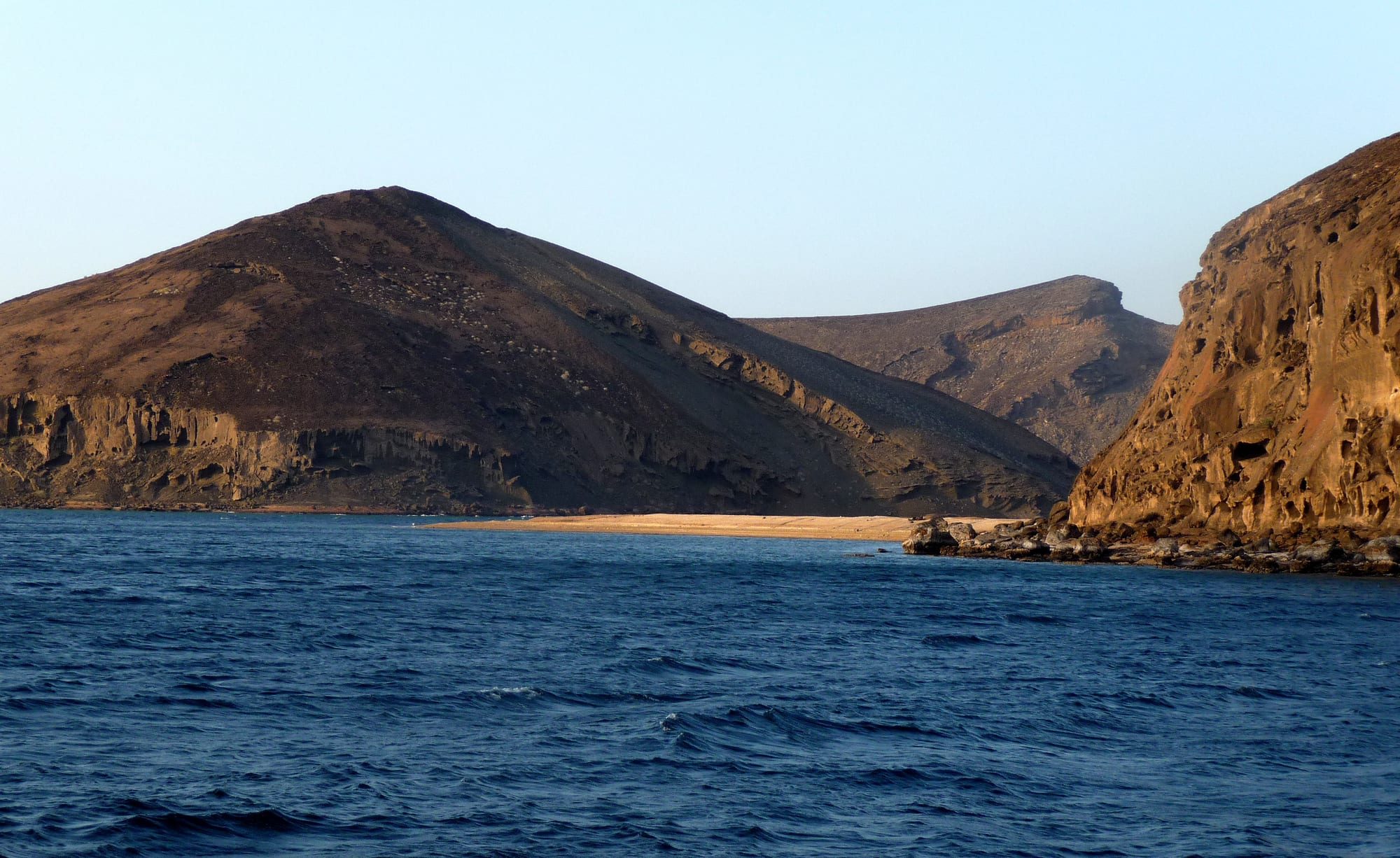
A bare, dark cone-shaped hill rising from deep blue sea beside a golden, wind-carved cliff, with a thin strip of pale sand between them under a clear sky

Djibouti

Devil's Island in Djibouti, its bare slopes and weathered golden cliffs rising from deep blue water. (gailhampshire / Wikimedia Commons · CC BY 2.0)

A small, hot, strategically placed country at the mouth of the Red Sea — mostly desert and salt lake, home to foreign military bases and a container port that is its main source of income.

Explore Djibouti

History

The territory is the homeland of the Afar, who spread into Ethiopia and Eritrea, and the Issa, a Somali clan; both have herded livestock across this harsh land for centuries, and the port of Tadjoura was an old outlet for the caravan trade, including in enslaved people, between the Ethiopian highlands and the sea.

France bought Obock in 1862, extended its hold over the coast in the 1880s, and developed the deep natural harbour of Djibouti city as the terminus of a railway to Addis Ababa, making the colony — "French Somaliland," later the "French Territory of the Afars and the Issas" — a transit point for Ethiopia's trade. France kept it after most of its African empire had gone, and independence came only in 1977.

Since then Djibouti has been dominated by a single party and, since 1999, led by President Ismaïl Omar Guelleh. A brief civil war with an Afar rebel movement in the 1990s ended in a power-sharing deal. The country's fortune has been its location: astride one of the world's busiest shipping lanes, it hosts French, American, Japanese, Italian, and Chinese military bases and leans heavily on its container port, through which over 95 per cent of landlocked Ethiopia's imports and exports move. Since 2024 attacks on Red Sea shipping have cut traffic through the Bab al-Mandab strait to well under half its pre-war level, and a Houthi offensive on the Yemeni side of the strait that began in September 2026 pushed oil above 100 dollars a barrel — pressure on the trade Djibouti lives by.

  • Djibouti: The Gatekeeper of the Red Sea — A hot, small territory at the mouth of the Red Sea — a French coaling station and railhead that became one of the world's most crowded clusters of foreign military bases

Culture & Customs

Djiboutian society is Muslim and split between two closely related pastoralist cultures, Somali and Afar, each with its own language, poetry, and clan structure. Both share a nomadic heritage, an oral tradition rich in poetry and proverb, and strong codes of hospitality and honour.

The chewing of khat (also qat), a mildly stimulant leaf imported from Ethiopia, is a central social ritual for many men, who gather in the afternoons to chew and talk. Tea, heavy with sugar and spice, and coffee are the drinks of welcome.

Dress is modest, and Ramadan reshapes the daily rhythm. The capital has a distinctly cosmopolitan edge from the foreign military and shipping presence, alongside the traditional life of the herding interior.

  • Djibouti: The Generosity of the Nomad — A Muslim nation of Somali and Afar traditions, where news is exchanged before anything else, guests are met with water and a meal, and old codes of solidarity still shape how people treat one another

Daily Life

Around three-quarters of Djibouti's roughly one million people live in the capital, Djibouti city, a hot, low-rise port on the Gulf of Tadjoura. The rest live in a handful of small towns and in scattered nomadic and semi-settled communities across the desert, herding goats, sheep, and camels.

The economy is almost entirely built on services tied to the port, the railway, the free-trade zones, and rent from the military bases; there is very little agriculture or industry, and most food and water are imported or desalinated. Unemployment is high, and the gap between the port economy and the pastoral interior is wide. Djibouti also hosts refugees from Somalia, Ethiopia, Eritrea, and Yemen.

Daily life in the city runs early because of the heat, pausing through the hottest hours; the afternoon khat session and the evening, when it finally cools, are when the streets fill.

  • Djibouti: A Day Split by the Heat — A capital that holds around three-quarters of the country, a pastoral interior still built around camels, goats and the search for water, and a working day that starts early, pauses hard, and only really comes back to life once the heat breaks

Food

Djiboutian food blends Somali, Afar, Yemeni, and French influences. Rice or flatbread (canjeero/lahoh, a spongy fermented pancake) is eaten with spiced goat, lamb, or fish stews, often flavoured with cumin, cardamom, and other spices. Skoudehkaris, a spiced one-pot rice dish cooked with meat, is a signature dish.

Grilled fish, often split open and cooked Yemeni-style, is a local delicacy in the capital, and sambusa pastries are a common snack, especially in Ramadan. The French legacy shows in good baguettes and pastries and in a few colonial-era restaurants.

Very sweet, spiced tea (shaah) and coffee are drunk throughout the day. Alcohol is available in hotels and some restaurants in the capital but is not part of the local culture.

  • Djibouti: Food and the National Dish — Spiced rice with fish or meat on a Red Sea coast, camel meat and milk from a pastoralist heartland, and an afternoon ritual built around a mildly stimulating leaf

Attractions & Natural Wonders

Djibouti's sights are geological. Lake Assal, about 155 metres below sea level, is the lowest point in Africa and one of the saltiest bodies of water in the world — a brilliant white salt pan ringed by black lava and turquoise brine, some 120 km west of the capital.

Lac Abbé, on the Ethiopian border, is a semi-dry rift lake where hot springs have built hundreds of pale limestone chimneys, some tens of metres tall, venting steam across a lunar plain grazed by Afar camels — an overnight camping trip and the most striking landscape in the country.

Offshore, the Gulf of Tadjoura draws snorkellers and divers to reefs and, from in the cooler months, to the juvenile whale sharks that gather close to shore around Arta Bay. The islands of Moucha and Maskali lie at the mouth of the gulf, while the two volcanic "Devil's Islands" sit at its far western end, in the Ghoubbet al-Kharab. Inland, the Goda Mountains near Tadjoura offer a rare patch of green — the Day Forest, the wettest and one of the very few wooded corners of the country — and cooler air, and the Grand Bara is a vast plain of sand flats, crossed each year by the Grand Bara 15K race.

Planning basics

Budget

Djibouti is expensive for what it offers. The capital's hotels are priced for diplomats, aid workers, and military contractors, and desert excursions require a 4x4 with driver and a guide. Cash is used for most things outside the top hotels.

Source
Traveller reports, 2022–2024 — verify against a current source.
Daily Budget Midrange
USD 150–300 (business hotel, hired 4x4 with driver, guided desert trips)
Daily Budget Shoestring
USD 60–100 (simple hotel, local eateries, shared transport)

Organise Lake Assal and Lac Abbé trips through a local operator; there is no public transport to them.

Source: Traveller reports, 2022–2024 — verify against a current source.

Visa Requirements

Most nationalities need a visa. Djibouti offers an e-visa applied for online in advance, and a visa on arrival at the airport for many passports, though the government recommends the e-visa. The e-visa covers short stays of up to 90 days. Carry a printed e-visa approval.

Typical Validity
Up to 90 days on a short-stay e-visa

Apply for the e-visa before travel where possible; on-arrival queues can be slow.

Safety

Djibouti city and the main tourist areas are generally safe, with petty theft the main concern. The borders with Somalia and Eritrea are sensitive and best avoided, and there is a residual risk from regional instability and, offshore, from piracy in the wider Gulf of Aden, though naval patrols have largely suppressed it. Djibouti sits on the Bab al-Mandab strait, where Houthi attacks have kept shipping well below pre-war levels since 2024 and where an offensive that began in September 2026 brought fighting on the Yemeni side to about 20 km from the strait's African shore, and thousands of people fleeing it have crossed to northern Djibouti. Djibouti itself has not been a battleground, but the region is volatile: check current official travel advice before you travel.

Source
US Department of State and French diplomatic advisories — check for the latest wording.

Stay away from the Eritrean and Somali border zones, carry lots of water on any desert trip, and take the heat seriously — dehydration and heatstroke are the real dangers.

Source: US Department of State and French diplomatic advisories — check for the latest wording.

Climate

One of the hottest countries on Earth. The cooler season, roughly November to April, still sees daytime highs around 28–32°C. From May to October the heat is extreme — regularly above 40°C on the coast in midsummer, and hotter still on the inland plains.

Hot Season
May–Oct, dangerously hot, especially inland
Cool Season
Nov–Apr, hot but bearable, best for travel

Transportation

Djibouti-Ambouli International Airport serves the capital. A modern Chinese-built electric railway runs to Addis Ababa in Ethiopia. Within the country, travel is by 4x4 — hired with a driver for the desert routes — or by shared minibus on the few paved roads. Boats cross the Gulf of Tadjoura to Tadjoura and Obock.

Distances are short but roads to the salt lakes are rough tracks; a guide and a second vehicle are wise.

Best Time to Visit

November to February, the coolest months, are the only comfortable time for the desert and the salt lakes. Juvenile whale sharks gather close to shore in the Gulf of Tadjoura, around Arta Bay, in the cooler months. Avoid the summer, when heat makes any outdoor activity hazardous.

Currency

The currency is the Djiboutian franc (DJF), pegged to the US dollar at a fixed rate — about 177 francs to the dollar — that has held since 1973. US dollars and euros are accepted at hotels and by tour operators.

Symbol
Fdj
Cash To Bring
US dollars or euros to change
Currency Code
DJF — Djiboutian franc

Language

French and Arabic are both official. Somali and Afar are the main spoken languages, matching the two largest communities. French is used in government, business, and education, and English is spoken by some in tourism and around the international bases.

English
Limited
Spoken Languages
Somali, Afar
Official Languages
French, Arabic