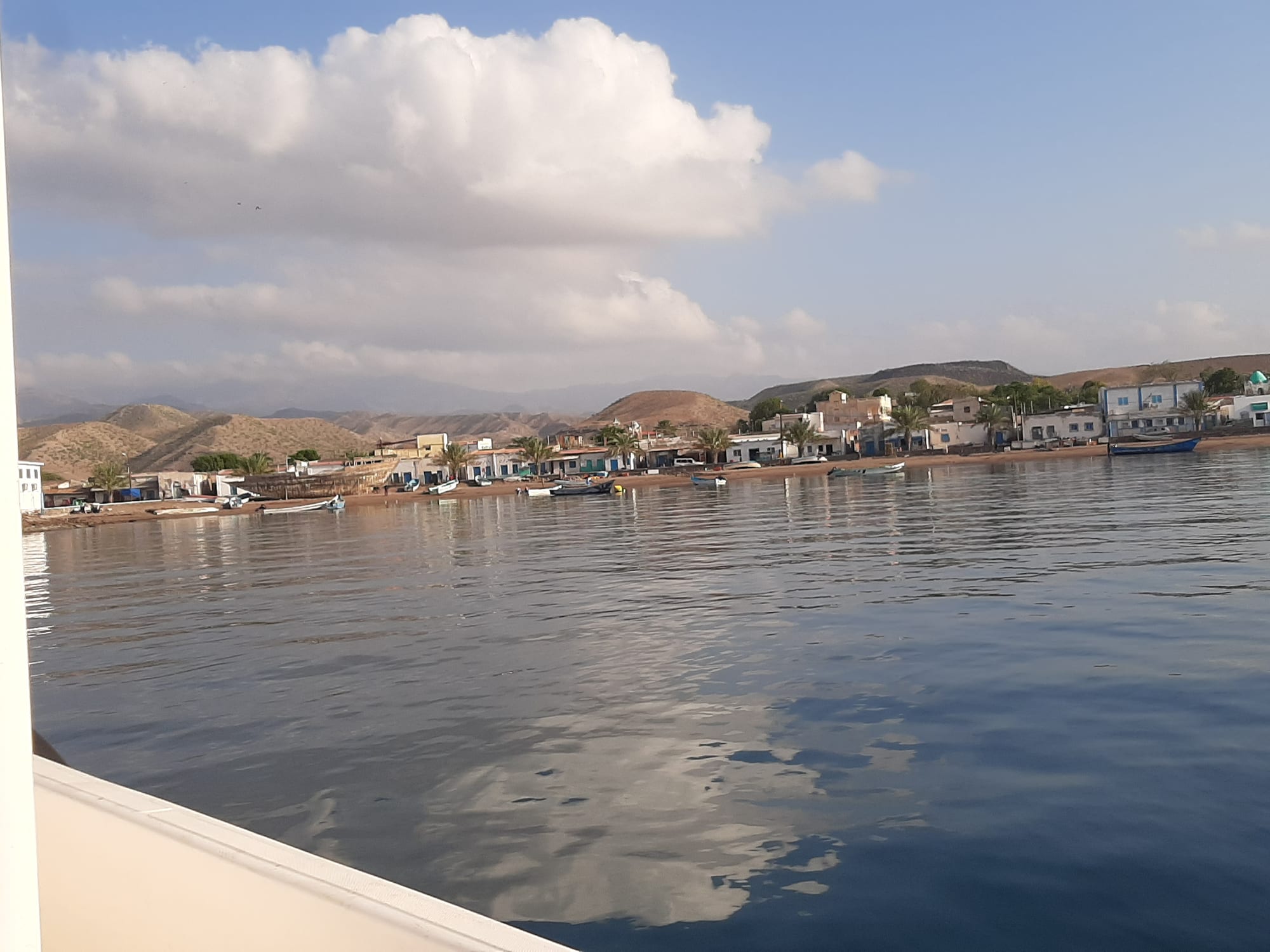
Low white and pale buildings along a shoreline with fishing boats drawn up on the sand and bare brown hills behind

Djibouti

Tadjoura

The waterfront of Tadjoura, with fishing boats on the shore and the dry hills behind the town. (Miaz85 / Wikimedia Commons · CC BY-SA 4.0)

A small whitewashed port on the north shore of the Gulf of Tadjoura, one of the oldest towns in Djibouti and long the seat of an Afar sultanate and a port for the caravan trade with the Ethiopian highlands. Known for its mosques, its beach and the green Goda Mountains behind it. This page is written to explain the town, not to encourage travel.

Neighbourhoods

  • The old town
    • First-time visitors
    • Historic district

    The tight core of whitewashed houses for which Tadjoura is known, with mosques among the lanes and shaded doorways where people sit out the heat of the day.

    Open in Maps
  • The seafront and the port
    • Boats and the gulf
    • Local life

    The shoreline where fishing boats are drawn up on the sand, beside the new port, built mainly for cargo to and from Ethiopia's Afar Region. It is the arrival point for boats across the gulf and the busiest strip in town.

    Open in Maps
  • The Sables Blancs shore
    • Beaches
    • Quiet and residential

    The coast near the town, where a pale sand beach faces the gulf and a handful of simple places to stay and eat have grown up. It is where residents and visitors go to swim.

    Open in Maps

Things to do

In the town

  • The old mosques of Tadjouralandmark

    The town is known for its mosques, plain whitewashed buildings that give the streets their character.

    Open in Maps
  • The waterfront and fishing beachattraction

    Wooden boats pulled up on the sand, nets spread to dry and the morning catch sold at the shore, with the port jetty beyond.

    Open in Maps

Beaches

  • Plage des Sables Blancsbeach

    A pale sand beach near the town, a place to swim on the northern shore of the gulf.

    Open in Maps

Short trips from the town

  • Day Forest National Parkpark

    A remnant juniper forest in the mountains behind the town, the wettest part of the country and markedly cooler than the coast.

    Open in Maps
  • Goda Mountainsattraction

    The range rising steeply behind Tadjoura to 1,750 metres, the country's largest heavily vegetated area, with Afar villages around the forest.

    Open in Maps
  • Randaneighborhood

    A small town in a valley north of the Day Forest, on the RN-11 road about 32 km from Tadjoura, with a milder climate than the coast; it long played a part in the trade between the port and the interior.

    Open in Maps
  • Obockneighborhood

    The coastal town north-east along the shore where France established its first post on this coast in 1862, before moving the administration to Djibouti City.

    Open in Maps
  • Djibouti Cityneighborhood

    The capital, on the far shore of the gulf, reached by boat across the water or by road around the head of the bay.

    Open in Maps

Seasonal events

  • Independence Daylate June

    The anniversary of independence from France in 1977, marked across the country with parades and public celebrations.

  • Eid al-Fitrvaries with the lunar calendar

    The festival that ends Ramadan, the biggest family celebration of the year in this Muslim town.

  • Whale shark seasonthe cooler months

    The season when juvenile whale sharks gather close to shore in the Gulf of Tadjoura, around Arta Bay.

Eat and drink

Long-standing places and food districts in Tadjoura. Hours, ratings and directions come from your maps app, always current.

Tadjoura classics

  • Grilled fish from the gulfrestaurant

    The catch landed on the beach — grilled or baked whole with chilli, spices and lime and eaten with flatbread — is what the town eats and cooks best.

    Open in Maps
  • Skoudehkarisrestaurant

    The national one-pot dish of rice cooked with spiced goat or lamb, served in the small eating houses near the market and the port.

    Open in Maps

Markets and tea stalls

  • The town marketmarket

    A small daily market of fish, dates, vegetables trucked in from the highlands and imported goods, busiest in the early morning.

    Open in Maps
  • Tea stands by the waterfrontcafe

    Sweet spiced tea and cardamom coffee, drunk in the shade through the afternoon, are the fixed points of the day here.

    Open in Maps

Experience Tadjoura

History

Tadjoura is one of the oldest settlements on this coast and was a port long before Djibouti City existed. Its position at the foot of the Goda Mountains put it at the sea end of a caravan route climbing to the Ethiopian highlands, and in the nineteenth century goods came down it to the gulf, above all from Shewa — ivory, gold, honey, grain and ostrich feathers, and enslaved people, a trade that continued on a smaller scale even after its abolition by decree in 1889.

Since at least the sixteenth century the town has been the seat of an Afar sultanate, the Sultanate of Tadjoura; its port rose to prominence in the early nineteenth century as an alternative to Zeila, though the sultan's real authority reached little further inland than Lake Assal. France signed treaties with the local rulers in the nineteenth century as it assembled the territory that became French Somaliland, and the line of sultans continued afterwards, into the twenty-first century.

The town's commercial importance fell away once France built its new port at Djibouti City in 1888 and ran a railway inland from there: trade moved to the south shore, and Tadjoura became a quiet regional centre living on fishing, herding and the highland gardens above it. It was affected by the civil conflict between the government and Afar rebels in the early 1990s. More recently a new port was built, intended mainly for potash from Ethiopia's Afar Region, with a new road, the RN-11, running inland towards the Ethiopian border at Balho; the capital lies about 130 km away by road around the gulf.

Culture & Customs

Tadjoura is an Afar town, and Afar language, clan structure and custom shape daily life more visibly here than in the mixed capital. Descent, seniority and the reputation of a family matter in how people are addressed, and disputes are often settled through elders rather than formal institutions. The sultanate remains part of the town's identity; its sultan from 1985, Abdoulkader Houmed, died in 2019.

It is also a religious town, known for its mosques; the call to prayer sets the shape of the day, Friday is the gathering point of the week, and Ramadan turns the rhythm upside down, with the streets busiest late at night. Dress is modest and behaviour reserved in public; visitors dressed as they might be on a beach in the capital stand out.

Life here is oral and social. Poetry, song and long conversation over tea are the entertainment, and hospitality towards a guest is a point of honour — refusing tea outright is awkward. The afternoon khat session is a male ritual, the leaf arriving by road from Ethiopia. Women have long had a large role in trade; in the nineteenth century they handled the trade with the Afar interior. Wedding celebrations, with drumming and dancing, are the great social occasions of the year, alongside the two Eids.

Daily Life

Tadjoura is the third-largest town in the country, the main centre of the northern shore and of the region that carries its name. Its population is overwhelmingly Afar, with families spread between the town, the villages of the Goda Mountains and herding camps in the drier country beyond.

The economy is small: fishing from the beach, livestock, gardens in the mountain valleys producing fruit and vegetables for the town, government and school employment, and the port, which brought construction work and some traffic to the Ethiopian border road. Many households also depend on money sent by relatives in Djibouti City or abroad. Water, electricity supply and jobs for young people are the recurring concerns, and drought in the interior pushes herding families towards the town.

The day divides around the heat. Fishing boats go out and return in the early morning, the market and the shops are busy before ten, and the middle of the day empties the streets. In the late afternoon the town comes back to life — tea stalls, the khat session, football on open ground, and families out along the shore once the sun drops. Movement in and out is by pickup along the coast road and by boat across the gulf.

Food

Fish is the staple of the coast and the thing Tadjoura does best. Whatever the boats bring in is grilled over charcoal or baked whole in a clay oven after being scored and rubbed with chilli, garlic and spice, and eaten with flatbread and a squeeze of lime.

Away from the shore the food is that of the country as a whole: skoudehkaris, rice cooked in one pot with spiced goat or lamb; stews thickened with cumin, cardamom and the xawaash spice mix; and lahoh, the spongy fermented pancake also called canjeero, eaten at breakfast with ghee and sugar or with sauce. Sambusa pastries and bajiye fritters are the snacks, above all in Ramadan.

Dates, and fruit and vegetables from the mountain villages, reach the market in season, and camel and goat milk are drunk fresh or soured. To drink, there is shaah, very sweet tea heavy with cardamom and ginger, and coffee. Alcohol has no place in the town's life.

Planning tools

Budget

Tadjoura is cheaper than the capital but has very little choice. There are a few simple hotels in town and beach places along the shore, meals are inexpensive, and the real expense is transport: a hired vehicle with a driver, or a place on a boat across the gulf.

Daily Budget Midrange
USD 150–300 (the better beach or town lodging, hired 4x4 with driver, guided trips)
Daily Budget Shoestring
USD 40–80 (simple room, local eateries, shared transport)

Fix the price of a vehicle or boat before setting out, and bring cash — there is no reliable way to pay by card.

Best Time to Visit

November to February, when average temperatures are around 26°C rather than the 36°C of summer, the sea is comfortable and whale sharks are in the gulf. The mountains behind the town are cooler than the shore all year. From May to September the heat is extreme.

Suggested Number of Days

The town itself is small and needs only a day. Two or three allow time for the beach, the mountains behind it and the coast further along, all of which involve slow road travel. Heat limits how much fits into a day.

First Visit
1 day
With Surroundings
2–3 days

Transportation

The town is walkable end to end. Shared minibuses and pickups run along the coast road and up into the mountains when they fill, on no fixed timetable, and a hired 4x4 with a driver is the practical way to reach the forest or Obock. Boats cross the gulf to the capital.

Departures of shared transport and boats depend on demand and the weather, so allow spare time and confirm locally on the day.

Airport & Station Connections

Most people arrive from Djibouti City, either by ferry across the gulf — a crossing of about two and a half hours — or by road around the gulf, about 130 km. The town has an airstrip, but the nearest international airport is in the capital.

Walkability

Easy on foot: the old town, the market and the waterfront are all within a few hundred metres of each other, and the streets are flat. Shade is scarce and few people walk between late morning and mid-afternoon. The beach outside town is far enough to want a vehicle in the heat.

Safety

Djibouti sits on the Bab al-Mandab strait, where Houthi attacks have kept shipping well below pre-war levels since 2024 and where an offensive that began in September 2026 brought fighting on the Yemeni side to within about 30 km of the strait's Djiboutian shore; Djibouti itself has not been a battleground. Tadjoura is quiet and crime against visitors is rare, though ordinary care with valuables applies. The practical dangers are heat, dehydration and the condition of the mountain tracks; medical facilities are very limited and serious cases are taken to the capital.

Djibouti city and the main tourist areas are generally safe, with petty theft the main concern. The Eritrean border zone north of Obock is sensitive and best avoided, water should be carried on any trip inland, and photography of the port and of anyone in uniform causes problems. Check current official travel advice before travelling.

Climate

Hot and dry on the coast all year, with very little rain; the mountains behind the town are wetter, with some 500 mm of rain a year in the Day Forest, and milder, which is why the forest survives there.

Summer
May to September is extreme, with average temperatures around 36°C
Winter
November to February is the bearable season, with average temperatures around 26°C and warm sea

Local Customs

A conservative Muslim town, more so than the capital. Modest dress is expected of both men and women, including away from the beach, and swimwear belongs only at the shore. Greetings come before business, the right hand is used for eating and giving, and khat chewing in the afternoon is a male social ritual here as elsewhere in the country.

Ask before photographing people or houses, do not photograph the port or anyone in uniform, and do not enter mosques without being invited.

Common Payment Methods

The Djiboutian franc in cash is used for almost everything, and card payment cannot be relied on, so money is best changed or withdrawn in Djibouti City before coming.