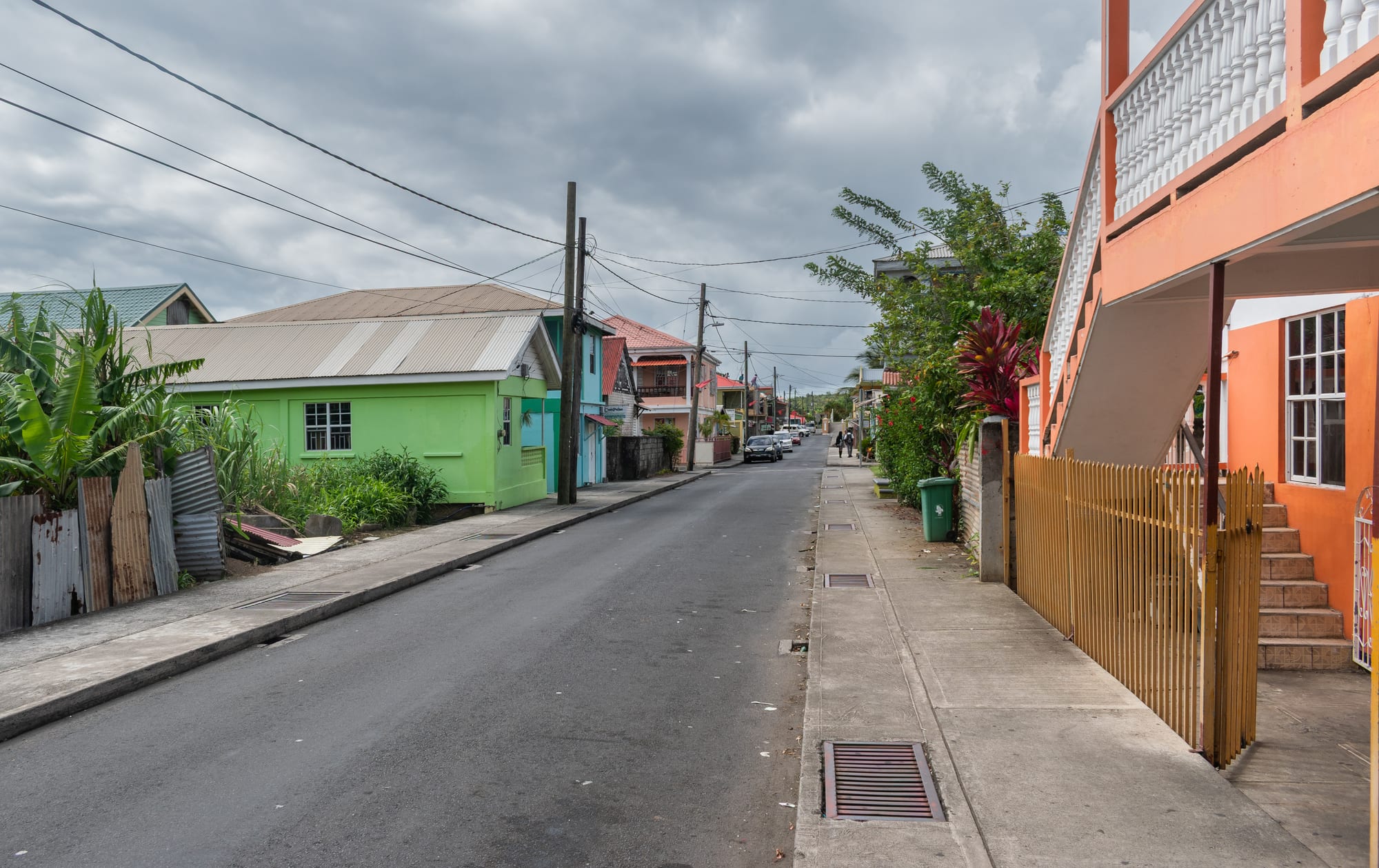
A quiet street in Portsmouth lined with brightly painted green, blue and orange houses under a cloudy sky

Dominica

Portsmouth

Rodney Street in Portsmouth, one of the streets of the town's 18th-century grid. (Tournasol7 / Wikimedia Commons · CC BY 4.0)

Dominica's second town, on Prince Rupert Bay on the north-west coast, between the wide Indian River and the Cabrits peninsula. Laid out by the British in 1765 as the island's capital and soon abandoned for Roseau because of fever from the swamps, it is now a small harbour town known for its river boat trips and the restored garrison of Fort Shirley.

Neighbourhoods

  • The town centre
    • First-time visitors
    • Historic district
    • Local life

    The grid of streets laid out in 1765 around a central square, now part of Benjamin's Park, with streets named after British figures of the day such as Egremont, Queensborough and Rodney. Small painted houses, shops, the market and the harbour on Prince Rupert Bay are all a short walk apart.

    Open in Maps
  • The Cabrits peninsula
    • History
    • Walks
    • Nature

    The twin-peaked headland north of town, an extinct volcano that was once a separate island, now joined to the mainland and protected as a national park. Forest, wetlands and the restored buildings of Fort Shirley look out over Prince Rupert Bay and Douglas Bay.

    Open in Maps
  • Picard
    • Quiet and residential

    A community that forms part of Portsmouth, for years home to a large foreign medical school campus that moved away after Hurricane Maria. The Picard River reaches Prince Rupert Bay close by.

    Open in Maps

Things to do

The Cabrits and Fort Shirley

  • Fort Shirleylandmark

    A Georgian garrison of brick and stone begun by the British in 1765, once over 50 buildings housing more than 600 men; its soldiers' revolt of 1802 helped lead to the freeing of all slave soldiers in 1807, and restoration began in 1982.

    Open in Maps
  • Cabrits National Parkpark

    A national park established in 1986 on the Cabrits peninsula, protecting tropical forest, wetlands, coral reefs and the fort, with paths up to the summits of East and West Cabrit and the last stage of the Waitukubuli Trail.

    Open in Maps

The river and the bay

  • Indian Riverattraction

    The widest river in Dominica, forming the town's southern edge; boat rides up it are one of the island's best-known trips, and scenes of Pirates of the Caribbean: Dead Man's Chest were filmed here.

    Open in Maps
  • Turtle nesting on the Portsmouth beachesbeach

    Leatherback, hawksbill and green turtles come ashore to nest between April and October, and the beaches of Portsmouth are among the island's protected viewing sites.

    Open in Maps

Markets and sport

  • Portsmouth farmers' marketmarket

    The town's farmers' market, held on Tuesdays, Fridays and Saturdays.

    Open in Maps
  • Benjamin's Parkattraction

    The town's main sports ground, built partly on the old central square, which has hosted first-class cricket for the Windward Islands.

    Open in Maps

Short trips from the town

  • Morne Diablotin National Parkpark

    A park in the northern mountains, established in 2000 to protect the endangered Sisserou and Jaco parrots, with the short Syndicate Nature Trail loop and a trail to the summit of Morne Diablotins, the island's highest mountain.

    Open in Maps

Eat and drink

Long-standing places and food districts in Portsmouth. Hours, ratings and directions come from your maps app, always current.

Portsmouth classics

  • Portsmouth farmers' marketmarket

    The town's farmers' market, the place for local produce on Tuesdays, Fridays and Saturdays.

    Open in Maps
  • Creole food in the town centreneighborhood

    Small restaurants and roadside stands serve Dominican Creole cooking — fried chicken, fish and chips and tasty bakes — along with cold drinks.

    Open in Maps

Experience Portsmouth

History

The Kalinago called the area Ouyouhao, and the French knew it as Grand Anse, the great bay. After Britain took the island, the Royal Engineer John Simpson surveyed the site in 1765 and laid out a town on a grid around a central square, today part of Benjamin's Park, with the House of Assembly, the court house and government offices meant to stand on its east side. It was named after the naval port of Portsmouth in southern England, and its streets after British figures of the day — Egremont, Queensborough, Rodney and others.

Portsmouth was chosen as Dominica's capital, but only briefly. The swamps around it bred malaria and yellow fever, and the seat of government moved to Roseau, where it has stayed. The bay remained strategically important: in 1765 the British began Fort Shirley on the Cabrits peninsula, which the French extended during their occupation from 1778 to 1784. In April 1802 the African soldiers of the 8th West India Regiment, recruited as slaves, mutinied there and held the garrison for three days in protest at poor conditions, lack of pay and fear of being sold back into slavery; the revolt influenced the Mutiny Act of 1807, which freed all serving soldiers recruited as slaves. The fort was abandoned in 1854 and decayed until restoration began in 1982.

The Cabrits became a national park in 1986. For years the Ross University School of Medicine at Picard brought large numbers of foreign students to the area, until Hurricane Maria caused extensive damage in 2017 and the school moved to Barbados.

Culture & Customs

Portsmouth shares the island's Creole culture: Kwéyòl in everyday speech, a strong Catholic tradition, and the music, Carnival and bélé drumming that run through Dominican life. The town has produced well-known figures for its size, including Gordon Henderson of the cadence-lypso band Exile One and Roosevelt Douglas, a former prime minister of Dominica, both born in the area.

Cricket is the town's sporting focus. Benjamin's Park, laid out partly on the old central square of the colonial plan, is its main venue and has hosted first-class matches for the Windward Islands.

The landscape around the town is part of its identity as much as its history. The Indian River, the widest river in Dominica, is one of the island's best-known attractions, and boat trips run up it. The Cabrits, named from the French word for goats after the animals that sailors set loose there, is the end of the Waitukubuli National Trail, which runs the length of the island from Scotts Head in the south. The restored fort is both a heritage site and a reminder of the soldiers' revolt of 1802.

Daily Life

Portsmouth has about 3,600 inhabitants, making it Dominica's second-largest town, though it is far smaller than Roseau. It sits in Saint John Parish on the shore of Prince Rupert Bay, a natural harbour, with the Indian River as its southern boundary and the Cabrits to the north, and the communities of Picard and Glanvillia close by.

The town has its own sea port on the bay, and a farmers' market runs on Tuesdays, Fridays and Saturdays. For years the medical school at Picard was the area's biggest economic presence, with over a thousand students arriving annually from the United States and Canada, and its presence was a major resource for local people. The school moved to Barbados after Hurricane Maria. Since the 2010s the town and the Cabrits in particular have been developing tourist infrastructure, and a scuba diving centre opened inside the national park in 2018.

The week follows the market on its set days, quiet Sundays and minibuses running to and from Roseau. Recovery from Hurricane Maria and building to withstand future storms remain everyday concerns, as across the island.

Food

Portsmouth eats the island's Creole food, built on what Dominica grows and catches. The national dish is callaloo, a soup of leafy greens with coconut milk and sometimes salted meat or seafood. Green fig and saltfish — green bananas with salted cod, seasoned with onions, peppers and garlic — is a traditional meal, bake and saltfish (fried dough with salt cod) is a common breakfast, and fish broth, a soup of seafood and vegetables, is everyday food. Most plates pair fish, chicken or pork with provisions: dasheen, yam, green banana, breadfruit and plantain.

Roadside stands and small-town restaurants serve fried chicken, fish and chips and tasty bakes, a fried dough made with flour, water and sugar or sometimes salt, along with cold drinks. The farmers' market is where the town buys fruit, vegetables and provisions on its market days.

Cocoa tea, made by boiling local cocoa sticks with cinnamon and bay leaves, is drunk at breakfast, and bush teas are brewed from local plants. At Christmas the calyces of the sorrel plant are boiled into a bright red drink. Rum, coconut water and fresh fruit juice are everyday drinks, and Kubuli, the island's golden lager, is brewed with water from Dominica's own Loubière Springs.

Planning tools

Budget

Portsmouth is a small, low-key town with guesthouses and small, locally run places to stay rather than large resorts. Local food is inexpensive; the main extra costs are river boat trips, national park site passes, dive trips and a hire car for reaching the rest of the island. Air fares and fuel-linked costs have risen since 2026.

Daily Budget Midrange
USD 150–300 (small hotel, Indian River boat trip, hire car, guided hikes and diving)
Daily Budget Shoestring
USD 70–110 (guesthouse, local food, minibuses)

A national parks site pass covers many of the island's protected sites; walking around the town and along the bay costs nothing.

Best Time to Visit

The first months of the year are the driest across the island and best for hiking. The heaviest rain falls from June to October, overlapping the Atlantic hurricane season, though this is also when turtles come ashore to nest, from April to October.

Suggested Number of Days

One or two days cover the town, the river and the Cabrits. Three or four suit anyone who also wants the northern mountains, diving in the bay or a stretch of the long-distance trail; rain can stretch the number.

First Visit
1–2 days
With Surroundings
3–4 days

Transportation

The town is small enough to walk, and the Indian River, where the boat trips run, forms its southern edge. Shared minibuses link Portsmouth with Roseau and the villages along the way; services thin out on Sundays. A hire car or a 4x4 is the easiest way to reach the mountains and the east coast.

Driving is on the left; roads are steep, narrow and slow, and landslips are common after heavy rain.

Airport & Station Connections

Douglas–Charles Airport, the island's main airport, on the north-east coast, is about an hour away by road and handles regional flights and some direct services from the United States. Roseau, the capital, is about 30 miles away, reached by minibus or hire car. Portsmouth also has its own sea port on Prince Rupert Bay. A larger international airport is under construction at Wesley, expected to be finished in 2027.

Walkability

The centre is a compact grid on flat land by the bay and easy to cover on foot. The fort is reached by a path up the Cabrits peninsula north of town, and the path continues to the summits of East and West Cabrit. Pavements are uneven in places.

Safety

Dominica is generally safe, with low levels of violent crime, though petty theft and the occasional robbery occur. The greater hazards are natural: Hurricane Maria caused extensive damage around the town in 2017, and heavy rain can flood rivers and bring landslides on roads and trails.

Keep valuables out of sight, check the forecast before heading into the mountains, never cross a flooded river and take a guide for longer hikes. Check current official travel advice before travelling.

Climate

Tropical and wet, with rain possible all year. The heaviest falls come from June to October, and the first months of the year are drier. In Roseau, further south on the same leeward coast, average highs are 28–31 °C and average lows 19–23 °C through the year.

Summer
June to October is the wettest time and falls in the hurricane season; on this coast highs of 28–31 °C are usual
Winter
roughly January to May is drier, with frequent showers inland; lows on this coast are usually 19–23 °C

Local Customs

English is the official language, and Kwéyòl, a French-based creole, is widely spoken. Life is church-centred, mostly Catholic, and Sundays are quiet.

Dress modestly away from the beach and in church, and ask before photographing people.

Common Payment Methods

The currency is the East Caribbean dollar (XCD), pegged at 2.70 to the US dollar. US dollars are widely accepted, with change usually given in EC dollars. Cards are mostly accepted in Roseau and at dive shops, so carry cash in Portsmouth, particularly for minibuses, the market and river guides.