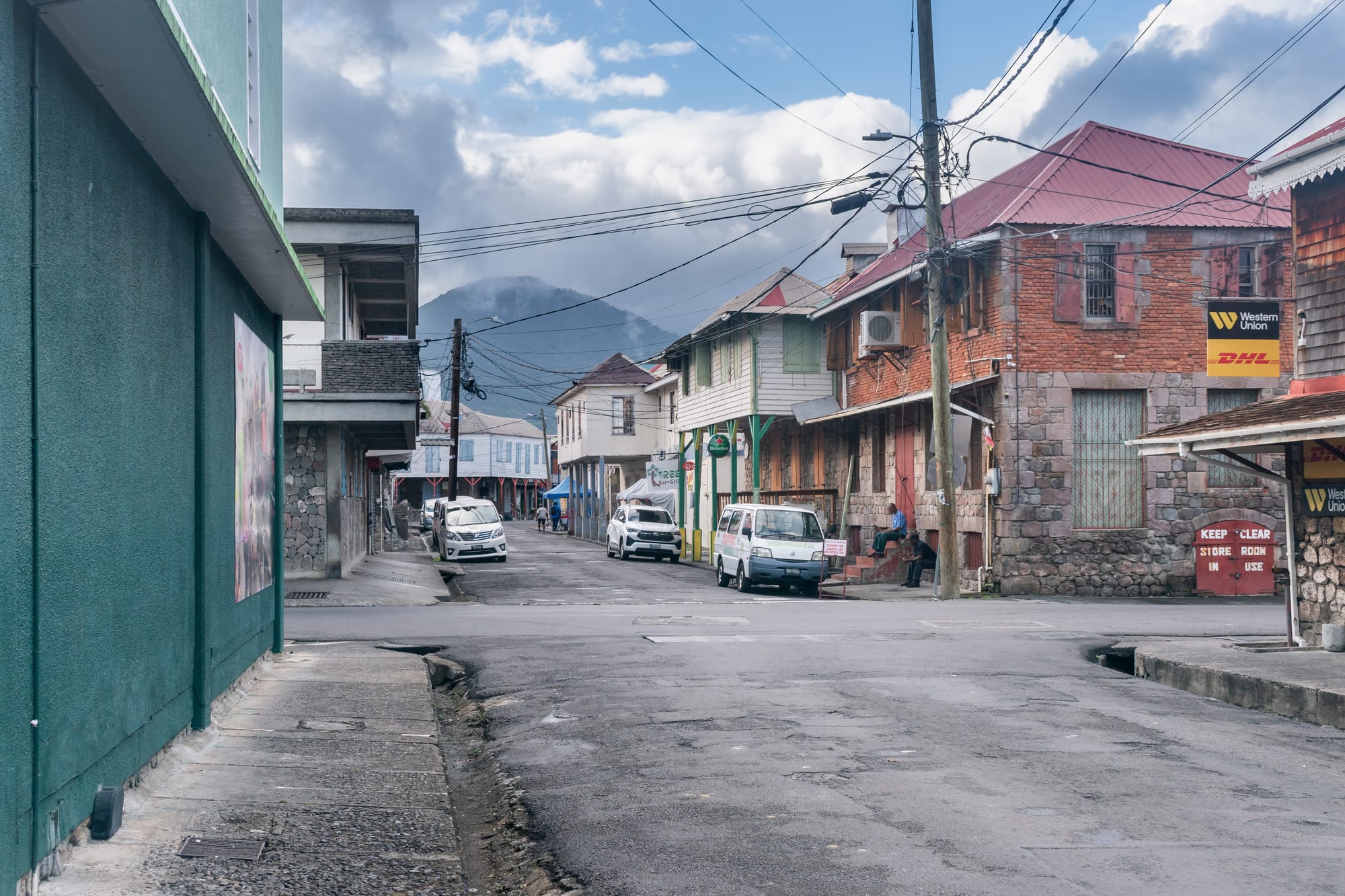
A quiet street of wooden and stone houses with red tin roofs in Roseau, a forested mountain behind under clouds

Dominica

Roseau

Hanover Street in central Roseau, with the hills of the interior behind. (Tournasol7 / Wikimedia Commons · CC BY 4.0)

Dominica's capital and largest town, a compact grid of wooden and stone buildings on the island's west coast where the Roseau River meets the Caribbean Sea, with Morne Bruce and the green hills rising behind. Founded by the French and fortified by the British, it was badly hit by Hurricane Maria in 2017 and remains the island's main port and business centre.

Neighbourhoods

  • Central Roseau and the French Quarter
    • First-time visitors
    • Historic district
    • Close to public transport

    The old core between the sea and the Roseau River, an irregular grid of about 80 small blocks spreading out from the Old Market. The French Quarter's narrow streets are lined with wooden houses and balconies, beside the cathedral, the museum on the bayfront and the shops and offices where most of the town's business is done.

    Open in Maps
  • Morne Bruce and the Botanic Gardens
    • Parks and views
    • Quiet and residential

    The green eastern edge of the centre. The Botanic Gardens spread out at the foot of Morne Bruce, a hillside enclave on the site of the old garrison, reached by road or by the steep Jack's Walk path, with views over the town, the gardens and the sea.

    Open in Maps
  • Newtown and Potter's Ville
    • Local life
    • Quiet and residential

    Districts laid out under British plans in the late 18th and early 19th centuries to the south and north of the old centre. They are residential neighbourhoods with their own football pitches, close enough to walk into town.

    Open in Maps
  • Goodwill and Bath Estate
    • Local life
    • Sport

    Suburbs built from the 1950s (Goodwill) and the early 1980s (Bath Estate) as Roseau spread beyond its old grid. Community sports facilities, schools and housing make these the places where much of the town's population actually lives and commutes from.

    Open in Maps

Things to do

Landmarks and museums

  • Roseau Cathedrallandmark

    The Roman Catholic Cathedral of Our Lady of Fair Haven, built of dark stone in the Gothic Romanesque revival style and dating in its present form from 1916; its interior is more spacious than the outside suggests.

    Open in Maps
  • Old Market Plazalandmark

    The colonial market square where trade with the surrounding islands, including the slave trade, was carried on and public executions were held; renovated in 1988 as a craft centre with stalls of jewellery, spices and souvenirs.

    Open in Maps
  • The Dominica Museummuseum

    The national museum, in an 1810 building on the bayfront that was once a market and post office, covering the island's natural history and early history, with pre-Columbian artefacts.

    Open in Maps
  • Fort Younglandmark

    The fort built by the British in 1770 and named after Sir William Young, the island's first civilian British governor; only ruins remain, on a site now occupied by a hotel.

    Open in Maps
  • The French Quarterneighborhood

    The most historic part of town, with streets of wooden buildings and balconies that are among the best examples of Caribbean vernacular architecture on the island.

    Open in Maps

Parks and viewpoints

  • Dominica Botanic Gardenspark

    Gardens first planted in 1890 on 16 hectares of a former sugar estate, where a baobab felled by Hurricane David in 1979 still lies on the school bus it crushed, and a centre works to protect the island's two endemic parrots.

    Open in Maps
  • Morne Bruceviewpoint

    The hill above the gardens, once the garrison that protected Roseau, with barracks remains, an old cannon, a large cross erected in the 1920s and a panoramic view of the town and sea.

    Open in Maps
  • Windsor Parkattraction

    The national stadium, completed in 2007, used mainly for cricket and football and also as the main stage of the World Creole Music Festival.

    Open in Maps

Markets

  • Roseau Saturday marketmarket

    The early-morning Saturday market near the mouth of the Roseau River, where vendors set up before dawn to sell fresh fruit, seafood and spices.

    Open in Maps

Short trips from the town

  • Trafalgar Fallsattraction

    The waterfalls near the inland village of Trafalgar, north-east of Roseau, best known for the falls and their hydroelectric plant and a popular stop on the island's ecotourism trail.

    Open in Maps
  • Morne Trois Pitons National Parkpark

    Dominica's first national park, established in 1975 and a UNESCO World Heritage Site since 1997, an area of volcanic activity with boiling mud ponds, small geysers, gorges and pools.

    Open in Maps
  • Boiling Lakeattraction

    A flooded fumarole 6.5 miles east of Roseau, filled with bubbling greyish-blue water usually wrapped in vapour, and the second-largest hot lake in the world; the trail from Laudat crosses the Valley of Desolation and takes about six hours.

    Open in Maps
  • Laudat and Titou Gorgeattraction

    A small mountain village about 20 minutes from Roseau, the gateway to the Boiling Lake, Fresh Water Lake and Titou Gorge, a swimming place fed by small waterfalls of hot and cold water.

    Open in Maps
  • Champagne Beachbeach

    A coastal spot south of Roseau known for snorkelling and diving among coral and the streams of bubbles rising from geothermal vents in the seabed.

    Open in Maps
  • Scotts Headattraction

    A fishing village at the island's south-west tip, beside a tied island with a small lighthouse and the ruins of Fort Cachacrou, overlooking the Soufrière Scotts Head Marine Reserve, a popular diving and snorkelling site.

    Open in Maps

Seasonal events

  • Carnival (Mas Domnik)February or March, before Ash Wednesday

    Dominica's Carnival, held in Roseau and drawing on the carnivals of Martinique, Guadeloupe and Trinidad, with the Calypso Monarch competition, the Carnival Queen pageant, parades and parties, street celebrations on the Monday and Tuesday before Ash Wednesday, and in some villages the older chanté mas masquerade songs.

  • World Creole Music Festivallast weekend of October

    A three-day festival of Creole music from the Caribbean, the French Antilles, Africa and North America, closing Creole heritage month, with Windsor Park among its venues.

Eat and drink

Long-standing places and food districts in Roseau. Hours, ratings and directions come from your maps app, always current.

Roseau classics

  • Roseau Saturday marketmarket

    The market by the river mouth is the place for tropical fruit, fresh fish and spices, and for snacks from the early-morning stalls.

    Open in Maps
  • Creole restaurants in central Roseauneighborhood

    The town's restaurants centre on Creole cooking built around fresh local herbs and freshly caught seafood, and even its French, Italian and Chinese kitchens add a Creole touch.

    Open in Maps
  • Rum shopsneighborhood

    Small bars known as rum shops are found all over town, serving mostly beer — above all the local Kubuli — along with rum and whisky.

    Open in Maps

Experience Roseau

History

Roseau stands on an alluvial fan built up as the Roseau River wandered across the coastal plain, and the river drew people long before Europeans arrived: Amerindians migrating through the islands settled here over the last 2,000 years, and the town occupies the site of the Kalinago village of Sairi. French settlers who established a small settlement named it after the river reeds, roseaux, that grew thickly along the banks. They laid it out on the French pattern, with streets running out from a central point — today's Old Market.

France and Britain fought over the town repeatedly. The French built a fort to protect it in 1699; the British replaced it with Fort Young in 1770. In 1778 a French invasion captured Fort Young and Roseau and took control of the island, which returned to British control under the Treaty of Paris in 1784. The British then added fortifications, government buildings, a grid of streets and new districts to the north and south, Potter's Ville and Newtown. The census of 1844 counted 3,954 people. French influence survives in the architecture and the crooked streets around the Old Market, English influence in public buildings and street names.

Growth in the 20th century spread the town outward, to Goodwill in the 1950s and Bath Estate in the early 1980s. Storms have marked recent decades. Hurricane David in 1979 wrecked the Botanic Gardens; in 2015 Tropical Storm Erika sent the Roseau River over its banks overnight; and in September 2017 Hurricane Maria left the capital's infrastructure in ruins, with half the town flooded and power lines down almost everywhere. Rebuilding stronger has been a national project since.

Culture & Customs

Roseau's culture is the island's Creole mix in concentrated form: French-Catholic and British-Protestant churches a few streets apart, Kwéyòl in the streets and English in the offices. The Catholic cathedral, in Gothic Romanesque revival style, and the Georgian Anglican church on Victoria Street are both examples of European styles with a touch of creolisation. The town is the seat of the Catholic diocese that covers the whole island.

Music runs deep. The musician Prince Ital Joe was born in Roseau in 1963. Calypso, steelpan and the older chanté mas masquerade songs come out at Carnival, and every October the World Creole Music Festival brings Creole performers from across the Caribbean, the French Antilles, Africa and North America to Windsor Park, which also hosts the Calypso finals and the Miss Dominica pageant. The novelist Jean Rhys, author of Wide Sargasso Sea, was born in Roseau in 1890.

Sport is mostly played close to home: cricket in the Botanic Gardens, football on pitches in Newtown, Potter's Ville and Bath Estate, and netball and basketball in the schools. Elsewhere a stretch of street, pavement or beach often becomes a makeshift pitch. The streets of the centre serve as gardens, playing fields and meeting places, and on Sunday afternoons families head for the shade of the Botanic Gardens.

Daily Life

Roseau had a population of about 14,700 in 2011, but the town is the centre of a wider area that has sprawled along the coast to places such as Canefield, Fond Cole, Castle Comfort and Wall House. Few people now live in the old centre; most commute in each morning, filling the narrow streets with cars and minibuses that the town's tight grid was never built for. Courtyards that were once common are giving way to offices.

The town is the island's main port for foreign trade, shipping bananas, bay oil, vegetables, grapefruit, oranges and cocoa, with a deepwater harbour at Woodbridge Bay to the north, and cruise ships are a frequent sight offshore. Services employ much of the workforce: government ministries, banks, shops, radio stations, labour unions and several embassies are all here. Roseau is also the island's centre of education, with secondary schools, Dominica State College and private medical schools.

Weekdays are busy and loud, Saturdays begin before dawn at the market, and Sundays are quiet, with most shops closed and buses scarce. Hurricane Maria still shapes daily concerns: rebuilding houses and infrastructure to withstand future storms.

Food

Roseau eats Dominican Creole food, built on what the island grows and the sea provides. The national dish is callaloo, a soup of leafy greens with coconut milk and sometimes salted meat or seafood, which took the title in 2013. Green fig and saltfish — green bananas with salted cod, seasoned with onions, peppers and garlic — is a traditional plate, bake and saltfish (fried dough with salt cod) is a common breakfast, and fish broth, a soup of seafood and vegetables, is everyday food. Most meals pair fish, chicken or pork with provisions such as dasheen, yam, green banana, breadfruit and plantain.

The Saturday market near the mouth of the Roseau River is where the town shops for tropical fruit, fish and spices, and the food market at the north end of town is full of vendors selling tropical fruit. Roadside stands sell fried chicken, fish and chips and tasty bakes, a fried dough made sweet or salty. Restaurants in the centre cook Creole food with fresh local herbs and seafood.

Cocoa tea, made by boiling local cocoa sticks with cinnamon and bay leaves, is the breakfast drink, and bush teas are brewed from local plants. Fresh juices are made from limes, passionfruit, grapefruit, oranges, tamarinds or guavas, and at Christmas sorrel calyces are boiled into a bright red drink. Rum and coconut water are popular, and the rum shops scattered through town pour Kubuli, the local golden lager, brewed with water from the island's Loubière Springs.

Planning tools

Budget

Roseau has little mass tourism and few large hotels, so most visitors stay in guesthouses and small, locally run places. Local food from the market and roadside stands is inexpensive; guided hikes, national park site passes, dive trips and a hire car are the main extra costs. Air fares and fuel-linked costs have risen since 2026.

Daily Budget Midrange
USD 150–300 (small hotel, sit-down Creole meals, hire car, guided hikes and diving)
Daily Budget Shoestring
USD 70–110 (guesthouse, market food and bakes, minibuses)

Site passes for the national park are one of the main extra costs, so it pays to plan which falls and trails to visit.

Best Time to Visit

The first months of the year are the driest, with a noticeably drier spell in Roseau from February to April, and the best trail conditions inland. The heaviest rain falls from June to October, which overlaps the Atlantic hurricane season. The World Creole Music Festival fills the town on the last weekend of October.

Suggested Number of Days

Two or three days are enough for the town itself. Most visitors use Roseau as a base for the national park, the falls and the south-west coast, so a week makes sense for hikers and divers; heavy rain can close trails and add a day.

First Visit
2–3 days
With Surroundings
5–7 days

Transportation

Roseau is the hub of the island's road network, linking traffic to the north, east and south. Minibuses leave from the capital for most of the island; their destinations are usually not posted on the front, so it helps to ask locals where each one stops. Services are much reduced on Sundays. Many visitors hire a car or a 4x4 for the mountain roads, or use taxis and guided tours.

Driving is on the left; roads are steep, narrow and slow, and landslips are common after heavy rain.

Airport & Station Connections

Douglas–Charles Airport, the island's main airport, is on the north-east coast, on the far side of the island from Roseau, and handles regional flights and some direct services from the United States. Canefield Airport, about 3 miles north of Roseau, takes small aircraft from nearby islands. A ferry terminal in Roseau links Dominica with Guadeloupe to the north and Martinique and St Lucia to the south, and cruise ships call at the town. A larger international airport is under construction at Wesley, expected to be finished in 2027.

Walkability

The centre is small and walkable — its grid of about 80 blocks covers some 30 hectares — but the streets are irregular and narrow, and it is easy to get lost in them. Traffic pours into the centre on weekdays, and pavements are uneven. Jack's Walk, a steep 15-minute climb from the Botanic Gardens to the top of Morne Bruce, is the best short walk in town.

Safety

Dominica is generally safe, with low levels of violent crime, though petty theft and the occasional robbery occur. In Roseau the greater danger has been water: the Roseau River burst its banks during Tropical Storm Erika in 2015, and Hurricane Maria flooded half the town in 2017.

Keep valuables out of sight, take a guide for the Boiling Lake and other long trails, check the forecast before heading into the interior, and never cross a flooded river. Check current official travel advice before travelling.

Climate

A tropical monsoon climate with fairly constant temperatures all year: average highs of 28–31 °C and lows of 19–23 °C. Roseau receives about 1,800 mm of rain a year, much less than the mountainous interior, with a drier stretch from February to April.

Summer
June to October is the wettest time and falls in the Atlantic hurricane season, with average highs of 28–31 °C as in the rest of the year
Winter
roughly January to May is drier, with the driest weather from February to April; average lows are 19–23 °C, and showers still fall

Local Customs

English is the official language, but Kwéyòl, a French-based creole, is widely spoken in the streets and markets. Catholicism is central to community life, and Sundays are very quiet, with many shops and restaurants closed. The streets of the centre are social spaces as much as roads, used for conversation and games.

Dress modestly in town and in church, keeping swimwear for the beach and rivers; ask before photographing people, especially at the market.

Common Payment Methods

The currency is the East Caribbean dollar (XCD), pegged at 2.70 to the US dollar. US dollars are widely accepted, with change usually given in EC dollars. Cards are accepted in Roseau's larger shops, restaurants and dive operators; carry cash for minibuses, market stalls and anywhere outside the capital.