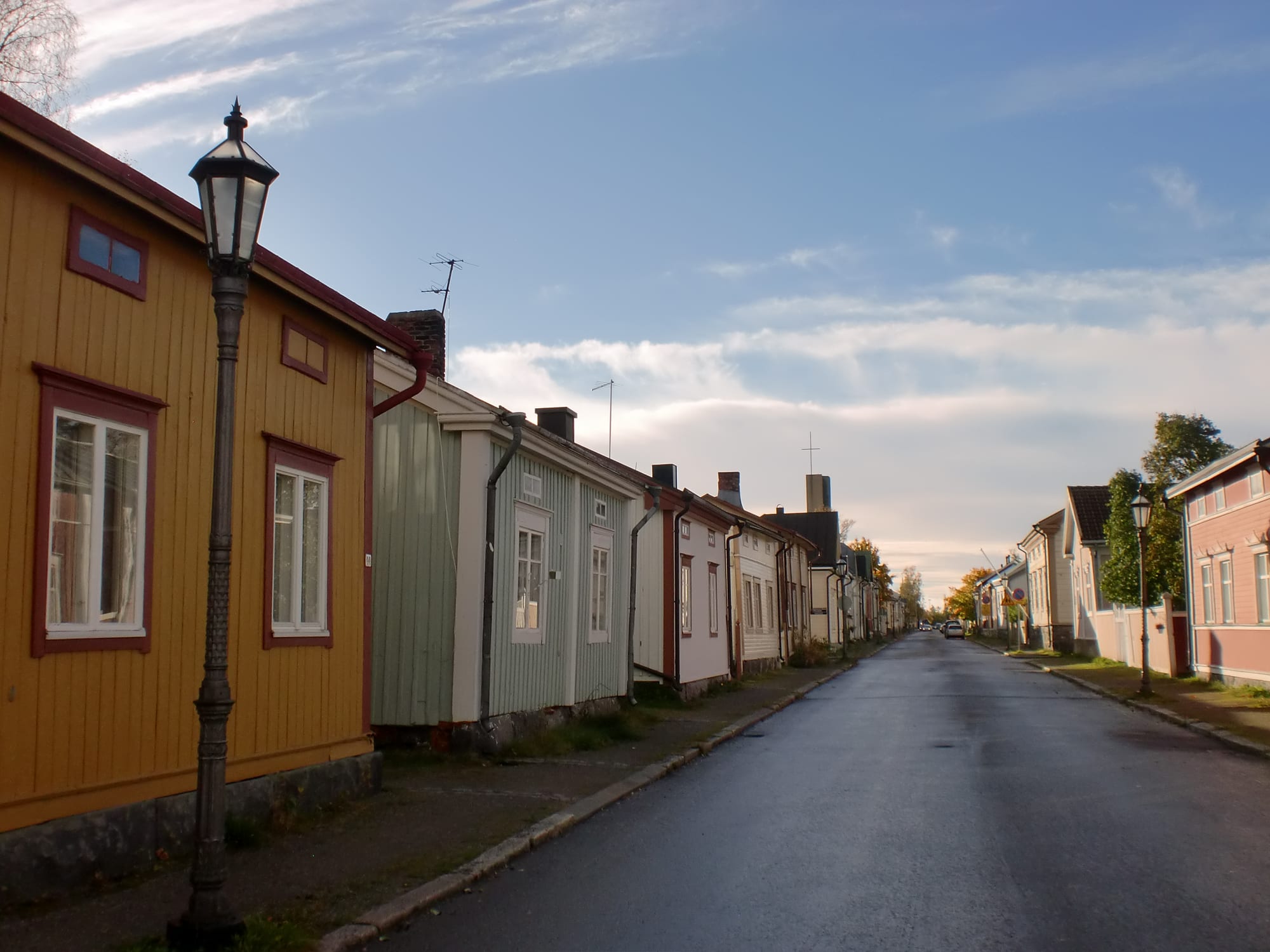
A quiet street of low wooden houses in Kokkola's old Neristan quarter

Ostrobothnia & the West Coast, Finland

Kokkola

Wooden houses in Neristan, Kokkola's old artisans' and sailors' quarter. (Mikkoau / Wikimedia Commons · CC BY-SA 4.0)

The regional capital of Central Ostrobothnia, on the Gulf of Bothnia, chartered in 1620 as a port for the tar trade. Tar and shipbuilding once made it one of Finland's richest towns, and in 1854 its defenders captured a British gunboat. Today it is a bilingual industrial town with a well-preserved wooden quarter, Neristan, and an island lighthouse offshore.

Neighbourhoods

  • Neristan
    • Historic district
    • First-time visitors
    • Cafés

    The 'lower town', the old artisans' and sailors' quarter of wooden houses on a grid, one of the best preserved in Finland. Its houses now hold restaurants, cafés and small shops as well as homes, and the river and park bound it to the east.

    Open in Maps
  • Town centre and the station
    • Close to public transport
    • Shopping

    The modern centre around the railway and bus stations and the Chydenia shopping centre, with the main cluster of eateries around Chydenia and bars on Rantakatu and Torikatu. Oppistan, the more prosperous old merchants' 'upper town', survives less well than Neristan.

    Open in Maps
  • Meripuisto and the shore
    • Seaside
    • Families
    • Outdoor recreation

    The seaside park about 2.5 km north of the centre, reached by paths along the creek, with the campsite, a beach and the jetty for the summer ferry to Tankar island.

    Open in Maps
  • Ykspihlaja
    • Industrial heritage
    • Port

    The port and industrial district about 5 km west of the centre, home to one of Finland's busiest ports and the chemical and metal plants that drive the local economy.

    Open in Maps

Things to do

The old town and its history

  • Neristanneighborhood

    Streets of old wooden houses in the lower town, best explored on foot by wandering the grid at random.

    Open in Maps
  • The English boatlandmark

    The British gunboat captured at the Skirmish of Halkokari in 1854, kept in a boathouse in the English Park; the town has refused repeated British requests to return it.

    Open in Maps
  • Museum Quartermuseum

    A small block of museum buildings around a grassy square with a café, including the Pedagogio of 1696, Finland's oldest urban secular wooden building, and the 18th-century merchant's home of Lassander House.

    Open in Maps
  • K. H. Renlund Museummuseum

    The art collection donated to the town by councillor Karl Herman Renlund, shown mainly in Roos House, built in 1813 by a merchant and shipping family.

    Open in Maps
  • Kaarlela Churchlandmark

    The stone Lutheran church south of the station, a landmark for centuries and a popular venue for weddings and concerts, with a local history museum of old farm buildings beside it.

    Open in Maps

The coast and islands

  • Tankar islandattraction

    A lighthouse island in the outer archipelago with a working lighthouse, a seal-hunting museum, a bird-watching tower and nature trails, reached by the summer ferry from Meripuisto.

    Open in Maps

Short trips from the town

  • Jakobstadattraction

    A neighbouring town to the south with a Swedish-speaking majority and the protected old Skata quarter, dating from 1783, reached along the scenic Seven Bridges Archipelago Road.

    Open in Maps
  • Kalajokibeach

    A coastal town to the north whose sandy beaches are one of the places to swim in the Gulf of Bothnia in summer.

    Open in Maps
  • Kaustinenattraction

    An inland municipality bordering Kokkola, home of a still-living fiddle music tradition and of the Nordic countries' biggest folk music festival.

    Open in Maps

Seasonal events

  • Kaustinen Folk Music FestivalJuly

    A week-long festival in neighbouring Kaustinen, held since 1968 — the largest folk music and dance festival in the Nordic countries.

  • Kokkola CupJuly

    An annual football tournament for under-18s, played in and around the town.

  • Venetian Festivalend of August

    The night when people close up their summer cottages with bonfires, lights and fireworks before autumn sets in.

Eat and drink

Long-standing places and food districts in Kokkola. Hours, ratings and directions come from your maps app, always current.

Food districts and cafés

  • Cafés and restaurants of Neristanneighborhood

    Several of the old wooden houses of the lower town now hold cafés and restaurants.

    Open in Maps
  • Museum Quarter cafécafe

    A café on the grassy square of the Museum Quarter, among the 17th- and 18th-century buildings.

    Open in Maps
  • Around Chydenia and the stationneighborhood

    The main concentration of the town's restaurants, pizzerias, cafés and food stalls, in and around the shopping centre near the railway and bus stations.

    Open in Maps
  • Tankar island cafécafe

    A café on the lighthouse island, alongside the seal-hunting museum, open in the summer ferry season.

    Open in Maps

Experience Kokkola

History

King Gustav II Adolf of Sweden chartered Kokkola in 1620 as a shipping port for the tar trade, making it one of the oldest towns in Finland, and gave it a seal showing a burning tar barrel that survives in today's coat of arms. In 1765 the Swedish parliament granted the town staple rights, allowing it to trade directly abroad, and tar exports and shipbuilding made Kokkola for a time one of the richest towns in Finland. But the town was always losing a race with the sea: the land rises here by almost 9 mm a year, and much of today's built-up area was under water when the town was founded, so its harbour slowly shrank to a narrow creek.

On 7 June 1854, during the Crimean War, Royal Marines from HMS Vulture and HMS Odin tried to land at Halkokari to destroy public property. Local defenders with hunting rifles, supported by troops and artillery, drove them back, killing nine, and captured one of the British boats. It was the only Royal Navy vessel still in foreign hands in 1914 and remains on show in the town, which has turned down British requests for its return.

The town had a Swedish-speaking majority until 1933. In 1977 it absorbed the surrounding rural municipality of Kaarlela and took its Swedish name, Karleby, and in 2009 Lohtaja, Kälviä and Ullava were merged into the city.

Culture & Customs

Kokkola's best-known cultural institution is the Ostrobothnian Chamber Orchestra, founded in 1972 by the conductor Juha Kangas, which often plays at Snellman Hall. The town theatre has a regular programme in Finnish, and the art collection of K. H. Renlund is shown in the merchant's house of the Roos family.

Two languages shape daily life. The centre is bilingual, the villages around it are mostly Swedish-speaking, and the town marks the northern edge of the Swedish-speaking coast; the areas merged in 2009 are entirely Finnish-speaking. Schools exist in both languages, and some pre-schools teach bilingually from an early age.

The calendar follows the light. In summer the ferry runs to Tankar, people head to their cottages, and the folk music festival in neighbouring Kaustinen, rooted in a long-unbroken local fiddle tradition, draws visitors from across the Nordic countries. At the end of August the Venetian Festival closes the cottages with bonfires and fireworks. Sport is popular: Kokkolan Tiikerit play in the top volleyball league, Hermes play ice hockey and KPV football, and in winter there are about 150 km of ski tracks.

Daily Life

About 48,000 people lived in Kokkola at the end of 2023, the great majority of them in its urban areas; the municipality is the 22nd most populous in Finland and covers a large area of farmland, villages and sea. About 6 per cent of residents had a foreign background in 2024, below the national average.

Industry is the backbone of the economy. The chemical industry is a major employer: the cobalt refinery is described as the only large one outside China, Boliden runs a zinc plant, and an industrial park built by Kemira is now shared among several firms. The port at Ykspihlaja, about 5 km from the centre, is one of the busiest in Finland, importing oil, ore and limestone and exporting refined products and timber. The city and the regional health and social services authority are the largest employers.

Much of the town's shopping is in Chydenia, near the station, which draws about 2 million visits a year. The Chydenius Institute, a university consortium, and Centria University of Applied Sciences provide higher education, with some degrees taught in English.

Food

Kokkola shares the plain, hearty food of Ostrobothnia. Leipäjuusto, bread cheese, comes originally from Southern Ostrobothnia, northern Finland and Kainuu: a mild fresh cheese, set in a round disk and baked or grilled until it has brown marks, which squeaks against the teeth. It is traditionally sliced and eaten with coffee, or served with cloudberry jelly. Rieska, a soft flat bread, and sour rye bread are everyday staples, and potatoes, pork and milk anchor the farm table.

The sea adds Baltic herring, whitefish and salmon, salted, smoked or fried, and the Swedish-speaking villages share Scandinavian habits such as pickled herring and cardamom buns with coffee.

Eating out is informal. The main cluster of restaurants, pizzerias, cafés and food stalls is around Chydenia and the station, while the wooden houses of Neristan hold cafés and restaurants with more atmosphere. In summer the café on Tankar island and the one in the Museum Quarter make good coffee stops, and pulla, the cardamom sweet bread, comes with coffee everywhere.

Planning tools

Budget

Kokkola is one of the cheaper Finnish towns, with mid-priced hotels used mainly by business travellers, a seaside campsite with cabins, and many museums free to enter. The summer ferry to Tankar and a hire car for the coast are the main extras.

Daily Budget Midrange
USD 140–230 (central hotel, restaurant meals, the Tankar ferry, a hire car)
Daily Budget Shoestring
USD 70–110 (campsite cabin or budget room, lunch buffets and pizzerias, walking)

Neristan, the English boat and the Museum Quarter cost nothing to see; the Tankar ferry runs only in summer, so plan an island trip for June to August.

Best Time to Visit

June to August, when the Tankar ferry runs, the shore is pleasant for walking and swimming, and the Kaustinen festival is held nearby in July. The Venetian Festival at the end of August closes the summer. Winter brings snow and about 150 km of ski tracks, but short days.

Suggested Number of Days

One or two days are enough for the old town and its museums. Three leave time for the island and the coast. In summer, the ferry timetable decides when an island trip is possible.

First Visit
1–2 days
With Surroundings
3 days

Transportation

The town is small and the sights are easily walked. A few hourly city bus lines circle Kokkola, and rental scooters and bikes are available in the centre. Paved paths run along both banks of the creek to the sea. A car is useful for the coast, the archipelago road and inland villages.

From Vaasa, Jakobstad and Jyväskylä the bus is quicker than the train, as the railway route is indirect.

Airport & Station Connections

Kokkola railway station lies on the Seinäjoki–Oulu line, and direct trains from Helsinki via Tampere take just under four hours; the bus station is across the road. Kokkola-Pietarsaari Airport is in Kronoby, about 20 km south of the centre, with flights from Helsinki of just over an hour. Coaches link the town with Vaasa, Jakobstad, Oulu, Jyväskylä and Helsinki. There is no passenger ferry from Kokkola.

Walkability

Very good. Neristan, the museums, the English Park and the station are within a short walk of each other on flat streets, and the creek-side path to Meripuisto makes a pleasant walk of about 40 minutes. Pavements can be icy in winter.

Safety

Finland is consistently rated one of the safest countries in the world, with very low crime. The hazards around Kokkola are the weather and the sea: strong winds on the open coast, cold water, shifting sea ice in winter, and slippery roads and elk in the countryside.

Keep off sea ice, which moves with wind and currents, and take care on icy streets in winter. Check current official travel advice before travelling.

Climate

A northern coastal climate with long, snowy winters and short, mild summers. February is the coldest month, with an average temperature of -9.3°C, and July the warmest, averaging 16.5°C. The land here is still rising from the sea by about 9 mm a year.

Summer
mild — July averages 16.5°C, with long light evenings
Winter
cold — February averages -9.3°C, with snow and ski tracks through the winter

Local Customs

Kokkola is officially bilingual: about 82 per cent of residents speak Finnish and 12 per cent Swedish as their first language. The centre is bilingual, while most of the surrounding villages speak Swedish, making this the northernmost Swedish-speaking area on Finland's west coast. Tipping is optional and never necessary.

Bars and restaurants serve alcohol to over-18s; stronger drinks for home are sold only in the state Alko shops. Neristan's houses are mostly private homes, so look from the street.

Common Payment Methods

The currency is the euro. Cards and phone payments are accepted almost everywhere and ATMs are easy to find in the centre. Market stalls and small countryside sellers may take only cash.