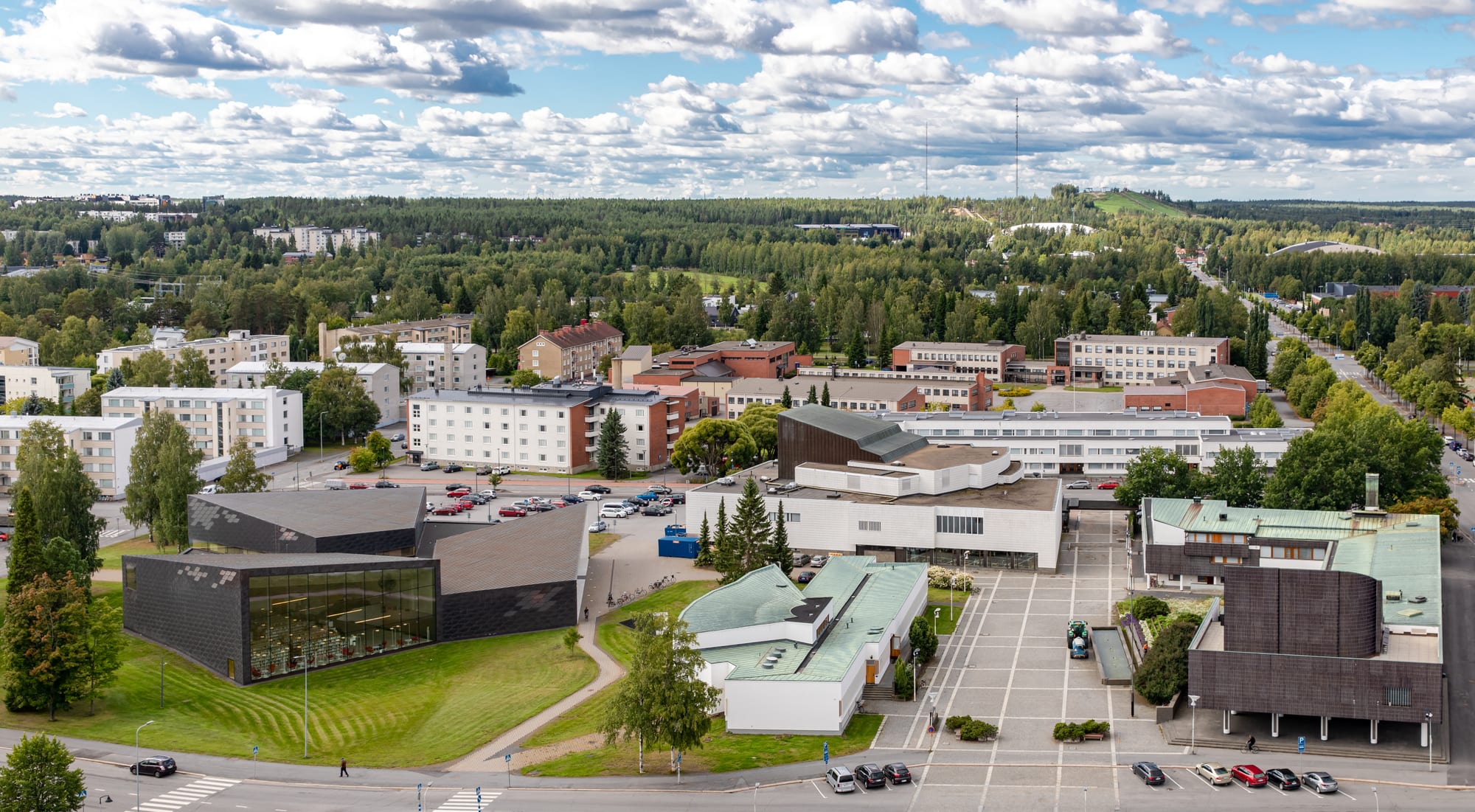
View from the church bell tower over the library, city hall and theatre of Seinäjoki's Aalto Centre

Ostrobothnia & the West Coast, Finland

Seinäjoki

The library, city hall and theatre of Seinäjoki's Aalto Centre, seen from the bell tower of Lakeuden Risti Church. (Ninara / Wikimedia Commons · CC BY 2.0)

The regional capital of South Ostrobothnia, on the Seinäjoki river in the flat farmland of western Finland. It grew from an ironworks of 1798 into a railway junction and market town, and gained an Alvar Aalto civic centre, now a World Heritage Site. Today it is a growing service and food-industry city best known for its summer tango and rock festivals.

Neighbourhoods

  • City centre
    • First-time visitors
    • Close to public transport
    • Shopping

    The compact grid facing the railway station, which shares a building with the bus station. The market square, the Torikeskus shopping centre and most of the city's bars and restaurants are a few minutes' walk away, and during Tangomarkkinat the streets become dance floors.

    Open in Maps
  • Aalto Centre
    • Architecture
    • Culture
    • Quiet

    Alvar Aalto's administrative and cultural centre, a short walk from the station: church, parish centre, city hall, library, state office building and theatre grouped around a granite-paved citizens' square. It is the reason most architecture lovers come to Seinäjoki.

    Open in Maps
  • Törnävä
    • Historic district
    • Parks
    • Festivals

    A green area about 5 km south of the centre, with an old church, a manor house of 1806 and its garden, and the open ground where Provinssirock is held each June.

    Open in Maps
  • Nurmo
    • Quiet and residential
    • Local life

    A former municipality just north-east of the centre, merged into Seinäjoki in 2009 and home to the headquarters and main plant of the meat company Atria.

    Open in Maps

Things to do

Alvar Aalto's Seinäjoki

  • Aalto Centrelandmark

    Six buildings by Alvar Aalto, mainly completed between 1960 and 1968, forming one of his most important works; in July 2026 it was designated a UNESCO World Heritage Site with 12 other Aalto works.

    Open in Maps
  • Lakeuden Risti Churchlandmark

    The 'Cross of the Plains', built in 1957–60 as the first building of the centre, with a 65-metre cross-shaped bell tower — Seinäjoki's highest building — that visitors can go up for views over the plain.

    Open in Maps
  • Seinäjoki City Halllandmark

    Aalto's town hall of 1961–62, faced with dark blue ceramic tiles, whose council chamber is also used for concerts.

    Open in Maps
  • Seinäjoki Librarylandmark

    Aalto's fan-shaped library of 1965, joined since 2012 by Apila, a copper-clad new library by JKMM Architects designed to complement it.

    Open in Maps
  • Seinäjoki City Theatrelandmark

    The last building of the centre, planned by Aalto in 1969 but built only in 1986–87 under Elissa Aalto's guidance.

    Open in Maps
  • Seinäjoki Civil Guard Housemuseum

    One of the first public buildings designed entirely by Aalto and seen as a breakthrough work, now holding a museum of the Civil Guard and the Lotta Svärd women's organisation.

    Open in Maps

Parks and the old town

  • Törnävä Churchlandmark

    The old church of Seinäjoki in the Törnävä area by the river.

    Open in Maps
  • Törnävä manorpark

    A manor house built in 1806 with an old garden, the centre of a museum area south of the city centre.

    Open in Maps
  • Kyrkösjärvipark

    One of the few artificial lakes in Finland.

    Open in Maps

Sport and nights out

  • OmaSP Stadionattraction

    The all-seater football stadium of SJK, one of Finland's leading clubs, with room for about 6,000 spectators.

    Open in Maps
  • Seinäjoki railway stationtransit hub

    The station that made the town, a junction of lines to Helsinki, Vaasa, Oulu and Haapamäki, with a statue of a railway worker in front; it is classed as a nationally significant built environment.

    Open in Maps

Short trips from the city

  • Isokyrö old churchlandmark

    A stone church built in 1513–33 in the village of Isokyrö, with wall paintings from 1560.

    Open in Maps
  • Ilmajokiattraction

    The neighbouring municipality to the south-west, home of the region's airport, where thousands gather for opera at the Ilmajoki Music Festival each June.

    Open in Maps

Seasonal events

  • ProvinssirockJune

    One of Finland's biggest and oldest rock festivals, held every June since 1979 at Törnävä, opening the summer festival season.

  • Tangomarkkinatearly July

    The world's oldest tango festival, held since 1985, with competitions that crown a Tango King and Queen, a daily parade and public dancing on Tango Street; it draws more than 100,000 visitors.

  • Vauhtiajotmid-August

    A combined motor-racing event and rock festival.

Eat and drink

Long-standing places and food districts in Seinäjoki. Hours, ratings and directions come from your maps app, always current.

Seinäjoki classics

  • Market squaremarket

    The square in the centre, ringed by bars and shops, where the city's market is held.

    Open in Maps
  • Mallaskoski beer at Minibaaricafe

    A small bar opposite the church that serves the locally brewed Mallaskoski beer on tap.

    Open in Maps

Cafés and bars

  • Bars and cafés of the city centreneighborhood

    Koulukatu, Kauppakatu and the streets around the market square hold rock bars, beer bars and cafés, and the Rytmikorjaamo club hosts live bands most weekends.

    Open in Maps

Experience Seinäjoki

History

Settlement spread along the Seinäjoki river in the first half of the 16th century, and in the 1550s there are said to have been just three houses here. For centuries the village belonged to other parishes — first Ilmajoki, then Nurmo — and in 1798 the Östermyra ironworks, making iron and gunpowder, was founded on the riverbank, giving the place the Swedish name it was long known by.

The railway made the town. The line from Tampere to Vaasa opened through Seinäjoki in 1883, the Kokkola line followed in 1885 and the line to Kristinestad in 1913, turning the village into one of Finland's main rail junctions. Seinäjoki gained its own local government in 1868, became an independent municipality in 1900, a market town in 1931 and a town in 1960. After the Winter War and the Continuation War, refugees from Jaakkima and Lumivaara in Karelia were resettled here.

In 1959 Alvar and Elissa Aalto won the competition for a new civic centre, which rose over the following decades: Lakeuden Risti Church was finished in 1960, the city hall in 1962, the library in 1965 and the theatre, after Alvar Aalto's death, in 1987. Mergers with Peräseinäjoki in 2005 and with Nurmo and Ylistaro in 2009 enlarged the city, and in July 2026 the Aalto Centre was inscribed by UNESCO as part of the Aalto Works World Heritage Site.

Culture & Customs

Seinäjoki is known across Finland for three big summer events. Tangomarkkinat, held since 1985 and described as the world's oldest tango festival, crowns the country's Tango King and Queen and fills the streets with public dancing to live music; the winners go on to tour Finland's dance halls. Provinssirock, one of Finland's biggest and oldest rock festivals, has opened the summer festival season every June since 1979, and Vauhtiajot combines motor racing with rock in August.

Outside festival time, culture centres on the Aalto buildings: the city theatre, the city orchestra, which tours in Finland and abroad, and the libraries old and new. Rytmikorjaamo is a popular rock club with Finnish or international acts most weekends.

The city is Finnish-speaking, and more than three-quarters of residents belong to the Lutheran Church. Sport is followed closely: SJK is one of the leading football clubs in the country, the JymyJussit and Maila-Jussit play pesäpallo, Finnish baseball, in the top league, and the speedway track on the edge of town has hosted the national championship final many times.

Daily Life

About 67,000 people live in the city, the 16th most populous municipality in Finland, and about 132,000 in the wider Seinäjoki region. The city keeps growing while the surrounding rural municipalities lose people, and its new residents are increasingly of foreign origin, although only about 6 per cent had a foreign background in 2024; Ukrainian is the most common foreign language.

Seinäjoki is a service and trading centre for the whole of South Ostrobothnia, with a large number of small businesses and an unusual number of shops for its size; the Torikeskus mall in the centre is one of its main shopping places. Food production and research matter here — the food company Atria is headquartered in the city — and Seinäjoki University of Applied Sciences gives it a student population.

Daily life follows the rhythm of a small Finnish city: trains and coaches through the travel centre by the station, lunch at noon, and evenings at home, at sports fields or in the bars around the market square. In summer the festivals transform the town for days at a time.

Food

South Ostrobothnia is farming country and its food is plain and hearty. Leipäjuusto, bread cheese, comes originally from this region, northern Finland and Kainuu: a mild fresh cheese set in a round disk two or three centimetres thick and baked or grilled until it has brown marks. It squeaks against the teeth when fresh, and is eaten in slices with coffee, sometimes with coffee poured over it in the cup, or with cloudberry jelly. Rieska, a soft flat bread, and sour rye bread are everyday staples, with potatoes, pork and milk anchoring the farm table.

The coast to the west adds Baltic herring, whitefish and salmon, salted, smoked or fried, and the market square is the place for seasonal produce.

For drinks, the local Mallaskoski brewery's beer is poured in the centre, and the neighbouring municipality of Isokyrö is home to the Kyrö distillery, which makes gin and whisky. Weekday lunch buffets are the everyday way to eat out, and coffee with pulla, the cardamom sweet bread, is offered at every visit.

Planning tools

Budget

Seinäjoki is one of the cheaper Finnish cities for most of the year, with good-value hotels and lunch buffets. Prices change sharply during the big summer festivals, when hotels fill and many visitors camp or bring a camper.

Daily Budget Midrange
USD 140–240 (city hotel, restaurant meals, a festival ticket or a hire car)
Daily Budget Shoestring
USD 70–110 (budget hotel or campsite, lunch buffets, supermarket dinners, walking)

Book rooms many months ahead for Provinssirock and Tangomarkkinat; at other times the Aalto Centre, its square and the bell tower view cost little or nothing.

Best Time to Visit

June to August, for the light nights, Provinssirock in June, Tangomarkkinat in early July and Vauhtiajot in August — or, for the architecture, a quieter week outside the festivals. Winters on the open plain are cold and dark, though the Aalto buildings can be seen year-round.

Suggested Number of Days

One or two days are enough for the compact centre and its architecture; three leave time for the surrounding countryside. Festival-goers plan around the length of the event instead, which usually runs several days.

First Visit
1–2 days
With Surroundings
3 days

Transportation

The centre is small and walkable. Local buses run on weekdays and Saturdays but not on Sundays, when only coaches operate, and an on-demand minibus serves the city on weekday working hours. City bikes and rental scooters are available. A car helps for the surrounding villages.

Check Sunday travel in advance, as there are no local buses that day.

Airport & Station Connections

Most visitors arrive by train: Seinäjoki is a junction on the main line, and the fastest Pendolino trains take roughly three hours from Helsinki or Oulu and just over an hour from Tampere. Coaches arrive from Helsinki via Tampere, from Vaasa and from Pori. Seinäjoki Airport, about 11 km south-south-west in Ilmajoki, handles only some charter flights, so the nearest regular airport is Vaasa, about 80 km to the west.

Walkability

Very good. The railway station opens straight onto the centre, and the shopping streets, market square and Aalto Centre are all within a short, flat walk. Törnävä is a longer walk or a short bike ride. Pavements can be icy from December to March.

Safety

Finland is consistently rated one of the safest countries in the world, with very low crime. Around Seinäjoki the hazards are the winter weather, slippery roads and elk in the countryside. Festival weekends bring crowds and late-night drinking in the centre.

Drive carefully on rural roads in winter and watch for elk at dusk. Check current official travel advice before travelling.

Climate

Flat, open and inland. Winters are long and cold and summers short, with long light evenings. In nearby Vaasa the average annual temperature is 4.7°C.

Summer
short, with long light evenings; nearby Vaasa recorded 33.7°C on 18 July 2018, the hottest reading in Finland that year
Winter
long and cold; in nearby Vaasa February is usually the coldest month and the record low is -38.6°C

Local Customs

Seinäjoki is a Finnish-speaking city with a strong Lutheran tradition, and South Ostrobothnians are proud of their regional identity. Tango is taken seriously here, as a social dance for all ages rather than a show. Tipping is optional and never necessary.

Bars and restaurants serve alcohol to over-18s; stronger drinks for home are sold only in the state Alko shops. Dress quietly and keep voices low in Lakeuden Risti and other churches.

Common Payment Methods

The currency is the euro. Cards and phone payments are accepted almost everywhere and ATMs are easy to find in the centre. Market stalls and small countryside sellers may take only cash.