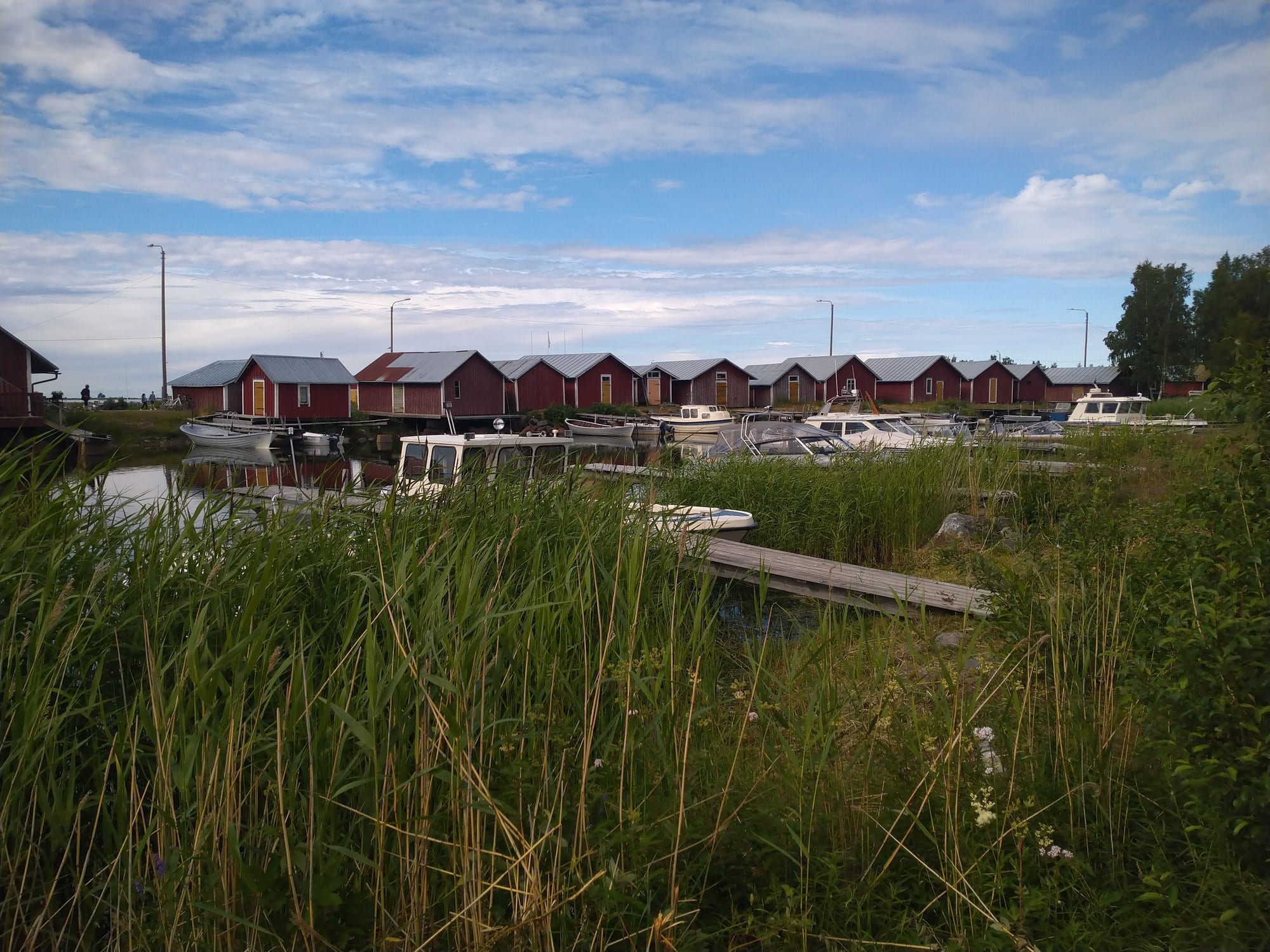
A row of red wooden boathouses beside a small harbour with moored motorboats, seen across tall green reeds

Finland

Ostrobothnia & the West Coast

Boats and red shore storehouses at Svedjehamn on Björkö, in the Kvarken archipelago. (LPfi / Wikimedia Commons · CC BY-SA 3.0)

The flat farmland and low, rising coast of western Finland along the Gulf of Bothnia — a bilingual shore of Swedish-speaking fishing and farming communities around Vaasa and the Kvarken archipelago, and inland the proud Finnish-speaking plains of South Ostrobothnia around Seinäjoki, with Kokkola to the north.

Explore Ostrobothnia & the West Coast

History

Ostrobothnia is young land in a literal sense: after the Ice Age the ground has risen steadily out of the sea, and the coast has moved westward over centuries, leaving harbours stranded inland. Finnic peoples lived on the rivers of the plain, and from the 13th and 14th centuries Swedish settlers took the coast, founding the fishing and farming villages whose descendants still speak Swedish.

Towns came in the 17th century, when the Swedish crown founded Vaasa in 1606 and chartered Kokkola in 1620 to handle the export of tar, the pine tar that Ostrobothnian farmers boiled from their forests and shipped to the navies of Europe. The tar trade made the coast rich for two centuries and built its shipyards. The Finnish War of 1808–09 was fought across the plains — at Lapua, Oravais and elsewhere — before Russia took Finland, and in 1854, during the Crimean War, British boats raided the coast and one was captured at Kokkola.

Vaasa burned in 1852 and was rebuilt on a new site to the north-west. In the civil war of 1918 the White Senate made Vaasa its seat of government while the Reds held Helsinki, and General Mannerheim's army drew on South Ostrobothnian volunteers. The region's conservative, rural politics produced the Lapua movement, a right-wing campaign of 1929–32. After the Second World War, Vaasa industrialised, and Vaasa and Seinäjoki grew into regional centres.

Culture & Customs

The coast and the plain are two cultures. Ostrobothnia proper, around Vaasa, Jakobstad and Närpes, is about half Swedish-speaking, and its villages have their own Swedish dialects. Inland South Ostrobothnia is almost entirely Finnish-speaking, and its people, eteläpohjalaiset, have a strong regional identity.

The plain's folklore includes the häjyt, knife-fighting troublemakers of the 19th century who became figures of legend and film, and the Kauhava puukko, a craftsman-made knife still produced there. The typical farmhouse of the lowlands, the Ostrobothnian house, stands among open fields and hay barns.

Two national poets came from the coast: J. L. Runeberg was born in Jakobstad in 1804, and Zacharias Topelius near Nykarleby in 1818. Seinäjoki hosts the Tangomarkkinat, the tango festival held since 1985, where a tango king and queen are crowned — Finnish tango is a serious national passion — and the Provinssi rock festival. Coastal villages keep up Midsummer poles, and revival movements have long shaped church life in the region.

Daily Life

Vaasa has about 68,000 residents and Seinäjoki about 65,000; Kokkola has about 48,000 and Jakobstad about 19,000. Smaller towns include Kristinestad, Kaskinen, Närpes, Lapua and Kauhava, and much of the population lives in farming villages strung along rivers.

Vaasa is the centre of a large energy-technology industry, with engine, electrical and power-grid manufacturers, and has universities in both Finnish and Swedish. Seinäjoki is a food-industry and services town — the meat company Atria has its head office there — and South Ostrobothnia is known for entrepreneurship, farming and small firms. Kokkola has a large chemical and metals industry at its port, and Närpes is known for its greenhouse tomatoes. Many coastal families have relatives in Sweden, and ferries and commuting keep the ties alive.

Days start early and life is family- and church-centred, with strong associations, sports clubs and village halls. The ageing countryside and the future of rail links are the regional debates.

Food

This is farming country, and its food is plain and hearty. Leipäjuusto, "bread cheese", is a mild cow's-milk cheese baked until browned in spots, squeaky when bitten and traditionally served with cloudberry jam or with coffee. Rieska, a flat, soft unleavened bread of barley or potato, and sour rye bread are everyday staples, and potatoes, pork and milk anchor the farm table.

The coast adds Baltic herring, whitefish and salmon, salted, smoked or fried, and the Swedish-speaking villages share Scandinavian habits — pickled herring, Midsummer snaps and cardamom buns with coffee. Närpes tomatoes are a regional pride, and Ostrobothnian farms grow potatoes and grain.

Isokyrö, in South Ostrobothnia, is home to the Kyrö distillery, which makes rye whisky and a rye-based gin from local grain. Coffee is drunk constantly and strong, and pulla and cakes appear at every visit, as well as at the church and village-hall gatherings that shape social life here.

Attractions & Natural Wonders

The Kvarken Archipelago off Vaasa, shared as a UNESCO World Heritage Site with Sweden's High Coast, is the natural highlight: low islands of boulders and long ridged moraines, the De Geer moraines, where the land rises by several millimetres a year. Replot Bridge, Finland's second longest, leads to Replot and Björkö, with walking trails and the fishing harbour of Svedjehamn.

Vaasa itself has its broad boulevards, the Ostrobothnian Museum, the Kuntsi museum of modern art, and the ruins of Old Vaasa's church to the south-east. Along the coast lie Kristinestad's wooden old town, Närpes's church stables, Jakobstad's wooden quarter of Skata, and Nykarleby, near Topelius's birthplace at Kuddnäs.

Inland, Seinäjoki's Aalto Centre — the Lakeuden Risti church, town hall, library and other public buildings — was designed by Alvar Aalto, and the open plains of South Ostrobothnia, with the Kyrönjoki river and old farmhouses, suit cycling. Lapua saw a battle of the 1808 war. Kokkola, to the north, has Neristan, its old quarter of wooden houses, and the English Park, where the boat captured in 1854 is displayed.

Cities in Ostrobothnia & the West Coast

Planning basics

Budget

One of the cheaper parts of Finland. Hotels in Vaasa, Seinäjoki and Kokkola cost less than in the south, and summer cottages and farm stays on the coast are good value. Seinäjoki's hotels fill and prices rise during its big summer festivals. A car is the main extra cost, since public transport barely reaches the archipelago.

Daily Budget Midrange
USD 140–250 (hotel or seaside cottage, restaurant meals, a hire car for the Kvarken islands)
Daily Budget Shoestring
USD 70–110 (hostel or budget hotel, lunch buffets, supermarket dinners, trains)

Book Seinäjoki well ahead for the Tango Festival and Provinssi weekends, and rent a car or bicycle for the Kvarken islands.

Safety

The region is very safe. The hazards are the weather and the sea: strong winds on the open coast, cold water, shifting sea ice in winter, and slippery roads and elk crossings in the countryside.

Keep off sea ice, which moves with wind and currents, and drive carefully on rural roads in winter. Check current official travel advice before travelling.

Climate

Flat, open and windy, with more sunshine than the interior in spring and early summer. Winters are colder and snowier than on the south coast, and the shallow Gulf of Bothnia usually freezes along the shore, sometimes across the Kvarken strait. Inland South Ostrobothnia is known for cold clear nights and early frosts on its open plains.

Summer
15–23°C, bright and breezy, with long light evenings
Winter
-6 to -12°C, snow from December to March, frozen sea along the coast

Transportation

Seinäjoki is a rail junction on the main line from Helsinki, with branches to Vaasa and the main line continuing north to Kokkola and Oulu. Vaasa and Kokkola have small airports, and a car ferry crosses the Gulf of Bothnia from Vaasa to Umeå in Sweden in a few hours. Buses link the coastal towns, but a car or bicycle is needed for the Kvarken islands and the countryside.

Ride out over Replot Bridge by car or bicycle; the outer islands have no regular public transport.

Best Time to Visit

June to August for the archipelago, the beaches and the summer festivals — Seinäjoki's Tango Festival and Provinssi rock festival among them. May and September are quiet and light. Late winter, from February to March, brings skiing, snow and frozen sea with bright days, though most tourist services close.