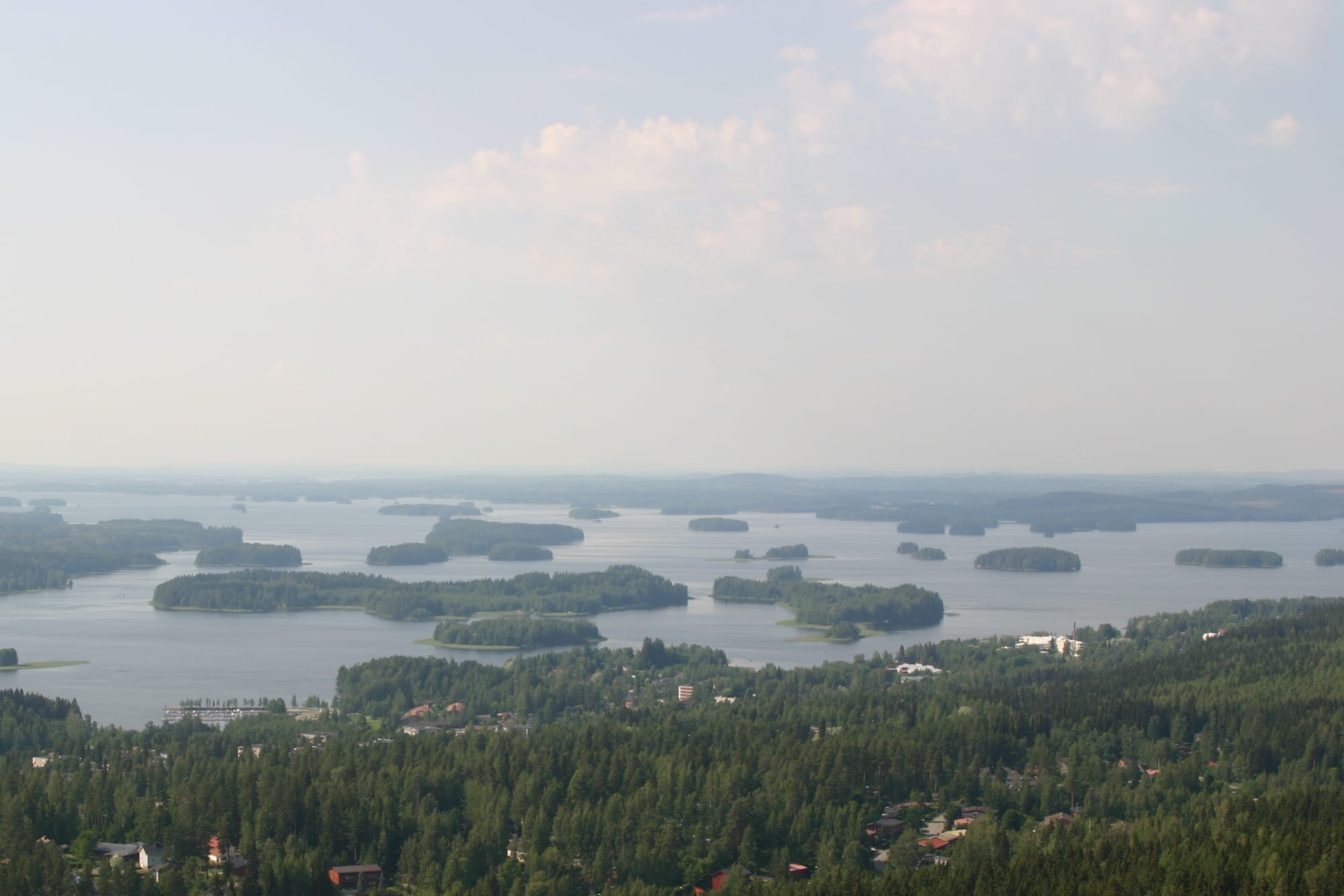
Forested islands scattered across a wide lake under a hazy summer sky, seen from a hill above pine forest and houses

Finland

Lakeland

The islands of Lake Kallavesi seen from Puijo hill in Kuopio. (Jeanie Mackinder / Wikimedia Commons · CC BY 2.0)

The forested, lake-filled heart of Finland, running from industrial Tampere through Jyväskylä and the Saimaa system of Savo to North Karelia on the eastern border — the classic summer landscape of islands, cottages and lake steamers, with Savonlinna's island castle, Kuopio, Joensuu and the Koli hills.

Explore Lakeland

History

After the Ice Age the land was left as a mosaic of lakes and ridges, and it was settled by Finnic hunters and then by slash-and-burn farmers from Savo and Karelia, who pushed north and west through the forests from the Middle Ages. Karelia faced east: Orthodox missionaries and Novgorod's traders reached it early, and the Treaty of Nöteborg of 1323 drew a border between Swedish and Novgorodian spheres that shaped its religion for centuries.

Sweden fortified the frontier. Olavinlinna was begun at Savonlinna in 1475 to defend Savo against Russia, and Kuopio and Joensuu grew later as market towns. The border moved west and east in repeated wars, and much of Savo and Karelia changed hands between Sweden and Russia in the 18th century before the whole region came under the Grand Duchy of Finland in 1809.

Industry arrived in Tampere, where the Scottish engineer James Finlayson founded a cotton mill on the Tammerkoski rapids in 1820; the city became Finland's leading manufacturing centre, and in 1918 it saw the largest military operation of the civil war, won by the Whites. Jyväskylä became a centre of Finnish-language education, opening the first Finnish-language teacher-training college in 1863. After the Second World War, North Karelia and Savo absorbed many of the evacuees from territory ceded to the USSR, and the region later shifted from farming and forestry towards universities, services and technology.

Culture & Customs

The Lakeland holds two of Finland's most distinct regional characters. People from Savo are known for a roundabout, joking way of speech that other Finns find hard to pin down, and the Savo dialect is one of the most recognisable in the country. North Karelia keeps traditions of song and Kalevala-inspired art; painters and composers of the national-romantic era, Sibelius among them, went to Koli and Karelia for inspiration.

Religion is more varied here than in most of Finland. Most people are Lutheran, but the Orthodox Church of Finland had its archbishop in Kuopio until 2018, its monastery is New Valamo in Heinävesi, and Orthodox churches stand in many North Karelian towns and villages.

Summer is festival season: the Savonlinna Opera Festival in Olavinlinna's courtyard, Tampere's theatre festival, the Ilosaarirock festival in Joensuu, and the Neste Rally Finland on the gravel roads around Jyväskylä. Tampere calls itself a sauna capital and has old public saunas still in use, and cottage life — wood-heated sauna, rowing boat, lake swim — is the region's shared ritual.

Daily Life

Tampere, with about 260,000 residents, is Finland's third city and the largest inland city in the Nordic countries. Jyväskylä has about 150,000, Kuopio about 125,000 and Joensuu about 78,000; Mikkeli, Savonlinna, Varkaus and Iisalmi are smaller. The rural population is ageing and shrinking, and many villages depend on summer residents who swell their numbers in July.

Tampere has moved from textiles to technology, games and engineering, and has opened a tram network and a new arena in the 2020s. Jyväskylä and Kuopio are university and hospital cities, the University of Eastern Finland has campuses in Kuopio and Joensuu, and forestry, sawmills and paper mills still employ many people across Savo and Central Finland. The town of Nokia, near Tampere, gave its name to the company that began there as a pulp mill.

Life follows the seasons more than the clock. Summer means cottages, berry and mushroom picking and evenings on the jetty; winter means skiing on lit trails, ice fishing and winter swimming through holes in the lake ice.

Food

Savo and Karelia gave Finland much of its traditional food. Kalakukko, from Kuopio, is a loaf of rye dough baked for hours around vendace or perch and pork. Karelia's karjalanpiirakka are open rye-crust pastries filled with rice porridge and eaten with egg butter, and karjalanpaisti, Karelian hot pot, is beef and pork stewed slowly in the oven.

Lake fish is everyday food: muikku, small vendace, are a lake staple, often fried crisp, and pike-perch, perch and whitefish come smoked or in soup. Savonlinna's speciality is lörtsy, a large half-moon fried pastry filled with meat and rice or with apple.

Tampere's signature is mustamakkara, a black sausage of blood, pork and grain eaten with lingonberry jam, a speciality of the city. Pyynikki's observation tower is known for its sugared doughnuts. Summer brings bilberries, lingonberries and chanterelles from the forests, and crayfish from the lakes in August.

Attractions & Natural Wonders

Tampere spreads between the lakes Näsijärvi and Pyhäjärvi: the Tammerkoski rapids and the Finlayson mill area, the Vapriikki museum centre, the Moomin Museum, the Lenin Museum, the Pyynikki ridge and tower, and the Särkänniemi amusement park with its Näsinneula tower. In Central Finland, Jyväskylä has the Alvar Aalto Museum and Aalto's university buildings, and nearby Petäjävesi's wooden church of 1763–65 is a UNESCO World Heritage Site.

South Savo is Saimaa country. Savonlinna's Olavinlinna, on its island in the Kyrönsalmi strait, hosts the Savonlinna Opera Festival each July, and lake boats run from the town. Linnansaari and Kolovesi national parks protect islands and the Saimaa ringed seal, and Mikkeli has Mannerheim's wartime headquarters.

In North Savo, Kuopio has its market square, the Orthodox Church Museum and the Puijo tower above Lake Kallavesi. North Karelia's Joensuu is a lively university town on the Pielisjoki river, and New Valamo monastery at Heinävesi welcomes visitors. Koli National Park, on the western shore of Lake Pielinen, offers the view from Ukko-Koli over wooded islands — the landscape painted by Eero Järnefelt — with walking trails in summer and skiing in winter.

Cities in Lakeland

Planning basics

Budget

Cheaper than Helsinki. Tampere, Jyväskylä and Kuopio have good-value hotels and lunch buffets, and rented lakeside cottages — the classic way to stay — are affordable for families and groups, especially by the week. Savonlinna's hotels are dear and fully booked during the opera festival, and lake cruises, canoe hire and opera tickets are the main extras.

Daily Budget Midrange
USD 150–290 (city hotel or lakeside cottage, restaurant meals, lake cruise, hire car)
Daily Budget Shoestring
USD 70–110 (hostel, campsite or shared cottage, self-catering, trains and buses)

Book Savonlinna rooms months ahead for July, and look at weekly cottage rentals rather than hotels for a Lakeland stay.

Safety

The region is very safe. The hazards are outdoor ones: drowning, often linked to alcohol and small boats, cold water in early summer, thin ice on lakes in late autumn and spring, mosquitoes and ticks in summer, and elk on the roads at dusk.

Wear a life jacket in rowing boats and canoes, keep off ice that has not been checked, and watch for elk on rural roads. Check current official travel advice before travelling.

Climate

More continental than the coast. Summers are the warmest in Finland, with days that can pass 25–30°C and warm lake water for swimming by July; winters are colder and snowier than in the south, and the lakes freeze from around December to April. North Karelia and North Savo are the coldest parts of the region.

Summer
warm, 18–28°C by day, light nights, lakes warm enough to swim
Winter
-8 to -15°C, often colder in the east; steady snow cover and frozen lakes

Transportation

Trains from Helsinki reach Tampere in under two hours, and Jyväskylä, Kuopio and Joensuu in roughly three to five; Savonlinna is reached by train or by bus. Lake steamers and cruise boats run in summer from Tampere, Savonlinna, Kuopio and other lake towns. Distances are long and rural buses sparse, so a hire car is the practical way to reach cottages, national parks and small towns.

Allow time between towns: roads wind around lakes, and a map distance can be much longer by road.

Best Time to Visit

June to August is the Lakeland season — lake boats run, cottages open, Midsummer bonfires burn on the shores, and the Savonlinna Opera Festival fills July. Early September brings autumn colour and quiet. February and March suit skiing and skating on the frozen lakes, with more daylight than midwinter.