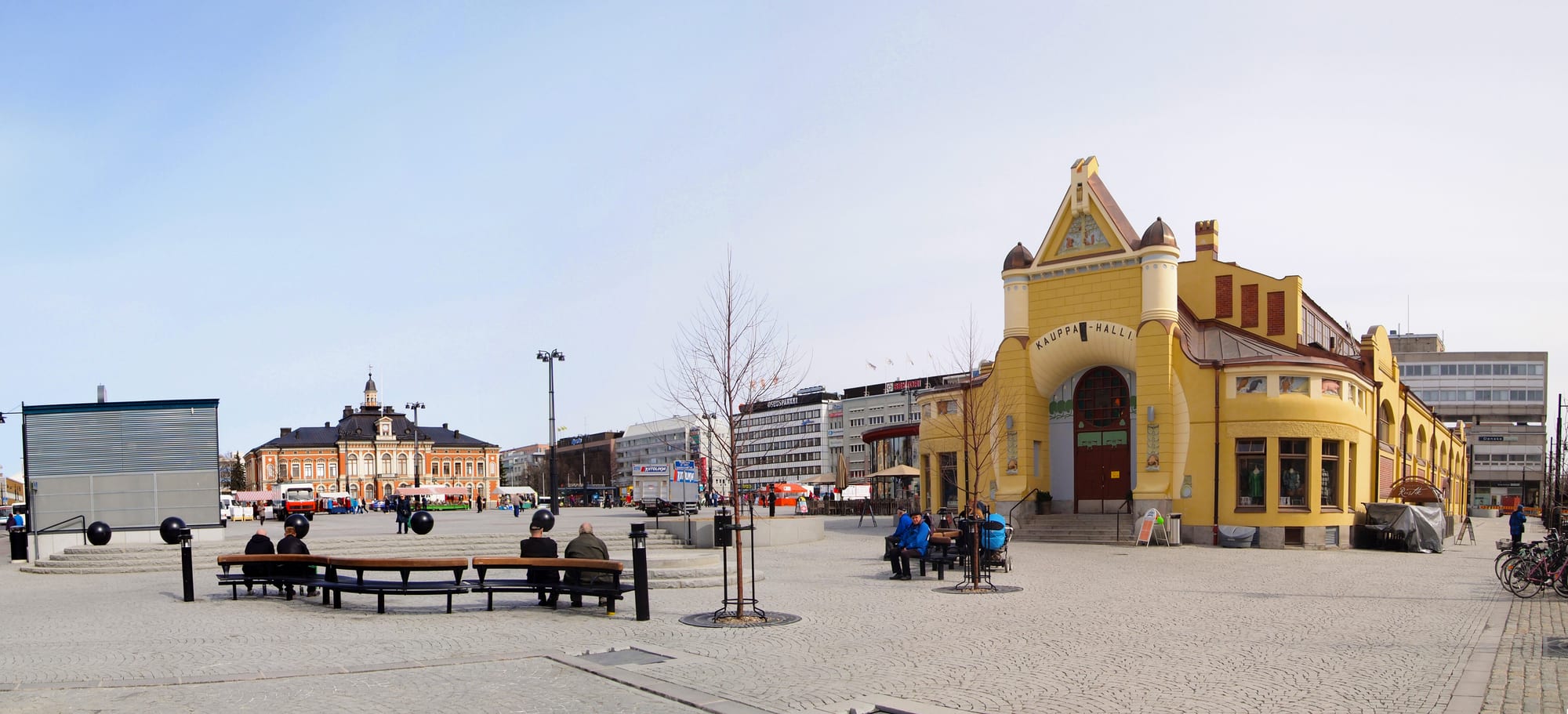
A wide paved market square in Kuopio under a cloudy sky

Lakeland, Finland

Kuopio

Kuopio Market Square, at the heart of the city centre. (Tiia Monto / Wikimedia Commons · CC BY-SA 3.0)

The capital of North Savo, built on a peninsula and islands in Lake Kallavesi in the Finnish Lakeland. Founded as a Swedish provincial seat in the 18th century, it grew into the main university, hospital and cultural centre of eastern Finland. Today it is a compact grid town around a busy market square, known for the Puijo tower, Savo humour and kalakukko.

Neighbourhoods

  • Market Square and the city grid
    • First-time visitors
    • Close to public transport
    • Shopping

    The centre of town, laid out on a dense grid around the market square, which locals call the centre of the universe. Every other street is a quiet lane kept for walkers and cyclists, a pattern dating from the first town plan of 1776, and the market hall, city hall, shops, cafés and the bus hub are all here.

    Open in Maps
  • Vahtivuori
    • Historic district
    • Museums
    • Lakefront

    The district between the market square and Lake Kallavesi, holding the cathedral, Snellman Park, the Kuopio Museum, the art museum, the city library and the passenger harbour. Summer lake boats leave from the harbour here.

    Open in Maps
  • Väinölänniemi
    • Beaches
    • Parks
    • Historic homes

    A green peninsula at the southern tip of the centre, surrounded by the lake, with beaches, sports fields and three parks. The Orthodox St Nicholas Cathedral, the home of Minna Canth, the photography centre and the Old Kuopio Museum stand nearby, and the area fills for a rock festival each summer.

    Open in Maps
  • Puijonlaakso
    • Students
    • Quiet and residential
    • Outdoor recreation

    A green district of about 6,400 people at the foot of Puijo hill, built from the 1960s as Kuopio's first suburb. Many residents are students, with the university hospital and part of the University of Eastern Finland close by, and the forest paths and ski slopes of Puijo start at its edge.

    Open in Maps
  • Männistö and Itkonniemi
    • Quiet and residential
    • Local life

    Residential districts east of the centre with a small shopping centre, a Catholic church and Männistö Church. Honkalahti beach lies on the Itkonniemi shore, within reach of the centre.

    Open in Maps

Things to do

Famous landmarks

  • Kuopio Market Squarelandmark

    The large, gently sloping square at the heart of the grid, moved here in the 1850s, with market stalls, the market hall on one side and the city hall on another.

    Open in Maps
  • Kuopio City Halllandmark

    A Neo-Renaissance town hall completed in 1886 on the edge of the market square, chosen in a 2009 poll as one of the three most beautiful municipal buildings in Finland.

    Open in Maps
  • Kuopio Cathedrallandmark

    The stone Neoclassical Lutheran cathedral built between 1806 and 1815, briefly used as a stable during the Finnish War and pictured on the town's coat of arms.

    Open in Maps
  • St Nicholas Cathedrallandmark

    The Orthodox cathedral in Väinölänniemi, completed in 1903 and consecrated in 1904, with a gilded iconostasis renewed in a 2003–04 renovation.

    Open in Maps

Museums

  • Kuopio Museummuseum

    A castle-like Art Nouveau building of 1907 by J. V. Strömberg on the edge of Snellman Park, the third-oldest purpose-built museum building in Finland.

    Open in Maps
  • RIISA – Orthodox Church Museum of Finlandmuseum

    The national museum of the Finnish Orthodox Church's visual and material heritage, with icons and church treasures.

    Open in Maps
  • Kuopio Quarter-Block Museummuseum

    A block of old wooden town houses kept in their 19th-century style, including a pharmacy museum.

    Open in Maps
  • Victor Barsokevitsch Photographic Centremuseum

    A centre in Väinölänniemi for Finnish and foreign photography, one of the country's major photographic galleries.

    Open in Maps

Parks, the lake and viewpoints

  • Puijo towerviewpoint

    A 75-metre observation tower opened in 1963 on top of the 150-metre Puijo hill, with views over the islands of Kallavesi and the first revolving restaurant in the Nordic countries; ski jumping hills stand on its western side.

    Open in Maps
  • Snellman Parkpark

    The town's oldest park, on the site of the first market square next to the cathedral, now part of the Kuopio National City Park established in 2017.

    Open in Maps
  • Väinölänniemipark

    The lakeside peninsula park south of the centre, with a beach, sports fields and lawns used for picnics and summer events.

    Open in Maps
  • Port of Kuopioattraction

    The passenger harbour on Maljalahti bay, the busiest in the Finnish Lakeland, where cruise boats leave in summer and restaurants and market stalls line the quay.

    Open in Maps
  • Lake Kallavesipark

    The tenth-largest lake in Finland, wrapping around the town on three sides; summer cruises and rented boats explore its islands.

    Open in Maps

Markets

  • Kuopio Market Hallmarket

    An Art Nouveau market hall on the square with room for about 30 businesses, selling meat, fish, kalakukko and handmade crafts.

    Open in Maps
  • Pikku-Pietari Market Alleymarket

    A lane of old log stables a few blocks from the square, now holding a café with a terrace, art exhibitions and small craft shops.

    Open in Maps

Sport

  • Kuopio Football Stadiumattraction

    The 5,000-seat stadium built in 2005, a short walk south of the centre, home of the football club KuPS.

    Open in Maps

Short trips from the city

  • Tahkoattraction

    A year-round resort within Kuopio's borders, with ski slopes, marked snowmobile routes and summer hiking, and opera staged in a former strip mine nearby.

    Open in Maps
  • New Valamolandmark

    An Orthodox monastery in Heinävesi, refounded here in 1940 by monks from Valaam on Lake Ladoga, now an active centre of Orthodox life that welcomes visitors all year.

    Open in Maps
  • Lintula Holy Trinity Conventlandmark

    A small convent in Palokki, Heinävesi — the only Orthodox nunnery in the Nordic countries.

    Open in Maps

Seasonal events

  • Finland Ice Marathonlate February

    A skating marathon on the frozen lake, with distances of 25 to 200 km, on a track that stays open to the public afterwards.

  • Kuopiorockturn of July and August

    A two- to three-day rock festival on the Väinölänniemi peninsula and beach, held since 2003.

  • Kuopio Wine Festivalsummer

    A large wine, food and music festival on the market area by the passenger harbour.

  • ANTI – Contemporary Art Festivalannually

    A festival of site-specific and live art, free to watch, staged in streets, shops and other public places around the city since 2002.

  • Kuopio Marathonearly September

    A largely flat marathon, half-marathon and 10 km course with views of Lake Kallavesi.

Eat and drink

Long-standing places and food districts in Kuopio. Hours, ratings and directions come from your maps app, always current.

Kuopio classics

  • Kalakukko at the marketmarket

    The market hall and the square are the classic places to buy kalakukko, the Savo loaf with fish baked inside it, alongside bakeries that specialise in it.

    Open in Maps
  • Muikkuravintola Samporestaurant

    A classic Kuopio restaurant in Vahtivuori serving fried vendace (muikku) in a pub-like atmosphere.

    Open in Maps
  • Peräniemen Kasinorestaurant

    A wooden lakeside restaurant and terrace on Väinölänniemi, in use since 1902.

    Open in Maps

Cafés and bars

  • Kauppakatuneighborhood

    The street along the southern edge of the market square, where most of the centre's restaurants are found, along with several pubs.

    Open in Maps
  • Pikku-Pietari Market Alleycafe

    A café with a summer terrace among the old stables and craft shops of the alley.

    Open in Maps

Experience Kuopio

History

A parish church stood on the Kuopionniemi peninsula by the 1550s, and Governor Per Brahe the Younger founded a settlement here in 1653. The official founding came on 17 November 1775, when King Gustav III of Sweden made the town the seat of the province of Savo and Karelia. Pehr Kjellman's first town plan of 1776 laid out the grid that still shapes the centre, with every other street kept as a narrow lane. The stone cathedral rose between 1806 and 1815, and during the Finnish War it was briefly used as a stable.

After 1809 Finland became an autonomous Grand Duchy of the Russian Empire, and Kuopio benefited from new transport links: the Saimaa Canal of 1856 opened a summer water route to the Baltic, and the Savo railway reached the town in 1889. Some of the first schools teaching in Finnish were founded in Kuopio, and Minna Canth, the first major Finnish-language playwright and prose writer after Aleksis Kivi, lived and died here.

After the Second World War the population grew quickly with Karelian evacuees and a high birth rate. Suburbs followed from the 1960s, beginning with Puijonlaakso, and a series of mergers from 1969 to 2015 — Nilsiä in 2013 and Maaninka in 2015 among them — turned the town into a large municipality of lakes, farms and forest. Kuopio has since become one of the main university and hospital cities of eastern Finland.

Culture & Customs

Kuopio is known as the cultural centre of eastern Finland. The Kuopio Museum, the art museum and the city theatre stand in the centre, music is taught from kindergarten to doctorate level alongside dance, and the city hosts a department of the Sibelius Academy. The ANTI festival brings live and site-specific art into city streets, public spaces and even a supermarket, and the Kuopio Dance Festival, Kuopiorock and the wine festival are among the city's notable events.

Local identity is Savonian. People here have a reputation for being jovial and verbally playful, and in Savo talk it is the listener's job to work out what the speaker really meant. The Orthodox Church is unusually visible for a Finnish city: Kuopio was the seat of the Orthodox archbishop until 2018 and remains the seat of the Diocese of Kuopio and Karelia, with St Nicholas Cathedral and the national church museum.

Sport is part of daily life. KalPa plays ice hockey in the top Liiga, KuPS plays football at the stadium south of the centre, and Puijo hill holds both forest trails and ski jumping hills that host a yearly World Cup competition. In late winter skaters race a marathon on the frozen lake.

Daily Life

About 127,000 people live in the municipality, making it Finland's eighth most populous; the urban area itself had about 90,000 at the end of 2018. Some 7 per cent of residents had a foreign background in 2024, below the national average. The city and Kuopio University Hospital are the largest employers, and the University of Eastern Finland and Savonia University of Applied Sciences give the town a large student population, especially in health, pharmacy and nutrition.

Many people live in suburbs built since the 1960s — Puijonlaakso, Saarijärvi, Kelloniemi, Levänen, Jynkkä and Neulamäki — and in Saaristokaupunki, an island district where every home stands within 500 metres of the lakeshore. The centre is the most densely built in Finland, and the market square is where people meet, shop and change buses.

Life follows the lake. In summer people head for the beaches, boats and some of the more than 8,000 summer cottages within the municipality; in winter Kallavesi freezes and becomes a place for skating and skiing. The merged rural areas make Kuopio Finland's largest milk-producing municipality.

Food

Kuopio's best-known food is kalakukko, a traditional Savonian dish of fish — perch, vendace, smelt or salmon — baked inside a loaf of bread. It is especially popular here, the city has many kalakukko bakeries and holds an annual baking contest, and locals call Kuopio the promised land of kalakukko. Warm kalakukko is sold at the market hall and on the market square.

The other local favourite is muikku, the vendace, a small lake fish served fried at kiosks and restaurants; Muikkuravintola Sampo in Vahtivuori has long been the classic place to eat it. The market hall gathers fishmongers, bakers and other local producers under one roof, and in summer stalls set up by the passenger harbour.

Kuopio was the European Region of Gastronomy in 2020. Weekday lunch buffets are the everyday way to eat out, and most of the centre's restaurants are on or near Kauppakatu. Korvapuusti cinnamon buns and strong coffee are as much a part of the day here as anywhere in Finland.

Planning tools

Budget

Kuopio is cheaper than Helsinki, with good-value city-centre hotels and lunch buffets. Summer lake cruises, a hire car for the countryside and the ski season at Tahko are the main extra costs, and rooms fill on big festival weekends.

Daily Budget Midrange
USD 150–280 (city hotel, restaurant meals, a lake cruise, museum tickets)
Daily Budget Shoestring
USD 70–110 (hostel or campsite, self-catering, market food, local buses)

Lunch buffets on weekdays are the cheapest way to eat a hot meal; the market square, Snellman Park and the lakeshore beaches cost nothing.

Best Time to Visit

June to August, when the lake boats run, the beaches and terraces open and the light nights last; Kuopiorock and the wine festival fall in this season. Late winter brings skiing on Puijo and at Tahko and skating on the frozen lake, with more daylight than midwinter.

Suggested Number of Days

Two days cover the compact centre and the lakefront. Four or five allow for time on the lake and trips into the surrounding countryside. In summer, boat timetables shape how much fits in; in winter, short days do.

First Visit
2 days
With Surroundings
4–5 days

Transportation

The centre is small enough to walk. Local Vilkku buses cover the city, with the market square as the hub, and smartphone tickets are sold through apps. There are electric city bikes and rental scooters in the centre. In summer, cruise boats run from the passenger harbour on Kallavesi and onwards along the lake routes towards Savonlinna and Iisalmi.

Many bus lines pass through the market square and continue to the far side of the city, so check the direction before boarding.

Airport & Station Connections

Kuopio Airport is in Rissala, Siilinjärvi, about 14 km north of the centre, with Finnair flights to Helsinki taking about an hour; a bus meets most flights. Pendolino and InterCity trains reach Kuopio railway station, about four to five hours from Helsinki, and direct coaches run from Helsinki, Tampere, Turku, Oulu, Jyväskylä and Joensuu. In summer, lake boats arrive from the south.

Walkability

Very walkable. The grid centre, the cathedral, museums, harbour and Väinölänniemi are all within a short walk of the market square, and the quiet pedestrian lanes between the streets make getting about on foot pleasant. Puijo is a steep walk or a short bus ride. Pavements can be icy in winter.

Safety

Finland is consistently rated one of the safest countries in the world, with very low crime. In Kuopio the hazards are outdoor ones: cold lake water in early summer, thin ice on Kallavesi in late autumn and spring, icy pavements in winter, and elk on country roads at dusk.

Wear a life jacket in small boats, keep off lake ice that has not been checked, and take care on icy streets. Check current official travel advice before travelling.

Climate

A continental climate bordering on subarctic. Winters are long and cold, with average daytime highs below freezing from November to March, and summers are short and fairly mild; the lake keeps summer nights warmer than away from the water.

Summer
short and fairly mild, with the lake keeping nights warmer; in Joensuu, to the east, summer days often pass 20°C
Winter
long and cold, with average highs below freezing from November to March; Joensuu, to the east, averages 24 days a year at -20°C or colder

Local Customs

Tipping is optional and never necessary; service is included in bills. Kuopio is monolingual Finnish-speaking, and the Savo dialect and its dry, joking style of talk are a point of local pride — Savo speakers leave it to the listener to work out what they mean. Sauna is part of ordinary life. Dress is casual and practical.

Bars and restaurants serve alcohol to over-18s; stronger drinks for home are sold in the state Alko shops. Dress quietly and keep voices low in the Lutheran and Orthodox cathedrals.

Common Payment Methods

The currency is the euro. Cards and phone payments are accepted almost everywhere, and ATMs are easy to find in the centre. Some market stalls and small craft sellers take only cash, so a little is useful.